


Customer Profile: Dokotela
- Type: Telehealth mental health services platform
- Care model: Broad network of independent mental health specialists enabled by a digital platform
- Scale indicators: 25,000 appointments facilitated; 12,000 lives touched
- Documentation context: Specialists may use transcription software to support quality in treatment letters and related documentation
The Challenge: Clinical Documentation that Keeps Up With Telehealth Scale
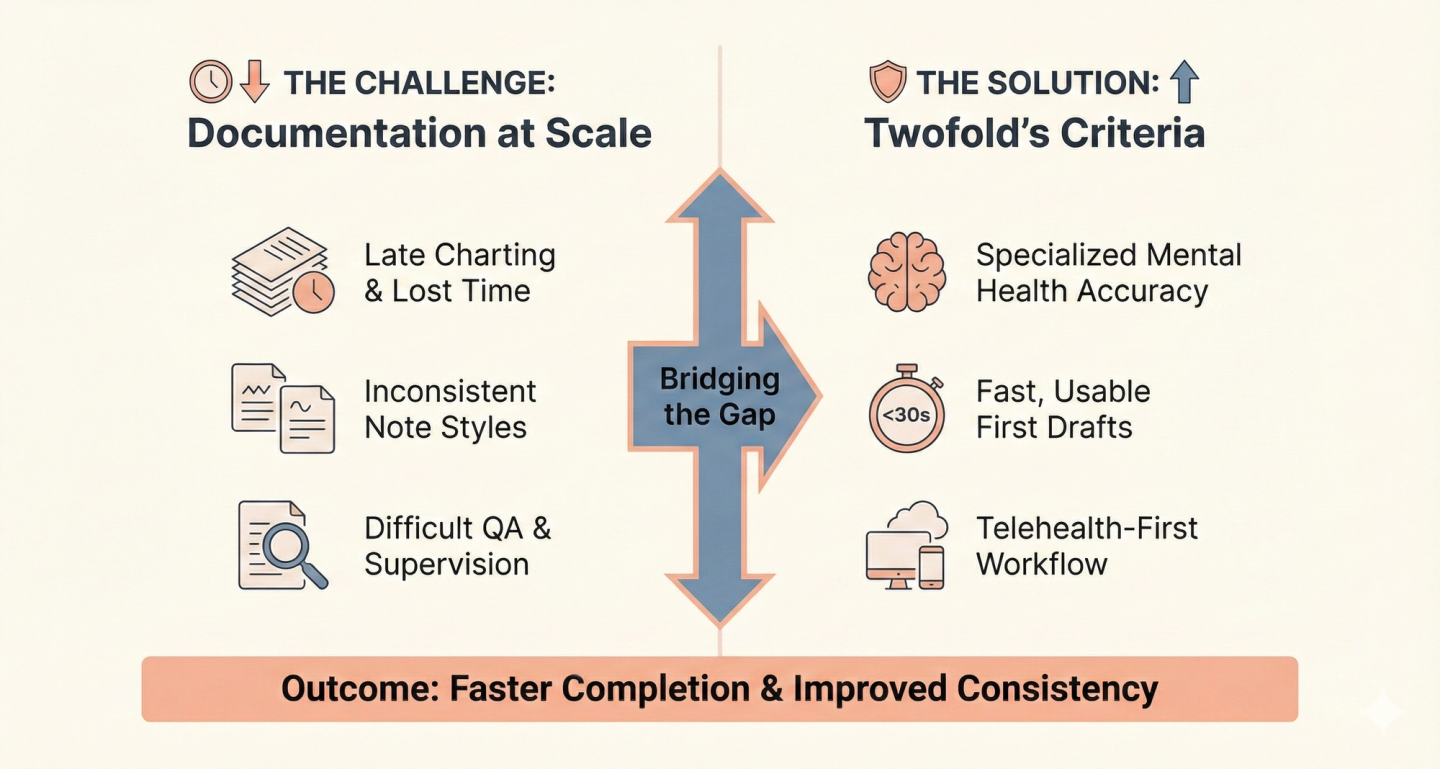
For telehealth mental health care, the documentation problem is rarely "just" transcription. Notes often need to capture:
- nuanced subjective history and context
- clinical impressions and risk-relevant details
- a clear plan, follow-up, and patient instructions
- consistent formatting across clinicians for internal quality and downstream requirements
Dokotela also signaled an ongoing focus on operational improvement and "AI scribe technology that will save time on documentation."
At higher appointment volumes, documentation issues compound quickly:
- charts close late
- note styles drift between clinicians
- clinicians lose time after-hours
- quality assurance and supervision become harder
Evidence on AI scribes in general suggests they can improve documentation efficiency and clinician workflow, but that outcomes vary significantly by technology choice and implementation approach.
What Dokotela Evaluated
"We evaluated several options. Twofold stood out because it fit telehealth workflows, produced structured notes fast, and required minimal setup."
- Dr Zelko Mustac, Founder and Psychiatrist, Dokotela
Dokotela's evaluation centered on what typically determines whether an AI scribe actually works in real clinical operations:
1. Accuracy for Mental Health and Longitudinal Sessions
Generic transcription or general‑purpose AI often produces output that needs heavy editing for behavioral health nuance. Twofold positions itself as built specifically for therapy and mental health documentation and supports formats commonly used in these settings.
2. Speed to a Usable First Draft
An AI scribe must return a well‑structured draft quickly enough to support same‑day completion. Twofold describes generating notes in under 30 seconds.
3. Telehealth-First Workflow Support
Dokotela's model depends on telehealth. Twofold is designed to capture clinical conversations for both in‑person and telehealth workflows.
4. EHR Flexibility Without Heavy Integration Work
Multi‑clinician environments often involve multiple systems and workflows. Twofold emphasizes "copy into any EHR" as a simple path to adoption, avoiding complex integration overhead.
5. Privacy, Security, and Deployment Safety
Twofold highlights HIPAA‑focused controls (including a BAA, encryption, and deletion controls) and states that audio is processed in real time and not stored.
6. Standardization for Teams
Dokotela's scale means documentation consistency matters across providers. Twofold's team workflow features focus on shared templates and role‑based permissions.
Why Dokotela Chose Twofold
"Twofold helped us cut documentation time significantly and improved consistency across clinicians. It allows our providers to focus on patients and not paperwork"
Kim Daly, Onboarding and Project Manager, Dokotela
Dokotela selected Twofold because it aligned with the operational realities of a scaled telehealth practice:
Twofold Fit Dokotela's Requirements on the Criteria that Matter Most for "Best AI Scribes"
Fast, Structured Notes (Not Raw Transcripts)
Twofold is positioned to generate structured clinical notes (including SOAP and other formats) quickly, with templates and personalization.
Built for Mental Health Documentation
Twofold explicitly frames itself as designed for therapists, mental health providers, and clinicians, rather than a general medical transcription tool repurposed for behavioral health.
Telehealth and In-Person Coverage
Twofold supports both in‑person and telehealth sessions, with device flexibility (phone or desktop).
EHR-Agnostic Workflow
Twofold emphasizes that clinicians can copy the finished note into any EHR in seconds, enabling rapid deployment without a long integration cycle.
Privacy-First Posture for Clinical Teams
Twofold states it is HIPAA compliant and highlights controls such as encryption, consent resources, deletion controls, and real‑time audio processing.
Team Standardization
Twofold's team features focus on centralized templates and role‑based permissions to keep multi‑provider documentation consistent and compliant.
Deployment Approach: How Dokotela Implemented Twofold at Scale
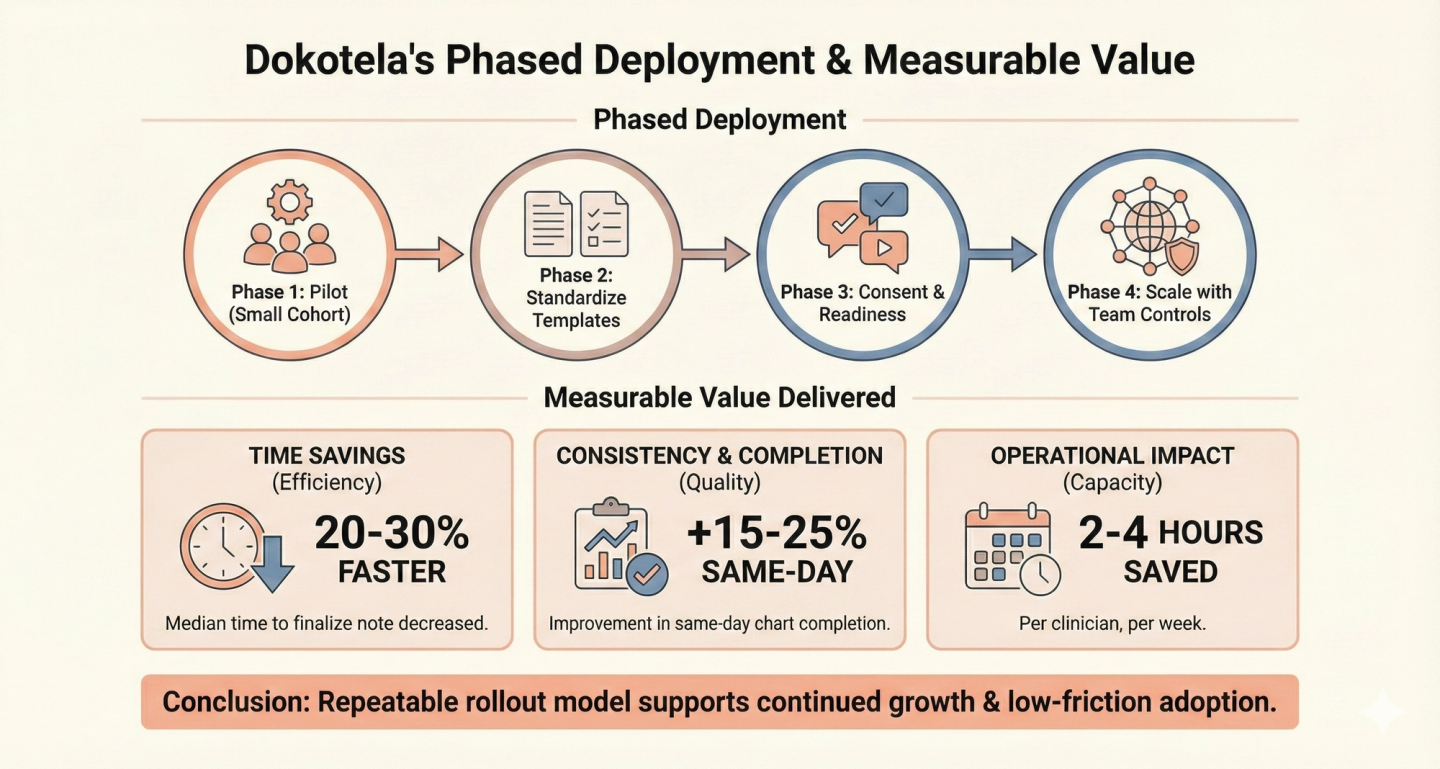
Dokotela rolled out Twofold over several weeks, starting with a small pilot group, then expanding in phases to ensure note quality, template consistency, and clinician confidence. Within weeks, Twofold was standardized and deployed across 50 clinicians (and growing), supported by shared templates, streamlined workflows, and team‑ready controls that made adoption predictable and repeatable.
Below is a rollout structure that matches the constraints of telehealth operations and is consistent with published implementation best practices for AI scribe deployments (consent, training, and quality controls).
Phase 1: Pilot With a Small Clinician Cohort
- Select a representative set of appointment types (intakes, follow-ups, therapy sessions)
- Configure note templates (SOAP, DAP, BIRP, progress note formats as needed)
- Establish a clear "review and sign" standard (AI produces a draft; clinician finalizes)
Phase 2: Standardize Templates for Consistency
- Create shared templates and note instructions for consistent structure across providers
- Define required elements (for example: assessment clarity, plan specificity, follow-up tasks)
Phase 3: Consent and Operational Readiness
- Ensure patient-facing consent language is clear about transcription tools (Dokotela already communicates that specialists may use transcription software).
- Provide quick-start training and a simple troubleshooting path
(Short training is a common adoption accelerator in large deployments).
Phase 4: Scale Across Providers With Team Controls
- Roll out to the broader clinician network
- Use role-based permissions and shared templates where appropriate
- Track adoption and quality signals weekly (see metrics below)
Results and Value Delivered
Faster Note Completion and Fewer After-Hours Charts
With Twofold generating structured drafts quickly, clinicians spent less time turning session details into finalized documentation. This reduced end‑of‑day charting pressure and made same‑day completion more attainable for a larger share of appointments.
- Median time to finalize a note decreased by 20% to 30% after week 2 to 4 stabilization per provider.
More Consistent Documentation Across Clinicians
As the deployment scaled, Dokotela used standardized templates and shared structure to reduce variation between clinicians, improving readability and making QA and supervision workflows easier to manage.
- Same-day chart completion improved by 15 to 25 percentage points within the rollout period.
Lower Operational Friction to Scale Beyond the First Cohort
Because Twofold's workflow is designed to fit into existing documentation habits and systems, Dokotela was able to onboard additional clinicians with a repeatable process rather than reinventing setup for each provider.
- Clinicians reported saving 2 to 4 hours per week on documentation once templates were standardized.
Conclusion
Over several weeks, Dokotela deployed Twofold to 50 clinicians and growing, turning clinical documentation into a scalable, standardized workflow. The result was faster note completion, more consistent documentation across providers, and a repeatable rollout model that supports continued growth. For teams evaluating AI medical scribe options, Dokotela's implementation highlights what matters most at scale: structured note quality, telehealth‑ready workflows, team templates, and low‑friction adoption.