


Many clinicians assume that any AI tool is safe as long as it's popular. That assumption is putting practices at risk. From unsecured data storage to hidden model training, the gap between AI scribe hype and HIPAA reality is wider than most people realize. Believing common myths, such as assuming a signed BAA guarantees compliance, can lead to fines, breach notifications, and lost patient trust. This article exposes five persistent myths about HIPAA-compliant AI notes and gives you actionable steps to protect your practice before it's too late.
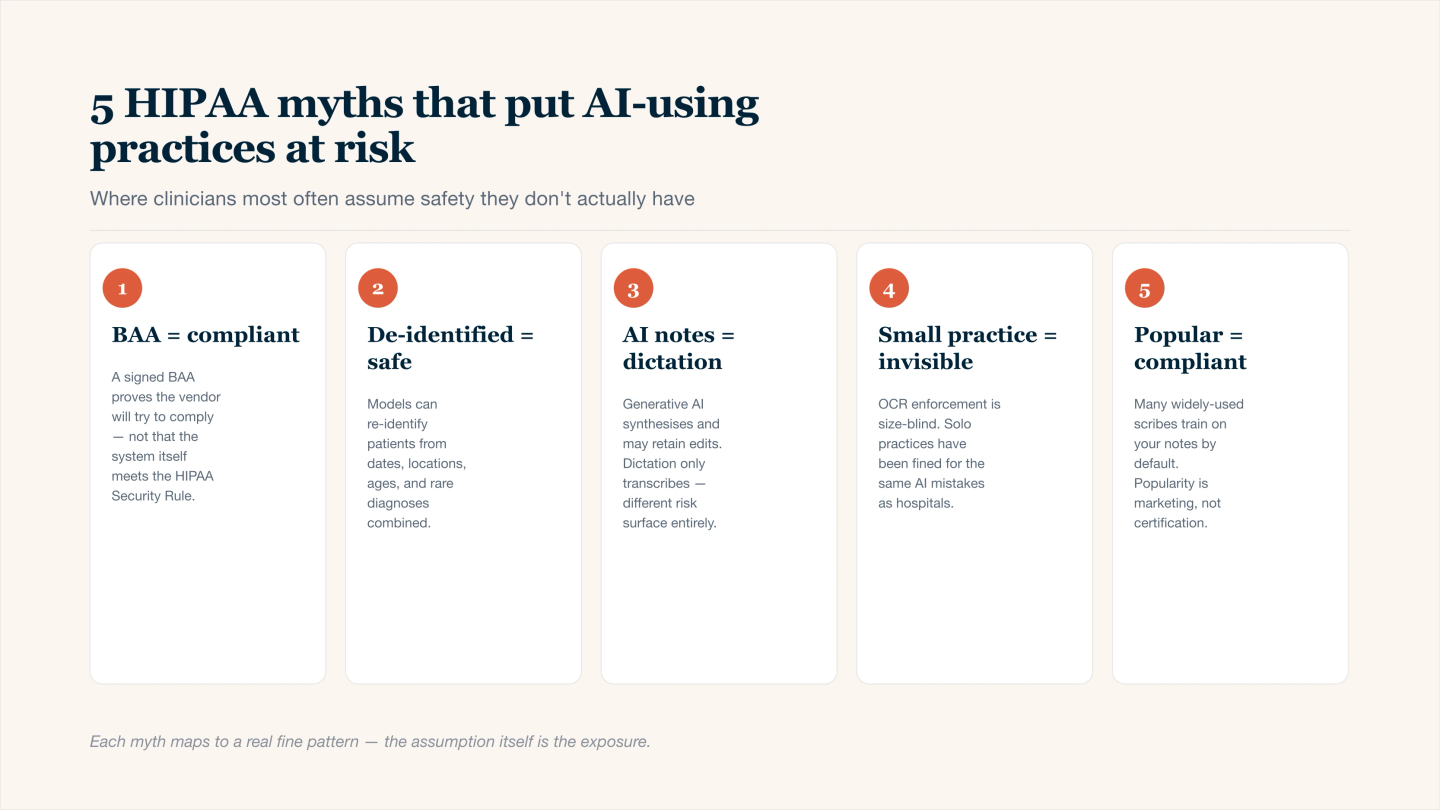
The five HIPAA assumptions that most often expose AI-using practices — read these before signing any AI note vendor.
Myth 1: "Any AI Note Tool with a BAA Is Automatically HIPAA-Compliant"
Why a BAA Is Necessary but Not Sufficient
A Business Associate Agreement (BAA) is legally required when a vendor works with Protected Health Information (PHI). But the truth is that a BAA is not a technical safeguard. It means the vendor agrees to protect your data and accept liability if they fail. It does not guarantee their AI setup actually follows HIPAA's Security Rule.
3 Risks Even with a Signed BAA
Risk | Why it Matters |
|---|---|
PHI logged for model training | Vendor "de-identification" can fail, exposing patient data without authorization. |
Data cached on undisclosed servers | Your notes might pass through foreign or unsecured subprocessors that your BAA does not cover. |
Missing audit trails | No logs means no way to detect or prove who accessed patient data. |
4 Questions to Ask Before Trusting Any BAA
- "Do you use patient data to train your models?"
- "How long is my data stored?"
- "List every subprocessor that touches my PHI."
- "Are audit logs enabled and accessible to me?"
Myth 2: "De-Identifying Patient Data in AI Notes Means Zero Risk"
The Re-Identification Reality
- The Myth: Remove names and birth dates = safe for any AI.
- The Risk: AI models can re-identify individuals using combinations of dates, locations, ages, and rare diagnoses.
PHI Elements Often Overlooked in "De-Identified" Notes
Element | Example Risk |
|---|---|
Dates (admission, discharge, exam) | Combined with age, which narrows to 1-2 individuals |
Treatment dates ("3rd follow-up") | Creates a timestamped behavioral profile |
Small town or clinic name | Identifies the community population |
Voice or dictation patterns | Audio fingerprints can be traced back |
Device IDs (tablet/smartphone) | Links notes to a specific clinician's device |
Myth 3: "AI Notes Are Just Like Dictation Software, So the Same Rules Apply"
Why Generative AI Changes the Compliance Equation
- The Myth: Dictation software has been around for decades. AI notes are just a faster version, so the same HIPAA rules apply.
- The Risk: Generative AI systems do more than transcribe speech. They synthesize, infer, and sometimes retain interaction data, creating compliance considerations that traditional dictation software typically does not.
Dictation vs. Generative AI: A Compliance Comparison
Feature | Dictation/Transcription | Generative AI Notes |
|---|---|---|
Data retention | Usually deleted after transcription | Often retained for model improvement |
PHI access | Single clinician + vendor | Vendor + model trainers + cloud logs |
Output predictability | Exact words spoken | Synthesizes/infers new text |
Breach surface | Narrow (audio + text) | Wide (prompts, completions, feedback loops) |
The Danger: Feedback Loops
When clinicians correct or edit AI‑generated notes, those interactions may be retained by the AI provider and, in some cases, used to improve underlying models or services. That creates a critical compliance concern: patient PHI could move beyond the original documentation workflow and into broader vendor data pipelines.
If those workflows are not explicitly covered under a Business Associate Agreement (BAA), organizations may be exposing sensitive patient data to uses they did not intend or authorize.
Myth 4: "Small Practices Don't Need to Worry, OCR Only Targets Large Hospitals"
Why Small Practices Are Not Off the Hook
- The Myth: The Office of Civil Rights goes after big hospital systems, so a solo practice or small clinic isn't worth their time.
- The Truth: Regulators have made it clear; size offers no protection. Small practices are being fined for the same AI-related violations as their larger counterparts.
Myth 5: "If the AI Note Tool Is Popular, It Must Be HIPAA-Compliant"
Popularity Does Not Equal Privacy: The Consumer AI Trap
- The Myth: Thousands of doctors use it. It must be safe.
- The Risk: Popularity is not a compliance certification. Many widely used AI scribes (including some marketed directly to clinicians) will not sign BAAs or guarantee data isolation.
Why This Matters
These tools may use your patient notes to train their next model. That is a direct HIPAA violation, unless you obtain explicit, informed patient authorization for each patient.
Vetting Checklist: 4 Must-Ask Questions
- Do you sign a BAA that covers all your subprocessors?
- Show me evidence of your HIPAA Security Rule risk analysis.
- What is your data deletion policy?
- Can I export all patient data and delete it permanently without your help?
Protecting Your Practice Starts with These Actions
You don't need to abandon AI notes. You need to use them intelligently.
3 Steps to Reduce Your Risk
Step | Action |
|---|---|
1 | Create a list of every AI tool that comes into contact with patient data (notes, dictation, scheduling, auto-fill). |
2 | Get written confirmation that your vendor does not retain PHI after note generation and does not use patient data to train models. |
3 | Conduct a HIPAA Security Risk Assessment. |
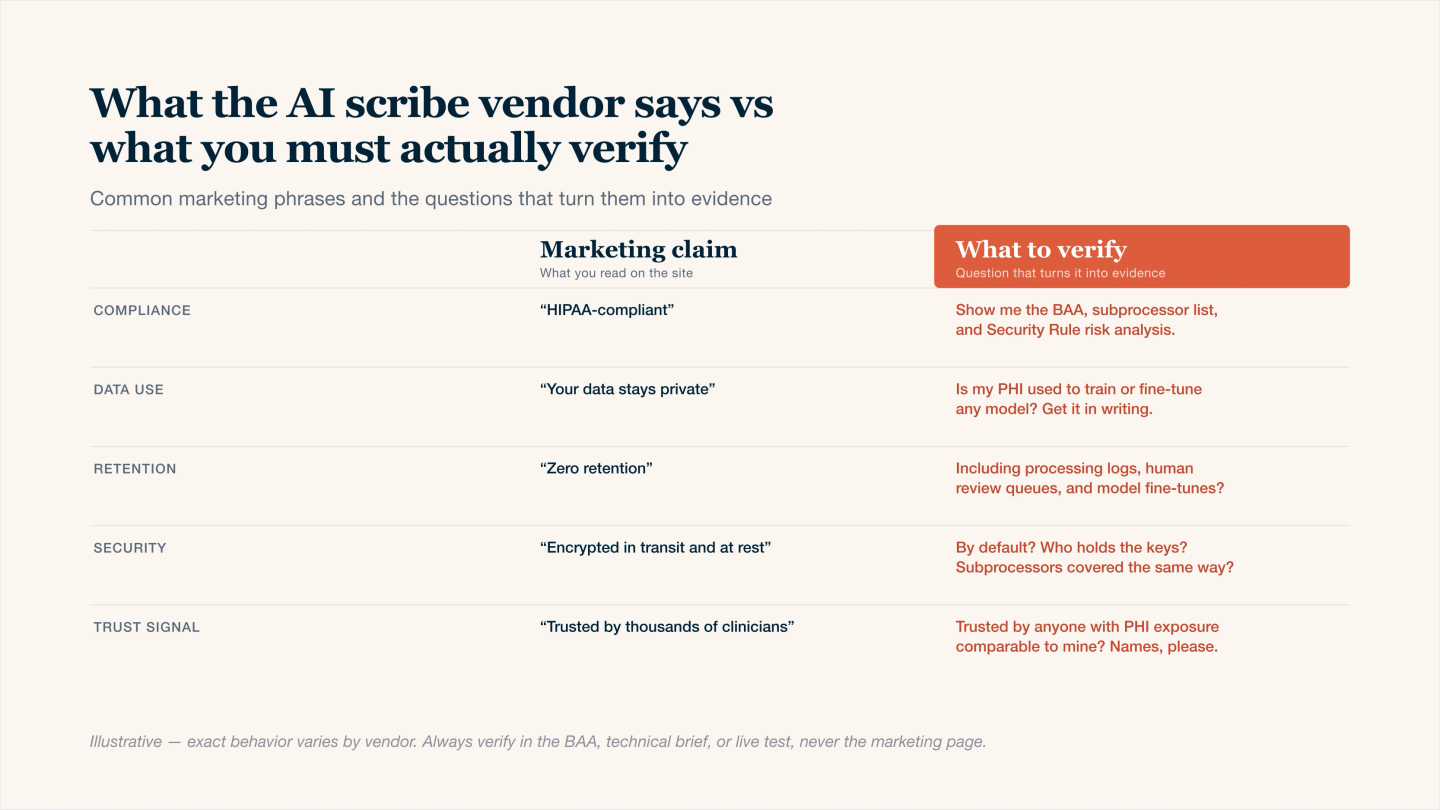
Every AI scribe marketing phrase has a verification question — never accept the claim without asking it.
Conclusion
HIPAA-compliant AI note tools can save hours of documentation time. But the myths outlined here, from trusting a BAA only to assuming popularity equals compliance, have already cost real practices real money. The solution is simple: You don't need to fear AI; you just need to vet it. Pick one AI tool your practice uses and run it through the checklist above. Your patients trust you with their most sensitive information. Make sure your AI tools earn that same trust.