
Free for a week, then $19 for your first month
Template

Case Conceptualization Template

Discover practical Case Conceptualization templates to enhance your documentation efficiency.

Case Conceptualization Template Template Hero Image

Imagine you're sitting in your office late at night, wading through a stack of patient notes trying to make sense of complex cases. You find yourself overwhelmed, struggling to organize your insights effectively. Enter the Case Conceptualization Template—your potential ally in conquering chaos with clarity. This article is your guide to expertly navigate its nuances.

What Is a Case Conceptualization Template?

A Case Conceptualization Template is a structured framework utilized in clinical settings for organizing client information, treatment planning, and decision‑making. This tool helps mental health professionals develop a cohesive understanding of a client's case by synthesizing diverse data points.

It allows clinicians to visually map out a patient's psychological state, background information, and presenting issues. By distilling complex data into comprehensive insights, these templates facilitate effective treatment strategies.

Key Components of a Case Conceptualization Template

A Case Conceptualization Template consists of several vital elements:

  • Identifying Information
  • Presenting Problems
  • Background History
  • Cognitive and Emotional Functioning
  • Diagnosis and Prognosis
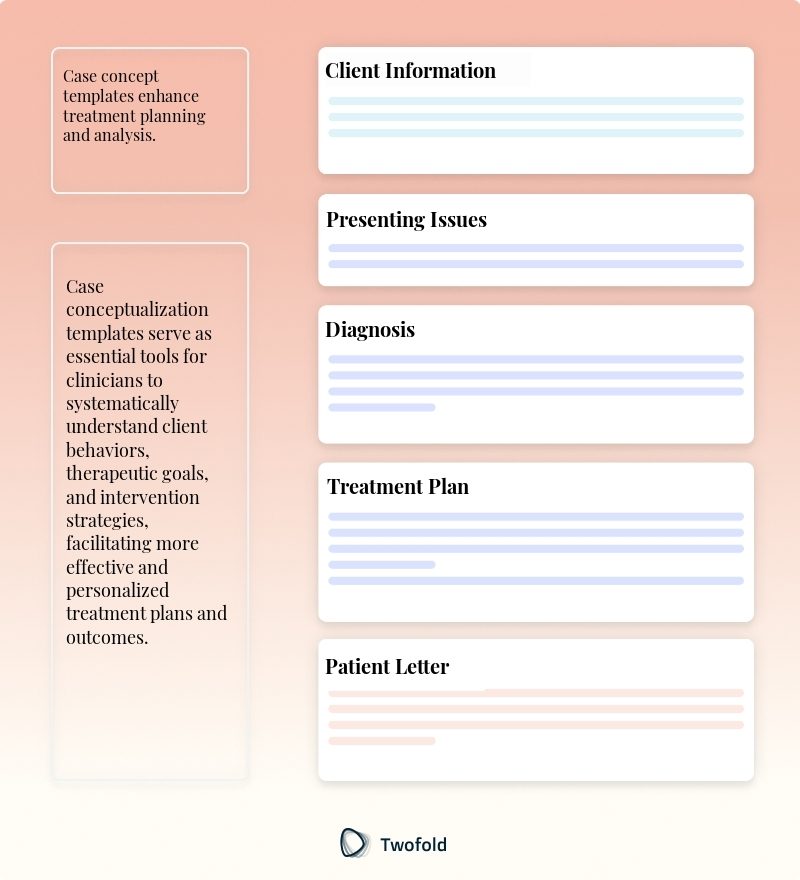
Key Components of Case Conceptualization Template

How to Use a Case Conceptualization Template: Step-by-Step Process

  1. Begin with gathering all relevant information about the client.
  2. Organize the data into the key sections of the template.
  3. Link presenting problems with potential underlying causes.
  4. Include observations from clinical interviews and assessments.
  5. Summarize insights and formulate a treatment plan.

Benefits of a Case Conceptualization Template

Benefit

Explanation

Clarity

Breaks down complex cases into understandable components.

Clinical Precision

Facilitates accurate diagnosis and treatment planning.

Efficiency

Saves time by organizing data systematically.

Communication

Enhances communication between healthcare providers.

Stakeholders in Case Conceptualization

The Case Conceptualization Template serves a range of stakeholders:

  • Therapists:Uses it to uncover underlying issues swiftly.
  • Psychologists: Rely on it for detailed patient evaluations.
  • Social Workers: Find it useful for coordinating client services.
  • Medical Staff: Nurses use it for evidence-based care planning.

Example of a Case Conceptualization Template

Consider a patient diagnosed with anxiety—this template segments symptoms, explores history, and maps out treatment avenues.

See Template Example

Real-World Use Cases: Practical Impact of the Case Conceptualization Template

See how this template shapes therapeutic success stories:

  • A therapist employs the template to decode a child's behavioral patterns, enabling a focused intervention plan.
  • During a team meeting, a psychologist uses the template to recommend a collaborative care approach for a complex case.
  • A social worker applies the template to align community resources with a client's specific needs, enhancing recovery potential.

Conclusion

The Case Conceptualization Template is instrumental in the clinical setting, bridging the gap between data gathering and effective treatment. By fostering clarity, enhancing communication, and promoting organized thought processes, it empowers healthcare professionals to deliver personalized patient care. A thorough grasp of this tool elevates the quality of patient interactions and outcomes.

Disclaimer: This article is for informational purposes only and does not constitute legal or medical advice. Always consult professional guidelines and regulatory bodies for specific compliance requirements.

FAQ

Frequently asked questions

  • How can a Case Conceptualization Template address poly-symptomatic presentations when standard diagnoses aren't fitting?

    Poly‑symptomatic cases are complex due to overlapping or co‑occurring symptoms across different disorders. A Case Conceptualization Template can be adapted to highlight symptom clusters rather than focusing solely on narrow diagnostic criteria.

    By detailing each symptom's frequency, duration, and impact, alongside potential stressors or triggers, divergent symptoms can be matched with innovative treatment approaches.

    Clinicians may incorporate biopsychosocial elements within the template to better understand how environmental factors contribute to complex symptomology, thereby facilitating more tailored and effective interventions.

  • In what ways can a Case Conceptualization Template facilitate interdisciplinary collaboration?

    For interdisciplinary teams, synchronization in approach is crucial for consistent patient care. The Case Conceptualization Template can include sections where contributions from different specialties are logged and matched with their specific interventions.

    Creating a shared column for cross‑disciplinary notes allows different providers e.g., psychologists, social workers, and medical professionals to input observations and adjust strategies based on a comprehensive view of the patient's evolving needs.

    Such integration promotes the development of a unified care plan that respects and utilizes the unique perspectives and expertise of each discipline, ultimately enhancing coordinated care delivery.

  • What are the best practices for maintaining patient confidentiality while utilizing the Case Conceptualization Template in team settings?

    Confidentiality is paramount when handling patient data. When discussing a Case Conceptualization Template in team settings, identifiers should be kept minimal, using pseudonyms or general descriptors where possible to protect patient privacy.

    Access to the template should be restricted to only those involved in direct care, with secure systems ensuring data protection. Regular audits can be introduced to ensure only authorized personnel access sensitive information.

    When sharing insights with teams, focus on de‑identified data trends or treatment outcomes, ensuring that discussions prioritize collective learning and improvements in care, rather than specifics that could compromise patient anonymity.