

Free for a week, then $19 for your first month
Expert Advice

Can AI Turn Raw Conversation Into Billable SOAP Notes? What to Check First

Learn key checks before trusting AI to turn chats into billable SOAP notes.

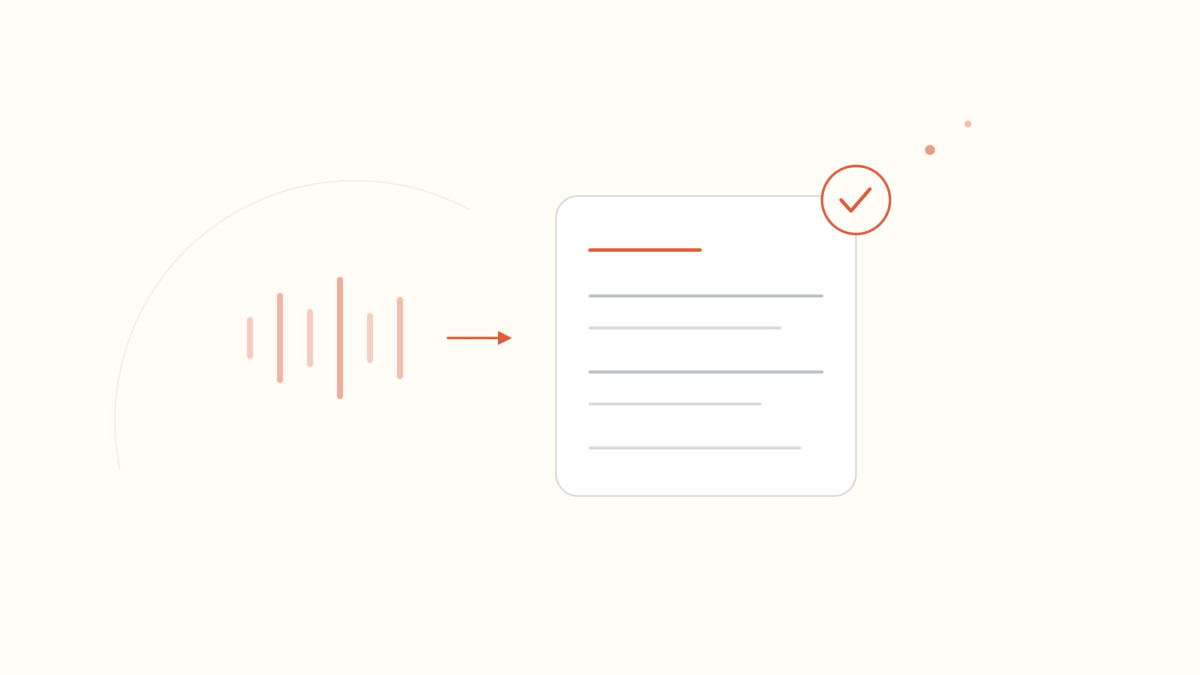
A spoken conversation transforming into a structured clinical note marked approved in coral — turning dialogue into a billable SOAP note.

While AI note tools are remarkably advanced, turning raw conversation into a claim‑ready document is far from just automatic. Hallucinations, coding errors, and compliance blind spots can turn efficiency into a liability. The technology is ready, but are your workflows? Before you trust an algorithm with your license and revenue, you need a checklist. Here are the five essential AI SOAP note checks to perform first.

Why "Billable" is the Highest Standard for AI SOAP Notes
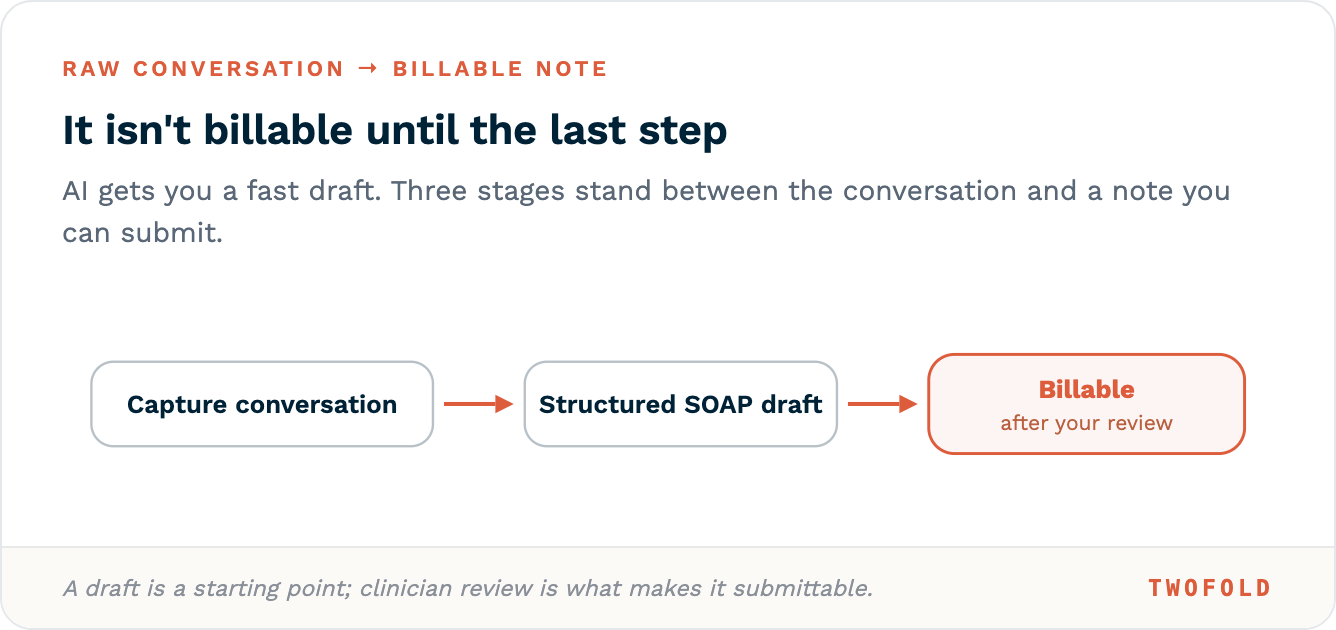
Three stages from raw conversation to a billable note: capture the conversation, generate a structured SOAP draft, then make it billable after clinician review.

A clinically accurate note is not automatically a billable one. For a SOAP note to reach the reimbursement line, it must function as a legal and financial contract between your practice and the payer. This requires far more than a coherent summary of the patient's complaints.

What Does "Billable" Actually Demand?

To justify a specific Current Procedural Terminology (CPT) code, your SOAP note must explicitly check three boxes:

  • Medical Necessity: The documentation must clearly prove why the patient needed to be seen and why your specific interventions were required. If the "Assessment" doesn't explicitly link the symptoms to the diagnosis, the claim is not valid.
  • Level of Service (MDM): The note must accurately reflect the Medical Decision Making (MDM) complexity, whether it was straightforward, low, moderate, or high. This determines the dollar amount of the claim.
  • Payer-Specific Nuances: Commercial insurers, Medicare, and Medicaid all have slightly different documentation preferences. What works for one may trigger an audit flag for another.

The AI Risk:

Here is where AI becomes a double‑edged sword. A generative AI notes tool might paraphrase a patient's story but miss the critical objective data required for the E/M level. Additionally, it might "hallucinate" a subtle exam finding to fill a gap, turning a routine visit into a high‑level code that never actually happened.

See more risks of using a free vs. paid AI notes tool.

Your 5-Step Checklist Before You Hit "Approve"
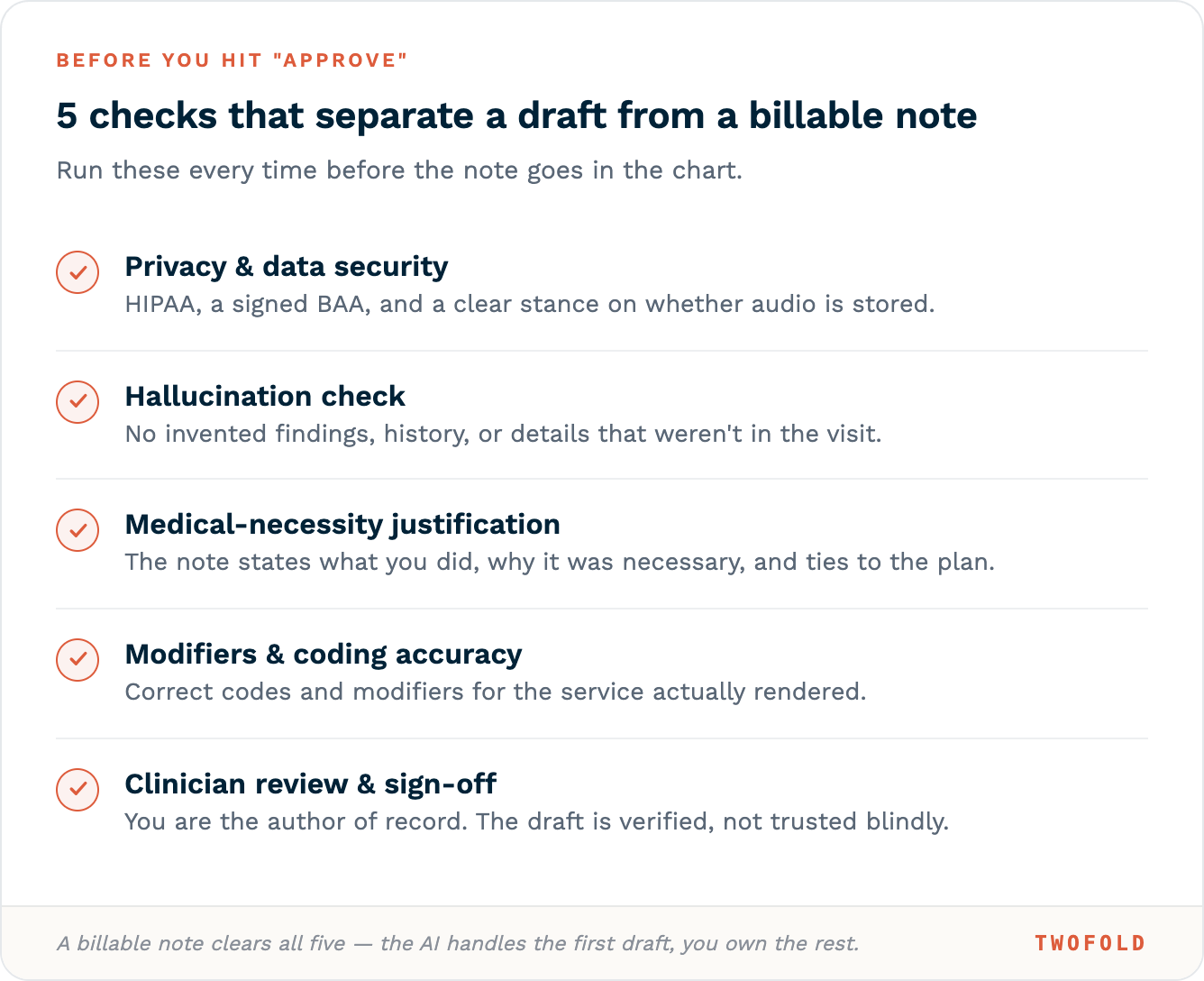
Five checks before approving an AI SOAP note: privacy and data security, hallucination check, medical-necessity justification, modifiers and coding accuracy, and clinician review and sign-off.

Before you sign your name to an AI SOAP note, you must run it through this non‑negotiable checklist:

1: Privacy and Data Security

You are transmitting Protected Health Information (PHI). If your AI tool isn't secure, you are violating HIPAA before you've even typed a single word.

  • Are you using HIPAA-compliant software? Many consumer-grade transcription apps store data on unsecured servers. Verify that the platform explicitly states HIPAA compliance in its Terms of Service.
  • Where is the audio/text stored? Does the vendor retain your audio for their own model training? Ensure the tool offers automatic data deletion after transcription.
  • Does the vendor sign a Business Associate Agreement (BAA)? This is a legal requirement. A BAA legally binds the vendor to safeguard your data.

2: Check for Hallucinations

Generative AI has a well‑documented flaw: it invents things to fill gaps. In clinical documentation, it's a liability.

  • Subjective (The Patient's Words): Compare the AI's "Chief Complaint" to the actual transcript. Accuracy in direct quotes is important.
  • Objective (The Exam & Vitals): This is where AI most frequently stumbles. If you didn't manually dictate a specific physical exam finding, the AI must leave it blank. Verify every single objective data point against your manual entry or dictation.

3: Medical Necessity Justification

This is where you prove the visit was worth the code you are billing.

  • Linking Symptoms to Diagnosis: The "Assessment" section must explicitly connect the dots.
  • Why was this service necessary?: The "Plan" section must clearly outline the clinical reasoning behind your actions. If the AI just says "EKG ordered" without context, an auditor will question the medical necessity.

4: Modifiers and Coding Accuracy

Even if the clinical story is perfect, a coding error will mess with your reimbursement. AI struggles with calculating the correct E/M level without explicit clinician guidance.

  • Level of Medical Decision Making (MDM): Does the AI correctly identify the complexity based on the number of diagnoses, data reviewed, and risk of complications? For example, did the AI consider the prescription of a high-risk medication (like an opioid or anticoagulant) when assigning the MDM level?
  • Time vs. Complexity: Are you billing based on total time or medical complexity? If you are billing based on time, the AI must accurately reflect the total duration you spent on that specific patient's care that day. Ensure the AI pulls the correct time if you dictate it.

5: Clinician Review

You know your patients and your practice style better than any algorithm.

  • Does it Sound Like You? If the AI uses jargon you never use or adopts a robotic, overly formal tone that doesn't match your clinical voice, rewrite it. A note should reflect the provider's unique perspective.
  • Does it Capture the Nuances of the Patient's Story? Did the patient mention a stressful life event that contextualizes their anxiety? Did they tear up while discussing their family history? AI misses emotional and social cues entirely. If these nuances are relevant to the treatment plan, you must add them manually.

Conclusion

AI can transform raw conversation into a draft SOAP note, but a draft is not a claim. The appeal of AI scribes must never overshadow the necessity of clinical oversight. By running every AI SOAP note through the five checks: privacy, hallucination filtering, medical necessity, coding accuracy, and the clinician review, you protect your patients, your practice, and your license.


References

Alder, S. (2023, January). What is Protected Health Information? 2026 Update. The HIPAA Journal.

Alder, S. (2026, January 5). HIPAA Business Associate Agreement - 2026 Update. The HIPAA Journal.

American Medical Association. (2026, January 23). CPT billing codes overview.

Apollo MD. (2023, January). Medical Decision Making (MDM)

Health Information Associates. (2026, April 22). AI in Medical Coding: What It Can—and Can't—Do.

IBM. (2023, September). What Are AI Hallucinations?

FAQ

Frequently asked questions

  • Can AI-generated SOAP notes be trusted for billing and compliance purposes?

    AI‑generated SOAP notes can be trusted for billing when the system is designed specifically for clinical documentation and paired with clinician oversight, but trust must be earned through verification, not assumed.

    • Structure & Completeness: AI excels at capturing required SOAP elements (Subjective, Objective, Assessment, Plan) and ensuring that critical components like Medical Decision Making (MDM) and medical necessity justifications are present. This reduces the risk of missing documentation that triggers denials.
    • Coding Accuracy: AI can suggest appropriate CPT and ICD-10 codes based on the documented complexity, but it often struggles with nuanced coding rules, such as correctly applying modifiers or distinguishing between time-based and complexity-based billing. This is where human expertise remains irreplaceable.
    • Error Profile: AI errors tend to be hallucinations (inventing exam findings) or omissions (missing dictated vitals). Human errors, by contrast, are often copy-forward mistakes, outdated problem lists, or inconsistencies between sections. Both require correction, but AI errors can be more dangerous if left unchecked.
    • Best Practice: Trust is highest when clinicians run every AI-generated note through a structured review checklist, like the 5-step protocol outlined in this article, before signing.

    See how AI is being used to streamline SOAP notes.


  • Is AI going to replace my clinical judgment in documentation?

    No, AI is not designed to replace clinical judgment; it is designed to amplify it by handling the burden of documentation so you can focus on what matters most: your patients.

    • Clinical Reasoning Remains Human: AI can transcribe, organize, and suggest, but it cannot interpret subtle clinical cues, weigh complex differentials, or make judgment calls about treatment pathways. These skills remain uniquely human and irreplaceable.
    • AI as a Scribe, Not A Practitioner: Think of AI as a highly efficient medical scribe that never gets tired or distracted. It captures what you say, but it cannot know what you didn't say, which is why your review and clinical intuition are essential to filling in the gaps.
    • Error Profile: AI errors often stem from a lack of contextual understanding, such as missing the significance of a patient's emotional state, misinterpreting ambiguous statements, or failing to recognize when a patient's story contradicts their exam findings. These are precisely the areas where clinical judgment shines.
    • Best Practice: Use AI to handle the structure and formatting, then apply your clinical expertise to refine the narrative.

    See how to tell if an AI SOAP note is actually clinically solid.


  • How does AI handle different patient populations, languages, and communication styles?

    AI's ability to handle diverse patient populations varies significantly depending on the tool's training data, language capabilities, and adaptability to different communication styles. So it's essential to choose a solution designed for real‑world clinical diversity.

    • Language and Dialect: Many AI note tools are trained primarily on standard English, which can lead to higher error rates with patients who speak with regional dialects, use medical jargon differently, or are non-native English speakers. Some advanced tools now support multiple languages and can be fine-tuned for specific populations.
    • Cultural and Contextual Nuance: AI struggles with cultural context. It also misses nonverbal cues like hesitation, tearfulness, or avoidance that are clinically significant but never explicitly spoken.
    • Pediatric and Geriatric Considerations: Children and elderly patients often communicate differently, using simplified language, indirect statements, or relying on family members as translators. AI can capture the words but may miss the developmental or age-related implications behind them.
    • Error Profile: AI errors in diverse populations tend to be misinterpretations (misunderstanding a phrase due to accent or dialect) or omissions (missing culturally specific symptom descriptions). Human clinicians, by contrast, are better at recognizing these nuances but may be rushed and miss documentation details.
    • Best Practice: Always review AI-generated notes for accuracy when working with diverse patient populations. Consider using AI tools that offer multilingual support, customizable vocabularies for different specialties, and allow you to add context manually where the AI misses subtle cues.

    See how AI SOAP notes are used in a multilingual context.