


AI therapy charting is software that helps therapists turn sessions into usable clinical documentation. In practice, that usually means AI‑assisted progress notes, SOAP notes, DAP notes, BIRP notes, intake notes, treatment plans, and other chart‑ready documentation created from ambient listening, dictation, typed summaries, or uploaded recordings.
For therapists, the value is straightforward. Better AI charting software can reduce after‑hours documentation, make note quality more consistent, and help practices keep records organized without adding more admin work. The best tools also differ in meaningful ways: some are focused on mental‑health documentation itself, some are better if you want an all‑in‑one EHR workflow, and some are lighter‑weight note assistants.
How to evaluate AI therapy charting software
The most useful way to compare AI therapy charting tools is to focus on six things: note‑format support, workflow fit, customization, privacy posture, pricing clarity, and the type of practice the tool is really built for. A product can be impressive and still be the wrong fit if it is too broad, too enterprise‑heavy, or not specific enough to therapy documentation.
For this article, the most important question is simple: which tool is the best fit for the average therapist or behavioral health practice searching for "AI therapy charting"? That search usually signals a need for faster documentation, better note consistency, and a smoother path from session to chart.
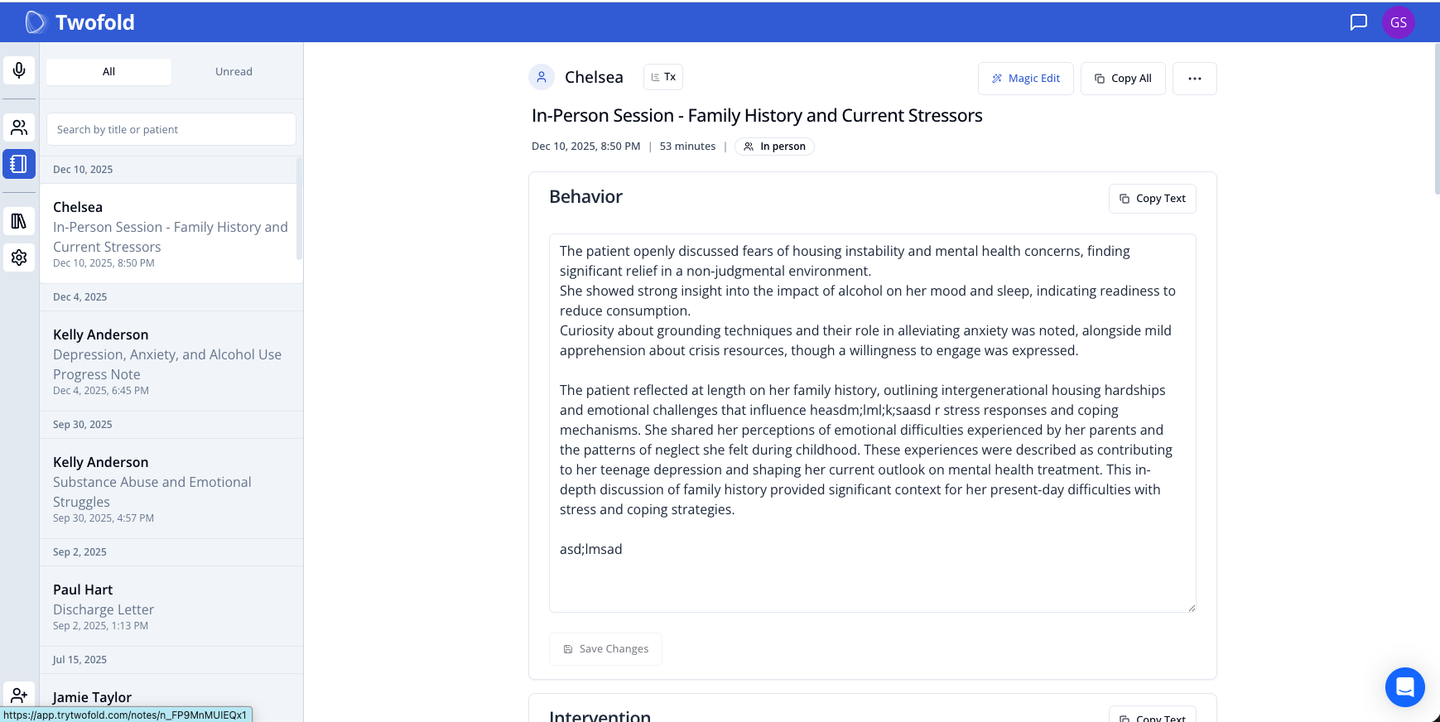
1. Twofold
Best overall AI therapy charting software
Pros
- Built specifically for therapy documentation, with public support for BIRP, DAP, SOAP, progress notes, intake notes, and treatment plans. It also supports couples and family sessions, which matters for real-world therapy charting rather than generic medical scribing.
- The pricing is easy to understand. Twofold publicly lists $69/month billed monthly or $49/month billed annually, and includes unlimited notes, treatment plans, custom templates, progress tracking, mobile and desktop apps, and premium support. That makes it easier to evaluate than tools that rely on usage credits or layered add-ons.
- The privacy posture is unusually clear. Twofold says it provides an automatic BAA at signup, uses encryption, stores no audio, and does not use PHI for AI training. For therapists comparing charting tools, that is a meaningful differentiator because these products sit close to sensitive session content.
- The workflow is focused. Twofold's public positioning is about helping clinicians create accurate therapy notes quickly, not about wrapping charting inside a much broader practice platform. For many therapists, that narrower focus is a strength because the buying problem is "finish charting faster," not "replace my entire software stack."
Cons
- If a practice wants an all-in-one EHR, billing, and scheduling system first and AI charting second, Twofold may feel more documentation-centered than platform-centered. That is a tradeoff, not a flaw, but it matters for buyers looking for one system to run everything. This is an inference based on Twofold's public product positioning versus broader EHR-style competitors.
Best for: therapists and group practices that want the strongest dedicated charting workflow rather than the broadest software suite.
2. TherapyNotes + TherapyFuel
Best only if you already use TherapyNotes
Pros
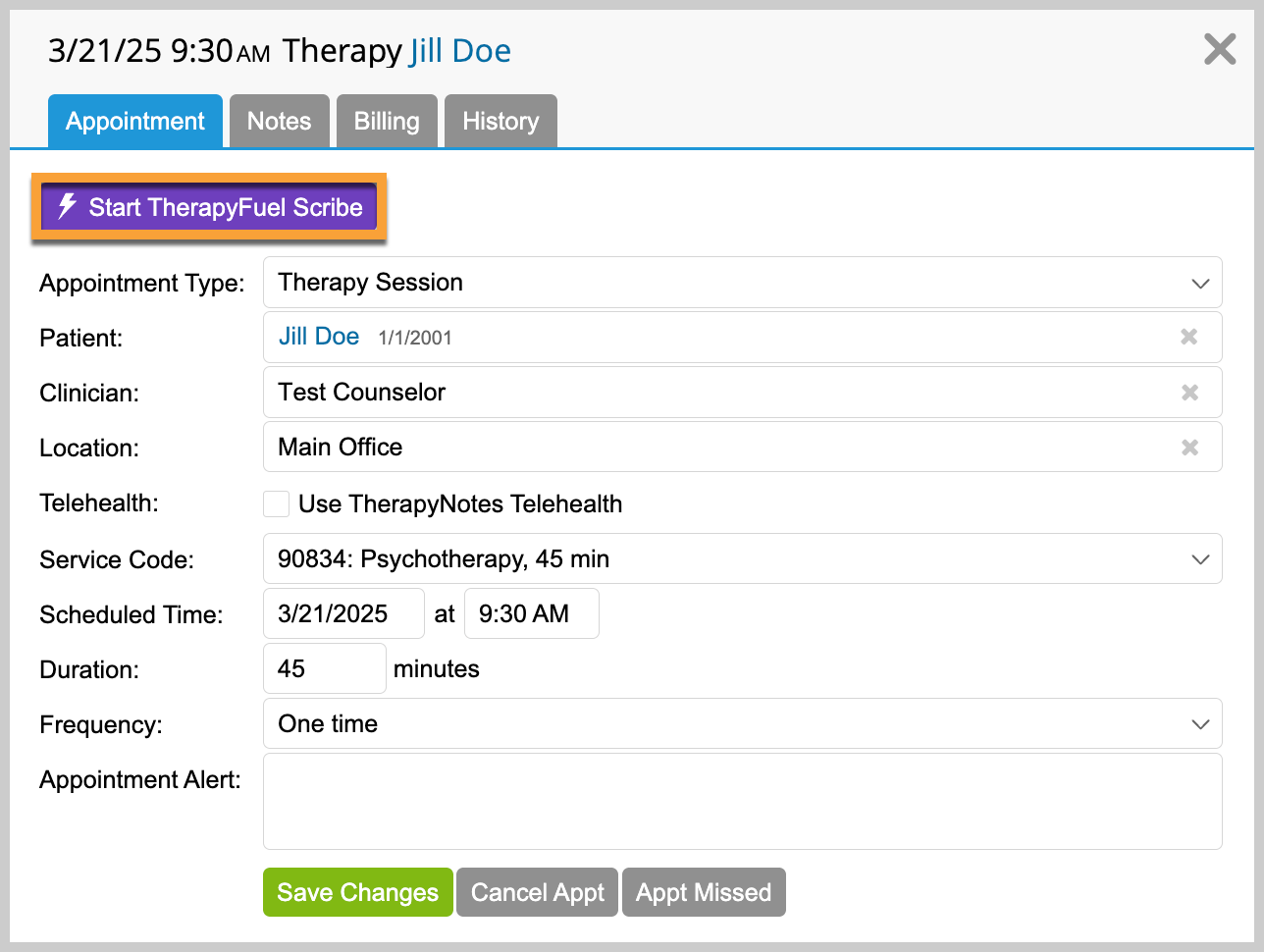
- If your practice already runs on TherapyNotes, adding TherapyFuel can be operationally convenient. TherapyFuel is priced at $40 per clinician per month, and the AI tools sit inside an established practice-management environment rather than introducing a separate documentation workflow.
Cons
- The biggest benefit is convenience for existing TherapyNotes users, not necessarily that it is the strongest dedicated charting experience. For a net-new buyer, that makes it more ecosystem-dependent than clearly best-in-class as a standalone AI therapy charting tool. This is an inference from how TherapyNotes positions TherapyFuel as an add-on inside its existing platform.
- Cost can stack. TherapyFuel is an additional $40 per clinician per month on top of the base TherapyNotes subscription, so the charting value should be weighed against the fact that it is not a single flat-price note tool.
- It is best suited to practices that are already committed to TherapyNotes. If you are not already in that ecosystem, its main advantage is much less compelling. That is an inference based on TherapyFuel's role as an extension of the TherapyNotes platform.
Best for: existing TherapyNotes practices that care most about staying inside their current system.
3. Blueprint
Best only if you want an all-in-one therapist platform
Pros
- Blueprint is broader than a note tool. It positions itself as an AI-assisted EHR for therapists, with scheduling, billing, forms, insurance, and documentation in one system. It also supports AI-generated progress notes, treatment plans, and session summaries, and says notes and treatment plans are customizable.
- The pricing structure can work for variable caseloads because Blueprint says its EHR is free and clinicians pay when the assistant does the work, with session credits that do not expire.
Cons
- For buyers specifically searching for AI therapy charting, Blueprint can feel broader than necessary. Its value proposition is the full therapist operating system, not a charting-first workflow, which may be more complexity than some practices want. This is an inference from Blueprint's own positioning.
- The usage-based model is less simple than flat subscription pricing. Some practices will like session credits, but others may prefer a straightforward monthly note tool when budgeting for documentation.
- Blueprint's AI is closely tied to its own EHR environment. That can be a strength if you want consolidation, but it is a weaker fit if you only want focused charting without changing where records live. This is an inference based on Blueprint describing its records as living in its EHR.
Best for: practices that want AI charting bundled with a broader platform, not just a dedicated documentation tool.
4. Upheal
Best for lighter-weight note support, not the strongest overall charting fit
Pros
- Upheal is clearly built for mental health. It supports many therapy-note formats, including SOAP, DAP, GIRP, BIRP, EMDR, PIRP, SIRP, PIE, intake, and more. It also highlights template customization, unlimited notes, and a free plan.
- Its HIPAA materials are public and specific. Upheal states that it acts as a HIPAA Business Associate, provides a BAA, and fully complies with HIPAA security and privacy rules.
Cons
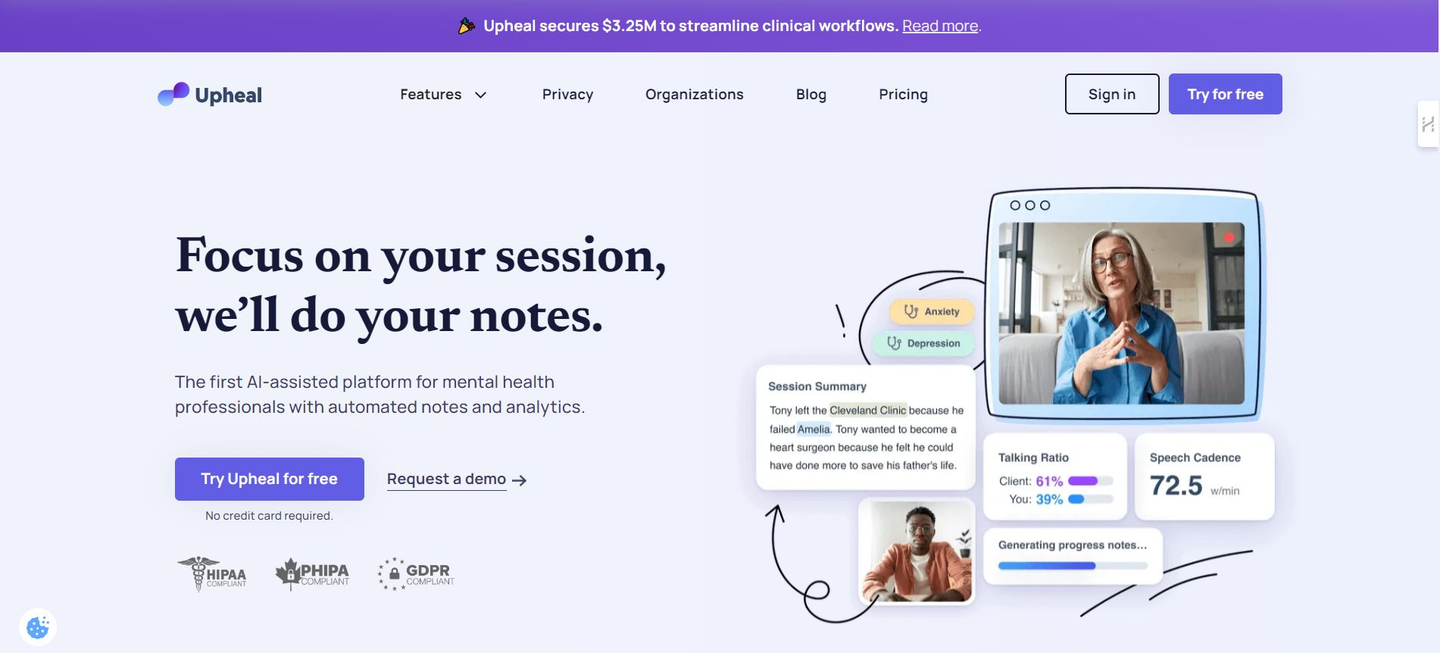
- Upheal reads more like an AI notes-and-analytics product than the clearest overall answer to "AI therapy charting." For therapists who want the most focused charting workflow, that positioning is a bit less direct. This is an inference from its own homepage and pricing language.
- The product has more privacy nuance than a vendor that simply says customer PHI is never used for training. Upheal states that any use of de-identified data for improving AI requires prior consent, which is better than default training, but still a more layered message for buyers who want the simplest possible privacy story.
- Upheal is appealing for smaller or lighter workflows, but it is less clearly positioned around full charting operations for a growing group practice than the top-ranked option. This is an inference from its public emphasis on therapy notes, analytics, and free entry pricing.
Best for: solo therapists and smaller teams that want a flexible, lower‑friction notes product.
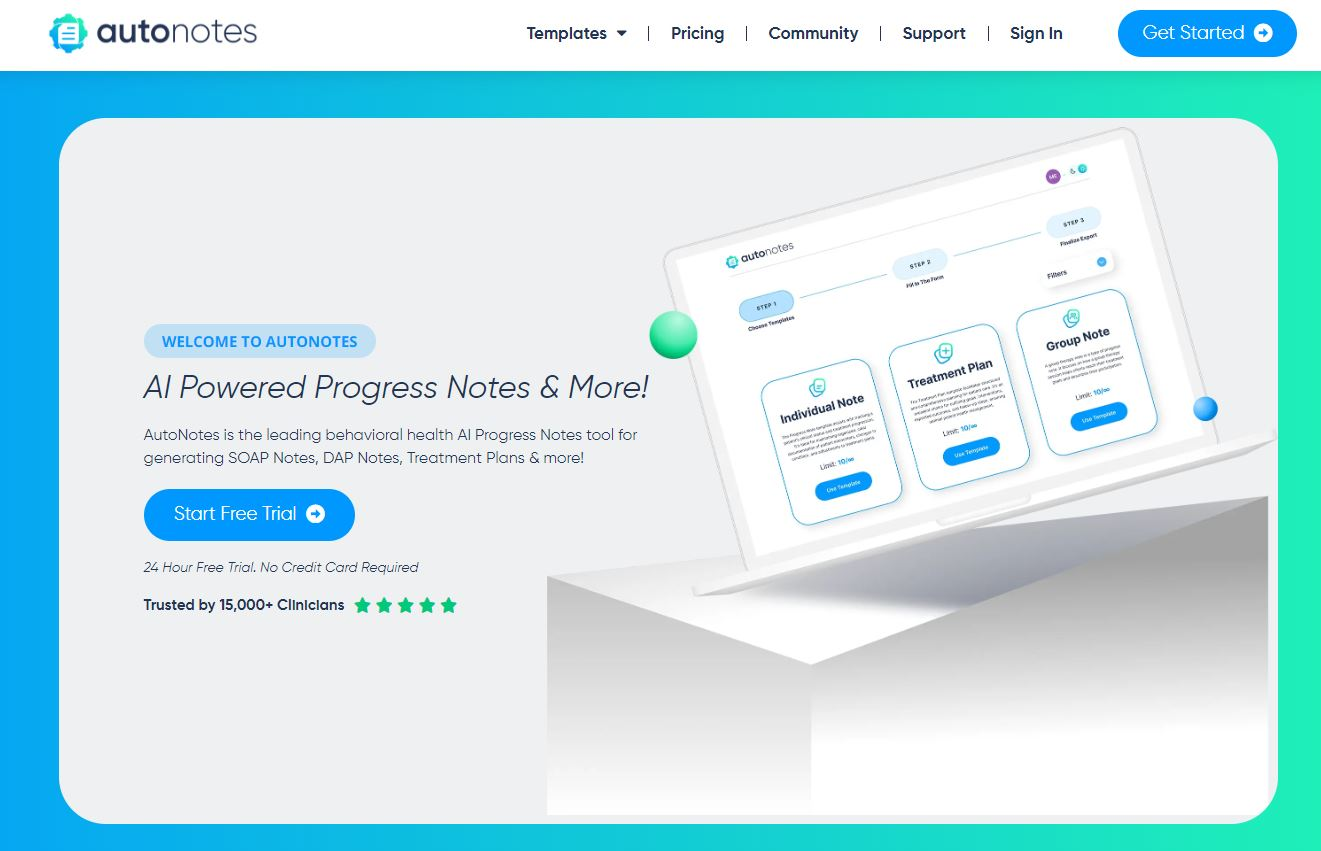
5. AutoNotes
Best for basic documentation support
Pros
- AutoNotes is straightforward. It supports AI progress notes, SOAP, DAP, BIRP, treatment plans, intake assessments, discharge summaries, EMDR, and custom therapy notes, and its pricing page is public.
- The product is priced for solo clinicians and teams, with lower-cost tiers and clear feature differences across plans. It also states that every plan includes HIPAA and PHIPA compliance plus note approval control.
Cons
- AutoNotes looks more like a simple documentation assistant than the strongest overall therapy charting platform. That can be a benefit for very simple needs, but it makes it less compelling as the top answer for buyers who want broader workflow fit. This is an inference from its public product and pricing pages.
- Several more advanced workflow features are pushed up the pricing ladder. Live session recording, note-to-note continuity, and custom template building appear in the higher tiers rather than the basic plan.
- Team management, advanced analytics, and custom workflows are positioned in the enterprise tier, which suggests a lighter core product for most users unless they move upmarket.
Best for: clinicians who mainly want quick AI note generation without adopting a larger platform.
What to look for in AI therapy charting software
1. Therapy-specific note formats
A therapy charting tool should support the formats clinicians already use. This includes SOAP, DAP, BIRP, intake notes, progress notes, and treatment plans. Twofold, Upheal, Blueprint, and AutoNotes all publicly describe support for therapy‑oriented documentation, though the exact format depth varies.
2. Workflow fit
Some practices want a dedicated documentation tool. Others want AI embedded in their practice‑management or EHR environment. Neither is automatically better. The right answer depends on whether you value specialization or consolidation more. Twofold is the clearest specialized option in this set, while TherapyNotes and Blueprint are stronger if you want charting inside a broader system.
3. Customization
Therapists rarely all chart the same way. Documentation style, payer needs, internal templates, and supervisor expectations vary by practice. Blueprint explicitly says its notes and treatment plans are customizable, and Twofold's pricing page includes custom templates in the published feature list.
4. Privacy and compliance clarity
Because therapy charting involves PHI, privacy posture matters. Twofold says it is HIPAA compliant, offers an automatic BAA, and deletes recordings after note generation. Upheal highlights HIPAA compliance and provides HIPAA documentation. AutoNotes says its plans include HIPAA and PHIPA compliance.
5. Pricing transparency
Published pricing makes evaluation easier. Twofold publishes monthly and annual prices. TherapyNotes publishes both its core pricing and its TherapyFuel add‑on price. Blueprint publishes its usage‑based pricing. Upheal and AutoNotes also publish pricing pages rather than forcing a demo for basic cost visibility.
Bottom line
Twofold is the best overall choice because its strengths map most directly to the actual problem behind the keyword: faster, cleaner, therapy‑specific charting with clear pricing and a very strong privacy posture.