


Every clinical supervisor faces the same challenge: ensuring documentation quality without becoming a micromanager. Traditional note reviews can often feel punitive, pushing clinicians toward defensive, vague notes that help no one. But what if you could depersonalize feedback and spot patterns without policing clinicians?
Enter AI therapy notes. When used intentionally, AI‑generated session summaries become a neutral third party. This means it highlights themes, inconsistencies, and learning opportunities without pointing fingers. This guide walks you through four practical ways to use AI notes to elevate clinical quality, reduce supervision time, and build trust with your team.
Why Traditional Note Review Often Becomes Micromanagement
Even with the best intentions, traditional note review methods frequently cross into micromanagement. The issue isn't supervision itself; it's how the review is structured. Below is a breakdown of common practices, how clinicians perceive them, and what supervisors actually intend.
Traditional Method | Clinical Perception | Supervisor Intent |
|---|---|---|
Random note audits | "They're looking for mistakes." | Ensure compliance |
Requesting resubmissions without context | "Nothing I do is good enough for them." | Correct errors |
Tracking individual note completion times | "It's like they're breathing down my neck." | Monitor productivity |
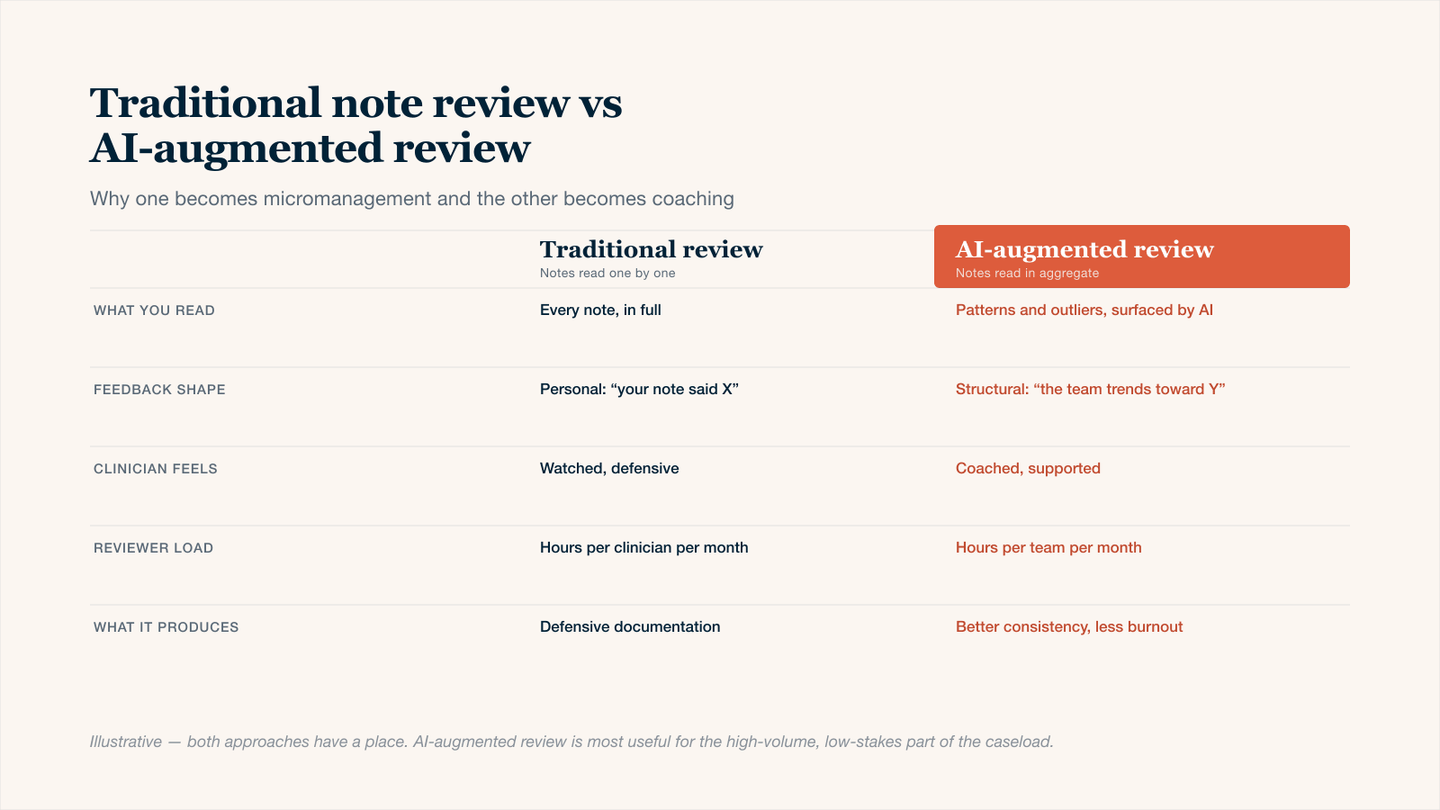
Same goal (better notes), opposite dynamics — one produces defensiveness, the other produces coaching.
The Cost of Defensive Documentation
When clinicians feel watched rather than supported, their behavior changes, and not for the better. Here's what typically happens:
- Clinicians Write For The Auditor, Not The Clinical Record: Notes become safe, vague, and stripped of clinical nuance.
- Risk Indicators Get Buried: Afraid of triggering a review, clinicians may soften language around suicidality, trauma, or diagnostic uncertainty.
- Supervision Becomes Adversarial: Instead of exploring clinical reasoning, sessions focus on formatting errors and missing checkboxes.
- Learning Stops: The supervisee's goal shifts from growth to compliance, exactly the opposite of what supervision intends.
What Exactly Are AI Therapy Notes?
Before implementing AI notes into supervision, it helps to understand exactly what they are. AI notes for therapists are algorithmically generated session summaries that transform clinical conversation into structured documentation formats. Unlike dictation software or basic templates, these tools use Natural Language Processing (NLP) to identify themes, interventions, and clinical markers.
Key Features that Matter for Supervisors
Feature | Why it Helps Supervision |
|---|---|
Theme Extraction | Quickly see what the clinician prioritized in session. |
Risk Flagging | Alerts to language suggesting SI, HI, or safety concerns. |
Aggregate Reporting | Spot group-wide patterns without shaming individuals. |
How AI Notes Differ From Traditional Templates
- Traditional Template:
- Empty fields.
- Clinician writes from scratch.
- No feedback on clinical blind spots.
- AI Note:
- A starting point based on the actual conversation.
- The clinician edits, refines, and adds nuance.
- Supervisor reviews changes, not the entire note.
4 Ways Supervisors Can Use AI Therapy Notes to Improve Quality Without Micromanaging
These four strategies move supervision from surveillance to skill‑building.
1. Use Aggregated Pattern Reports
Most supervisors fall into micromanagement because they review notes one at a time. That naturally focuses on individual errors. Aggregated reports flip the lens to team patterns.
Supervisor Action Steps
Instead of (Micromanaging) | Try This (Coaching) |
|---|---|
Pulling one clinician aside about missing strengths | Bring the pattern to group supervision: "Our AI report shows most of us are skipping client strengths. Let's practice writing one strengths statement together." |
Emailing a clinician: "You forgot risk follow-up again." | Anonymize the data: "Three of us are missing risk follow-up steps. " |
Tracking who fixes what | Measure improvement at the team level and re-run the report next month |
Why This Reduces Micromanagement
- No one feels singled out.
- The supervisor becomes a problem-solver.
- Clinicians self-identify areas for growth without shame.
2. Turn AI-Generated Missed Opportunities Into Coaching Prompts
AI notes are excellent at detecting what's missing, to prompt curiosity.
Common AI Flags and Better Supervisor Responses
Example flag: AI detects that a clinician consistently documents "assessed suicidal ideation" but never "safety plan steps."
Micromanaging Response | Coaching Prompt |
|---|---|
"You need to add safety planning to every SI note." | "Your AI summary shows a strong SI assessment. What might help you document the next step: the safety plan in your own clinical language?" |
The "One Question Rule"
After reviewing an AI flag, ask only one open‑ended question per note. For example:
- "What don't you see in the AI draft that you'd want a covering clinician to know?"
- "The AI missed the cultural context here. What would you add?"
- "Your edited note changed three of the AI's themes. Walk me through that."
3. Create a "Second Draft" Supervision Workflow
This is the single most practical time‑saver.
Step | Who | Action |
|---|---|---|
1 | Clinician | Reviews AI draft, edits for clinical accuracy and nuance, adds missing context (transference, cultural factors, etc.) |
2 | AI Tool | Flags major discrepancies between the AI draft and the final note (e.g., risk level mismatch, contradictory statements) |
3 | Supervisor | Reviews only the flagged discrepancies plus ONE section of the clinician's choice |
4 | Both | Discuss the one flagged item + the chosen section together |
4. Use AI to Measure Consistency, Not Compliance
This distinction changes everything.
Compliance (Avoid) | Consistency (Embrace) |
|---|---|
Did they sign the note by midnight? | Does the same intervention appear with the same name week to week? |
Did they include all required headers? | Does terminology align with their stated theoretical orientation? |
Did they hit a specific word count? | Is there a logical flow from assessment to intervention to plan? |
Did they check every box on the template? | Do patterns of language reflect actual clinical growth over time? |
How to Measure Consistency With AI
Ask your AI tool to generate a terminology consistency report that answers:
- Does this clinician use the same name for the same intervention across sessions?
- Does their documentation language shift when working with different diagnoses?
- Are there unexplained gaps between session content (from the AI transcript) and the chosen note structure?
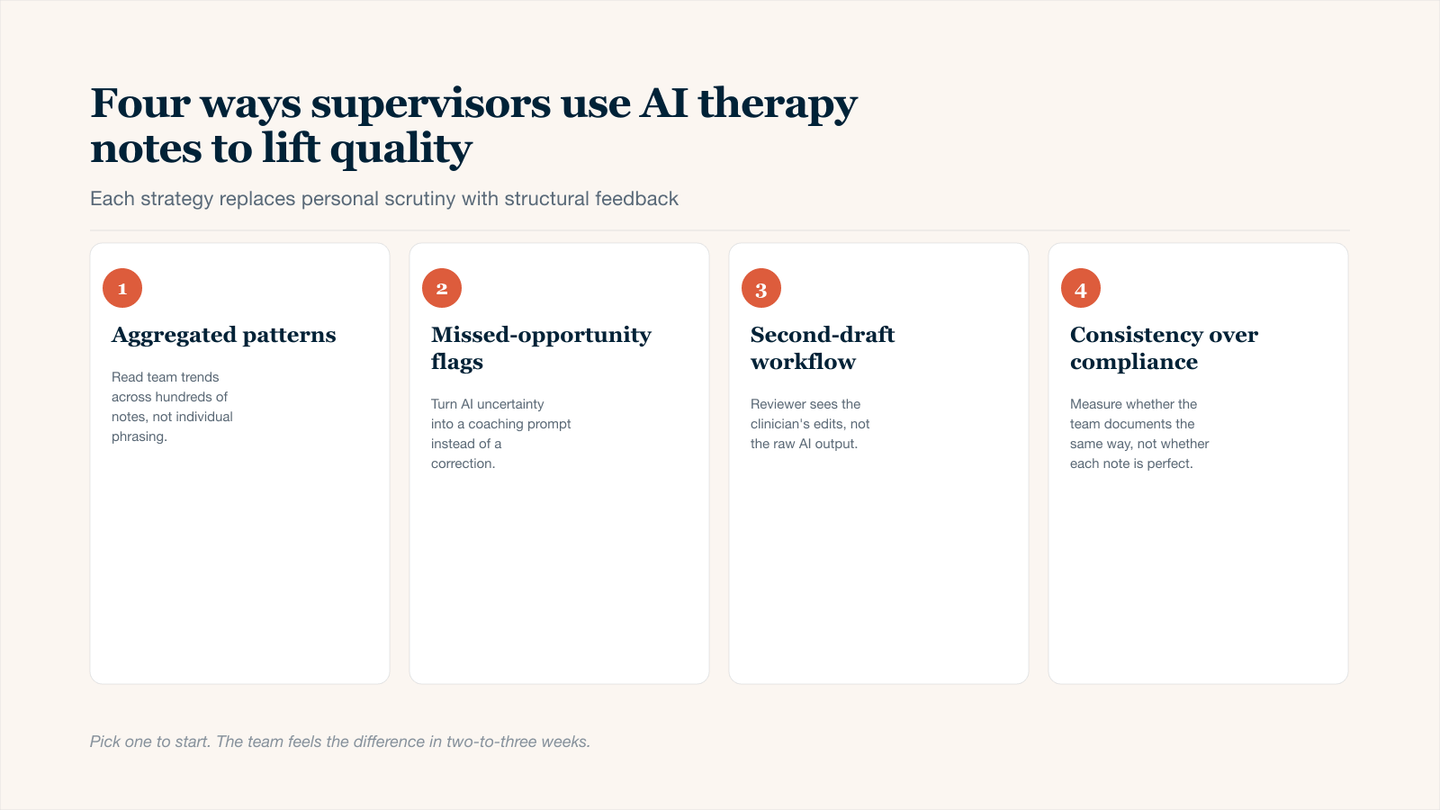
Four supervisor strategies — replace personal scrutiny with structural feedback.
Conclusion
AI therapy notes won't fix a broken supervision culture. But in the right hands, they take away the us-vs-them dynamic that fuels micromanagement. When you shift from random audits to aggregate reports, from searching for errors to coaching prompts, and from compliance checks to consistency conversations, supervision becomes what it was always meant to be: a shared learning space. Let the AI handle the patterns, and you handle the people.