



This guide compares Heidi Health and Lyrebird Health across features, pros & cons, pricing, integrations, accuracy, and more. Both are modern AI medical scribes; each has strengths and trade‑offs that will matter differently to solo clinicians vs team practices. See also our Heidi Health alternatives.
Heidi Overview
Heidi Health is an AI medical scribe that generates clinical notes from patient encounters, with free and paid tiers and growing adoption across specialties. It markets a permanent free plan and a Pro plan with expanded actions, templates, and controls.
Key points
- AI note generation & dictation: Structured notes from consult audio, plus dictation.
- Templates & prompts: Custom templates and free-text prompting (“assistant” actions) emphasized in marketing.
- Plans (May 2026, US): Free, Evidence Plus ($40/user/mo), Clinician ($150/user/mo, the closest equivalent to the legacy Pro plan), Evidence Team, Practice (new version), Enterprise. The legacy Pro and Practice tiers were renamed Scribe Plus and Scribe Team in February 2026 and are now only available to new subscribers in the UK and EU.
- Positioning & traction: Recent funding round and continued expansion noted in the press.
Considerations: Some advanced capabilities (e.g., deeper admin controls, SSO, onboarding help) live on higher‑tier plans.
Lyrebird Overview
Lyrebird Health is an AI medical scribe focused on generating comprehensive notes and documents (e.g., referral letters, MHCPs) and offers native EMR integrations in supported regions. It runs in the browser and supports primary care and specialty workflows.
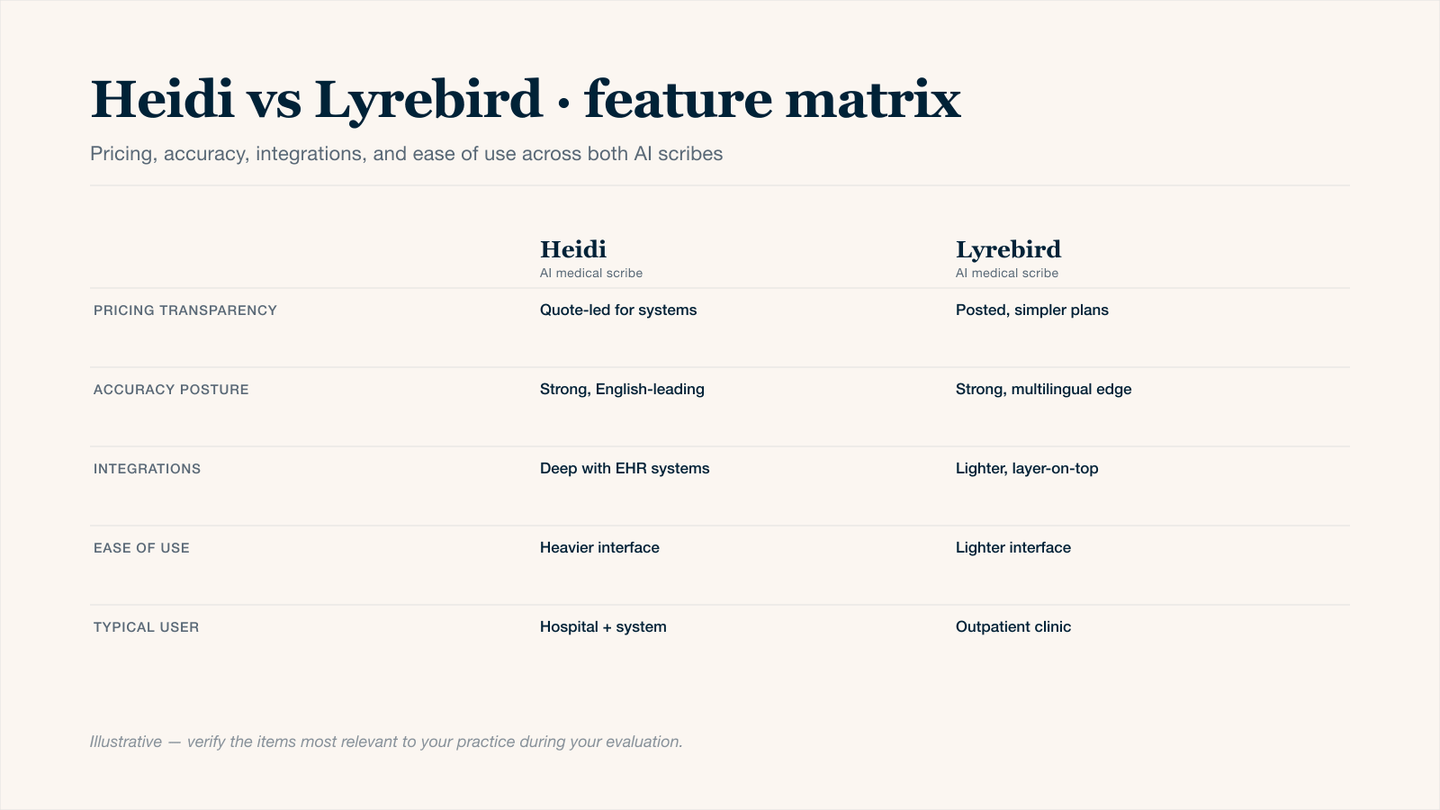
Heidi vs Lyrebird — five dimensions clinicians actually weigh.
Key points
- Listen → transcribe → generate: Background capture, then produce structured notes (vendor states no audio stored after session).
- Document creation: Referral letters, patient summaries, medical certificates, and more.
- Integrations: Native EMR integrations (e.g., Best Practice workflows are documented), with copy-paste fallback.
- Public reviews: Listings on G2 and Trustpilot offer anecdotal sentiment.
Considerations: Feature depth and integration availability can vary by region and EMR. Pricing is materially higher than many peers at the Pro level.
Pros & Cons
Aspect | Heidi | Lyrebird |
|---|---|---|
Pros | Permanent free tier; fast self-serve signup; growing template & prompt features; clear upgrade path; easy to use; good for solo or small practices. | Rich document types (referrals, certificates); native EMR integrations in supported setups; browser-based simplicity; strong formatting and export options; good for clinics needing structured outputs |
Cons | Some enterprise-style controls locked to higher tiers; integration breadth still evolving; mobile support limited. | Higher Pro pricing; integration availability depends on clinic stack/region; accuracy/time-savings claims are vendor-reported; mobile support limited. |
Last verified May 2026
Pricing (individual & team)
Heidi
- Free: Permanent free plan (basic capabilities).
- Pro (individual): Public pricing listed; Pro unlocks more actions/templates and faster processing. (Page shows Pro/Practice tiers with feature gating).
- Practice/Enterprise: Team controls, SSO add-on, onboarding, and central billing.
Lyrebird
- Free: $0 with 50 transcribe/dictate actions per month and 10 documents/letters per month — no EMR integrations. Lyrebird also added a "BP Free" tier (included with a Best Practice Premier subscription) that adds unlimited consult notes and the BP integration at no extra cost.
- Pro: $160/month per user, billed annually (Lyrebird's pricing page advertises a 33% saving on annual billing). Includes unlimited transcribe/dictate, unlimited documents and letters, unlimited care plans, and all integrations (BP + Cubiko + BetterConsult). Annual is the headline-priced option; monthly pricing for Pro is not separately listed on the public pricing page.
- Teams/Enterprise: Custom; SSO add-on, org sharing, onboarding, tiered discounts.
Note: Pricing shifts happen; confirm the vendor page before purchase. (Links above.)
Support & onboarding
- Heidi: Priority support and guided onboarding sit on higher-tier plans; template configuration & CS offered for teams.
- Lyrebird: Priority support included on Pro; personalized onboarding on Teams.
Accuracy & performance (what we can verify)
- Heidi: Public materials emphasize usability, adoption, and cost positioning; independent accuracy studies aren’t published.
- Lyrebird: Partner blog/KB and marketing cite strong accuracy and time-savings; treat as vendor-reported, not peer-reviewed. A recent academic review references Lyrebird’s workflow (transcribe → generate notes/docs) but doesn’t benchmark accuracy.
Integrations & workflows
- Heidi: Select integrations; details vary by plan/region. If your clinic needs deep EMR write-back or SSO, check plan pages.
- Lyrebird: Highlights native EMR connections (one-click transfer where supported) and documented Best Practice flows (AU). Copy-paste fallback available.
Ease of use & typical users
- Heidi: Strong self-serve motion (individual clinicians can start on Free and upgrade). Good for solo providers trialing a scribe with minimal friction.
- Lyrebird: Attractive for primary care/general practice where referrals/certificates and MHCPs are frequent, especially in stacks supported by integrations.
Ratings & reviews (directional)
- Lyrebird: Public listings on G2 and Trustpilot include positive anecdotes; sample sizes and verification vary—treat as directional.
- Heidi: Third-party roundups and competitor comparisons note rapid growth and premium pricing; read with usual skepticism.
Heidi vs Lyrebird: industry-specific use cases
Heidi
- Mental health & multi-specialty clinics wanting a low-friction trial via the free tier, then upgrading for more actions/templates.
Lyrebird
- Primary care & GP settings needing fast referrals/letters/MHCPs and where Best Practice or other supported EMRs are in use; teams that value built-in document types alongside notes.
Heidi vs Lyrebird vs Twofold
If you’re benchmarking broadly, Twofold Health’s AI scribe focuses on clinician‑friendly setup, competitive pricing, and payer‑ready note structures for therapy and primary care. If “value per seat,” minimal setup, and mental‑health‑oriented templates are priorities, add it to your short list for a head‑to‑head trial.
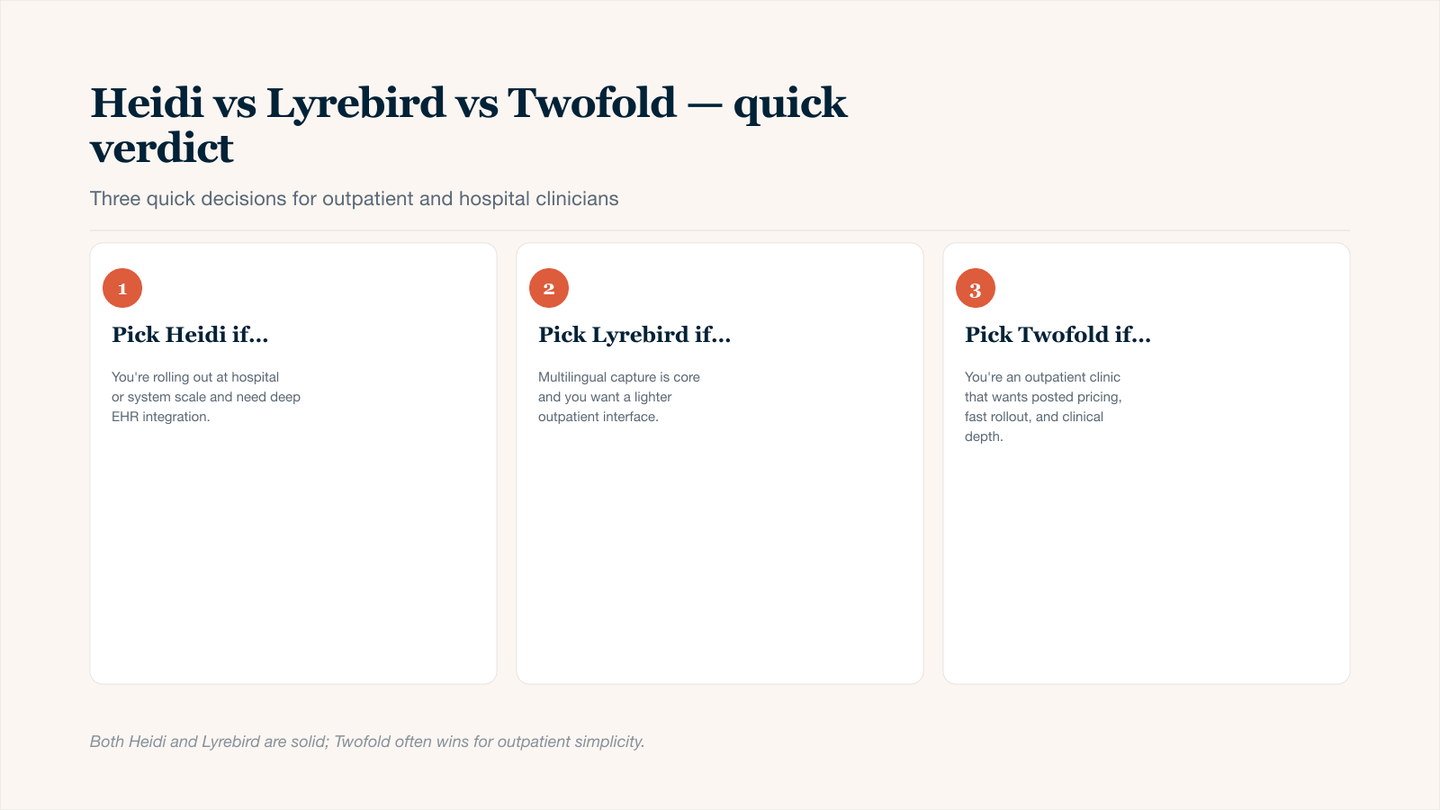
Heidi vs Lyrebird vs Twofold — three decisions for outpatient and hospital teams.
Conclusion
Heidi and Lyrebird both deliver capable AI scribe experiences, but they’re optimized for different realities.
For a fair decision, run a one‑week head‑to‑head with your own encounters and measure edit rates, time to final note, and downstream admin work (letters, referrals).
If you also prioritize ready templates, cost control, and quick team onboarding, include Twofold in that short list to benchmark value per seat. For comparison, Twofold's 2026 plan posts a single $49/month (annual) price that includes 24/7 human support, treatment plans, progress tracking, and four capture methods (live, dictate, upload audio, handwritten OCR) — without an upgrade tier.
Note: The information provided in this article is based on data available as of May 2026. Features and pricing are subject to change. Please consult the respective company websites for the most current information.
Disclaimer: This article is for informational purposes only and does not constitute legal or medical advice. Always consult professional guidelines and regulatory bodies for specific compliance requirements.