


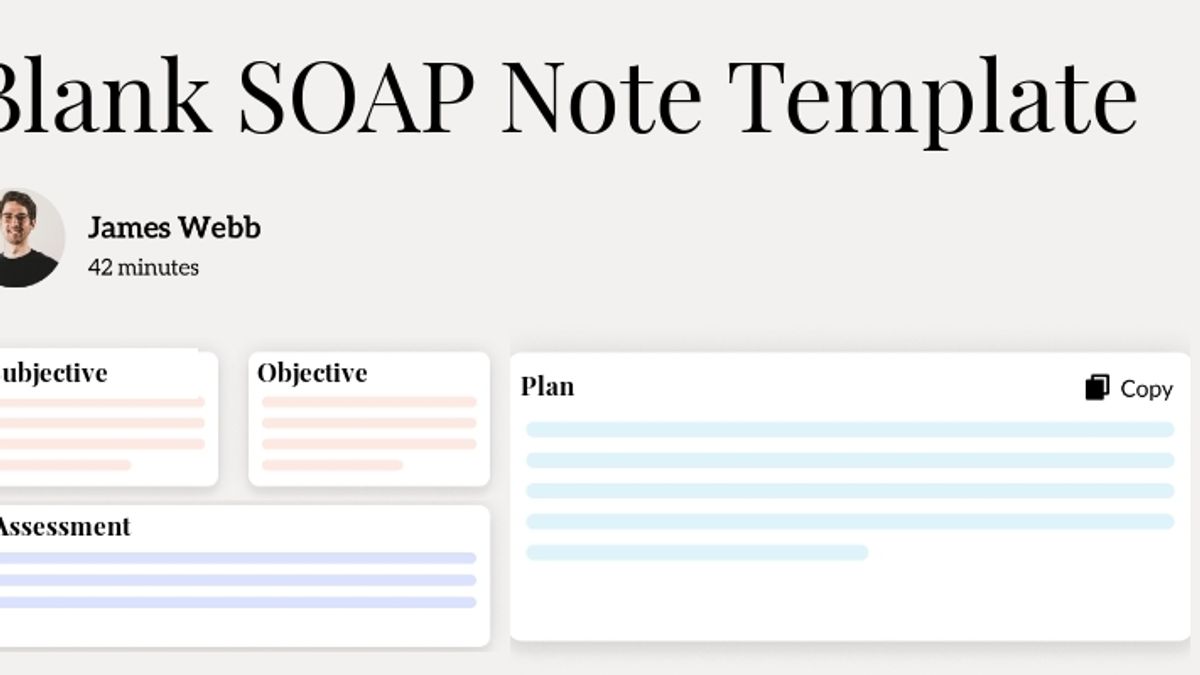
Ah, the world of patient documentation, where brevity meets precision. Welcome! If you’re reading this, chances are you’re grappling with note‑taking methods or simply on the hunt for efficiency. You might be a medical professional frustrated by fragmented patient notes or a student on a quest for clarity. Whatever the case, you’re in the right spot. Say hello to the Blank SOAP Note Template — a beacon of structure in the sometimes chaotic world of medical documentation.
What Is a Blank SOAP Note Template?
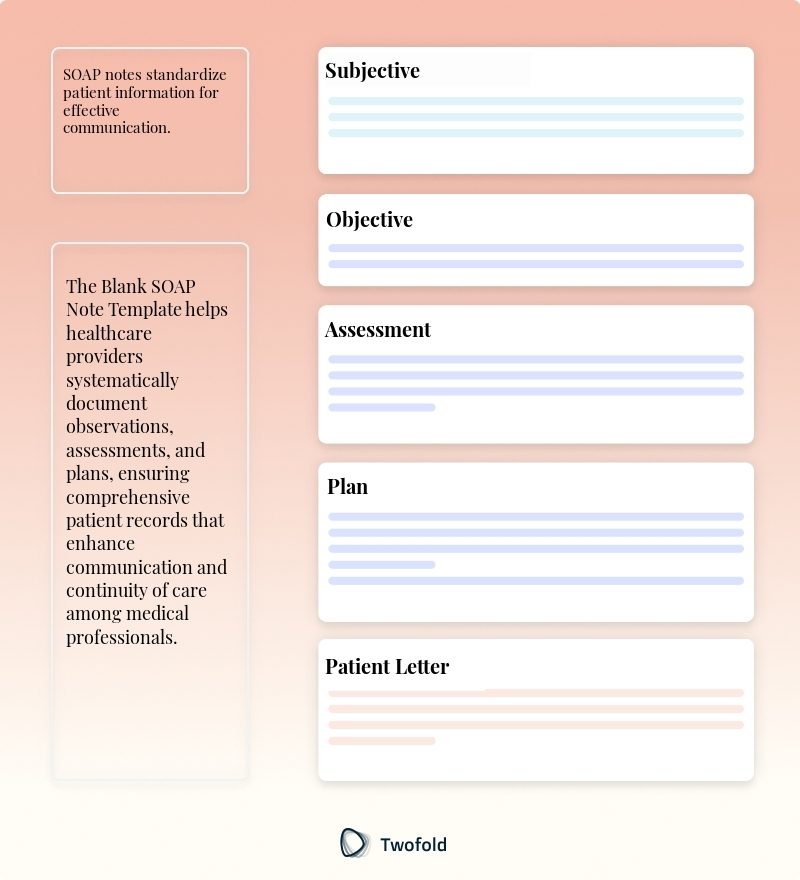
The Blank SOAP Note Template is a standardized tool for documenting patient interactions and clinical procedures. It organizes information into four key sections: Subjective, Objective, Assessment, and Plan, which helps streamline the documentation process.
This template aids in capturing precise details during patient care, ensuring that critical information is not overlooked. It's widely used across various medical settings due to its effectiveness in promoting clarity and consistency.
Key Components of a Blank SOAP Note
A Blank SOAP Note is composed of the following four elements:
- Subjective: Information provided by the patient about their symptoms and medical history.
- Objective: Clinician's observations and measurable data from clinical assessments.
- Assessment: Clinician’s diagnosis based on the subjective and objective information.
- Plan: Proposed treatment plan, including any ongoing tests or follow-ups.
How to Use a Blank SOAP Note Template: Step-by-Step Process
Step 1: Gather Subjective Information
Start by collecting detailed reports from the patient, including their symptoms and personal medical history. This section heavily relies on the patient's narrative.
Step 2: Record Objective Observations
Document the measurable data collected during the clinical examination. This step includes recording vitals, results from physical examinations, and lab results.
Step 3: Develop an Assessment
Provide a diagnosis or identify possible conditions based on the subjective and objective data gathered. This section synthesizes the information into a coherent diagnosis.
Step 4: Formulate a Plan
Create a detailed action plan outlining how the clinician intends to address the patient’s condition. Include prescriptions, additional tests, or referrals for specialists.
Benefits of a Blank SOAP Note
Benefit | Description |
|---|---|
Organizational Clarity | The template provides a structured approach to documenting patient encounters, reducing confusion. |
Efficiency | Standardized sections allow clinicians to quickly document and review patient information. |
Consistency | Ensures uniformity across different records, making data easier to interpret and share. |
Enhanced Communication | Facilitates smoother communication among healthcare providers by presenting clear and concise notes. |
Stakeholders in Blank SOAP Note
Several healthcare roles interact with the Blank SOAP Note, each benefiting uniquely from its structured layout:
- Physicians: A family doctor references past SOAP notes to track chronic conditions across multiple visits easily.
- Nurses: Transfer notes from shifts rely on SOAP entries to ensure continuity of care for incoming staff.
- Medical Students: Learning the ropes of patient diagnosis, a student uses SOAP templates to organize their training sessions.
- Administrative Staff: Uses data from SOAP notes for billing and insurance purposes, ensuring financial processes are aligned with documented care.
Example of a Blank SOAP Note
Below is a simple example to illustrate the format and structure of a Blank SOAP Note Template.