


Whether you're a seasoned healthcare professional or just venturing into it, assessing needs accurately is crucial. You clicked on this article because you know the challenges and the need for precision in pinpointing patient requirements. The Needs Assessment Template might be the key tool that's been missing from your clinical toolkit, simplifying the process and enhancing patient care.
What Is a Needs Assessment Template?
A Needs Assessment Template is a structured tool used by healthcare professionals to systematically identify the healthcare needs of a patient or group. It helps in organizing patient information and evaluating areas that require attention, thus facilitating comprehensive care planning.
This template serves as a guide to ensure that no critical aspect of patient assessment is overlooked. It acts as a repository of all necessary variables that must be checked to deliver quality healthcare services tailored to individual requirements.
Key Components of a Needs Assessment Template
At its core, a Needs Assessment Template comprises several vital elements that guide practitioners in evaluating patient needs meticulously:
- Patient Demographics: Essential information like age, gender, and contact details.
- Presenting Problem: Details about the current conditions or complaints.
- Medical History: Comprehensive past medical records and treatment history.
- Social History: Insights into patients' living conditions, employment, and social support systems.
- Functional Assessment: Evaluation of patients' ability to perform daily activities independently.
- Resource Needs: Identification of external resources like support groups or programs that may benefit the patient.
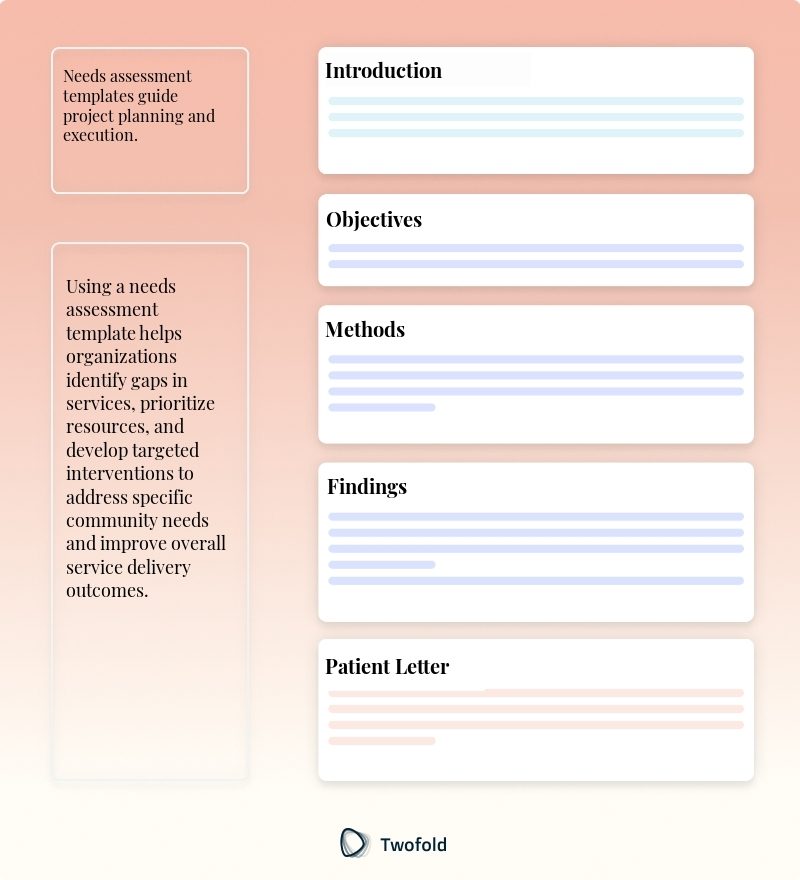
How to Use a Needs Assessment Template: Step-by-Step Process
Step 1: Gather Baseline Information
Begin by collecting basic patient data such as demographics, existing medical conditions, and a brief life history relevant to their current health status.
Step 2: Identify Patient Needs
Engage with the patient to identify overarching concerns and expectations, making use of standardized questionnaires within the template.
Step 3: Conduct Comprehensive Assessment
Use the template to conduct detailed evaluations across medical, psychological, and social spectrums, synthesizing this into a cohesive needs profile.
Step 4: Analyze and Document Findings
Collate the information from the assessment into the template, ensuring clarity and accuracy that aids later in care planning.
Step 5: Develop an Actionable Plan
Formulate a care plan based on identified needs, involving other healthcare professionals and resources as necessary to support patient requirements.
Benefits of a Needs Assessment Template
Benefit | Description | Impact |
|---|---|---|
Comprehensive Coverage | Ensures all aspects of patient needs are evaluated. | Reduces oversight and improves care efficacy. |
Enhanced Communication | Facilitates clear documentation that aids in communication among care teams. | Streamlines interdisciplinary collaboration. |
Time Efficiency | Standardized processes facilitate faster assessments. | More time for direct patient interaction. |
Data-Driven Decisions | Centralizes data collection for informed decision-making. | Better health outcomes through evidence-based interventions. |
Stakeholders in Needs Assessment
Several stakeholders play crucial roles in making the Needs Assessment Template effective:
- Clinicians: Use the template to conduct thorough and consistent patient evaluations. For instance, a family doctor using the template might identify a previously overlooked ailment, leading to timely intervention.
- Patients: Provide primary input for their assessments, ensuring the data reflects their true needs and concerns. Imagine a patient feeling their voice heard as they detail specific issues during an assessment.
- Care Coordinators: Aid in implementing the resulting care plans, ensuring all stakeholder actions are harmonized. Consider a coordinator using the template to align resources effectively.
- Healthcare Administrators: Leverage aggregated assessment data for operational planning and resource allocation. Picture an administrator using this data to enhance service delivery strategically.
Example of a Needs Assessment Template
A practical example of this template involves a structured format capturing demographics, medical and social history, current needs, and potential care resources.