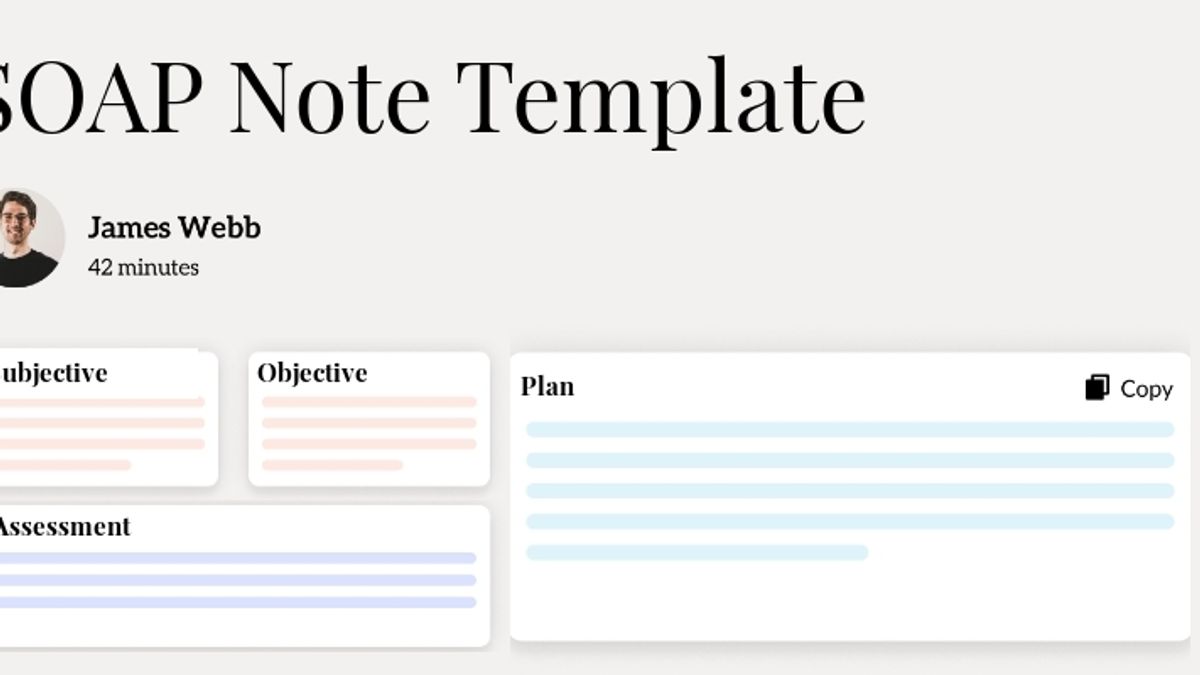
What a SOAP note is
SOAP started in medicine. The structure was developed by Dr. Larry Weed, according to the StatPearls review of SOAP notes, and that history is why most SOAP guides talk about vital signs and physical exams.
In a therapy session, the four headings stay the same but the content shifts. Objective becomes your mental status observations and any measure the client completed. Assessment becomes your read on how the client is doing against the treatment plan, and whether the diagnosis still fits.
Most outpatient therapists end up choosing between four or five formats. If your agency or a payer names one, use that. If the choice is yours, this is how they differ in practice:
| | |
|---|
| Subjective, Objective, Assessment, Plan | Practices that share charts with primary care or psychiatry, and anyone who wants the client's words kept apart from the clinician's observations |
| | Short routine sessions where splitting what was said from what was seen adds little |
| Behavior, Intervention, Response, Plan | Agencies and payers that want each intervention named along with the client's response to it |
| Situation, Intervention, Response, Plan | Sessions organized around a current event, and case management contacts |
| SOAP plus medications, side effects and labs | Medication management visits by a prescriber |
We'd pick SOAP over DAP when someone outside your practice reads your notes, such as a psychiatrist or a primary care doctor in the same system. They already read SOAP every day and know where to look for your assessment. For a solo private practice with no outside readers, DAP is usually faster and loses nothing.
What goes in each section of a therapy SOAP note
Subjective
What the client reports since the last session: mood, sleep, events, how homework went, and anything they want to work on today. Short direct quotes help when the client's exact words matter, for example how they describe a hopeless thought. Keep your interpretation out of this section.
Objective
What you saw and measured. For therapists that usually means appearance, behavior, speech, affect, thought process and content, and orientation, plus the score and date of any standardized measure given in session. If a structured mental status exam is part of your routine, the mental status exam checklist keeps it consistent.
Assessment
Your clinical judgment, tied to what you wrote above. Is the client improving, stable or worse? Did today's intervention help? Does the working diagnosis still hold, and is risk the same as last time? This is the section a reviewer reads first, so it should stand on its own.
Plan
The next session date, the focus for that session, any homework, referrals or coordination with other providers, and changes to the treatment plan. A plan that says "continue therapy" tells the next reader nothing.
Need the bare form with nothing filled in? Use the blank SOAP note template. For medication visits, the psychiatric SOAP note template adds the prescribing sections.
SOAP note example for a therapy session
This example is for a fictional client. Renee is 38 and in her seventh session of behavioral activation for major depressive disorder, recurrent, moderate (F33.1). Her PHQ‑9 at intake was 16.
S: Renee reports that she walked with her sister twice this week, which was the activity she scheduled last session, and skipped the third walk because of rain. She says mornings are still "the worst part" and she stays in bed until about 10 on weekdays off. Sleep is 6 to 7 hours, up from 5. Denies thoughts of death or self‑harm since the last session.
O: Arrived on time, casually dressed and groomed. Speech normal in rate and volume. Affect restricted but brighter when describing the walks. Thought process linear, no hopelessness expressed. Alert and oriented. PHQ‑9 today: 11.
A: Depressive symptoms are improving. PHQ‑9 has dropped 5 points since intake and she completed two of three planned activities, which supports continuing behavioral activation. Mornings remain the main barrier. No current suicidal ideation, and risk is unchanged from the last assessment. Diagnosis of F33.1 still fits.
P: Next session in one week. Schedule one morning activity before 9 a.m. on two days, with a rain backup (indoor stretching video). Repeat PHQ‑9 in two weeks. Check with her primary care provider about the sleep change, with her consent.
Notice what the Objective section holds here: observations and a score, with no vital signs. That's the main difference between a therapy SOAP note and the medical version most templates are built on.
Blank SOAP note template (copy and paste)
Copy the headings and prompts below into your EHR or a document. Delete the prompts as you write.
Client: name or ID. Date: session date. Session: start and stop time, in person or telehealth. Diagnosis: working diagnosis and code.
Subjective: What the client reports since the last session. Mood, sleep, stressors, homework. Key quotes. Client's goal for today. Any report of suicidal or homicidal thoughts.
Objective: Appearance and behavior. Speech. Affect and stated mood. Thought process and content. Orientation. Measures given today, with scores.
Assessment: Progress toward treatment plan goals. Response to today's intervention. Whether the diagnosis still fits. Current risk level and the reason for it.
Plan: Next session date and focus. Homework. Referrals or coordination. Changes to the treatment plan. When measures will be repeated.
Common mistakes in therapy SOAP notes
- Putting the client's statements in Objective. "Client reports feeling better" is subjective, even if it sounds like a finding.
- Copying the Assessment forward from last week. If nothing changed, say what you checked and why it's unchanged.
- Leaving the risk statement out because nothing came up. One line saying it was asked about and denied protects you and the client.
- A Plan with no date or target. "Continue CBT" can't be checked next session. "Practice thought record daily, review next Tuesday" can.
- Writing session content in detail. A SOAP note is part of the medical record. Detailed process notes about what was said belong elsewhere, if you keep them at all.
SOAP notes and HIPAA
A SOAP note is a progress note, so it lives in the client's medical record and can be released with it. HIPAA treats psychotherapy notes as a separate category only when they are kept apart from the rest of the record, and its definition leaves out the summary of diagnosis, symptoms, treatment plan and progress, which is exactly what a SOAP note holds (45 CFR 164.501). Our article on psychotherapy notes explains the difference in more detail.
Writing SOAP notes with Twofold
Twofold lists SOAP (Mental Health) in its Template menu. You record the session, press End, and the draft comes back in Subjective, Objective, Assessment and Plan order for you to review and paste into your EHR. The full flow is in the University guide How to Write a SOAP Note From a Live Session, and our longer article on SOAP notes covers the format itself.
DAP note template, BIRP note template, SIRP note template, progress notes template, blank SOAP note template and psychiatric SOAP note template.
Reviewed and updated October 2026.