

Free for a week, then $19 for your first month
Template

HIPAA Consent Form Template

Discover practical HIPAA Consent Form templates to enhance your documentation efficiency.

HIPAA Consent Form Template Hero Image

Ever found yourself tangled in medical paperwork, unsure of what each form actually means? You're not alone. The intricate maze of medical documentation, especially around consent forms, can be a puzzle. People often ask, “What exactly am I consenting to?” Understanding the HIPAA Consent Form can feel like learning a new language. But fear not — this article is here to simplify the process.

A HIPAA Consent Form Template is a standardized document used by healthcare providers to obtain consent from patients for the use and disclosure of their protected health information. This document ensures that patients are informed about how their data will be used under the Health Insurance Portability and Accountability Act (HIPAA).

The form typically highlights the patient's rights, how information will be used, and any instances where information may be disclosed without patient approval. Utilizing a template streamlines the consent process and facilitates consistent communication across medical practices.

Each component of a HIPAA Consent Form serves a unique purpose:

  • Patient Information: Captures full name, date of birth, and contact details.
  • Consent Statement: Clearly outlines what the patient is consenting to.
  • Authorized Uses: Defines how patient information will be used.
  • Disclosure Permissions: Specifies to whom information may be disclosed.
  • Revocation Clause: Details how patients can revoke consent.
  • Signature Section: Area for patient and provider signatures.
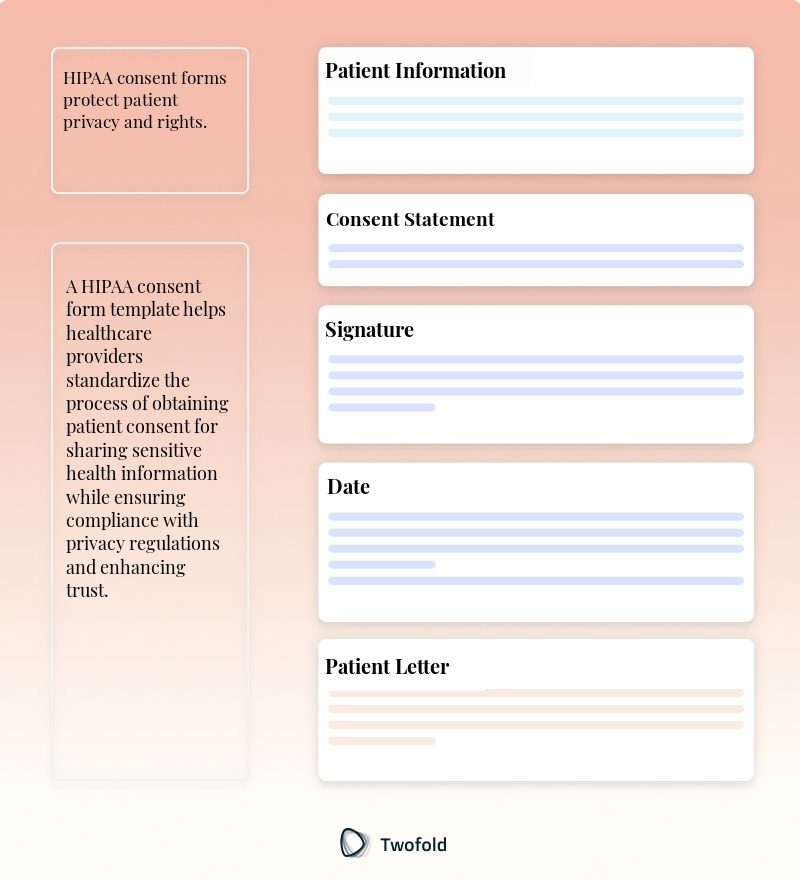
Key Components of HIPAA Consent Form Template
  1. Download the HIPAA Consent Form Template from a reliable source.
  2. Fill in patient information prior to the appointment.
  3. Discuss the consent form with the patient and address any questions.
  4. Obtain the patient's signature and date on the form.
  5. Sign the form yourself as a provider and date it.
  6. Store a copy in both digital and physical formats.

Benefit

Description

Uniformity

Ensures consistent information and consent processes across all cases.

Compliance

Helps meet legal requirements related to patient privacy.

Efficiency

Reduces time spent on explaining processes, as information is clearly outlined.

Patient Trust

Builds confidence as patients understand how their data is handled.

The process involves numerous stakeholders, each with their own responsibilities to ensure proper documentation:

  • Patients: For instance, a patient at a clinical visit reviews and signs the consent form to permit sharing their health data with a specialist.
  • Healthcare Providers: A physician ensures all forms are completed correctly before a procedure, maintaining compliance with the law.
  • Administrative Staff: They often prepare the forms ahead of consultations, enabling a smoother patient intake process.

A typical HIPAA Consent Form clearly communicates consent elements, ensuring both patient understanding and legal compliance.

See Template Example

HIPAA Consent Form Templates play a critical role in numerous healthcare settings:

  • Pediatrics: A pediatric clinic uses the form to explain to parents how their child's data is shared during school vaccination programs.
  • Dental: In a dental practice, the form helps patients understand data sharing with insurance companies for reimbursement purposes.
  • Mental Health: During mental health treatments, practitioners assure patients that only essential information will be shared with family, with consent.

Conclusion

Through a structured approach, the HIPAA Consent Form Template demystifies patient consent, ensuring compliance and fostering transparency. Understanding its components, stakeholders involved, and practical applications enables healthcare providers to enhance patient interactions and uphold legal standards.

Disclaimer: This article is for informational purposes only and does not constitute legal or medical advice. Always consult professional guidelines and regulatory bodies for specific compliance requirements.

FAQ

Frequently asked questions

  • How should a healthcare provider handle a situation where a patient is unable to provide written consent due to physical limitations?

    In cases where a patient cannot provide written consent due to physical limitations, healthcare providers should consider alternative methods for obtaining consent.

    This can include documenting verbal consent in the patient's file, witnessed by a third party, and ensuring that the verbal consent covers all necessary components identified in the HIPAA standard.

    Advanced considerations might also involve using electronic signature tools that facilitate consent through voice recognition or other accessible technologies suitable for individuals with disabilities.

  • What are the best practices for updating a HIPAA Consent Form when changes occur in a patient's care plan or data sharing agreements?

    When significant changes occur in a patient's care plan or data sharing agreements, it is crucial to update the HIPAA Consent Form to maintain compliance and transparency.

    Healthcare providers should promptly inform patients of any changes, provide them with the updated consent form, and explain how the changes affect their information sharing.

    An advanced practice involves maintaining a version control system for consent documents which tracks the changes and dates when patients have re‑consented, thus ensuring an auditable trail of consent modifications.

  • How can healthcare providers manage HIPAA Consent in the context of telehealth and remote consultations where traditional paper forms are impractical?

    For telehealth and remote consultations, healthcare providers should leverage electronic consent systems that are integrated into telehealth platforms.

    Providers can send digital consent forms to patients prior to the consultation, allowing them to review and sign the document electronically, ensuring it meets all of the same compliance requirements as a paper form.

    Advanced implementation may include secure portals that encrypt the consent information and provide audit logs that track when and how the consent was obtained, ensuring both privacy and legal compliance in the digital communication landscape.