

Free for a week, then $19 for your first month
Template

Social Work Treatment Plan Template

Discover practical Social Work Treatment Plan templates to enhance your documentation efficiency.

Social Work Treatment Plan Template Hero Image

Have you ever found yourself working with social work treatment plans and feeling like you're swamped by details and data, unsure if you've captured all the necessary information? It's a common challenge in social work to keep your documentation both comprehensive and practical without getting lost in mountains of paperwork. You're not alone, and this post might have just the insights you need.

What Is a Social Work Treatment Plan Template?

A Social Work Treatment Plan Template serves as a structured outline for social workers to document client information, goals, and the strategies needed to meet those goals. This template provides a detailed framework to ensure that no critical aspect is overlooked in the treatment process.

By standardizing the way client interactions and plans are documented, the template helps social workers maintain clarity and focus. It ensures that treatment activities are aligned with best practices, ultimately improving client outcomes.

Key Components of a Social Work Treatment Plan Template

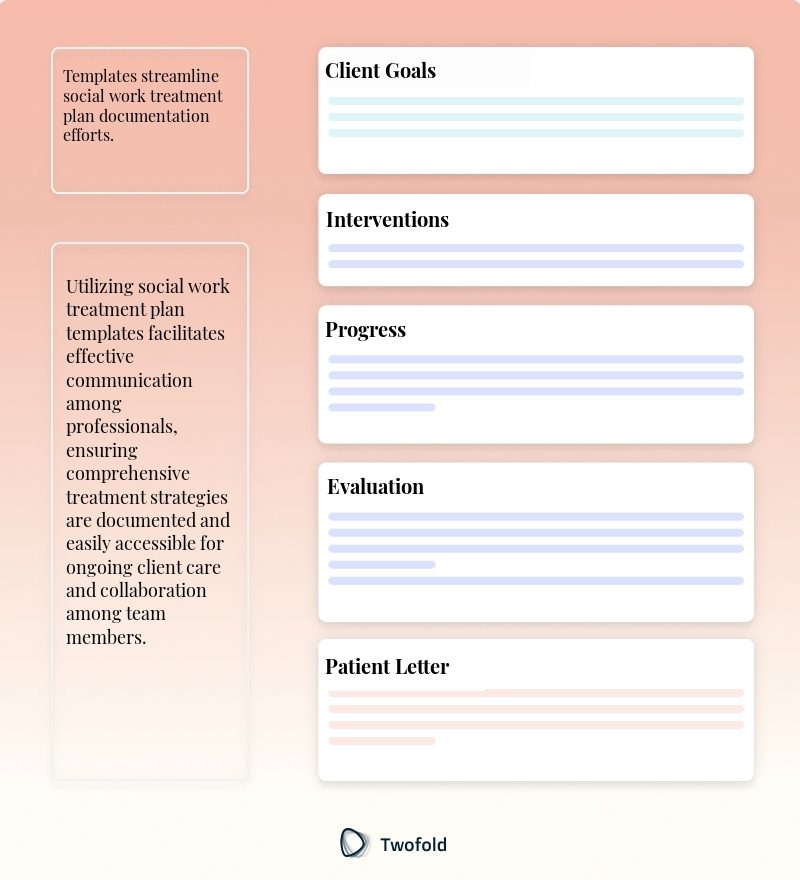
To construct an effective Social Work Treatment Plan, you should include the following components:

  • Client Identification: Details such as name, age, and contact information.
  • Assessment Summary: A concise evaluation of the client’s current situation and needs.
  • Goal Setting: Clear and specific goals that are both long-term and short-term.
  • Intervention Strategies: Methods and techniques planned to achieve the desired goals.
  • Monitoring and Evaluation: Criteria and tools for evaluating the progress and effectiveness of the treatment.
  • Client's Input and Agreement: Documentation of the client's priorities and their agreement to the plan.
Key Components of Social Work Treatment Plan Template

How to Use a Social Work Treatment Plan Template: Step-by-Step Process

  1. Begin by gathering critical client data and performing a comprehensive assessment.
  2. Discuss and establish client goals, ensuring they are specific and achievable.
  3. Select appropriate intervention strategies that are aligned with the client’s needs and goals.
  4. Document these strategies clearly in the template, ensuring to note down any required resources.
  5. Set measurable objectives and timelines to evaluate progress periodically.
  6. Review the plan with the client, get their input, and finalize the treatment strategy.
  7. Update the treatment plan regularly to reflect any changes in interventions or client's progress.

Benefits of a Social Work Treatment Plan

Benefit

Description

Clarity and Focus

Provides a clear outline of the client's goals and steps needed to achieve them.

Consistency

Ensures uniformity in documentation, which is essential for teamwork and continuity of care.

Client Engagement

Facilitates active client participation by involving them in the planning process.

Accountability

Allows social workers to track progress and make evidence-based adjustments.

Efficiency

Streamlines the documentation process, saving time for hands-on client interaction.

Stakeholders in Social Work Treatment Plans

The creation and implementation of treatment plans involve several key stakeholders:

  • Clients: For example, a teenager struggling with anxiety. Their involvement ensures the plan aligns with their personal goals.
  • Social Workers: Like the caseworker assigned to a homeless shelter, responsible for drafting and updating the plan.
  • Family Members: Such as parents who actively participate in the therapy sessions and support goal-setting for a child.
  • Healthcare Providers: Physicians providing necessary medical insights that inform the intervention strategies.
  • Community Resources: Local nonprofits that offer support services integrated into the treatment strategy.

Example of a Social Work Treatment Plan

Below is a basic example that illustrates how a treatment plan can be structured and populated with relevant data:

See Template Example

Real-World Use Cases: Practical Impact of the Social Work Treatment Plan Template

Social Work Treatment Plans significantly impact real‑world scenarios:

  • PTSD: A veteran with PTSD benefits from a structured plan that combines therapy, physical activity, and community support, leading to noticeably improved mental health.
  • Financial Planning: A single mother experiencing housing insecurity uses a treatment plan to access financial planning services and vocational training, helping her achieve self-sufficiency.
  • Rehabilitation: An elderly man recovering from a stroke follows a rehabilitation-focused plan that includes physical therapy and supportive family involvement, drastically enhancing his quality of life.
  • Education And Job Placement: A young adult transitioning out of foster care uses a plan to access education grants and job placement services, enabling a smooth transition to independent living.

Conclusion

In social work, a well‑structured treatment plan template is indispensable. It ensures clarity, engagement, and measurable progress, all while keeping stakeholders informed and accountable. Whether dealing with mental health issues, addiction recovery, or transition support, a standardized approach can elevate outcomes. By understanding the core components and refining your technique with expert insights, you'll enhance both your practice and your client's experience.

Disclaimer: This article is for informational purposes only and does not constitute legal or medical advice. Always consult professional guidelines and regulatory bodies for specific compliance requirements.

FAQ

Frequently asked questions

  • How should a social work treatment plan template be adapted for clients with multiple intersecting needs, such as co-occurring disorders?

    When working with clients who have co‑occurring disorders, it's essential to tailor the treatment plan to address both conditions simultaneously. This involves integrating interventions that consider the interaction between conditions, such as a mental health disorder and substance abuse.

    Specific examples include coordinating care with multiple service providers, such as psychiatrists and addiction specialists, to create a cohesive treatment approach.

    Advanced considerations may include adapting monitoring tools to capture progress across different areas of need and scheduling regular multidisciplinary team meetings to ensure the plan remains comprehensive and relevant.

  • What are the best practices for updating social work treatment plans to incorporate new evidence-based practices without disrupting ongoing treatment?

    To incorporate new evidence‑based practices effectively, social workers should first assess the compatibility of these practices with current interventions and client goals. This requires a thorough understanding of the latest research and potential impacts on the treatment process.

    Specific practices include implementing changes during scheduled evaluation phases rather than abruptly, to minimize disruption. Maintaining transparent communication with clients about the benefits and reasons for changes is also critical.

    Advanced considerations involve training staff to ensure they are equipped to execute new practices correctly and facilitating peer consultations to discuss potential challenges and solutions during implementation.

  • How can social work treatment plans be effectively integrated with digital tools and electronic health records (EHRs) while maintaining data security and client confidentiality?

    Integrating treatment plans with digital tools and EHRs requires careful planning to maintain security and confidentiality. This involves selecting platforms that comply with healthcare regulations such as HIPAA in the United States.

    Practical guidance includes using encrypted communication channels for data sharing and ensuring all team members are trained on cybersecurity practices. Clients should also be informed about data privacy policies and consent must be obtained for storing personal data electronically.

    Advanced considerations involve implementing role‑based access controls to limit who can view and edit sensitive information in EHRs, and conducting regular audits to ensure compliance with data protection standards.