

Free for a week, then $19 for your first month
Template

Medical History Form Template

Discover practical Medical History Form Template templates to enhance your documentation efficiency.

Medical History Form Template Hero Image

Imagine a world where every visit to your healthcare provider is seamless, with minimal paperwork and maximum focus on your well‑being. Sounds ideal, right? Many healthcare professionals and patients alike wish for an efficient way to handle medical records, and today, we'll uncover how using a comprehensive medical history form template can help alleviate these frustrations.

What Is a Medical History Form Template?

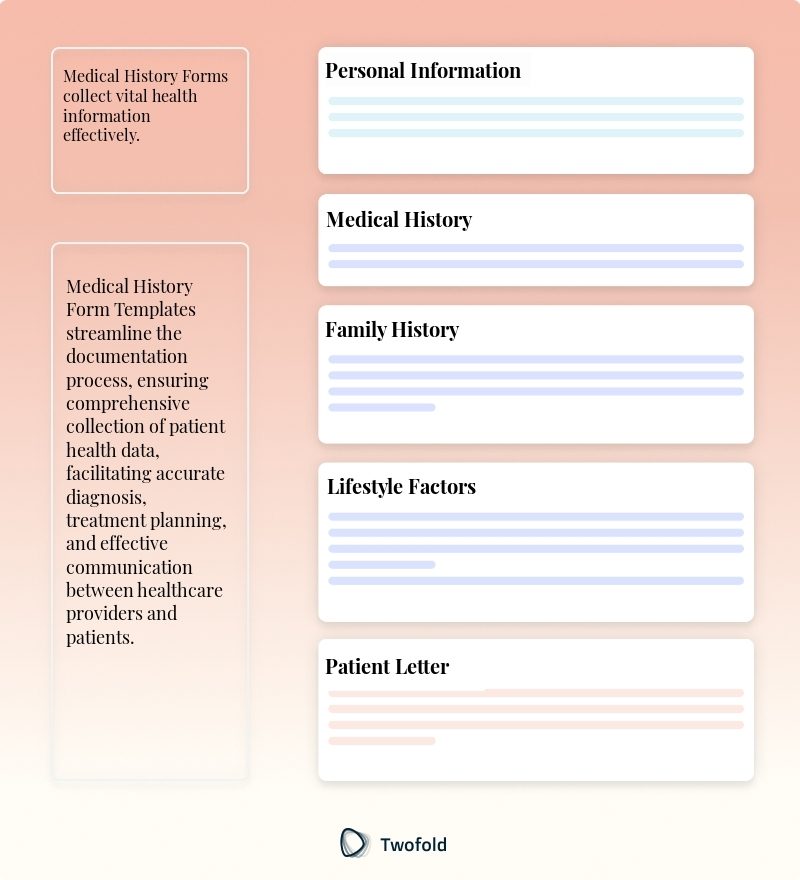
The medical history form template is a pre‑designed document that captures a patient's past and present medical data in an organized manner. It serves as a vital tool for clinicians, streamlining patient information intake during medical visits.

These templates include sections for documenting personal medical history, family medical history, surgical history, medications, allergies, and more. Whether in digital or paper form, they help ensure no critical detail is overlooked.

Key Components of a Medical History Form

A comprehensive medical history form should include the following components:

  • Patient Identification Information
  • Chief Complaint and History of Present Illness
  • Past Medical History
  • Medication List
  • Allergies
  • Family and Social History
  • Review of Systems
  • Physical Examination Findings
Key Components of Medical History Form Template

How to Use a Medical History Form Template: Step-by-Step Process

1. Gather Patient Information

Start by collecting the basic identifying information, such as name, date of birth, and contact details. This will initiate the document and prepare it for more detailed data input.

2. Document the Chief Complaint

Note the patient's primary reason for the visit. This sets the stage for a structured assessment and focused treatment plan.

3. Record Medical and Surgical History

Capture past illnesses, surgeries, and ongoing health issues, ensuring the context is understood for current or future treatment needs.

4. List Medications and Allergies

Provide a detailed list of all current medications, along with any drug allergies to ensure safe prescribing practices.

5. Include Family and Social History

Detail family medical conditions and social habits that could influence the patient's health, like smoking or alcohol use.

6. Conduct and Document a Review of Systems

Go through each body system to pinpoint other potential health concerns that might need attention.

Benefits of a Medical History Form

Benefit

Description

Improved Patient Care

Ensures all relevant patient history is considered, allowing for tailored treatment plans.

Efficiency

Reduces time spent gathering patient data, freeing up time for quality patient interaction.

Accuracy

Minimizes errors by providing clear and standardized information collection fields.

Continuity

Facilitates smooth information flow between different healthcare providers.

Stakeholders in Medical History Form

The medical history form involves several key stakeholders who contribute to and benefit from accurate patient documentation:

  • Patients: Ensure that all medical backgrounds are captured, like John, who manages his chronic conditions seamlessly with his doctor.
  • Clinicians: Use the form to maintain focuses during consultations, much like Dr. Smith who references them to enhance patient interactions.
  • Medical Assistants: Facilitate accurate data entry during patient check-ins to support team efficiency and precision.
  • Family Members: Often provide supplementary information for completeness in cases when the patient cannot articulate all history clearly.

Example of a Medical History Form PDF

For a comprehensive understanding, a downloadable PDF example of a medical history form can serve as a reference for implementing best practices in patient documentation.

See Template Example

Real-World Use Cases: Practical Impact of the Medical History Form Template

This form's impact in clinical settings can be significant:

  • During routine check-ups, healthcare providers like Dr. Andrews have noted quicker consultation times and improved diagnostics accuracy.
  • In emergency situations, having a readily available medical history ensures critical decisions are made promptly, safeguarding patient safety.
  • For chronic disease management, patients like Jane use these forms to track progression and adjust lifestyle interventions with their physician's advice.

Conclusion

Incorporating a well‑structured medical history form template into healthcare practices significantly enhances efficiency, accuracy, and patient care. Its utility spans from routine check‑ups to acute medical scenarios, underscoring its essential role in modern medicine. By maintaining comprehensive and up‑to‑date patient records, healthcare providers can foster better patient outcomes and streamline operations effectively.

Disclaimer: This article is for informational purposes only and does not constitute legal or medical advice. Always consult professional guidelines and regulatory bodies for specific compliance requirements.

FAQ

Frequently asked questions

  • How should a medical history form template be adapted for multi-disciplinary teams in collaborative care settings?

    In collaborative care settings, such as those involving multi‑disciplinary teams, a medical history form template should incorporate sections that facilitate the sharing of discipline‑specific observations.

    For example, while general healthcare details are applicable across the board, sections can be tailored to include physiotherapy assessments or psychological evaluations, facilitating comprehensive care.

    Advanced implementation includes creating digital templates that are interoperable with different electronic health record systems, promoting real‑time updates and seamless communication between team members.

  • What challenges arise in integrating genetic predisposition information into medical history forms?

    Including genetic predisposition information requires sensitivity to privacy regulations and a clear understanding of genetic counseling protocols. It's crucial to ensure that this information is gathered with informed patient consent and used appropriately to inform, rather than determine, treatment options.

    For advanced templates, integrating decision‑support tools that highlight relevant genetic tests based on family history can be invaluable for clinicians.

    Healthcare providers must also train staff in understanding genetic data to correctly interpret and utilize this information within treatment plans while ensuring confidentiality.

  • How can medical history forms be optimized to improve data sharing across different healthcare networks without compromising security?

    Optimizing medical history forms for cross‑network data sharing involves adopting interoperable standards like HL7 FHIR (Fast Healthcare Interoperability Resources) which enable consistent data exchange.

    Implementing robust authentication and encryption mechanisms ensures data security and integrity during transmission.

    Furthermore, employing role‑based access controls ensures that only authorized personnel can access sensitive patient information, maintaining compliance with data protection laws like HIPAA, while facilitating the smooth transfer of critical patient data between networks.