


For a 10‑clinician therapy group, we would standardize on Twofold if you want one practice‑wide documentation setup: shared templates pushed to every clinician, an admin dashboard, central billing, seat management, one group BAA, records custody for clinicians who leave, and unlimited notes. Twofold's individual plan is $49 a month billed annually, or $69 billed monthly ($19 for the first month on the monthly plan); for groups, pricing is quoted per practice with volume discounts, and the groups page lists $49 per clinician per month as the typical flat, unlimited cost, so 10 clinicians price at about $490 a month or $5,880 a year before the final quote. Mentalyc Team is the better fit if Chrome‑extension EHR transfer is the deciding issue, Upheal is better if built‑in telehealth and its treatment‑plan workflow matter more than group notes, and Eleos is better for a larger community‑based agency that wants enterprise compliance tooling.
The short answer for a 10-clinician therapy group
Twofold is the cleanest standard choice for a 10‑person outpatient therapy group that wants consistent notes, one invoice and clear admin control. We make Twofold, so weigh our view accordingly. The group‑specific pieces are the reason for the recommendation: shared templates, an admin dashboard showing note status, time saved and activity per clinician, centralized billing, seat management, onboarding support, 24/7 chat support, one signed BAA and a records‑custody setting that Twofold support can set up on request.
For clinicians, the value is that everyone starts from the same clinical structure. Twofold includes SOAP, DAP, BIRP, GIRP, PIRP, SIRP, progress notes, intakes, 70‑plus formats and custom templates. It also includes templates for group therapy, couples, family, EMDR, DBT, play therapy, supervision, substance use, biopsychosocial assessment, EAP, discharge, psychiatric evaluation and medication management. Treatment plans can be drafted from session notes with progress tracking, and CPT and ICD‑10 suggestions appear with each note for the clinician to review before billing.
The main tradeoff is EHR filing. Twofold works alongside any EHR, including SimplePractice and TherapyNotes, by copying the finished note into the chart, and formatting carries over. Direct EHR filing exists through the Twofold Partner API for partner EHRs. Notes are copied into SimplePractice, and Twofold does not charge an integration fee.
What will 10 clinicians cost per year?
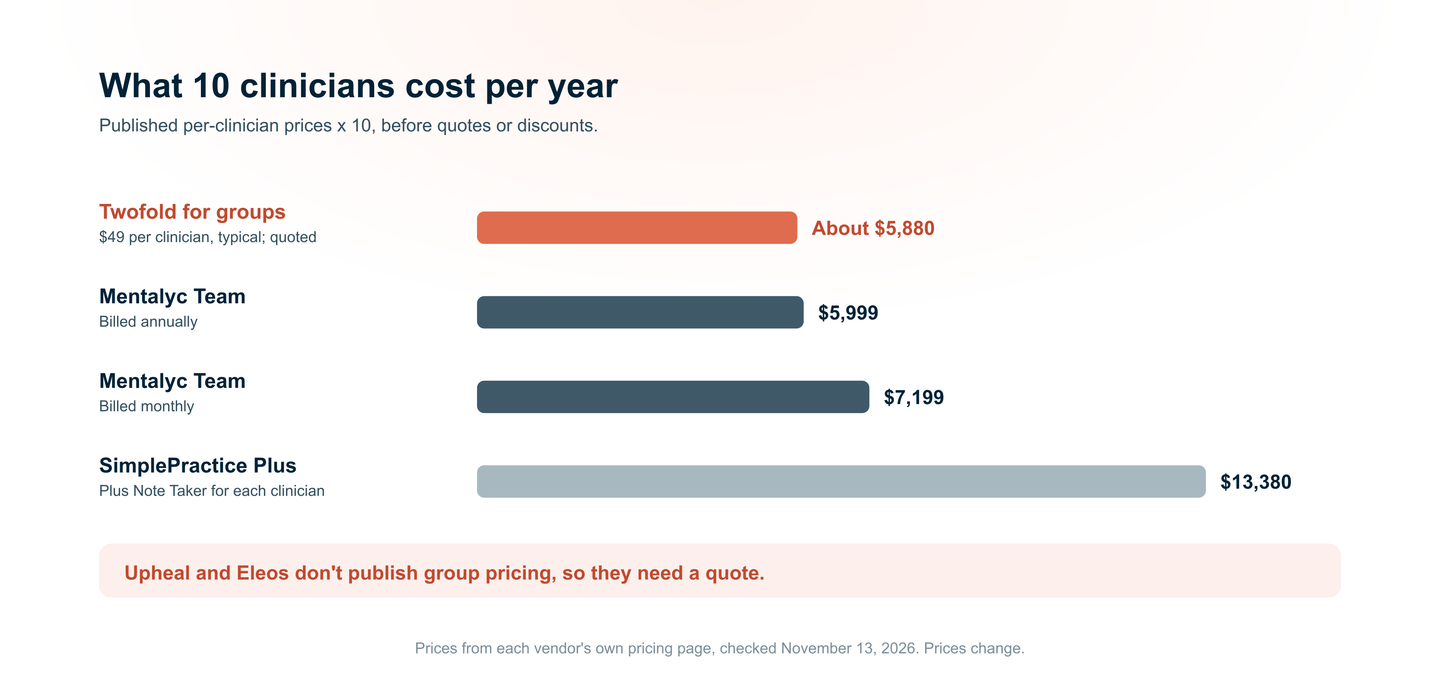
For a first‑pass budget, Twofold and Mentalyc publish enough team pricing to estimate 10 clinicians, while Upheal group pricing and Eleos pricing require a quote. Prices change, promos come and go, and written quotes control, so use this as the budget conversation before signing.
Vendor | Published price | 10-clinician monthly | 10-clinician annual | Note cap |
|---|---|---|---|---|
Twofold for groups | $49 per clinician, typical; quoted per practice | About $490 | About $5,880 | Unlimited |
Mentalyc Team | $49.99 annual; $59.99 monthly | $499.90 or $599.90 | $5,998.80 or $7,198.80 | Unlimited fair usage |
Upheal group practice | Quote required | Quote required | Quote required | Not published |
Eleos Health | Quote required | Quote required | Quote required | Not published |
SimplePractice Plus plus Note Taker | $99 first, $74 others, +$35 each | $1,115 | $13,380 | Not published |
Twofold group pricing is quoted per practice with volume discounts, so confirm the billing term on the written quote. Mentalyc Team pricing is from Mentalyc's team pages as of November 13, 2026. SimplePractice pricing uses Plus group list pricing plus the Note Taker add‑on, checked November 13, 2026.
For any capped plan, convert weekly caseload to monthly notes by multiplying weekly sessions by 52 and dividing by 12: 15 sessions a week is about 65 notes, 25 is about 108, and 35 is about 152. That is why a solo capped plan can look cheap and still fail for a full‑time clinician.
What does standardizing on one scribe mean?
Standardizing means the practice decides the documentation rules once, then gives every clinician the same templates, review process, consent process and new‑hire setup. If each clinician picks a different scribe, the practice inherits different note formats, audio policies, BAA terms and offboarding problems.
- Use one template set. For most 10-clinician therapy groups, that means a progress note, intake, treatment plan, group note, couples note and family note. In Twofold, the practice can build shared templates once and push them to every clinician.
- Use one clinical review rule. AI-drafted notes and billing-code suggestions should be reviewed by the clinician before signing or billing.
- Use one consent workflow. Decide who explains the AI scribe to clients, where consent is documented, and what happens if a client declines.
- Use one EHR filing rule. If you choose Twofold, decide where the note is copied into the EHR and who signs it. If you choose Mentalyc, decide when the Chrome extension is approved for use.
- Use one new-hire path. A new clinician should get an invite, the practice templates, the consent script, the EHR filing rule and the offboarding policy before seeing clients under the practice account.
A 2 to 4 week rollout plan for 10 clinicians
A 10‑clinician practice should roll out an AI scribe in 2 to 4 weeks by setting policy first, piloting second and adding the rest of the team after the templates are fixed. The first week is for setup. The second week is for real sessions with a small pilot group. Weeks 3 and 4 are for template tuning, training and full rollout.

- Days 1 to 3: choose the shared template set and the review rule. Pick the standard progress-note format, intake format, treatment-plan format and any specialty templates you need, such as EMDR, DBT, substance use, couples, family or group therapy. Name the person who approves template changes.
- Days 4 to 7: complete the contracting and privacy check. Confirm the group BAA, audio retention, transcript retention, PHI training policy, admin visibility and records custody after a clinician leaves.
- Week 2: pilot with 2 or 3 clinicians who see different visit types. Include at least one intake, one routine individual session, one couples or family session if you offer them and one group session if groups are part of the practice.
- Week 3: edit the templates and push them to everyone. This is where shared templates matter. If every clinician has to rebuild their own note style, the practice is not standardizing.
- Week 4: add the remaining seats and check adoption through the admin workflow. In Twofold, the admin dashboard shows note status, time saved and activity per clinician, which helps spot who needs support.
Admin needs for a 10-person practice
For 10 clinicians, admin controls decide whether the scribe becomes a practice system or another app each clinician manages alone. The owner or clinical director needs clear answers about visibility, seat changes, custody, billing and support.
Admin need | Twofold | Mentalyc Team | Upheal group | Eleos |
|---|---|---|---|---|
Shared templates | Build once, push to clinicians | Listed; detail limited | Listed | Enterprise configured |
Admin visibility | Note status, time saved, activity | Owners see saved notes | Five dashboards | Reviews 100 percent |
Seat changes | Admin controls active seats | Assign, remove, reassign | Four roles listed | Not published |
Records custody | Group can retain notes | Owner keeps records | Not published | Not published |
Billing | One invoice | One seat price | Group price unpublished | Quote-based |
Support | Training, success manager, chat | Not published | Not published | Demo-based |
Admin visibility deserves a real discussion before you sign. Some owners want usage and note status only. Others want access to saved notes for supervision, coverage or custody. Mentalyc publishes that owners can view clinician saved notes and client information, while Twofold publishes dashboard activity and note status plus records custody by support request. That is a governance choice as much as a software choice.
How should group therapy sessions be handled?
If your practice runs therapy groups, choose a scribe that can create one group note plus individualized documentation for each participant. Twofold's group therapy workflow creates one session note and an individualized summary for each participant, which fits a common clinical pattern: one shared group event and a separate record for each client.
Mentalyc also publishes group documentation on Super and Team: a session note plus an individual progress note for each participant. Upheal is weaker here as of November 2026. It supports group telehealth, but Upheal's feedback page says group therapy notes are on the roadmap with no ETA, and the pricing page does not list group therapy notes as a supported note type.
For Medicaid work, do not assume that a group note alone is enough. The CMS Medicaid behavioral‑health documentation fact sheet says documented services must meet the state's Medicaid program rules, and it specifically says group therapy should use group codes and document patient‑specific information in each attendee's medical record. Requirements vary by state and payer, so check your state Medicaid manual and payer contracts. This is not legal advice.
When should you choose Mentalyc, Upheal or Eleos instead?
Choose a competitor when one specific workflow matters more than Twofold's shared‑template and admin setup. For a 10‑clinician practice, the usual reasons are EHR transfer, built‑in telehealth or enterprise compliance tooling.
Choose Mentalyc Team if EHR transfer is the deciding factor
Mentalyc Team is the better pick if your clinicians will not tolerate copy and paste and you want a Chrome extension that pushes notes into SimplePractice, TherapyNotes, Jane, Valant, TheraNest, ICANotes, Headway, Alma or another EHR in one click. As of November 13, 2026, Team seats are for group practices and include unlimited notes under a fair‑usage clause.
The caveat is governance. Mentalyc publishes that owners can view clinicians' saved notes and client information. If that owner access fits your practice, and one‑click EHR transfer saves enough time, Mentalyc Team can be the better operational choice.
Choose Upheal if telehealth and treatment plans matter more than group notes
Upheal is the better pick if your group wants built‑in telehealth, mobile and desktop apps, AI notes from video, audio, dictation and uploads, and treatment plans tied to its Golden Thread workflow. Its individual AI Notes plan is $39 a month flat as of November 13, 2026, and Upheal publishes support for 35 session languages and 15 note‑language options.
The tradeoff is group‑practice clarity. Upheal does not publish a per‑seat group price, and group therapy notes are not supported yet. If your 10 clinicians run several therapy groups a week, test that gap before signing.
Choose Eleos if you are closer to an agency than a private group practice
Eleos is the better pick if your organization looks like a community behavioral health agency, SUD program, home health or hospice provider and you want enterprise compliance tooling. Eleos publishes documentation for individual, group, psychiatry and assessment notes, a compliance product that reviews 100 percent of notes, EHR‑agnostic browser‑extension filing and support for more than 150 languages with notes in English.
The tradeoff is buying process and budget clarity. Eleos does not publish pricing, and the call to action is a demo. That can be fine for a larger agency with implementation staff, but it is usually more process than a 10‑clinician outpatient therapy group wants when choosing a scribe this month.
Choose SimplePractice Note Taker if you want the scribe inside SimplePractice
SimplePractice Note Taker is worth considering if your whole practice already uses SimplePractice and wants the note taker inside that account. At list price checked November 13, 2026, Note Taker is a $35 per clinician monthly add‑on to an active SimplePractice plan, so a 10‑clinician Plus group prices at $1,115 a month before promos using the published Plus group pricing.
The caveat is scope. SimplePractice does not publish a standalone Note Taker plan, and no note cap appears on the pricing page. If you are not already committed to SimplePractice as the EHR, compare the total EHR‑plus‑scribe cost against a standalone scribe and your current EHR.
Questions to ask every vendor before signing
Ask every vendor the same questions in writing before you sign, because a 10‑clinician account creates privacy, billing and custody issues that a solo trial can hide. Use the same checklist for Twofold, Mentalyc, Upheal, Eleos, SimplePractice or any other scribe.
- Will you sign one BAA for the whole group, and is it included in the quoted price?
- Is audio stored, or is it deleted after the note or transcript is created?
- Are transcripts retained, for how long, and for what purpose?
- Do you use audio, transcripts, notes or other PHI to train AI models?
- Are notes unlimited per clinician, or is there a monthly cap, fair-usage clause or per-note fee?
- Can the practice build shared templates once and push them to every clinician?
- Can the tool create a group note plus individualized documentation for each participant?
- Who can see clinician notes, transcripts, client names and usage data?
- What happens when a clinician leaves, and do notes written under the group stay with the group?
- How does the note get into the EHR: direct integration, browser extension or copy and paste?
- What onboarding help do you provide for 10 clinicians, and who handles support after launch?
For Twofold, the privacy answers are published plainly: a signed BAA is included, audio is processed to create the note and never stored, data is encrypted in transit and at rest, and audio, transcripts, notes and other PHI are not used to train AI models. Whatever vendor you choose, get those answers in writing, in the contract or the security documentation. A sales call isn't enough.
Add your consent question to the same list. Psychologists have APA Ethics Code Standard 4.03 on permission before recording voices or images, and NASW's Code of Ethics says social workers should obtain clients' informed consent before audio or video recordings and discuss technology‑use policies with clients. State recording laws and payer expectations vary, so have counsel or your compliance lead review the exact script for your licenses and states. This is not legal advice.
How to run a 2-week pilot with 2 or 3 clinicians
Run the pilot with 2 or 3 clinicians for 2 weeks, and measure whether the scribe improves same‑day documentation without creating clinical cleanup. Pick clinicians who are honest about workflow friction, including one who does groups, couples, family work or intakes if those services matter to the practice.
Measure | How to score it | Pass signal |
|---|---|---|
Notes same day | Count ready or signed notes | Most ready before day's end |
Edits | Minutes and edit type | Few clinical corrections |
Template fit | Test key visit types | No extra side templates |
Group output | Review participant summaries | Patient-specific content appears |
EHR filing | Time chart transfer | Step feels acceptable |
Clinician preference | Ask what they would keep | 2 of 3 choose it |
After 2 weeks, choose the tool only if at least 2 clinicians would keep using it, notes are usually ready the same day and the remaining edits are template tuning rather than clinical repair. If the pilot fails on group documentation, offboarding, consent workflow or admin visibility, pause before adding the other 7 or 8 seats.