


In obstetrics and neonatal care, every second counts. Clinicians face a specific documentation dilemma: high patient volumes, payer requirements, and emotional stakes. The result is a documentation burden that fuels burnout and diverts focus from high‑risk deliveries. Enter the AI medical scribe, a powerful ambient tool that can help clinicians struggling to keep up.
This article explores how AI scribes handle the linguistic complexity, high‑stakes decisions, and the monitoring demands of women's and infants' health, restoring focus to the bedside.
The Unique Documentation Challenges of Women's & Infants' Health
Generic EHR templates fail to capture the trajectory of two lives simultaneously, manage data density, or respect emotional sensitivity. These distinct points demand a specialized solution.
The Complexity of Obstetric Coding and History
High-Risk Documentation
- Severity Tracking: Conditions like pre-eclampsia, GDM, and placenta previa require detailed documentation of progression and response to interventions.
- Billing Substantiation: Physicians must justify both time-based coding (e.g., prolonged counseling) and MDM-based coding (e.g., complex medical decisions) within a single encounter.
- Compliance Risk: Inaccurate capture of these elements directly impacts reimbursement accuracy and audit readiness.
The "Family" Dynamic
- Two patients, One Note: Documentation must simultaneously capture maternal status and fetal well-being, plus paternal/family genetic history.
- Sensitive SDOH Capture: Social determinants of health (housing instability, food insecurity, intimate partner violence) must be documented discreetly and non-judgmentally.
- Liability Exposure: Failing to differentiate casual conversation from critical SDOH flags introduces significant clinical and legal risk.
The Neonatal ICU (NICU)
The Problem of Volume
- Massive Data Aggregation: Single daily notes must synthesize ventilator settings, daily weights, and multiple lab trends, etc.
- Copy-paste Trap: High data volume forces clinicians into dangerous "copy-forward" habits, perpetuating outdated or incorrect values.
- Comparative Workload: NICU notes contain significantly more discrete data points than adult medicine, as illustrated below.
How AI Medical Scribes Are Adapting to OB & NICU Workflows
Advanced AI medical scribe tools now implement targeted adaptations to meet these specialty‑specific demands.
Natural Language Processing (NLP) and Medical Vocabulary
The Challenge:
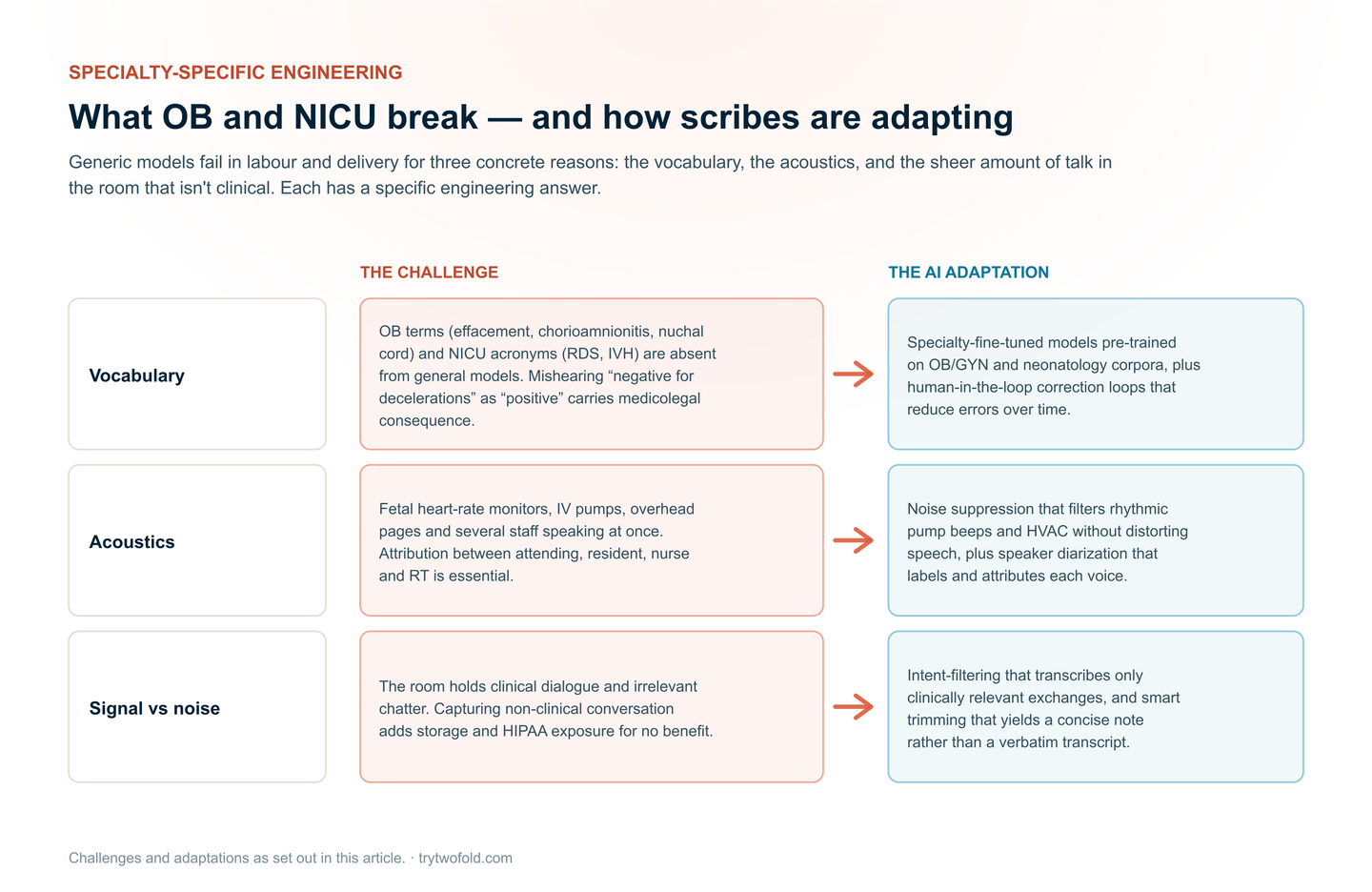
- Specialized Lexicon: OB terms (effacement, chorioamnionitis, nuchal cord) and NICU acronyms (RDS, IVH) are absent from general language models.
- Risk of Misinterpretation: Mishearing "negative for decelerations" as "positive for decelerations" can have significant medicolegal consequences.
The AI Adaptation:
- Specialty-fine-tuned Models: AI is pre-trained on OB/GYN and neonatology corpora (thousands of de-identified notes) to recognize specialty-specific jargon with >95% entity recognition accuracy.
- Continuous Learning Loops: Human-in-the-loop review feeds corrections back into the model, progressively reducing errors over time.
Handling the "Ambient" Audio in Labor and Delivery
The Noisy Environment
- Acoustics: Fetal heart rate monitors, IV pumps, overhead pages, and multiple staff speaking simultaneously create a dense audio landscape.
- Cross-talk Confusion: Distinguishing the attending physician from the resident, nurse, and respiratory therapist is essential for accurate attribution.
The AI Adaptation:
- Advanced Noise Suppression: AI-driven algorithms filter out rhythmic pump beeps and ambient HVAC noise without distorting speech clarity.
- Speaker Diarization: The system labels each speaker (Dr. Montgomery, Nurse Smith, Patient) and structures the note accordingly, ensuring accurate attribution of clinical decisions
Conversation Capture
- Signal vs. Noise: The room contains both clinical dialogue and irrelevant chatter (e.g., scheduling discussions, personal anecdotes).
- Privacy Risk: Capturing non-clinical conversations creates unnecessary data storage and HIPAA exposure.
The AI Adaptation:
- Intent-filtering Algorithms: The AI is trained to transcribe only clinically relevant exchanges, patient history, exam findings, and treatment discussions, while suppressing side conversations.
- Smart Trimming: The final draft excludes irrelevant phrases, producing a concise, clinically actionable note rather than a verbatim transcript.
Critical Risks and Mitigation Strategies
The following factors need to be considered before using an AI tool for OB/neonatal documentation.
The "Hallucination" Risk
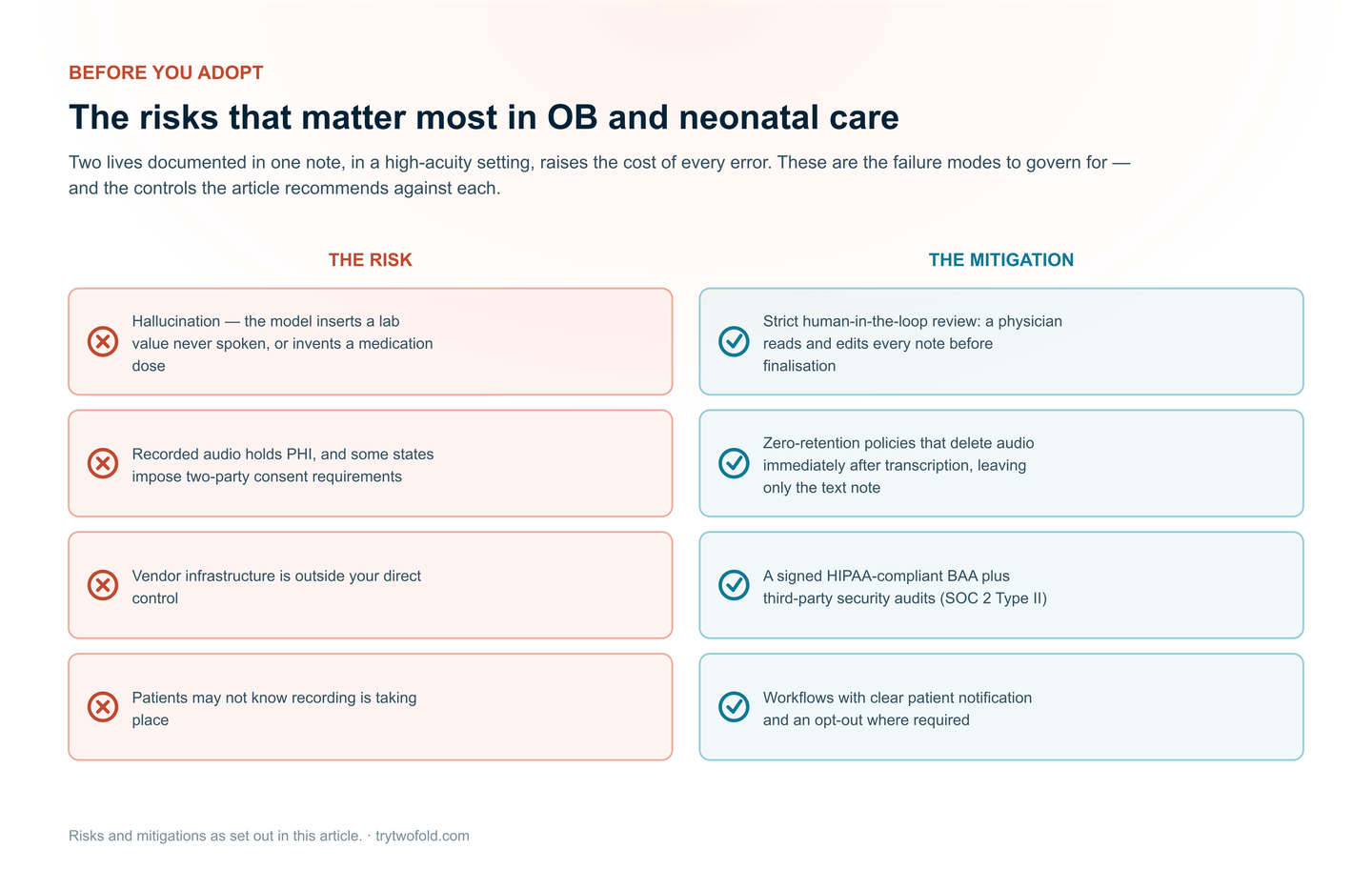
- The Problem: AI occasionally fabricates or 'hallucinates' data, such as inserting a lab value that was never spoken, or inventing a medication dose.
- The Mitigation: Strict human-in-the-loop review; physicians must review and edit every note before finalization.
Privacy, HIPAA, and Audio Storage
- The Problem: Recorded audio contains Protected Health Information (PHI) and, in some states, is subject to two-party consent requirements.
- The Mitigation: Zero-retention policies where audio is deleted immediately after transcription, leaving only the de-identified text note in the EHR.
- Business Associate Agreement (BAA): Always verify the vendor signs a HIPAA-compliant BAA and undergoes third-party security audits (SOC 2 Type II).
- Patient Consent: Ensure workflows include clear patient notification and opt-out options where required.
Conclusion
The unique demands of obstetrics and neonatology require specialized AI medical scribes engineered for clinical complexity. By automating dense data aggregation, capturing nuanced shared decision‑making, and synthesizing NICU notes, these tools reclaim hours for bedside care while reducing cognitive burden. However, adoption demands unwavering vigilance against hallucinations and privacy concerns. When thoughtfully implemented, AI medical scribes amplify clinical judgment rather than replace it.