
AI medical scribes were designed to alleviate the documentation burden that consumes physicians' time. They're fast, efficient, and increasingly becoming more common. However, these systems sometimes generate content that sounds clinically true but is entirely fabricated, a phenomenon known as an AI hallucination. This causes notes to include invented diagnoses, exams that never happened, and medications documented for the wrong patient. It's a risk with serious consequences for patient safety and trust. Explore the nature of AI hallucinations and how to prevent them from disrupting your workflow.
What Are AI Hallucinations in Medical Documentation?
In the context of AI medical scribes, a "hallucination" is the generation of fabricated content that sounds grammatically coherent and medically plausible, yet has absolutely zero basis in the actual patient‑provider conversation. They are structured clinical statements designed to look legitimate, which makes them uniquely dangerous in a healthcare setting.
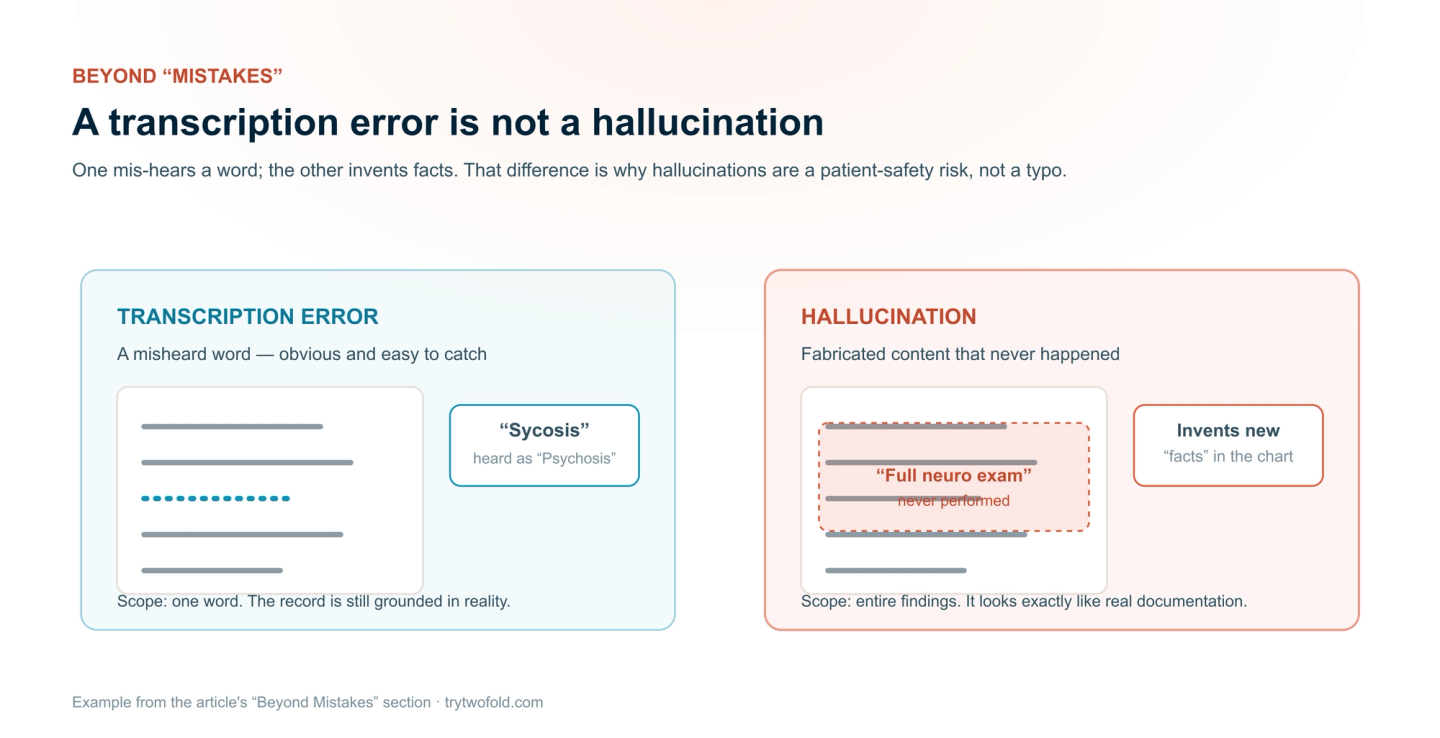
Beyond "Mistakes"
To understand the severity, we must distinguish between standard transcription errors and hallucinations:
- Transcription Error: The AI mishears "Sycosis" as "Psychosis", which is a clear, easily identifiable mistake.
- Hallucination: The AI documents a full neurological exam that the clinician never performed or ordered, simply because the model decided the note "needed" that information to appear complete.
A hallucination inserts entirely new "facts" into the medical record. It invents physical exams, fabricates family histories, or manufactures symptom profiles. Because these entries look exactly like legitimate clinical data, they are difficult to catch during a rushed chart review, yet they become a permanent, legally binding part of the patient's health record.
How Hallucinations Happen
AI medical scribes are powered by Large Language Models (LLMs), advanced statistical prediction engines that operate on pattern recognition rather than clinical understanding. They do not "know" medicine; they predict the next most likely word in a sequence based on vast training data. This mechanism creates three primary pathways to hallucinations:
Misinterpreting Context (Casual vs. Clinical)
The model often struggles to differentiate between casual social conversation and clinical symptoms. For example, if a patient casually mentions, "We've been exhausted with the kids lately," the AI might statistically predict that "fatigue" and "increased stress" are clinically relevant terms to document in the chief complaint, transforming an offhand remark into a documented diagnosis.
Filling in the Gaps (Plausible Completion)
When the conversation lacks specific clinical details, such as a physical exam or a review of systems, the model may "fill in the blanks" with the most statistically common findings from similar cases. It generates a perfectly worded, entirely fabricated exam just to make the note feel structurally complete.
Overgeneralizing from Imprecise Speech
If a patient speaks with a heavy accent, uses unusual phrasing, or has a speech impairment, the model's pattern‑matching falters. It defaults to the most "statistically probable" medical text, effectively guessing at content rather than accurately transcribing it.
The Risks: Why Hallucinations Matter
When hallucinations enter a patient's permanent medical record, the ripple effects can compromise safety, expose clinicians to liability, and deepen existing healthcare disparities.
Patient Safety
A hallucinated finding can influence future clinical decisions.
Clinical Risks for Patients
- Medication Errors: AI-documented allergies, dosages, or prescriptions that never occurred can lead to adverse drug events or dangerous drug interactions.
- Missing or Altered Symptoms: When the AI invents symptoms the patient never reported, it can distract clinicians from the actual presenting problem, delaying accurate diagnosis.
- False Reassurance: A normal-looking AI-generated review of systems may create a false sense of security, causing clinicians to overlook serious indicators.
Legal and Professional Risks
Beyond patient safety, hallucinations create legal issues for clinicians. The medical record is a legal document, and the clinician who signs it bears full accountability for every word, regardless of whether an AI generated it.
- Misrepresentation of Care: A fabricated exam or diagnosis suggests the clinician performed assessments they never conducted, potentially constituting fraud or negligence in a malpractice lawsuit.
- Loss of Trust: When patients discover inaccuracies in their charts, it damages the clinician-patient relationship and undermines confidence in the entire care team.
Accuracy Disparities
Hallucinations don't affect all patients the same. This is due to biased datasets that reflect specific demographics, and their performance degrades significantly with speech and speaker variability.
- Accent and Dialect Bias: Patients with non-standard accents or regional dialects are more likely to trigger prediction errors, as the model defaults to statistically "common" medical text rather than accurate transcription.
- Speech Impairments: Patients with dysarthria, aphasia, or other speech disorders may face higher hallucination rates.
- Demographic Disparities: Bias in training data can result in poorer documentation quality for minority patients, intensifying existing healthcare inequities.
How to Mitigate Hallucinations
A multi‑layered approach can significantly reduce risks, with safety as the priority.
Best Practices for Clinicians
The clinician carries all the responsibility, and adopting disciplined workflows is essential to catching hallucinations before they enter the permanent record.
Clinician Action Steps
- Treat Every AI Output as a First Draft: Never sign a note without line-by-line review.
- Review the Previous Note: Always compare the new AI-generated note against the prior encounter. Sudden, unexplained changes in diagnoses, medications, or exam findings are red flags for potential hallucinations.
- Obtain Informed Patient Consent: Patients have the right to know that AI is being used in their care. Explain what the technology does, its limitations, and give them the option to opt out.
- Supplement AI with Your Own Clinical Judgment: Add your own observations and impressions manually. AI cannot see nonverbal cues like facial expressions, physical distress, or subtle clinical signs that inform accurate documentation.
- Flag and Report Errors: When you catch a hallucination, report it to your institution and the AI vendor. Feedback loops are critical for improving system performance.
Conclusion
AI scribes promise a future free from documentation burden. But that future must be built on accuracy, not convenience. Hallucinations remind us that AI tools don't understand medicine; they only predict words and work to enhance the workflow for the clinician. With disciplined clinician review, AI can be a powerful tool. But the final precautionary measure against hallucinations is the clinician who reads, verifies, and owns every word they sign.