


As ambient AI medical scribes become more normalized in clinical settings, beneath this efficiency lies a pressing concern: are we digitizing historical healthcare disparities into patient records? Research shows these systems exhibit significant performance disparities across racial and linguistic groups. This research article investigates how an AI medical scribe can inadvertently pick up and amplify clinician bias, leading to misdiagnoses, omitted data, and loss of patient trust.
What Is Algorithmic Bias in Healthcare AI?
Algorithmic bias in healthcare AI occurs when the system produces systematically unfair or inaccurate outcomes for certain groups of people. For AI medical scribes, this bias manifests in the clinical notes they generate.
Unlike human error, which is typically variable, algorithmic bias is systematic and consistently applied. When an AI scribe underperforms for a certain demographic, it does so for every single patient in that group. This transforms isolated human biases into systemic inequalities embedded in the documentation process.
The Three Sources of Bias
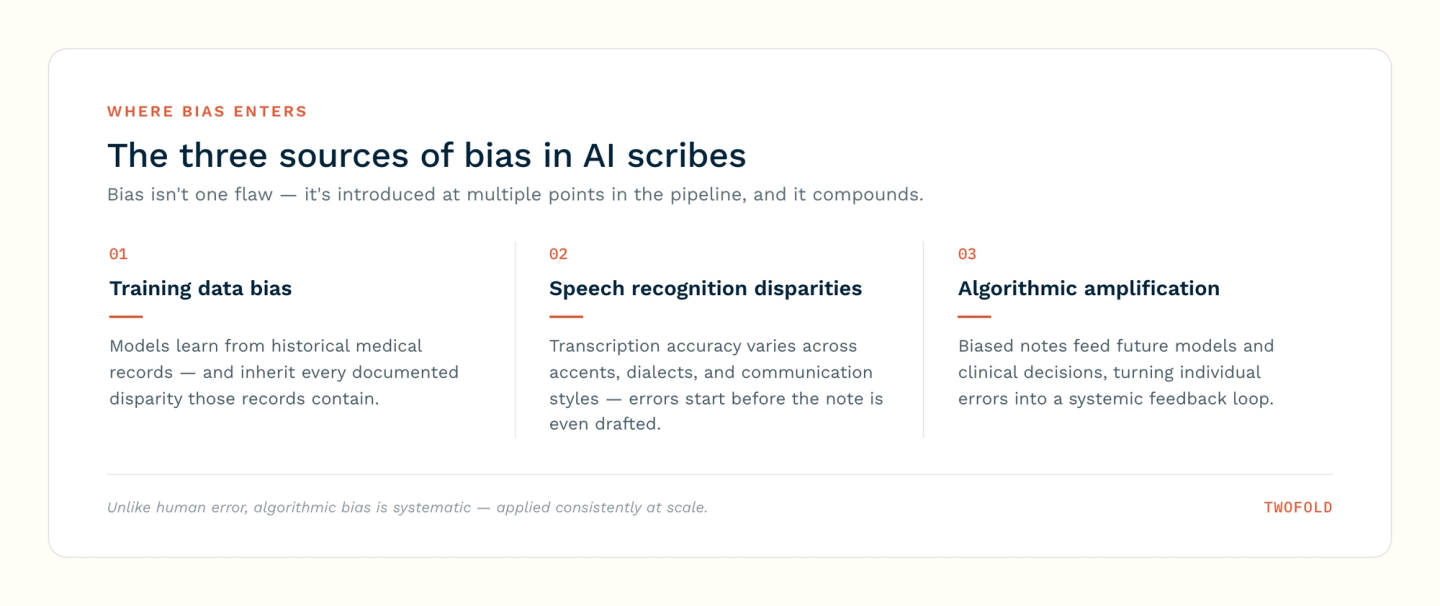
Bias in AI medical scribes does not stem from a single source. It is introduced at multiple points across the AI lifecycle, from initial development through real‑world implementation.
1. Training Data Bias
AI scribes are powered by large language models trained on vast corpora of medical records and other text data. The quality and representativeness of this training data directly determine the system's performance. Without transparency about what data these models are learning from, it is impossible to assess whether they will perform equitably across diverse patient populations. When historical healthcare disparities are encoded into medical records, and those records are used to train AI, the technology learns and perpetuates those very disparities.
2. Speech Recognition Disparities
Before an AI medical scribe can summarize a clinical conversation, it must first transcribe what was said. The Automatic Speech Recognition (ASR) systems that power this transcription are not equally accurate for all speakers.
A 2025 study published in npj Digital Medicine noted that the speech recognition systems AI scribes use are less accurate in transcribing Black patients' speech compared to white patients.
This issue, however, extends beyond race. Accents, dialects, and cultural communication styles can challenge even the best‑trained models. Patients with non‑standard English accents, speech impairments, or dialects face higher risks of transcription errors.
3. Algorithmic Amplification
Even when individual clinician biases are not present, AI systems can amplify them through algorithmic processes.
- How Amplification Works: While clinician bias does not replicate uniformly across a healthcare system, algorithmic bias is consistently applied to every patient interaction. A biased model will produce biased outputs for every patient in the affected group, not just those seen by biased clinicians.
Beyond Race: The Full Spectrum of Bias
While racial disparities in speech recognition are important to note, bias in AI scribes affects multiple dimensions of patient identity.
- Gender Bias: Research has found that AI models across the healthcare sector can downplay symptoms of women and ethnic minorities, reinforcing patterns of under-treatment that already exist across different groups.
- Linguistic Bias: As mentioned above, patients with non-English accents, speech disorders, or diverse dialects face higher error rates. In multilingual settings, AI scribes trained on English-language data are not equipped to function properly and accurately.
- Geographic and Cultural Bias: A 2026 study addresses the issue that models trained on data from high-income countries may not translate to low- and middle-income countries (LMICs), where diagnostic norms, health record formats, and clinical communication vary. This creates a risk of digital colonialism, where technologies developed in one context are implemented entirely into different systems without the appropriate adaptation.
The Systemic Risk: Why Bias Needs to be Addressed
While understanding the sources of bias is important, the greater concern lies in the systemic risks they create. When biased AI scribes are implemented at scale, they essentially embed inequality into the clinical record.
These are the following consequences:
- Clinical decisions are made based on incomplete or inaccurate documentation.
- Risk profiles are developed using biased data.
- Predictive algorithms trained on these notes inherit and amplify the same biases.
- Health disparities are reinforced rather than reduced.
The Evidence: What the Research Shows
While early evidence shows efficiency gains, a growing body of research reveals concerning patterns of bias, inaccuracy, and unintended clinical consequences.
Racial and Ethnic Disparities in Performance
Perhaps the most troubling evidence comes from studies examining how AI scribe performance varies across patient demographics. The findings are stark and consistent: AI scribes systematically underperform for Black patients and other minority groups.
The aforementioned 2025 study, led by Columbia University researchers, revealed that AI documentation tools used by 30% of physician practices are producing dangerous errors, including fabricated diagnoses and missed symptoms, with significantly higher error rates for Black patients. These AI scribes can hallucinate physical exams that never happened and systematically underperform for patients with limited English proficiency.
Additionally, recent news reflects that the uptake of AI models across the healthcare sector could lead to biased medical decisions, reinforcing patterns of under‑treatment that already exist across different groups in Western societies. AI tools have been found to downplay symptoms of women and ethnic minorities, with bias‑reflecting LLMs leading to inferior medical advice for female, Black, and Asian patients. These disparities highlight the urgent need for more diverse training datasets and improved dialect sensitivity.
The Hallucination Problem
AI scribes have a tendency to generate entirely fabricated content that appears clinically plausible but has no basis in reality.
For example, a recent evaluation of AI‑generated ambient notes found hallucinated content in 31% of AI‑drafted notes, compared with human‑made errors in 20% of notes written by physicians.
Documentation Failure Modes
AI medical scribes utilizing large language models report lower overall error rates but note distinct documentation failure modes, namely:
- AI hallucinations: Content that appears plausible but has no basis in reality.
- Omissions: Clinically significant information that is lost.
- Misattribution: Attributing statements or findings to the wrong patient.
- Contextual Misinterpretations: Misunderstanding the clinical context.
Automation Bias
The risks of AI medical scribes extend beyond the accuracy of the notes themselves to how clinicians interact with and are influenced by AI‑generated content.
Automation bias is essentially when a physician may be inclined to blindly adopt system recommendations or be disproportionately influenced by the presence of AI predictions, even when they are inaccurate. This means that even when clinicians review AI-generated notes, they may unconsciously accept incorrect information because the AI's suggestion creates this 'cognitive anchor' that influences their clinical reasoning.
How This Perpetuates Reduced Clinical Reasoning
A 2026 JAMA Psychiatry study examining more than 20,000 annual checkups found that AI scribes documented neuropsychiatric symptoms more often than human scribes. On average, clinicians using AI scribes were less likely to provide a depression diagnosis or intervention, and visits that incorporated an ambient AI scribe were associated with lower rates of depression diagnoses, behavioral health care referrals, and SSRI prescriptions.
The researchers noted that 'this increased documentation did not translate to increased attention to depressive symptoms' and added 'automating documentation leads clinicians to be less active in general, analogous to reduced proficiency observed in pilots after the emergence of autopilot'.
The Counterpoint: AI Scribes Can Outperform Humans
It is important to acknowledge that not all evidence points to AI inferiority. A 2026 comparative study found that AI‑generated notes outperformed human documentation across multiple quality domains. Top AI scribes scored higher than humans in thoroughness, accuracy, and freedom from bias.
The finding that AI scribes can outperform human documentation in controlled settings does not negate the evidence of bias in real‑world implementation. It suggests that with proper design, oversight, and customization, AI medical scribes have the potential to improve documentation quality, but only if the risks of bias are actively addressed.
Learn more about AI medical scribes' impact in 2026.
The Consequences: How Bias Affects Patient Care
The documented biases in AI medical scribes translate into real‑world harm for patients, clinicians, and healthcare systems. When flawed documentation enters the medical record, the consequences ripple across every aspect of care.
Compromised Patient Safety
Inaccurate clinical documentation endangers patients.
Misdiagnosis and Delayed Treatment
When AI scribes fabricate physical exams, miss critical symptoms, or misattribute findings, clinicians make decisions based on incomplete or incorrect information.
These errors can lead to:
- Inappropriate medication prescriptions that could lead to harmful interactions with the patient's existing prescriptions.
- Missed warning signs of serious conditions.
- Unnecessary procedures or tests..
- Failure to escalate care when needed.
Reinforcing Health Inequities
AI scribes not only reflect existing disparities, but they also amplify them.
- Encoding Historical Bias: By learning from medical records that contain decades of healthcare disparities, AI models perpetuate and often amplify these biases.
- This creates a feedback loop: biased notes inform future clinical decisions, which generate more biased records, which train the next generation of AI systems.
- The Under-Treatment Effect: Bias-reflecting AI models have been shown to produce inferior medical advice for minorities, reinforcing patterns such as:
- Women's health symptoms are more likely to be downplayed.
- Pain in minority patients is more likely to be undertreated.
- Certain populations receive lower-quality care recommendations.
Loss of Patient Trust
Trust is the foundation of the patient‑clinician relationship, and biased AI documentation undermines it.
- Discovery of Errors: When patients read their clinical notes and find inaccurate or biased characterizations, trust is lost.
- The Consent Question: Even relatively simple AI scribes can raise important questions around consent. Patients may not be informed that an AI is listening to their conversation, documenting their symptoms, and generating a permanent medical record. When they discover this, particularly if the resulting notes contain errors, they may feel deceived, disrespected, or harmed.
The consequences of biased AI scribes represent a systemic threat to patient safety, health equity, documentation integrity, clinical reasoning, and patient trust. As adoption accelerates, healthcare organizations must recognize that the question is not whether bias will affect their patients, but which patients will be affected and to what degree.
The research is clear: unchecked, biased AI medical scribes will amplify healthcare disparities. Addressing these consequences requires intentional effort, oversight, and a commitment to equity at every stage of the AI lifecycle.
What Can Be Done: Strategies for Mitigating Bias
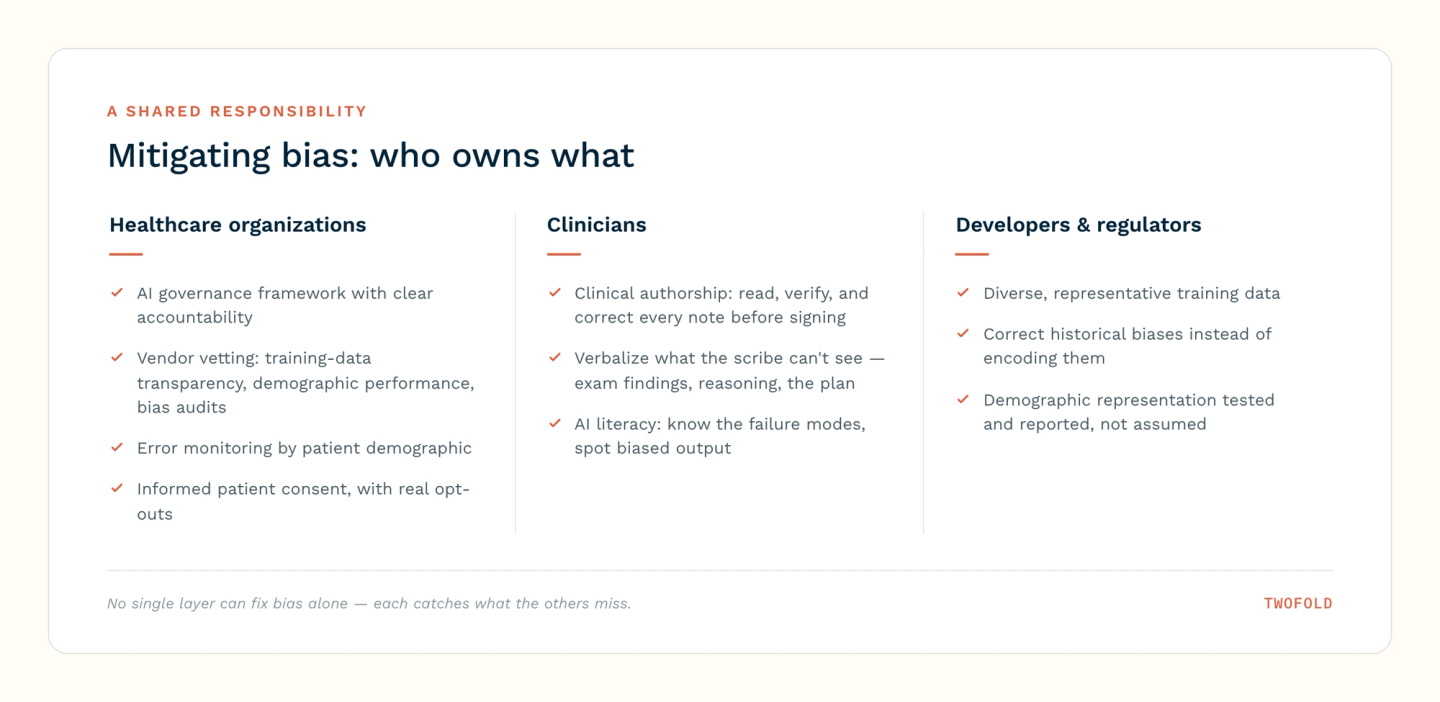
Addressing bias in AI medical scribes requires a multi‑layered approach that engages healthcare organizations, clinicians, AI developers, and regulators.
The strategies below recognize that mitigating bias is a shared responsibility across the AI lifecycle.
For Healthcare Organizations: Governance, Procurement, and Monitoring
Healthcare organizations' decisions about which vendors to select, how to implement the technology, and what oversight mechanisms to put in place determine whether AI scribes intensify or reduce disparities.
1. Establish an AI Governance Framework
Before implementing any AI scribe, organizations must have comprehensive AI governance and accountability frameworks in place.
Key Elements of an Effective Governance Framework:
- A dedicated AI governance committee with representation from clinical, legal, privacy, IT, and ethics domains.
- Integration with existing governance structures.
- Clear accountability for AI scribe performance, with designated individuals responsible for monitoring and escalation.
- Policies for access and correction of AI-generated records, allowing patients to review and request corrections.
2. Conduct Vendor Evaluation
Organizations must conduct comprehensive, evidence‑based vendor assessments.
What To Demand From Vendors:
- Transparency about training data.
- Demographic performance data.
- Bias audit results.
- Error rates and correction protocols.
- Data privacy and consent protocols.
3. Implement Continuous Monitoring and Auditing
AI scribes should undergo ongoing monitoring for performance, bias and safety concerns, and have the ability to be deactivated if harmful outputs are detected.
Monitoring Best Practices:
- Track Error Rates By Patient Demographic: This requires collecting and analyzing data on patient race, ethnicity, language, and other relevant characteristics.
- Regular Audits: Conduct periodic independent audits of AI scribe outputs.
- Feedback Loops: Create spaces for clinicians to report biased or inaccurate outputs. These reports should be reviewed and acted upon.
- Continuous Improvement: When bias is detected, systems should be retrained or adjusted.
4. Ensure Informed Patient Consent
Patients have a right to know when AI is being used in their care.
Consent Requirements:
- Explain the AI Scribe's Purpose: Patients should understand why the AI is being used and how it works.
- Disclose Data Use: Patients must be informed about how their data will be used, stored, and whether it will be used for AI training.
- Document Consent: Whether given orally or in writing, it must be documented.
- Respect Opt-Out Decisions: Patients who choose to opt out must be respected.
- Provide Ongoing Transparency: Organizations should maintain clear communication about system limitations and provide knowledgeable contacts for questions.
For Clinicians: Vigilance, Authorship, and Active Engagement
While AI scribes can reduce documentation burden, they cannot replace clinical judgment.
1. Maintain Clinical Authorship
Every AI‑generated note must be properly reviewed, edited, and signed by a clinician.
Best Practices for Note Review:
- Read every note before signing.
- Verify critical information.
- Correct errors immediately.
- Look for signs of bias.
- Document your review.
2. Verbalize Everything
AI scribes can only document what they hear. Clinicians can improve accuracy by explicitly verbalizing their observations and thought processes.
What to Verbalize:
- Nonverbal Observations: If you notice a patient appears anxious, in pain, or distressed, say it aloud.
- Physical Exam Findings: Describe what you find during the physical examination rather than relying on the AI to infer it.
- Clinical Reasoning: Verbalize your differential diagnosis, clinical impressions, and decision-making process.
- The Plan: Summarize the care plan aloud to improve both the scribe's documentation and the patient's understanding.
3. Engage in AI Literacy and Training
AI literacy and safe use should become an educational obligation.
Clinician Education Should Cover:
- How AI scribes work: their capabilities and limitations.
- Documentation failure modes such as hallucinations, omissions, and bias.
- How to identify and correct biased or inaccurate outputs.
- The importance of informed consent and patient communication.
- Legal and ethical responsibilities when using AI tools.
Empowering clinicians through continuing education and leadership in model development, implementation, and auditing is important for ensuring safe and equitable integration.
For Developers and Regulators: Design, Standards, and Oversight
Developers and regulators bear primary responsibility for ensuring that AI scribes are safe, fair, and transparent.
Improve Training Data Diversity
Bias in AI scribes often originates in biased or unrepresentative training data. Developers must take intentional steps to address this.
Training Data Best Practices:
- Include Diverse Voices: Training data must include speakers with varied accents, dialects, and linguistic backgrounds.
- Address Historical Biases: Medical records used for training reflect decades of healthcare disparities. Developers must actively correct for these biases rather than perpetuate them.
- Ensure Demographic Representation: Training data should include adequate representation across race, ethnicity, gender, age, and socioeconomic status.
Conclusion
AI medical scribes, while transformative, carry documented risks of bias that threaten patient safety and health equity. From systematic performance disparities across racial and linguistic groups to clinically significant hallucinations and reduced clinician engagement, these tools reflect and amplify the biases embedded in their training data and design. The solution is ongoing vigilance. Healthcare organizations must implement governance frameworks; clinicians must maintain active authorship and oversight, and developers must prioritize diverse training data and transparency.
Equity must be foundational to how we develop, implement, and monitor AI medical scribes. Only then can these powerful tools fulfill their promise of reducing documentation burden while advancing equitable care for all patients.