



In palliative care, every conversation carries profound weight. Discussions about goals of care, symptom management, advance directives, and what matters most at the end of life demand a clinician's full presence, empathy, and undivided attention. Enter AI medical scribes, intelligent tools that listen passively and generate clinical notes automatically. Learn how AI scribes help restore what matters most: the clinician's presence during life's most sensitive conversations.
What Are AI Scribes and How Do They Work in Palliative Care?
Ambient AI scribes are artificial intelligence tools that use Large Language Models (LLMs) and Natural Language Processing (NLP) to passively listen to clinical conversations and automatically generate structured medical documentation.
Unlike traditional dictation, these systems operate in the background:
- Real-time transcription of complex, multi-party goals-of-care discussions.
- Automatic note generation (progress notes, consultation letters) within minutes.
- Specialty-specific templates tailored for palliative medicine workflows.
- Seamless EHR integration to reduce manual data entry
Why Palliative Care Presents Unique Documentation Challenges
Palliative documentation goes far beyond capturing vitals or lab results. It must encapsulate the emotional, psychosocial, and ethical dimensions of end‑of‑life care. Key challenges include:
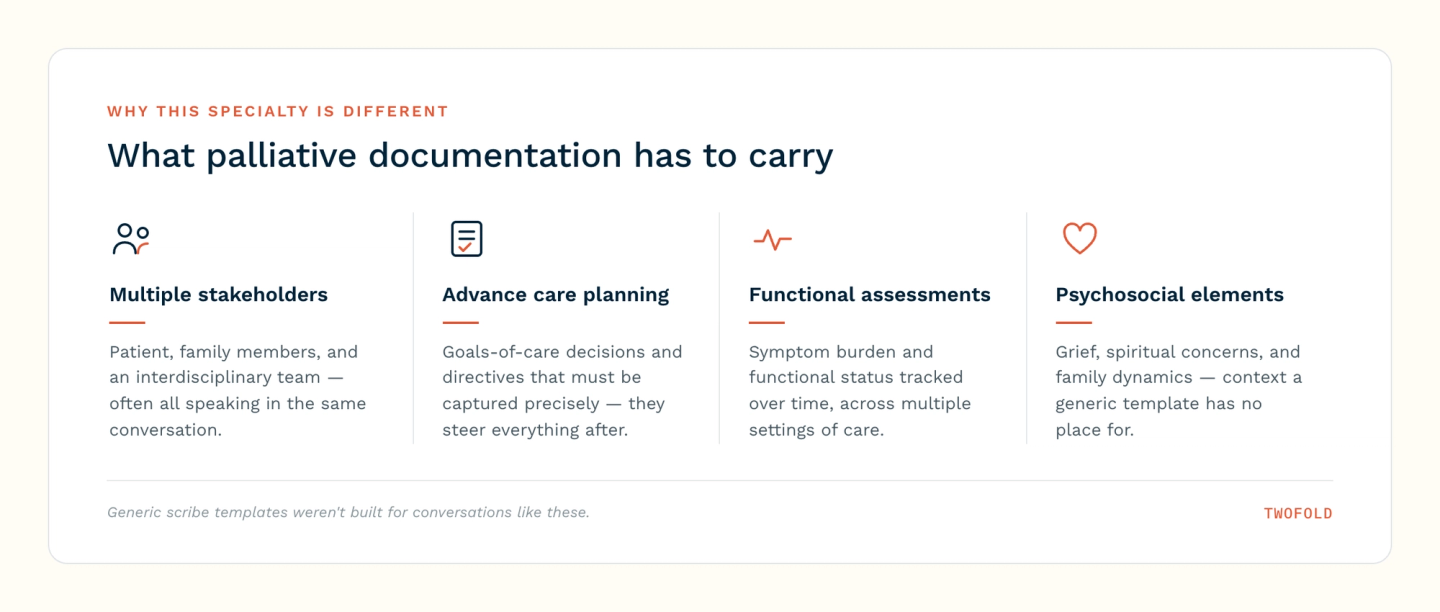
- Multiple Stakeholders: Conversations often involve patients, families, and interdisciplinary teams simultaneously.
- Advance Care Planning: Precise documentation of patient values, preferences, and surrogate decision-makers is legally and ethically critical.
- Functional Assessments: Accurate recording of tools like the Palliative Performance Scale (PPS) and symptom burden scores.
- Psychosocial Elements: Capturing spiritual concerns, caregiver strain, and social determinants of health (SDOH) that influence care decisions.
These complexities make generic scribe solutions inadequate, driving the need for AI specifically adapted to palliative medicine's unique linguistic and clinical nuances.
Benefits of AI Medical Scribes in End-of-Life Care
The most profound benefit of AI medical scribes is what they remove; the barrier between clinician and patient. By automating documentation, clinicians can:
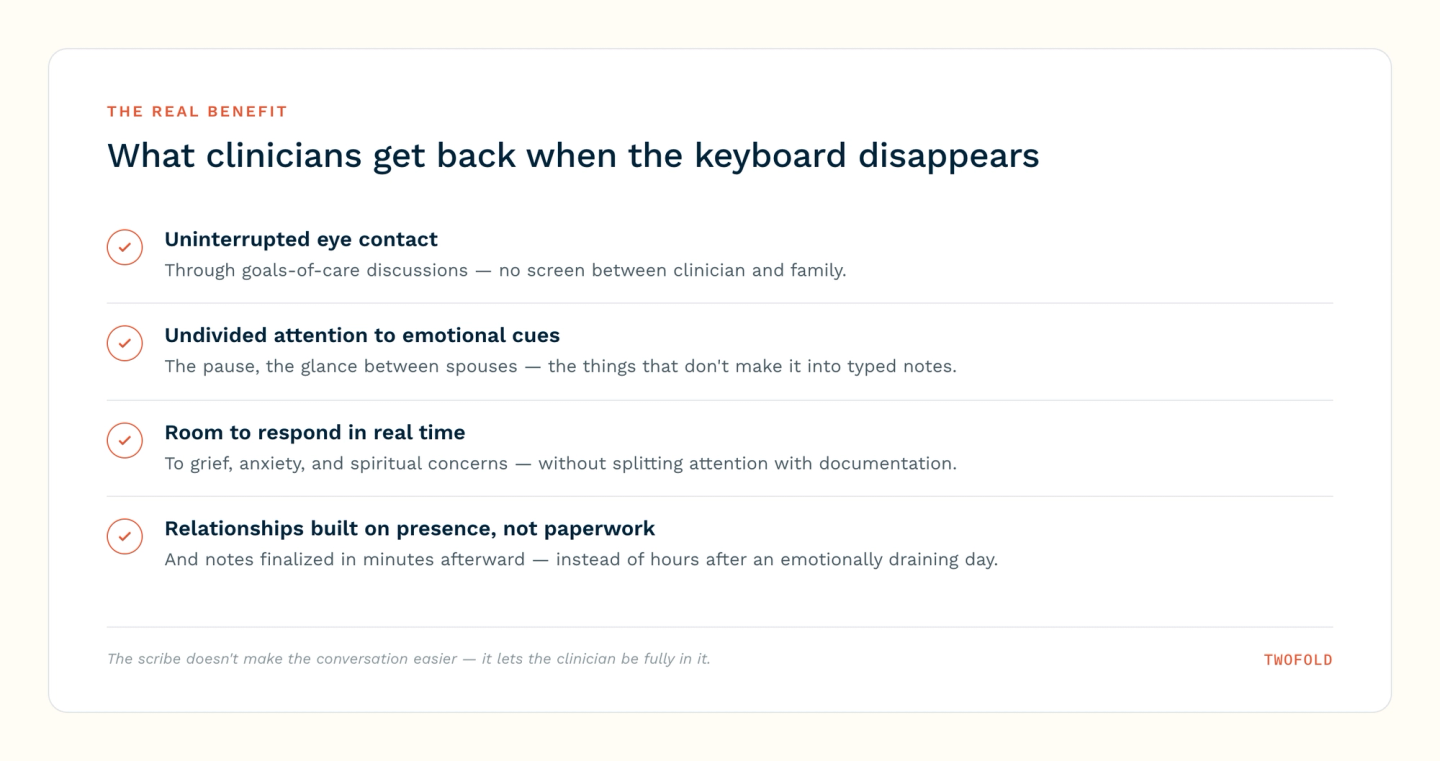
- Maintain uninterrupted eye contact during sensitive goals-of-care discussions.
- Give undivided attention to emotional cues from patients and families.
- Respond in real-time to grief, anxiety, and spiritual concerns without the distraction of typing.
- Nurture deeper therapeutic relationships built on presence, not paperwork.
Reducing Clinician Burnout
Documentation burden is a primary driver of burnout in every specialty. AI scribes directly address palliative care burnout by:
- Cutting after-hours "pajama time" spent catching up on charts.
- Lowering cognitive load and mental fatigue after emotionally draining consultations.
- Enabling clinicians to finalize notes in seconds, not hours.
- Creating space for self-care and reflection between difficult conversations.
Improving Documentation Quality and Consistency
AI scribes enhance clinical record‑keeping by:
- Generating timely, comprehensive notes immediately after consultations.
- Ensuring consistent capture of advance care planning discussions and patient values.
- Reducing omissions in complex, multi-symptom documentation.
- Supporting standardized templates aligned with palliative care best practices.
- Creating audit-ready records for regulatory and reimbursement purposes.
Enhancing Team Efficiency and Access
Beyond individual clinicians, AI scribes benefit the broader care ecosystem:
- Interdisciplinary teams receive clearer, more complete documentation.
- Handover quality improves between shifts and care settings.
- Administrative time is reduced, potentially allowing one additional patient visit per day.
- Remote and home-based palliative care becomes more sustainable with streamlined workflows.
Challenges and Ethical Considerations
The table below outlines the primary concerns and their potential mitigations clinicians should consider before implementing AI:
Challenge | Risk | Mitigation Strategy |
|---|---|---|
AI "Hallucinations" | Fabricated symptoms or diagnoses could compromise patient safety | Mandatory clinician review; clinician remains legally responsible for final note |
Content Omissions | Critical elements such as advance directives, psychosocial distress, and spiritual concerns may be missed | Specialty-specific AI training; structured palliative care templates |
Privacy & Consent | Unauthorized recording; patients may not understand AI's role | Explicit informed consent; clear opt-out options; data encryption |
Trust & Adoption | Clinicians may distrust AI accuracy or find it frustrating | Ongoing training; feedback loops; emphasizing AI as a tool, not replacement |
Legal Liability | Unclear responsibility when AI-generated errors occur | Updated liability frameworks; clear institutional policies |
Conclusion
AI medical scribes will not replace palliative clinicians, but they can restore what matters most: their presence with patients. By automating documentation, these tools free clinicians to focus on the human connection at the heart of end‑of‑life care. While challenges around accuracy, privacy, and trust remain, thoughtful implementation can mitigate these risks. As adoption expands, AI medical scribes promise to transform palliative care documentation, allowing clinicians to spend less time on paperwork and more time providing comfort and compassionate care.