


We compared the top AI medical scribes for 2026 on draft speed, note accuracy, EHR integration, compliance, and price. Twofold ranks first overall for independent practices, outpatient clinics, and self‑serve clinicians — fast, structured, EHR‑ready notes with transparent pricing and a BAA on every plan. Freed follows for flat‑fee simplicity, Doximity Scribe is the strongest genuinely free option for verified US clinicians, and Heidi pairs a free tier with a flexible template builder, while Abridge and Nuance DAX Copilot lead enterprise Epic deployments.
That said, the best AI medical scribe depends on your setting. Large enterprise systems often care more about Epic embedding, governance, and roll‑out support, which is where Abridge and Nuance DAX Copilot tend to fit better, and DeepScribe leans furthest into specialty depth. Smaller clinics prioritise setup speed, affordability, and editing time, which is why Freed, Doximity, and Heidi appear so often in today's search results. See also our best AI scribe tools roundup and ambient AI for medical practices.
How We Ranked the Best AI Medical Scribes
The pages surfacing today are all converging on the same evaluation logic: note quality, editing time, setup speed, EHR compatibility, support, pricing clarity, and best fit by organization size. Freed explicitly uses note quality, ease of use, EHR compatibility, support, pricing, and best fit; DeepScribe emphasizes specialty depth, EHR integration, context awareness, customization, coding, deployment, and compliance. That is the right frame for this query.
For clinicians, the core question is simple: which tool creates the most usable note with the least friction? That matters more than flashy demos, raw transcript quality, or feature bloat.
What to Look for in an AI Medical Scribe
Before choosing a tool, focus on five things:
1. Note quality and edit time
A fast draft is only helpful if it needs very little cleanup afterward. Current ranking pages repeatedly emphasize chart‑ready documentation over pure transcription.
2. EHR reality
Some clinicians need deep Epic or athenahealth integration. Others are perfectly fine with copy‑paste into any EHR if the note quality is high enough. The live SERP currently includes both types of products.
3. Specialty fit
General‑purpose medical scribes are not always the best fit for every specialty. DeepScribe leans into specialty depth, while DAX and Abridge lean into enterprise workflow and embedded deployment.
4. Pricing clarity
Independent practices care a lot about whether pricing is transparent and whether a tool can be tested without a long enterprise process. That is one reason self‑serve and flat‑fee products keep surfacing in search.
5. Privacy, consent, and workflow trust
As adoption rises, consent and privacy concerns rise too. That makes clarity around recordings, BAAs, and review workflows even more important.
Why you can trust this ranking
Between July 2024 and 2026, we aggregated:
- Peer-reviewed studies (e.g., the JAMA-Network qualitative study on ambient AI scribes)
- independent media reports from Forbes, The Washington Post, and The Wall Street Journal and
- more than 2,600 Reddit and G2 comments across nine clinician sub-reddits. Marketing posts were discarded; only first-hand experiences survived.
Each product below includes at least one verifiable expert or clinician quote you can open in a new tab. Ranking weightings:
Criterion | Weight |
|---|---|
Real-world accuracy & editing time | 30% |
Speed-to-note (seconds) | 20% |
EHR interoperability | 15% |
HIPAA / SOC-2 posture | 15% |
Total cost of ownership | 10% |
User delight (sentiment analysis) | 10% |
Key pain-point: AMA data show doctors still spend ≈ 49 % of the workday on documentation. Reclaiming that time is why "AI medical scribe" queries exploded 600 % YoY on Google Trends.
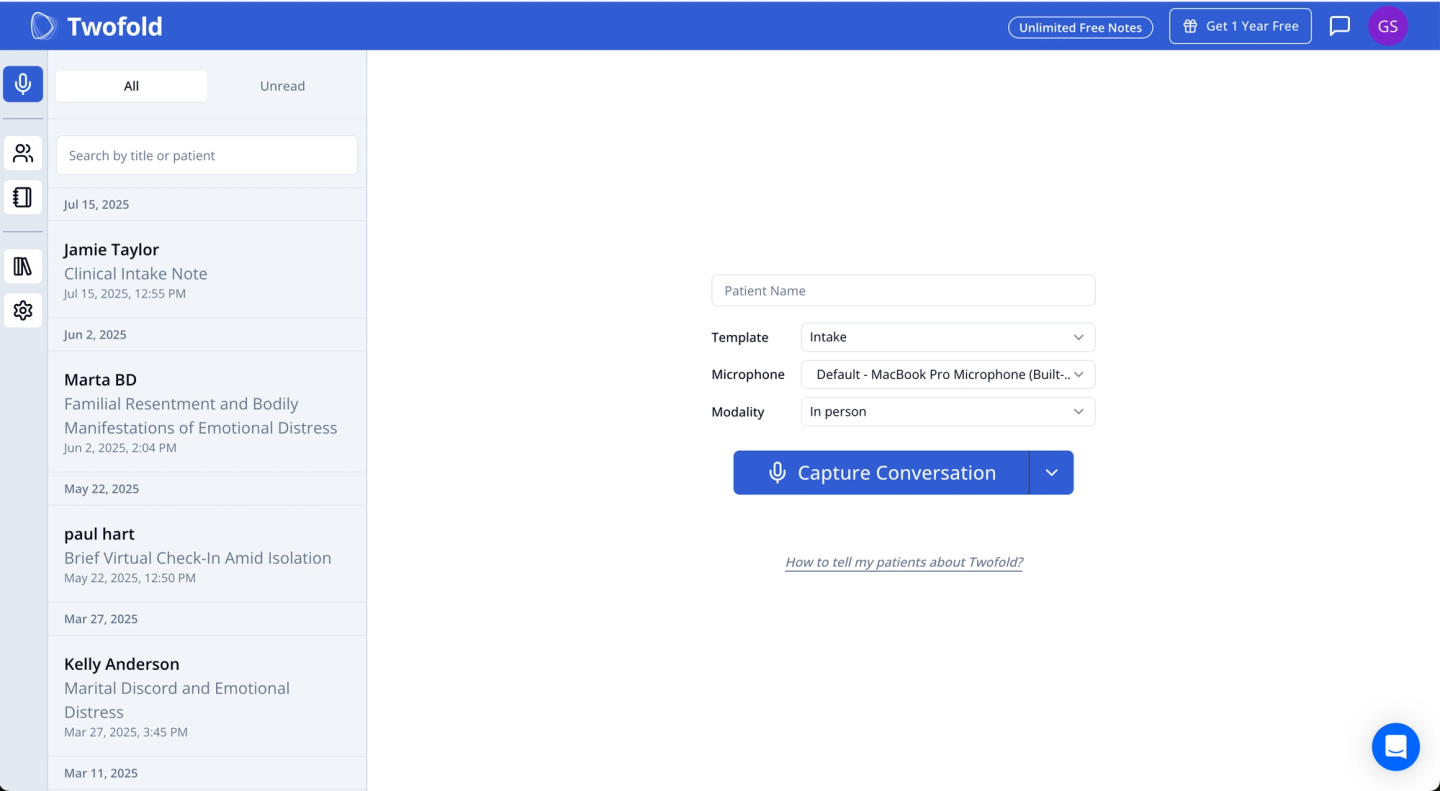
1. Twofold Health — Fastest edit-light drafts for outpatient practices
One Twofold user says:
"We've been using Twofold Health and it's amazing." – u/Proper_Parking_2461
Another Reddit user says that:
"Twofold ... really great. It's affordable and really easy to use." – u/Snoo-9266
A third Twofold user says:
"My vote is TwoFold ... customizable templates, responsive support and cheaper than the rest." – u/foreverandnever2024
Why it's the current best AI medical scribe:
- Speed: < 20 s from encounter end to structured note.
- Customization: Control the structure, styling, and wording of every section of every note.
- Breadth: Ready-made H&P, SOAP, discharge, and behavioral-health templates.
- Privacy: Audio auto-purged post-processing; instant BAA on sign-up.
- Cost clarity: Flat $49/mo (annual) with no per-minute audio fees.
- Customer support: 24/7 support available on all tiers.
Drawbacks
- No option to send the client letter directly to the patient.
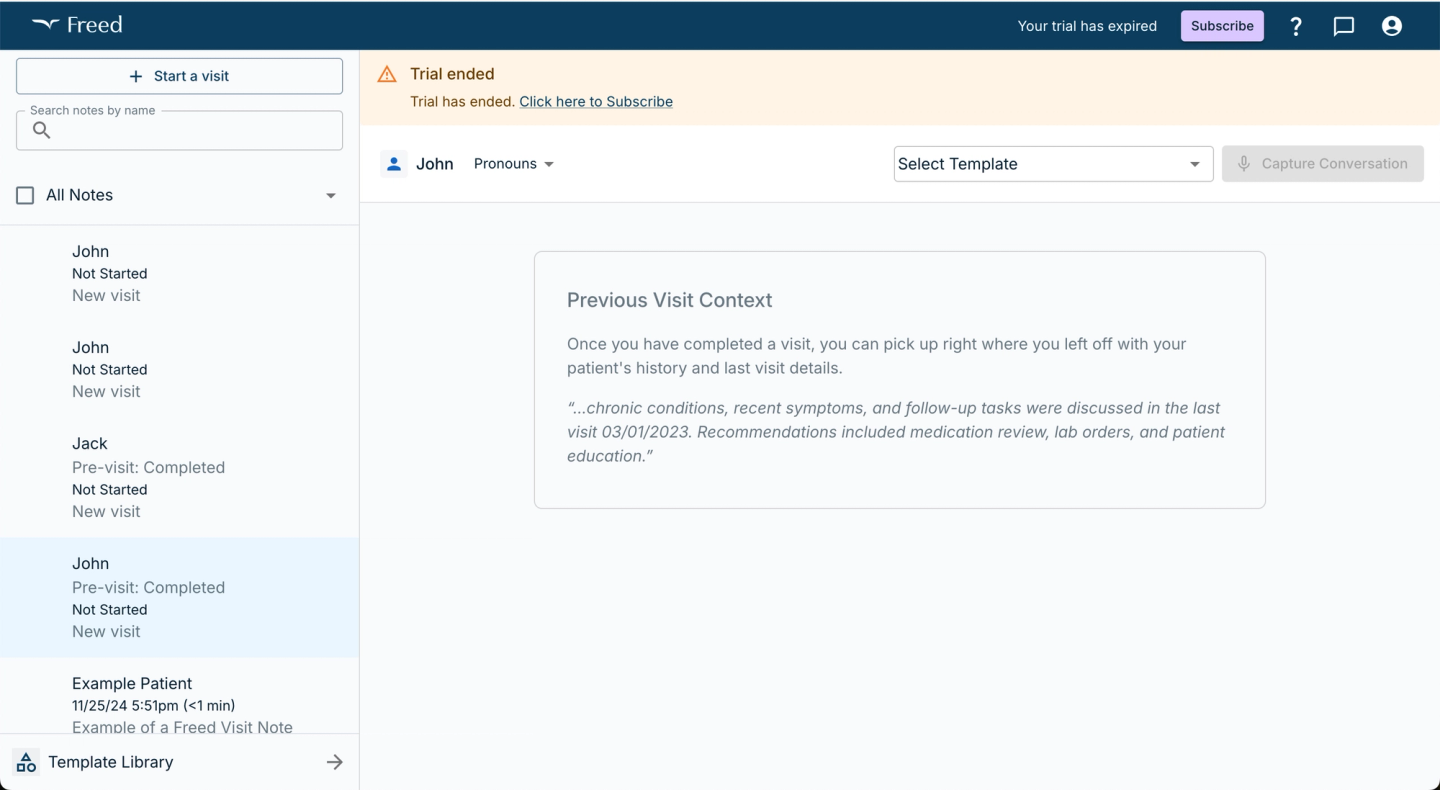
2. Freed AI — Flat-fee simplicity for small practices
- Ranked #2 in an independent Reddit "I tried all the AI scribes" post Reddit.
Pros
- Browser + mobile apps; EHR-agnostic copy-paste
- Zero per-minute costs; strong for small practices
- Skips Mental-Status-Exam if data lacking, lowering hallucinations
Cons
- Free tier minute cap; paid tier still sees peak-hour slow-downs
- Style can drift between notes—proofreading needed
3. Doximity Scribe — The best genuinely free option for verified US clinicians
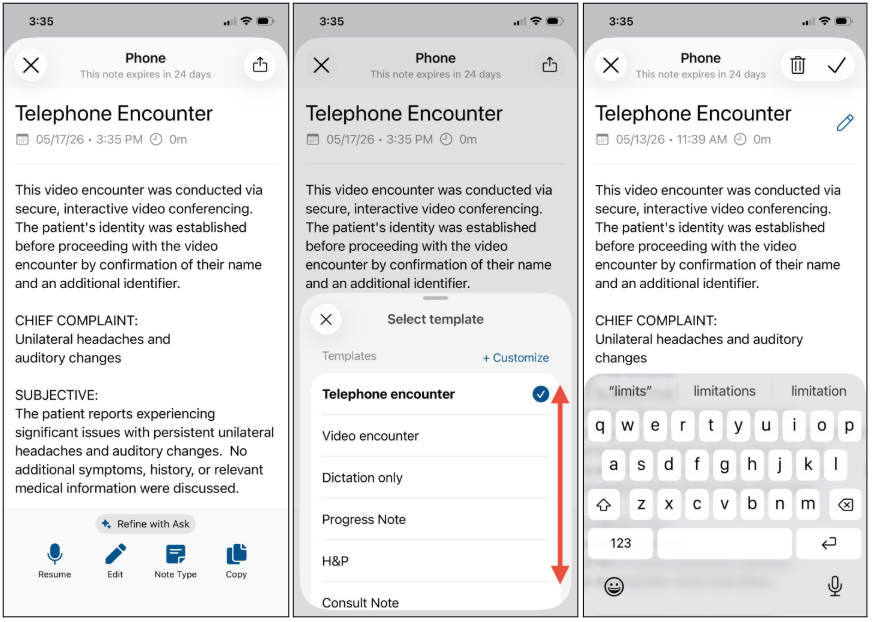
Doximity launched Scribe as a free ambient scribe for verified US clinicians, and it is now the tool most often named first when people ask for a no‑cost option.
Pros
- Genuinely free for verified US physicians, NPs, PAs, and medical students — no subscription and no per-minute fees.
- HIPAA-compliant with a BAA covering all Doximity users; audio is processed in real time and discarded, never retained.
- Works for in-person visits and for telehealth through Doximity Dialer, with no IT project — output copy-pastes into any EHR.
- Produces H&P, progress, consult, and custom note types, and doubles as on-demand dictation on mobile or web.
Cons
- US-only: requires a verified Doximity account, so it is unavailable to international clinicians.
- Copy-paste only — no deep EHR write-back, and no practice-level admin, templates, or team management.
- Recording is capped at 140 minutes, which is tight for long or back-to-back sessions.
- Behavioral-health formats (DAP, BIRP, GIRP) and treatment planning are not the focus.
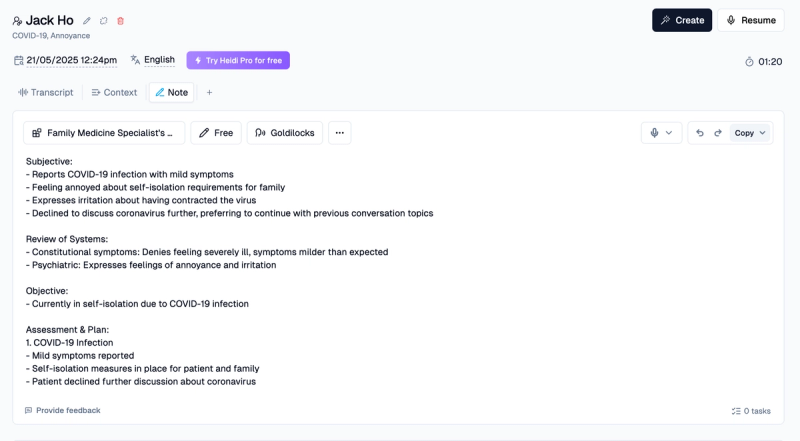
4. Heidi Health — Template-on-demand plus free tier
"Within a few minutes the team built me a custom template that performed flawlessly." — Christopher Rodriguez, FNP
Region-wide evaluation showed 530 hrs/week saved after rollout.
Pros
- Drag-and-drop template builder; learns clinician phrasing
- Free-forever plan for low-volume users
- Reported 530 hrs/week saved in region-wide rollout
Cons
- Web interface heavy on low-spec PCs
- Exports plain text only; needs manual formatting for PDFs
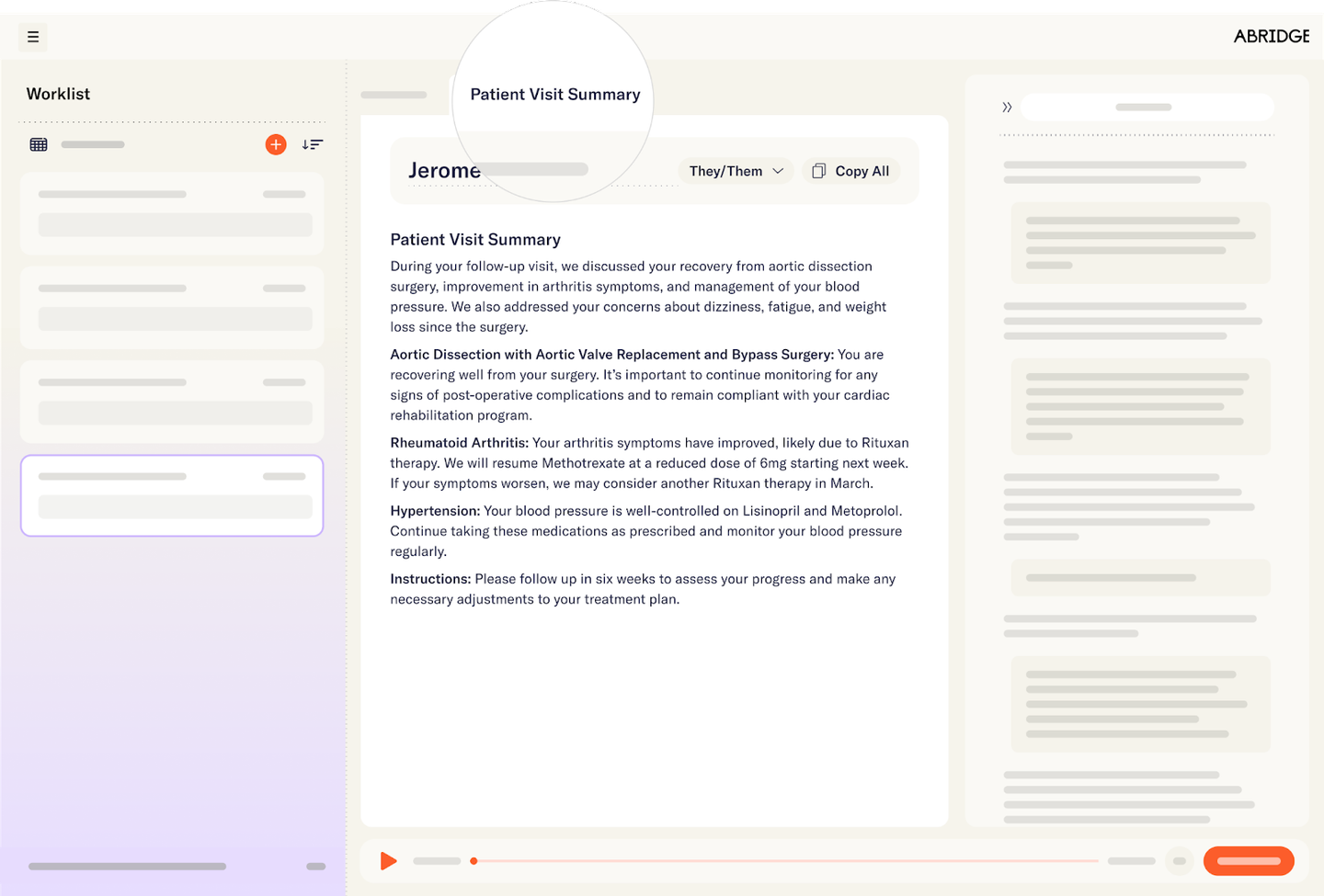
5. Abridge — KLAS-ranked No. 1 ambient AI for academic centers
- KLAS "Best in Segment" 2025 winner abridge.com.
- 90 % of clinicians at Corewell Health reported "more undivided attention to patients." abridge.com
Pros
- One-tap ambient capture inside Epic Haiku/Canto
- Generates patient-friendly visit recap PDF
- 90 % of clinicians in Corewell pilot felt more present with patients
Cons
- 30-day cloud retention may violate strict privacy policies
- Sold only through enterprise IT (no solo plan)
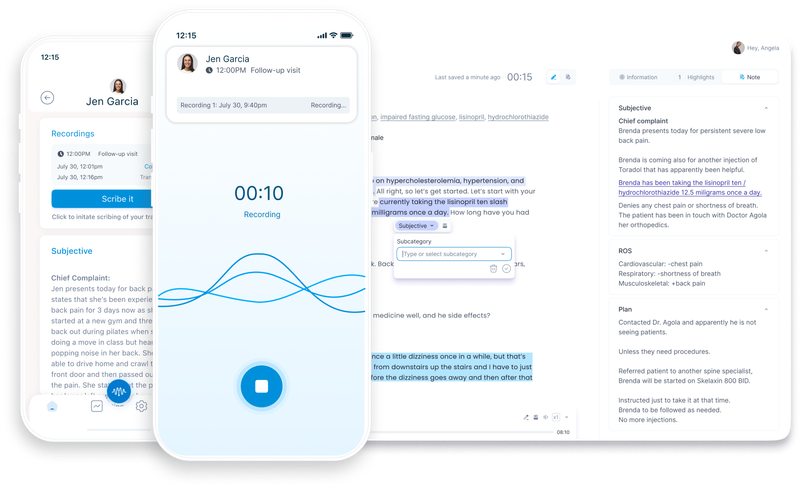
6. DeepScribe — Specialty-trained models for complex medicine
Reduces documentation time by up to 75 %; notes ready in 1.6 min on auto-only workflow.
Pros
- Ambient recording plus human reviewer for audit-level accuracy
- Integrations (Epic, athena, DrChrono) in active beta
- Advertises 75 % documentation time reduction
Cons
- Turnaround can stretch to hours on busy days
- Higher cost once volume surpasses 300 notes/month
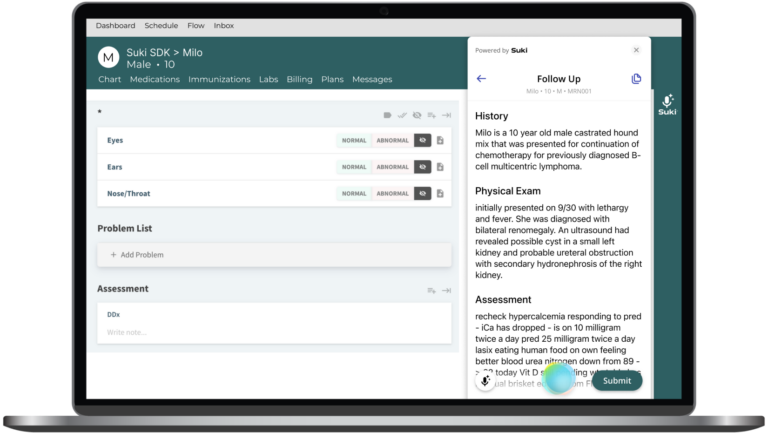
7. Suki AI — Voice-first assistant adored by primary-care docs
"Since integrating Suki I went from 10–20 extra charting hours a week to 15 minutes a day." — Dr. Jennifer J. Bryan, Family Medicine
Pros
- Cuts documentation to ~15 min/day for many primary-care docs
- Works on low-bandwidth cellular; 14-language dictation (May 2025 update)
- Simple, app-only deployment—no hardware installs
Cons
- $299–$399 / mo list (Compose to Assistant tier) — steep for small offices
- Generated A/P can be verbose; requires trimming
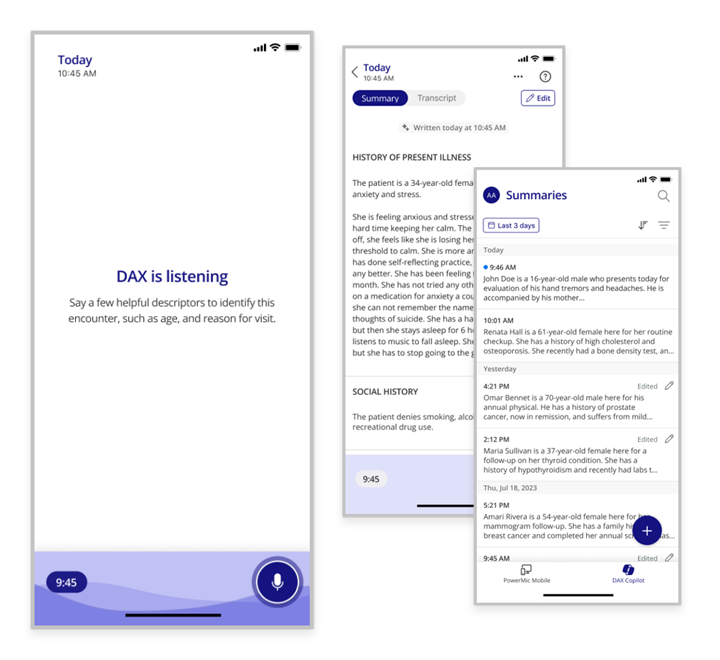
8. Nuance DAX Copilot — Deep Epic & Cerner integration, premium price
"Automating documentation through ambient voice tech has significantly reduced workloads and improved patient interaction." — Dr. Anthony Mazzarelli, Cooper University Health Care
Pros
- Note drops into the chart within minutes; multi-speaker detection
- HITRUST-certified; leverages Microsoft Azure security stack
- Proven to raise patient-satisfaction scores in system studies
Cons
- Enterprise quote-based; pricing varies by organization size and Epic/Cerner deployment scope
- Dragon-compatible EHRs only
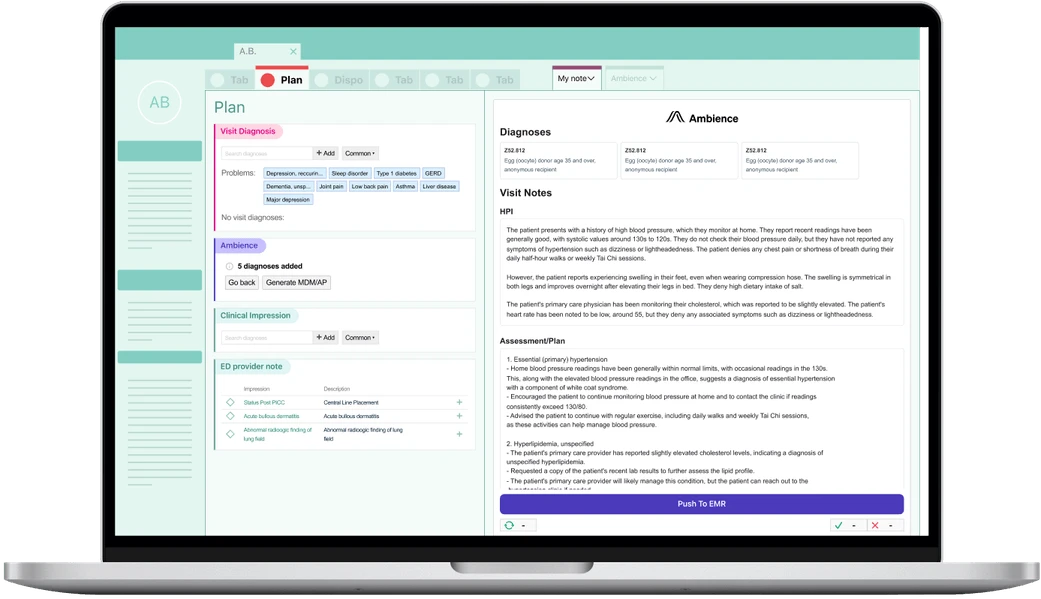
9. Ambience Healthcare — Coding-aware ambient scribe for large systems
"Think of this technology as a scribe that fluently speaks clinical language and the billing rulebook from day one." — William H. Morris, MD, CMO, Cleveland Clinic.
Pros
- Generates problem-oriented A/P and suggests CPT / ICD-10 codes
- SOC-2 + HITRUST; adopted by Cleveland Clinic pilot sites
- 27 % higher coding accuracy than baseline in multi-site study
Cons
- Requires proprietary ceiling mic array
- English-only; enterprise pricing undisclosed
10. Augmedix Go — Human-in-the-loop accuracy for sub-specialties
"Varsha, my Augmedix scribe, has significantly improved my productivity and job satisfaction." — G2 review
Pros
- Live remote scribe plus AI yields high fidelity in complex visits
- Deep chart-prep feature eliminates pre-visit paperwork
- Supports 35+ specialties, inpatient & ambulatory
Cons
- 3–5 min turnaround; slower than pure-AI tools
- A wearable camera/phone stand may feel intrusive
- Minimum contract size ≥ 5 providers
11. Vero Scribe — Underdog favorite in Canada & UK
"Total underdog, but my favourite ... accuracy has been great." — r/FamilyMedicine Reddit threat
Pros
- $69 CAD/mo billed annually ($89 CAD/mo monthly); ICD-10 auto-coding
- Clipboard chat answers quick medical queries
- Good Reddit feedback on accuracy
Cons
- No U.S. phone support yet
- Still seeking deep EHR integrations
Expert Round-table: Where AI scribes go next
- Ambient AI will soon "flag missing clinical concepts in real time," predicts JAMA authors after interviewing 22 physicians across four specialties.
- Revenue uplift of $5 per visit is already measurable when coders trust the AI, notes a Forbes analysis of Ambience deployments.
- Industry giants (Microsoft & Google) see scribes as the on-ramp for broader clinical decision support—an outlook echoed by The Verge and WSJ coverage .
Speed & Cost Leaderboard (2026 benchmarks)
Rank | Product | Score (/10) | Avg. draft time | Cheapest compliant plan | Mobile/Desktop |
|---|---|---|---|---|---|
1 | Twofold Health | 9.4 | 20 s | $49/mo | Mobile + Desktop |
2 | Freed AI | 8.9 | 2 min | $39/mo (40 notes) | Mobile + Desktop |
3 | Doximity Scribe | 8.7 | ~1 min | Free (verified US clinicians) | Mobile + Desktop |
4 | Heidi Health | 8.6 | 55 s | $0 (free tier) | Mobile + Desktop |
5 | Abridge | 8.4 | 120 s | Enterprise | Desktop |
6 | DeepScribe | 8.2 | 1.6–180 min | Enterprise (quote) | Mobile + Desktop |
7 | Suki AI | 8.1 | 50 s | $399/mo | Mobile + Desktop |
8 | Nuance DAX Copilot | 8.0 | 2 min | Enterprise (quote) | Desktop |
9 | Ambience Healthcare | 7.9 | 90 s | Quote | Desktop |
10 | Augmedix Go | 7.7 | 3–5 min | Enterprise | Mobile + Desktop |
11 | Vero Scribe | 7.6 | 50 s | $69 CAD/mo | Mobile + Desktop |
Scores (out of 10) are a weighted blend of note quality, format coverage, EHR fit, HIPAA compliance, and price. This 2026 refresh re‑weighted toward tools an independent clinician can actually buy and trial without an enterprise process, which is why quote‑only platforms moved down; see each tool's section for the detail behind its score.
Last verified August 2026
Capability matrix: top 5 tools side by side
Capability | Twofold | Freed | Doximity | Heidi | Abridge |
|---|---|---|---|---|---|
Works with any EHR (no IT project) | Yes — copy-ready output | Yes — copy-paste | Yes — copy-paste | Yes — copy-paste | Epic-centric |
Deep EHR write-back | No — paste into chart | EHR push (Premier tier) | No | Add-on | Yes |
Self-serve trial | Yes — 7 days, no card | Yes | Yes — free | Yes — free tier | Enterprise only |
Ambient + dictation modes | Both | Ambient | Both | Ambient | Ambient |
Coding support (ICD-10/CPT) | Included | Premier tier | No | Varies by plan | Yes |
Behavioral-health formats | DAP, BIRP, GIRP + treatment plans | General templates | Not a focus | General templates | Not a focus |
Flat per-clinician pricing | $49/mo | $39–119/mo | Free | Free tier + paid | Enterprise |
Capability snapshot verified August 2026 from vendor documentation and our testing — confirm plan details with each vendor.
Final Verdict
Twofold Health is the best AI medical scribe in 2026 for most independent practices and outpatient clinics. It has the strongest overall mix of fast draft generation, customization, note‑type breadth, pricing clarity, and cross‑device flexibility.
That does not mean it is the best answer for every organization. For Epic‑heavy enterprise systems, Abridge and Nuance DAX Copilot are stronger fits, and DeepScribe goes deepest on complex specialties. If cost is the binding constraint, Doximity Scribe is genuinely free for verified US clinicians and Heidi's free tier covers low‑volume use. For small clinics that want the simplest paid setup, Freed is a serious alternative. But for the broad query "best AI medical scribe," Twofold has the strongest case as the best overall option for the part of the market most likely to be doing self‑serve evaluation.
Last reviewed: August 2026 — the ranking, pricing tiers, plan availability, and vendor line‑up in this guide were re‑checked for currency, and Doximity Scribe was added. Confirm specifics with each vendor before purchasing.
How much does an AI medical scribe cost in 2026?
There are now two genuinely free options: Doximity Scribe is free to verified US clinicians, and Heidi offers a free tier for low‑volume use. Paid self‑serve scribes cluster around $39–$99 per provider per month — Twofold's compliant plan is $49/mo, Freed starts at $39/mo (capped at 40 notes) and reaches $79/mo for unlimited, and Vero is around $69 CAD/mo. Enterprise ambient platforms are contract‑priced: DAX Copilot, Abridge, DeepScribe, Ambience, and Augmedix are all quoted per health system. Factor in what's included: BAA, note formats, EHR write‑back, and mobile support vary widely between tiers.
Are AI medical scribes accurate enough for clinical use?
Yes for drafting — no for unsupervised charting. In peer‑reviewed evaluations of ambient AI scribes (see the NEJM Catalyst studies in the references), a majority of generated notes were accepted with little or no modification, but occasional errors and hallucinated text still occur. That's why every credible tool keeps a clinician review‑and‑sign step: the AI produces the draft, you verify it before it touches the chart. Accuracy also varies by audio quality and specialty vocabulary, so trial a tool on your own visits before committing. For what to check when a draft goes wrong, see our guide to catching AI scribe errors.
Do AI medical scribes work for telehealth visits?
Yes. Most tools capture telehealth visits either by listening to the call audio on your device or by processing a recording afterward, and the leading options work independently of your video platform — no Zoom or doxy.me integration required. Confirm two things first: that patient consent for recording is captured per your state's rules, and that audio isn't retained after the note is drafted. For a deeper look at wiring documentation into virtual care, see integrating AI notes with your telehealth platform.
Will an AI scribe work with my existing EHR?
Almost always — but through one of two models. Enterprise tools like DAX Copilot and Abridge integrate deeply with Epic and write notes directly into the chart, at enterprise prices and IT timelines. EHR‑agnostic tools like Twofold produce a structured, copy‑ready note that drops into any EHR — SimplePractice, athenahealth, eClinicalWorks, or a hospital system — with zero integration work. Deep write‑back saves a paste; EHR‑agnostic saves a six‑figure rollout. We compare the trade‑offs in AI scribe vs EHR overlay.