



For years, clinical documentation has lived in two eras: handwriting and dictation. Dictation solved the speed problem, turning speech into text faster than typing. Now the next phase has arrived. AI clinical notes are evolving beyond transcription into active decision support. Instead of just capturing what you say, intelligent systems now structure your note, flag inconsistencies, and suggest next steps all in real time. Explore how AI clinical notes are saving clinical reasoning for what matters most: the patient.
The Dictation Era: Faster but Not Smarter
Dictation can be very useful, but its limits are impossible to ignore.
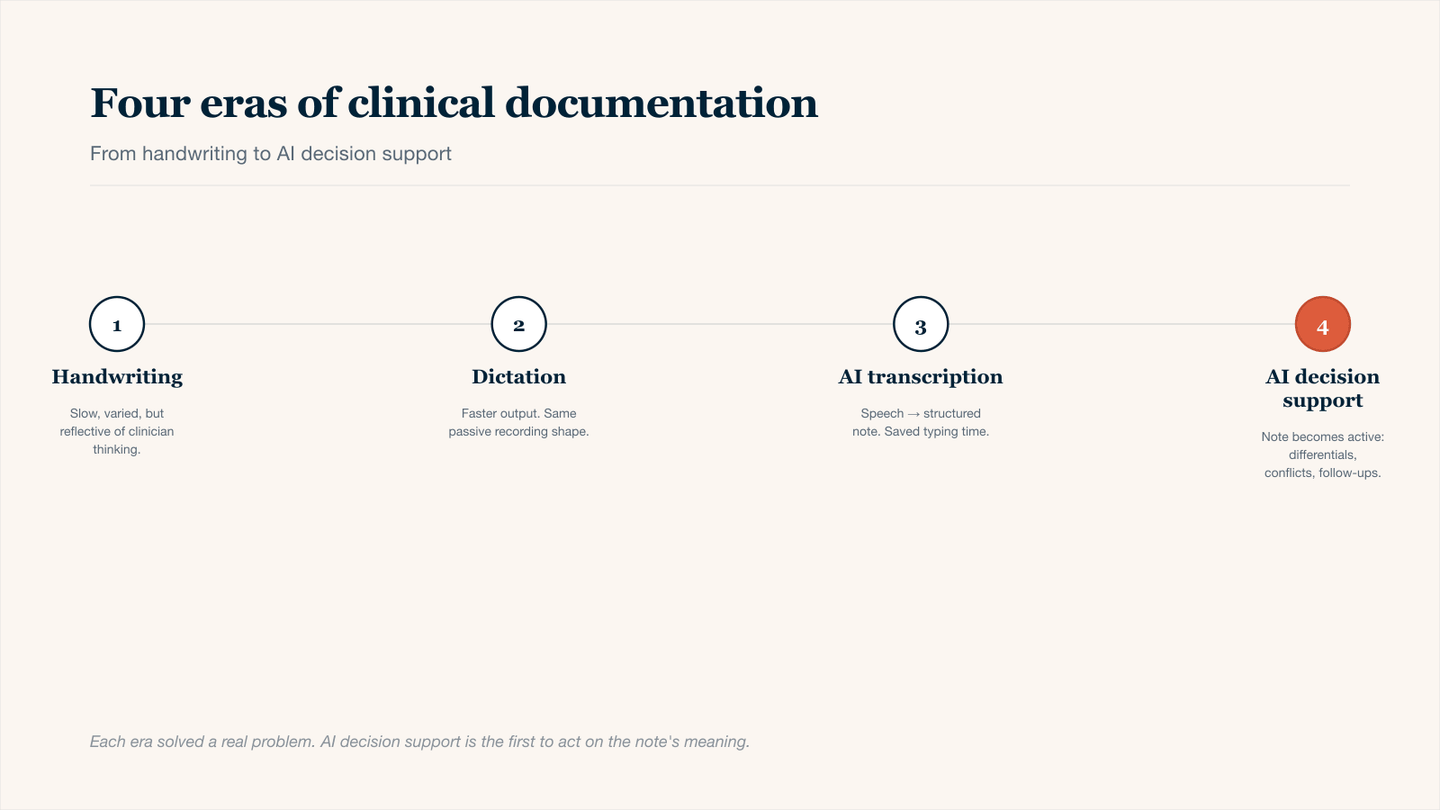
Four eras of clinical documentation — only the last one acts on the meaning of the note.
What Dictation Solved:
- Speed Over Typing: Reduced manual keyboard time by converting speech to text.
- Basic Transcription Accuracy: Captured patient narratives with reasonable accuracy.
What Dictation Missed:
- No Clinical Insights: Can not identify abnormal findings or missing data.
- No Decision Support: Fails to flag drug interactions, allergies, or guideline deviations.
- No Structured Data Capture: Produced free text instead of searchable, codified fields.
The Hidden Cost:
- Clinicians have to mentally parse notes to extract relevant facts.
- Manual flagging of follow-ups (e.g., "recheck BP in 2 weeks").
- Human spot-checking for drug interactions and contraindications.
The Shift to AI Clinical Notes
AI clinical notes now do more than transcribe. They structure, summarize, and suggest. This shift transforms passive recordings into clinical assets.
From Passive Recording to Active Structuring
Automatically Separates Subjective From Objective Data
- Maps dictated content into standard SOAP format (Subjective, Objective, Assessment, Plan).
- Reduces manual reformatting time by seconds per note.
Highlights Abnormal Labs Or Missing Medication Lists
- Compares dictated symptoms against structured lab data.
- Flags omissions like "no medication allergy documented."
Creates Billing-Ready HPI Without Templates
- Generates a History of Present Illness compliant with ICD-10 requirements.
- Includes location, quality, severity, timing, context, modifying factors, and associated signs.
What "Decision Support" Means Here
Real-Time Differential Suggestions Based On The Note's Content
- Example: Dictation mentions "chest pain on exertion." AI suggests to "rule out angina, GERD, etc."
- Ranked by likelihood using local prevalence and patient history.
Alerting For Drug-Allergy Conflicts Or Guideline Deviations
- Scanned meds against known allergies in the EHR.
- Flags outdated prescriptions.
Auto-Flagging Follow-Up Tasks
- Example: "Patient due for colon cancer screening" (based on age + last colonoscopy date).
- Generates clickable orders or reminders directly in the note.
Key Differences: Dictation vs. AI Decision Support
The table below contrasts traditional dictation with AI clinical notes that include decision support, highlighting why this shift is significant.
Feature | Dictation-Only | AI Clinical Notes + Decision Support |
|---|---|---|
Output format | Raw, unstructured text transcript | Structured SOAP (Subjective, Objective, Assessment, Plan) |
Clinical insights | None | Detects abnormal labs, missing meds, guideline deviations, etc. |
Decision support | None | Real-time differentials, drug-allergy alerts, care-gap flags, etc. |
Coding assistance | None | ICD-10 and CPT code suggestions based on note content |
Integration with EHR | None (text is pasted or typed) | Bidirectional (reads labs/meds;) and copy-paste options available |
Learning from prior notes | No | Yes (context-aware across patient history) |
4 Ways Decision Support Improves Clinical Workflow
Here are four measurable ways that AI clinical notes with decision support change daily practice.
- Fewer Missed Findings: AI compares dictated symptoms against structured lab results and vital signs.
- Cognitive Offloading: Instead of holding a dozen "rule out" diagnoses in working memory, the clinician sees them suggested in real time.
- Safer Handoffs: When a note is transferred to a covering physician, the AI automatically includes a summary section titled "Follow-up Required." This reduces information loss during transitions of care.
- Better Quality Metrics: Preventive care reminders (e.g., "mammogram due") are auto-populated based on patient age, history, and guidelines.
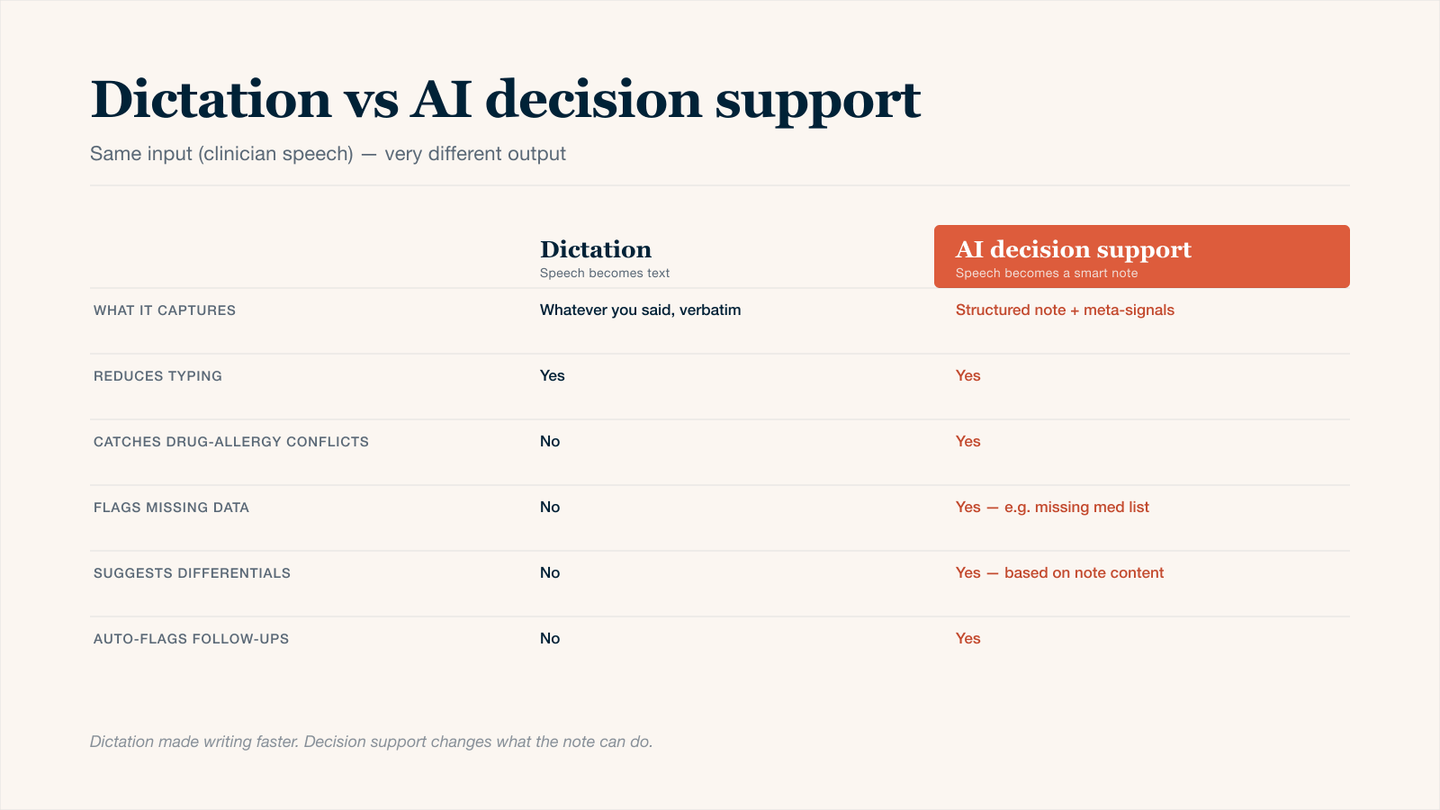
Dictation made writing faster. Decision support changes what the note can do.
Conclusion
The journey from handwriting to dictation was about speed. The journey from dictation to AI clinical notes is all about intelligence. Today's ambient tools analyze, alert, and advise, and turn a finished note into a clinical asset that supports real‑time decisions. For the busy clinician, this means less time looking for missing information and more time acting on what matters: patient care.