


AI SOAP notes can save time on documentation, but many clinicians worry: 'Will automation rid my notes of medical necessity?' A generic AI output often replaces clinical reasoning with vague language, leaving notes vulnerable to audits and denials. However, you don't have to choose between efficiency and compliance.
The key is understanding where AI excels and where it fails. When used as a first draft, AI SOAP notes can actually strengthen medical necessity by freeing you to focus on the clinical narrative. This article outlines a practical workflow to keep your notes defensible, reimbursable, and human.
Why Medical Necessity Gets Lost in AI-Generated SOAP Notes: Hallucination vs Omission
AI language models are trained to predict the next most probable word, not to verify clinical truth. This leads to two distinct problems: hallucination (inserting false but plausible data) and omission (leaving out critical necessity drivers).
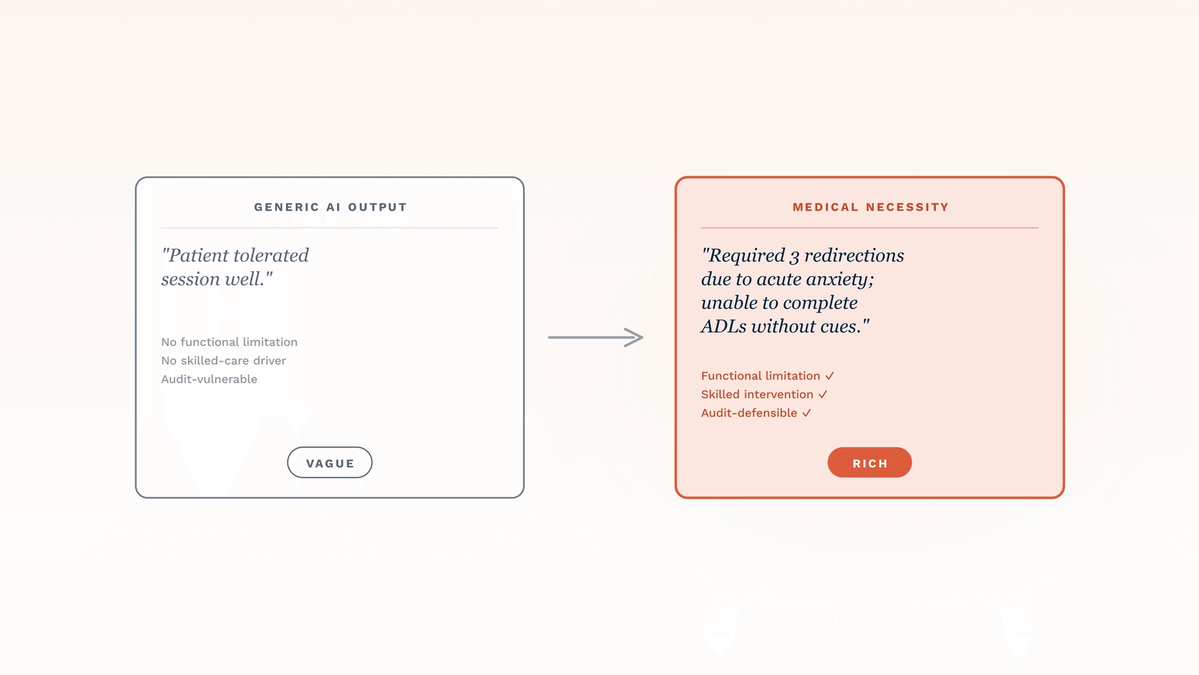
If you compare these two example Assessment entries:
- Generic AI output: "Patient tolerated session well."
- Medical necessity version: "Patient required 3 redirections due to acute anxiety; unable to complete ADLs without verbal cues."
The first tells an auditor nothing about why skilled care is needed. The second explicitly documents functional limitation and the need for direct intervention, two important factors of medical necessity.
The Issue of Blindly Using Templates
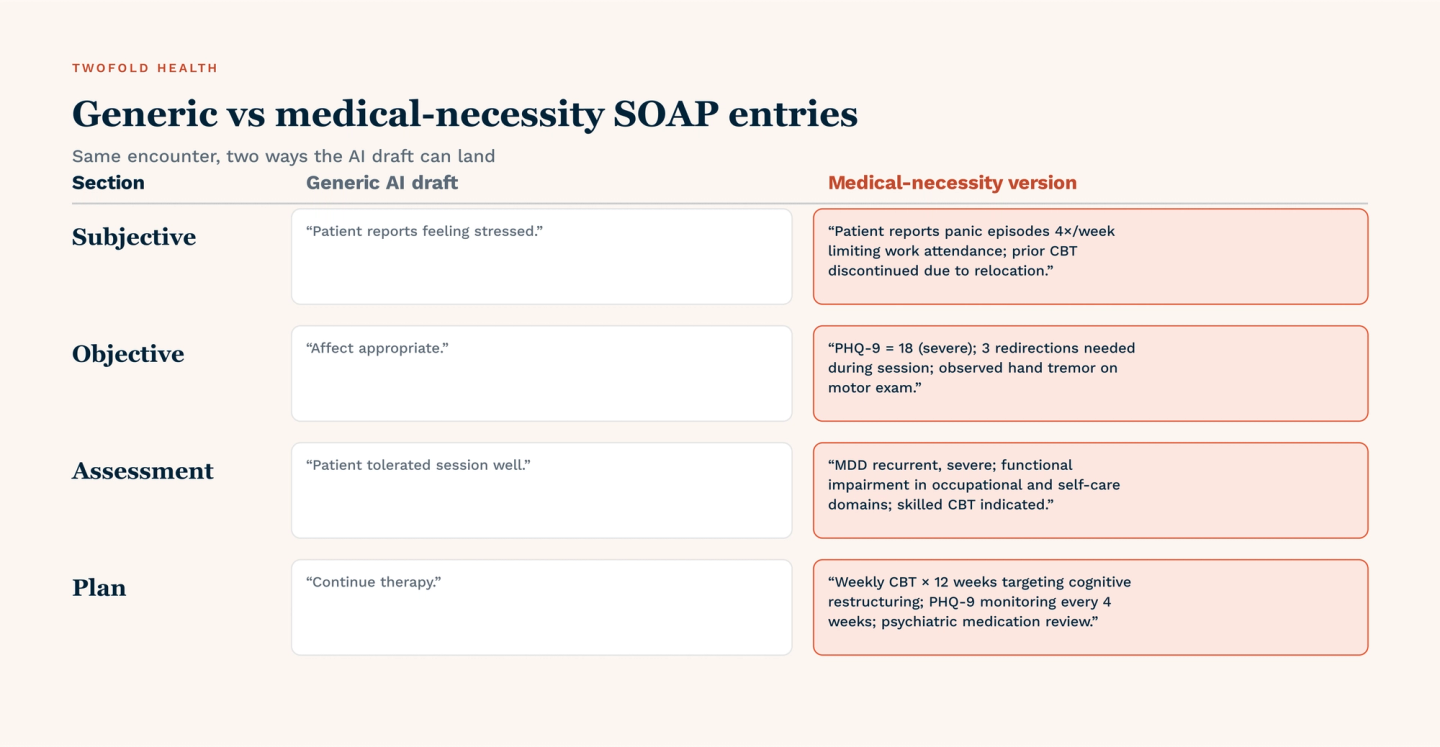
Many AI tools rely on generalized templates that fail to create a logical linkage between the Assessment and Plan sections. A common red flag is the phrase "Continue current plan" without any justification for ongoing therapy. Medical necessity requires a clear thread:
Because the patient still demonstrates [specific impairment], ongoing skilled intervention is required to prevent [measurable decline].
Without that linkage, your note becomes a checklist of services rendered rather than a clinical argument for reimbursement. Auditors will flag this immediately. The solution is not to avoid AI SOAP notes, it's to train yourself to spot and repair template‑blind language.
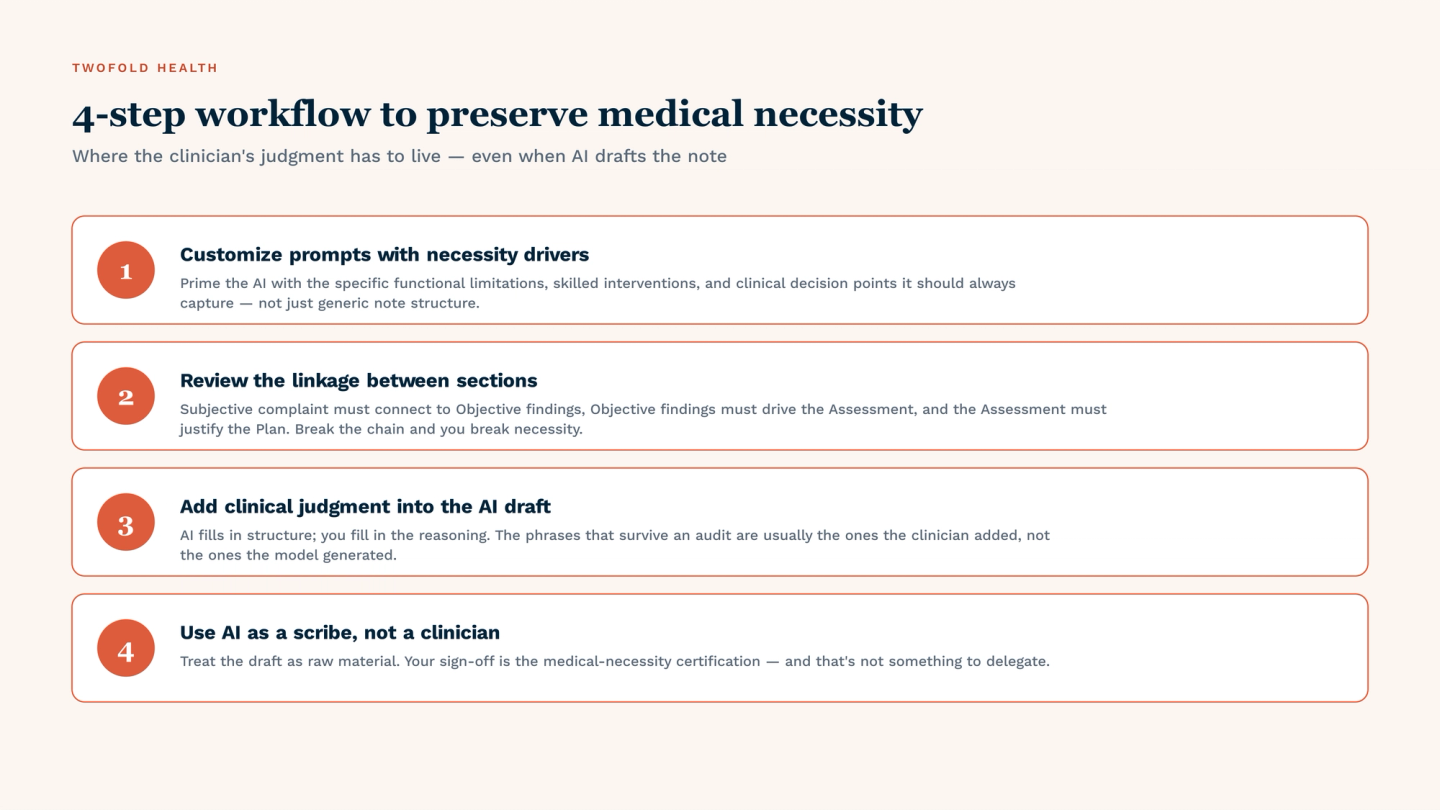
4-Step Workflow to Preserve Medical Necessity with AI SOAP Notes
These easy steps ensure medical necessity is prioritized in your AI SOAP note workflow.
Step 1: Customize Your AI Prompts with Necessity Drivers
Most clinicians lose medical necessity because they use vague prompts like "Write a SOAP note for physical therapy."
Instead, design prompts that make the AI capture functional deficits, skilled interventions, and risk of decline.
Use This Numbered Prompt Template:
- "List 2 specific functional limitations observed during this session."
- "Describe the patient's response to skilled intervention (e.g., verbal cues, manual facilitation)."
- "State the risk of functional decline if therapy is reduced or discontinued."
Step 2: Review the "Linkage" Between Sections
After AI generates the note, review it for logical flow. Medical necessity requires that the Subjective complaint drives the Objective findings, which support the Assessment, which thus justifies the Plan.
Section | What AI Typically Writes (Generic) | What Medical Necessity Requires |
|---|---|---|
Subjective | "Patient says doing okay." | Direct quote or paraphrase showing functional struggle (e.g., "I can't button my shirt anymore.") |
Objective | "Patient participated well." | Specific, measurable data (e.g., grip strength, ROM, timed walk, number of cues) |
Assessment | "Patient is improving." | Clinical judgment linking objective findings to functional outcome and remaining deficits |
Plan | "Continue with plan of care." | Frequency, duration, specific interventions, and discharge criteria |
Step 3: Add Clinical Judgment into the AI Draft
Before signing any AI‑generated SOAP note, ask yourself three questions:
- Does this note explain why the patient cannot perform this care independently (without skilled therapy)?
- Does it describe a change in status: positive, negative, or plateau?
- If an auditor read only the Assessment section, would they approve three more visits?
If the answer to any question is "no," revise until it becomes "yes."
Step 4: Use AI as a Scribe, Not a Clinician
Let AI handle transcription, grammar, sorting vitals, and formatting. But you must manually enter the Medical Decision-Making (MDM) elements: prognosis, specific risk factors (e.g., fall history, medication non‑adherence), and a discharge timeline. AI cannot know what you are thinking, so write those thoughts yourself.
Conclusion
AI SOAP notes can efficiently handle transcription, formatting, and data organization. The remaining clinical reasoning, functional linkages, and justification of skilled care require direct clinician input. Medical necessity is not preserved by automation; it is preserved by intentional editing. Clinicians should treat AI output as a first draft, then apply the 3‑Question Review Rule before signing. The responsibility for defensible, reimbursable notes remains entirely with the clinician.