



Clinicians spend up to half their day on clinical documentation, which is a leading cause of burnout. Artificial intelligence presents a solution, but not all AI tools are created the same when it comes to medical note‑taking. AI medical scribes for clinicians use ambient listening to generate structured SOAP notes automatically within your EHR. In contrast, general‑purpose LLMs like ChatGPT and Claude require manual copy‑pasting and custom prompts, raising privacy concerns. Understanding how these technologies work is essential before adopting any solution. This article compares AI Scribes vs ChatGPT vs Claude to help you choose the right tool for clinical notes.
How AI Scribes vs ChatGPT vs Claude Work for Clinical Notes
Understanding the design of these tools is the first step in making an informed decision for your practice. While both AI Scribes and general‑purpose LLMs use artificial intelligence to process language, their setups, training data, and intended workflows are different.
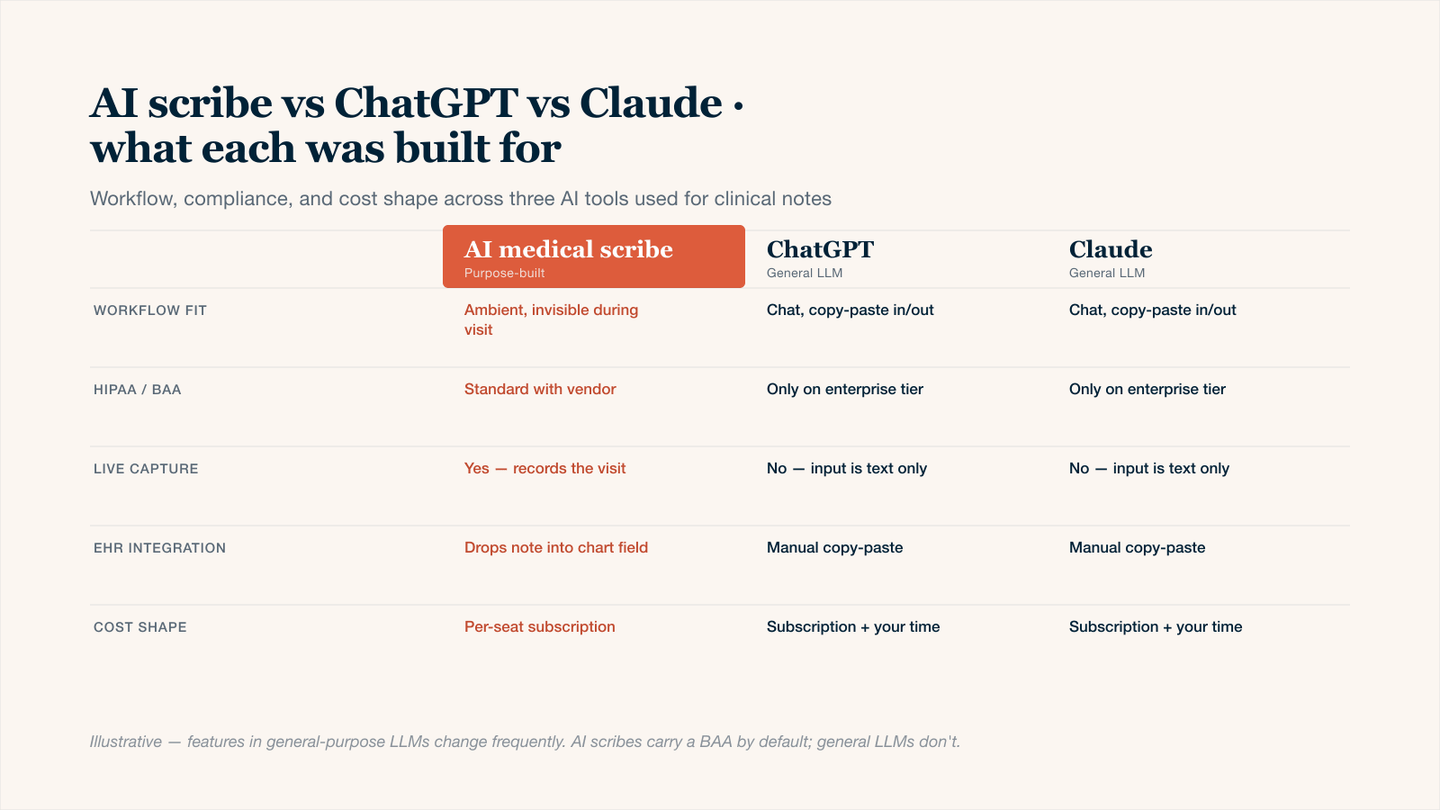
Same underlying AI — very different fit for the clinical workflow.
How an AI Scribe Works
An AI medical scribe is designed for one specific task: transforming a clinical conversation into a structured medical note with minimal human effort. It operates through a three‑step pipeline:
Step 1: Capturing the Conversation
The AI medical scribe uses ambient listening technology to securely capture the real‑time conversation between physician and patient. Unlike consumer smart speakers, these systems do not require wake words or manual commands. The audio is processed locally or through a HIPAA‑compliant cloud, ensuring patient privacy from the moment of capture.
Step 2: Speech-to-Text & Clinical Intelligence
The raw audio is transcribed into text using medical‑grade speech recognition. Then, a medical‑domain Natural Language Processing (NLP) engine identifies key clinical concepts such as symptoms, medications, diagnoses, and physical exam findings. This step filters out non‑clinical chit‑chat to focus only on relevant data.
Step 3: Structured Note Generation & Delivery
Finally, the AI assembles the extracted information into a structured note format, such as SOAP (Subjective, Objective, Assessment, Plan). The draft note is then pushed directly into the EHR via API, ready for the provider to review, edit, and sign. The entire process happens within seconds of the visit ending.
How General-Purpose LLMs (ChatGPT and Claude) Work for Clinical Notes
In contrast, ChatGPT and Claude are general‑purpose large language models. They are trained on massive, diverse datasets from the public internet, including Wikipedia, Reddit, and books, not on medical textbooks or de‑identified clinical transcripts.
Key Features and Capabilities Across AI Scribes and LLMs
Beyond how these tools work, their underlying feature sets and technical capabilities determine where they excel and where they fall short in clinical environments.
Feature | AI Scribe | ChatGPT | Claude |
|---|---|---|---|
Medical Fine-Tuning | Specialized in clinical language. | General-purpose, can be fine-tuned. | General-purpose, can be fine-tuned. |
Context Window | Optimized for clinical conversation length. | Large (128,000 tokens). | Very large (200,000 tokens). |
Hallucination Risk | Lower, often uses a human-in-the-loop review. | Moderate, known to "hallucinate" facts. | Lower |
Output Style | Structured and concise. | Can be verbose or formulaic. | Nuanced and professional. |
Multimodal | Not applicable. | Yes (voice, image generation). | No. |
Typical Use Case | Automating clinical note-taking. | Patient education, research, and data extraction. | Chart summarization, complex document review. |
AI Scribe vs ChatGPT vs Claude: Core Differences That Matter
The decision between these tools comes down to these core differences:
Workflow Fit: Invisible Assistant vs. Interactive Chatbot
AI Scribe (Invisible by Design)
- Listens passively in the background during patient encounters.
- Requires no typing, clicking, or voice commands from the clinician.
- Draft note appears automatically in the EHR at the visit end.
- Result: Fits into your existing workflow.
ChatGPT & Claude (Interactive by Design)
Requires explicit input for every task.
- Manual steps:
- Open chat.
- Copy-paste transcript.
- Write a prompt.
- Wait.
- Copy output.
- Paste into EHR.
- Reformat.
- Result: Requires you to adapt to their workflow
Cost Efficiency: Subscription Price vs. Hidden Time Costs
AI Scribe
- Upfront Cost ranges from $44- $400/provider/month.
- Saves hours on documentation time.
ChatGPT/Claude (for daily notes)
- Upfront cost is $20/month.
- Hidden time costs per note:
- Transcription.
- Copy-paste & prompting.
- Hallucination correction.
- Manual EHR formatting.
AI Scribes are overall better for daily documentation. ChatGPT/Claude are only cost‑effective for occasional use.
EHR Integration and Real-Time Documentation Differences
The most practical difference between these tools is how they connect (or fail to connect) with your existing electronic health record.
Feature | AI Scribe | ChatGPT/Claude |
|---|---|---|
Native EHR Integration | Yes, via API. | No, manual entry required. |
Note Delivery | Direct to EHR. | Copied and pasted from chat. |
Real-time documentation | Yes, generates a draft during or immediately after the visit. | No, requires manual upload/transcription after the visit. |
Billing Code Support | Often includes ICD-10 and CPT suggestions. | Unlikely without manual prompting. |
If you value a seamless, real‑time documentation workflow, an AI Scribe is the only practical choice among these options.
HIPAA Compliance and Data Privacy Considerations
This is the single most important legal and ethical distinction between the tools.
Standard versions of ChatGPT and Claude are NOT HIPAA‑compliant. Here's why:
- OpenAI and Anthropic (the companies behind ChatGPT and Claude) do not sign Business Associate Agreements (BAAs) with healthcare providers.
- Without a BAA, you cannot legally transmit protected health information (PHI) to these services.
- Both companies may retain user data to improve their models, creating a permanent privacy risk.
The Compliant Path
The best AI scribe tools are engineered for HIPAA compliance:
- They sign BAAs with healthcare organizations, assuming full legal responsibility for PHI protection.
- All data is encrypted in transit and at rest.
- Audio recordings are transcribed and then immediately deleted (no permanent storage).
- Models are hosted on private, healthcare-dedicated cloud systems, not shared with consumer traffic.
- Regular third-party security audits (e.g., HITRUST, SOC 2) verify compliance.
Pros and Cons of AI Scribes vs ChatGPT vs Claude
AI Tool | Pros | Cons |
|---|---|---|
AI Scribe | Seamless workflow & EHR integration. Reduces Burnout. Higher accuracy, lower hallucination risk. | Requires subscription cost. May require human oversight for complex cases. Still has rare hallucinations. |
ChatGPT | Extremely versatile. Fast for quick queries. Useful for patient education. | Not HIPAA compliant. Prone to hallucinations, can be overly verbose. |
Claude | Good for complex reasoning and long documents. Lower hallucination rates. More natural writing than ChatGPT. | No multimodal capabilities. Not HIPAA compliant. No native EHR integration. |
When to Use AI Scribes vs ChatGPT vs Claude
Use Case | Recommended Tool |
|---|---|
Clinical note | AI Scribe |
Chart review and summarization | Claude |
Billing code suggestions | AI scribe |
Telehealth documentation | AI scribe |
Data extraction from research | ChatGPT |
Practical Recommendation: Choosing the Right Tool for Clinical Notes
AI Scribe is the Medical Standard
For busy clinicians who want to reduce documentation time and improve patient focus, the integrated, secure, and accurate nature of an AI medical scribe makes it the ideal solution for documentation needs. Key advantages:
- Immediate ROI: Saves multiple hours a week on documentation.
- Peace of mind: HIPAA-compliant with signed BAA; no legal risk.
- Easy Use: No copy-paste, no tab-switching, no formatting headaches.
- Consistent Quality: Structured notes improve coding accuracy and audit readiness.
LLMs are Powerful Supplementary Tools
General‑purpose LLMs are not replacements for an AI Scribe, but they excel as supplementary tools in compliant environments:
- ChatGPT: Ideal for specialty-specific documentation assistance or research data extraction.
- Claude: Best for complex chart review and summarizing lengthy clinical documents
Faster, More Reliable Clinical Notes with Twofold
As this comparison shows, AI medical scribes outperform general LLMs for daily documentation. Twofold delivers all the advantages (workflow integration, accuracy, and HIPAA compliance) in one platform.
- HIPAA-Compliant: Signs BAAs, encrypts all data, and deletes audio after transcription. Your patient data stays secure.
- Seamless EHR Integration: Listens passively, generates SOAP notes automatically, and pushes them directly into your EHR. No unnecessary formatting.
- Proven Time Savings: Clinicians can save hours daily, reduce burnout, and spend more time with patients.
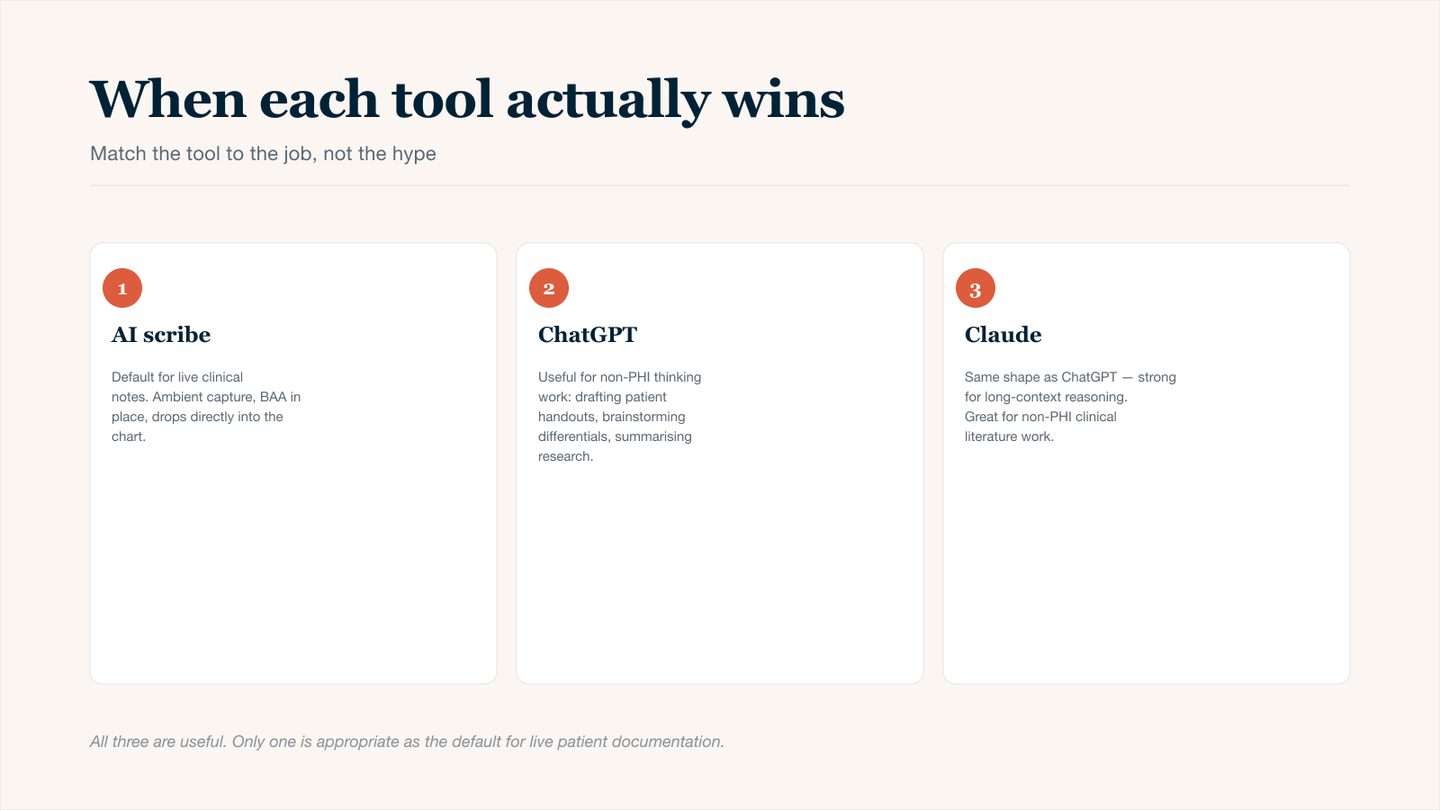
Three tools, three different jobs — only one is appropriate as the default for live patient documentation.
Conclusion
Choosing between AI Scribes and general‑purpose LLMs like ChatGPT or Claude comes down to matching the tool to the task. For daily clinical notes, AI medical scribes offer seamless EHR integration, HIPAA compliance, and lower hallucination rates, thereby reducing documentation time and burnout. ChatGPT and Claude excel as supplementary tools for research, patient education, and complex chart summarization, but only within compliant frameworks. The smartest approach is to use an AI Scribe for your core documentation workflow and keep a general LLM handy for occasional analysis.