


Key takeaways
- There are 25% more psychotherapy sessions lasting 53 minutes than 52 minutes, exactly where the higher-paying CPT 90837 code begins.
- All four of the largest psychotherapy professions have more sessions lasting 53 minutes than 52 minutes, with increases ranging from 18% to 44%.
- Physical, occupational and speech therapy sessions increase just 0.7% from 52 to 53 minutes, compared with 25% for psychotherapy, despite using the same recording system and having their own billing boundary at 53 minutes.
- When clinicians enter session length manually, they record 53 minutes 1,392 times, compared with 86 times for 52 minutes and 58 times for 51 minutes.
- Psychotherapy session lengths change exactly at the 53-minute threshold for the higher-paying CPT 90837 code, but the data cannot determine whether sessions are extended, scheduled around the threshold, or recorded differently.
Why we looked at this
In an earlier analysis of session lengths across 48 clinical specialties, we measured twelve psychotherapy professions separately, expecting them to differ. Ten of the twelve had median session lengths within two minutes of 53: mental health counseling at 54.6, psychotherapy at 53.9, clinical social work at 53.8, cognitive behavioral therapy at 51.2. Different licensures, different client populations, nearly the same number.
53 minutes is also where CPT 90837 takes over from CPT 90834 and reimbursement rises 15 to 25 percent. That could be a coincidence — the therapy hour has existed far longer than the code set, and a distribution centered near an hour will have its median land somewhere in the low fifties regardless.
Medians can't separate the two. A minute‑level histogram can. We wrote down what each outcome would mean before running the query, and said we would publish whichever we got.
Shape | Interpretation | Result |
|---|---|---|
Step up at 53, deficit at 51–52 | Billing thresholds affect session length | Step observed, deficit not observed |
Spikes at 45, 50 and 60 | Scheduling convention rather than billing | Not observed in measured durations |
Smooth curve through 38 and 53 | The earlier finding was an artifact of using medians | Not observed |
The distribution
Across 652,956 recorded psychotherapy sessions, 29,169 lasted 53 minutes and 23,343 lasted 52. Minute 54 is 1.9% above minute 53.
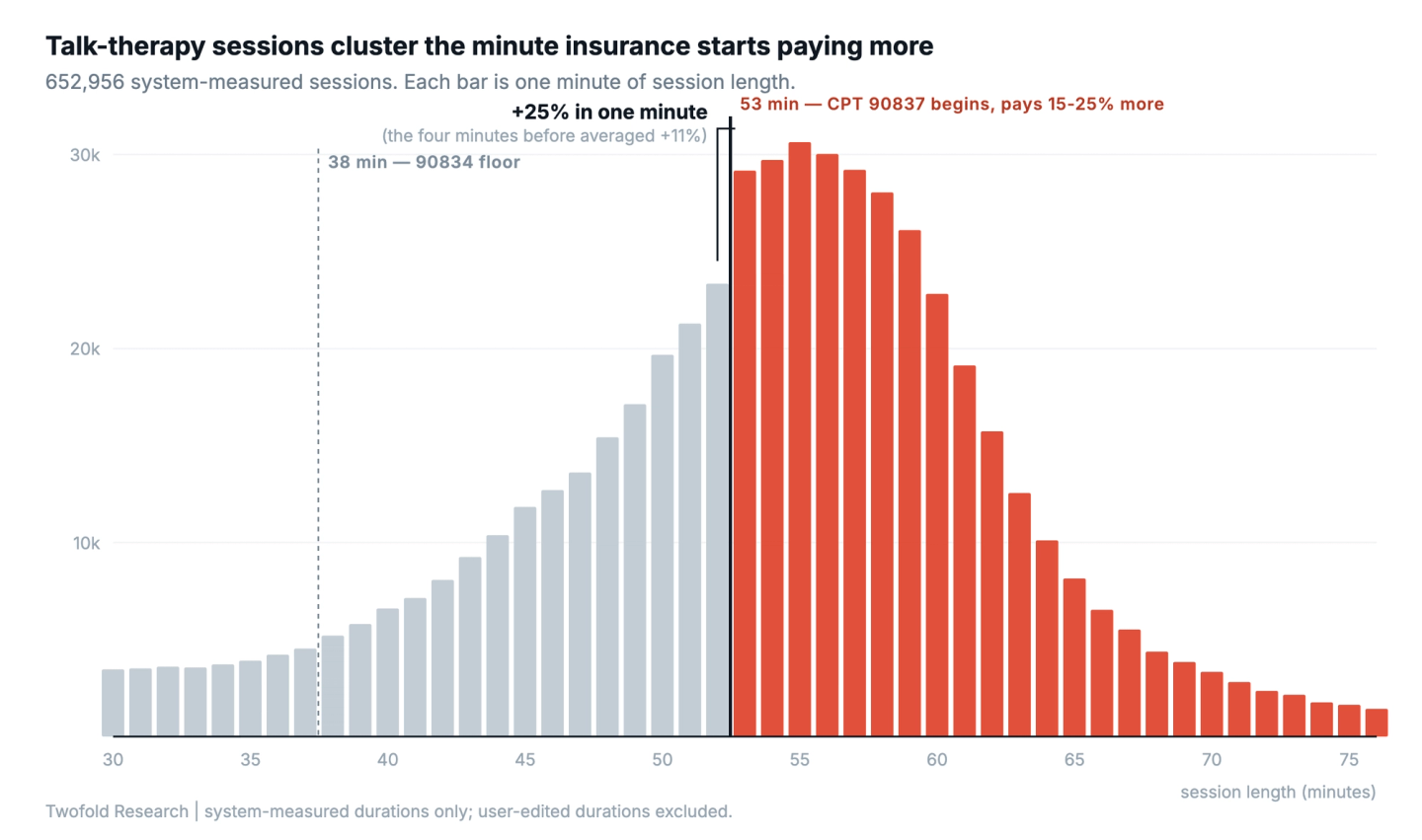
Figure 1. Recorded psychotherapy sessions by duration, minutes 30 to 76. System‑measured durations only.
Session length | Sessions | Change from previous minute |
|---|---|---|
48 minutes | 15,428 | +11.0% |
49 minutes | 17,129 | +11.0% |
50 minutes | 19,683 | +14.9% |
51 minutes | 21,288 | +8.2% |
52 minutes | 23,343 | +9.7% |
53 minutes | 29,169 | +25.0% |
54 minutes | 29,722 | +1.9% |
55 minutes | 30,635 | +3.1% |
56 minutes | 30,030 | −2.0% |
At the average rate of increase across minutes 49 to 52, minute 53 would hold about 25,900 sessions.
Why the boundary falls at 53
53 is not a scheduling interval, which is part of what makes it useful as a test. It comes from the fee schedule: the AMA places the boundary between the two psychotherapy codes at the midpoint of their targets, 45 minutes for 90834 and 60 for 90837, giving 52.5, rounded up.
CPT code | Face-to-face time | Reimbursement |
|---|---|---|
90832 | 16–37 minutes | Base |
90834 | 38–52 minutes | Middle |
90837 | 53 minutes and up | 15–25% above 90834; roughly $30–35 more per session on Medicare's 2026 national rates |
A 52‑minute session bills as 90834 and a 53‑minute session bills as 90837. There is no rounding at the boundary, and payers audit it.
The control cohorts
Physical, occupational and speech therapists bill under the CMS 8‑minute rule, whose unit steps fall at 23, 38 and 53 minutes. Psychiatry has a 53‑minute threshold for the 90838 psychotherapy add‑on. Both cohorts use the same recording software and have a billing boundary at the same minute.
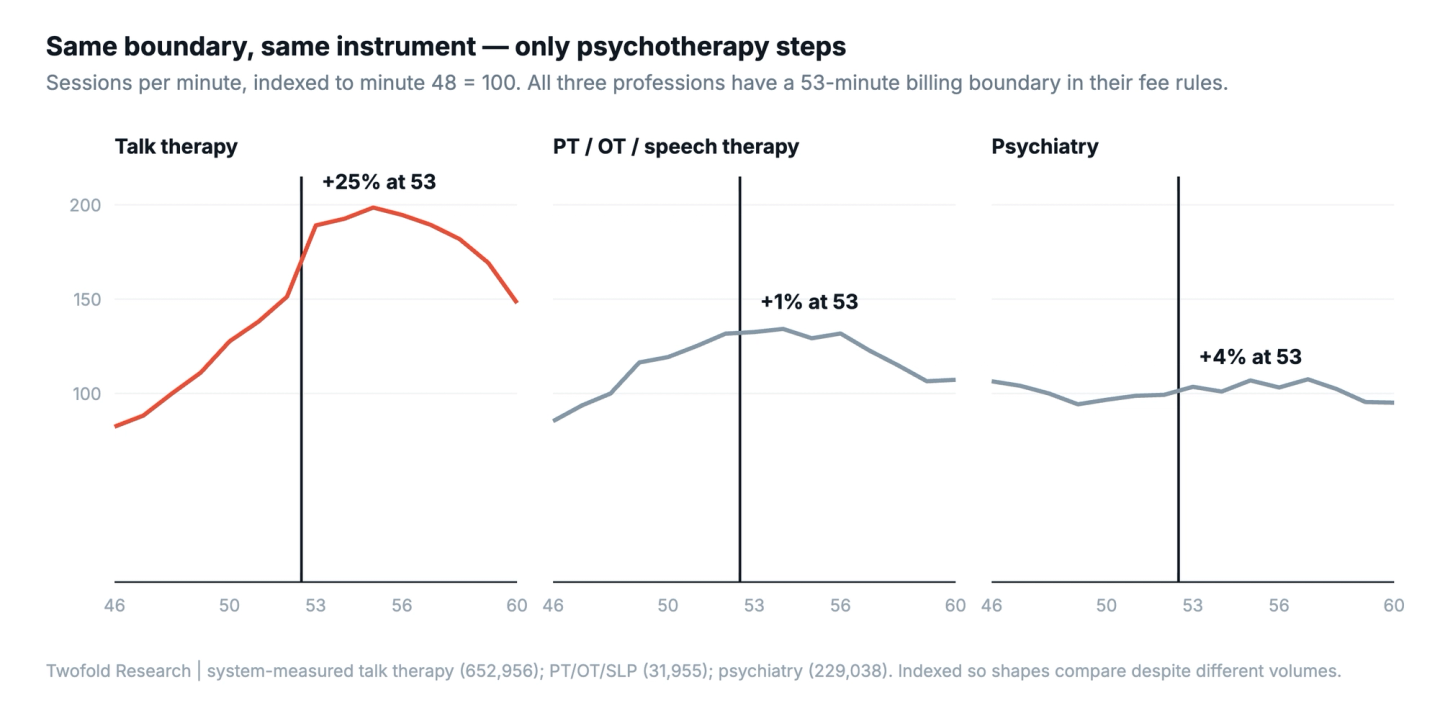
Figure 2. Sessions per minute by cohort, indexed to minute 48 = 100.
Cohort | Sessions 48–52 min | Sessions 53–57 min | Ratio | Change 52→53 |
|---|---|---|---|---|
Psychotherapy | 96,871 | 148,767 | 1.54× | +25.0% |
Physical / occupational / speech therapy | 3,745 | 4,112 | 1.10× | +0.7% |
Psychiatry | 5,402 | 5,769 | 1.07× | +4.3% |
The comparison makes several simpler explanations less likely. The recording software is identical across cohorts. The result holds under both floor and nearest‑minute rounding. A general tendency to drift past billing thresholds would be expected to appear in physical therapy, which has the same threshold. And 53 is not a round number, so a 45‑, 50‑ or 60‑minute scheduling habit does not produce it.
Profession | Sessions 48–52 min | Sessions 53–57 min | Ratio | Change 52→53 |
|---|---|---|---|---|
Clinical Social Work | 15,021 | 25,880 | 1.72× | +43.9% |
Mental Health Counseling | 35,290 | 57,840 | 1.64× | +39.3% |
Marriage and Family Therapy | 6,851 | 10,264 | 1.50× | +21.4% |
Psychotherapy | 29,186 | 41,962 | 1.44× | +18.1% |
3,046 clinicians contributed sessions between 50 and 57 minutes, and the largest single contributor accounts for 0.4% of them.
The part of the prediction that failed
We predicted the excess above 53 would come with a shortfall at 51 and 52 — the pattern produced when sessions that would otherwise end below a threshold are pushed across it. The excess is there. The shortfall is not.
Minute 51 holds 21,288 sessions and minute 52 holds 23,343, both close to what the preceding minutes predict. Instead of a hole followed by a spike, the distribution steps up at 53 and stays at the higher level through 57.
The absence of a deficit below 53 means scheduling around the threshold is also consistent with the pattern: a practice that books 55‑minute appointments rather than 50‑minute ones shifts its whole distribution without extending any individual session. The data cannot distinguish between these explanations.
Manually entered durations
Twofold records session length automatically, and a clinician can overwrite it. While checking whether edited durations could produce the pattern, our engineer noticed that the edit form only accepts whole minutes and multiplies by 60 — so every edited duration is an exact multiple of 60 seconds and lands on an integer minute by construction. Edited rows can generate a spike at any round value on their own. We excluded all 8,374 of them, 1.3% of sessions, from everything above.
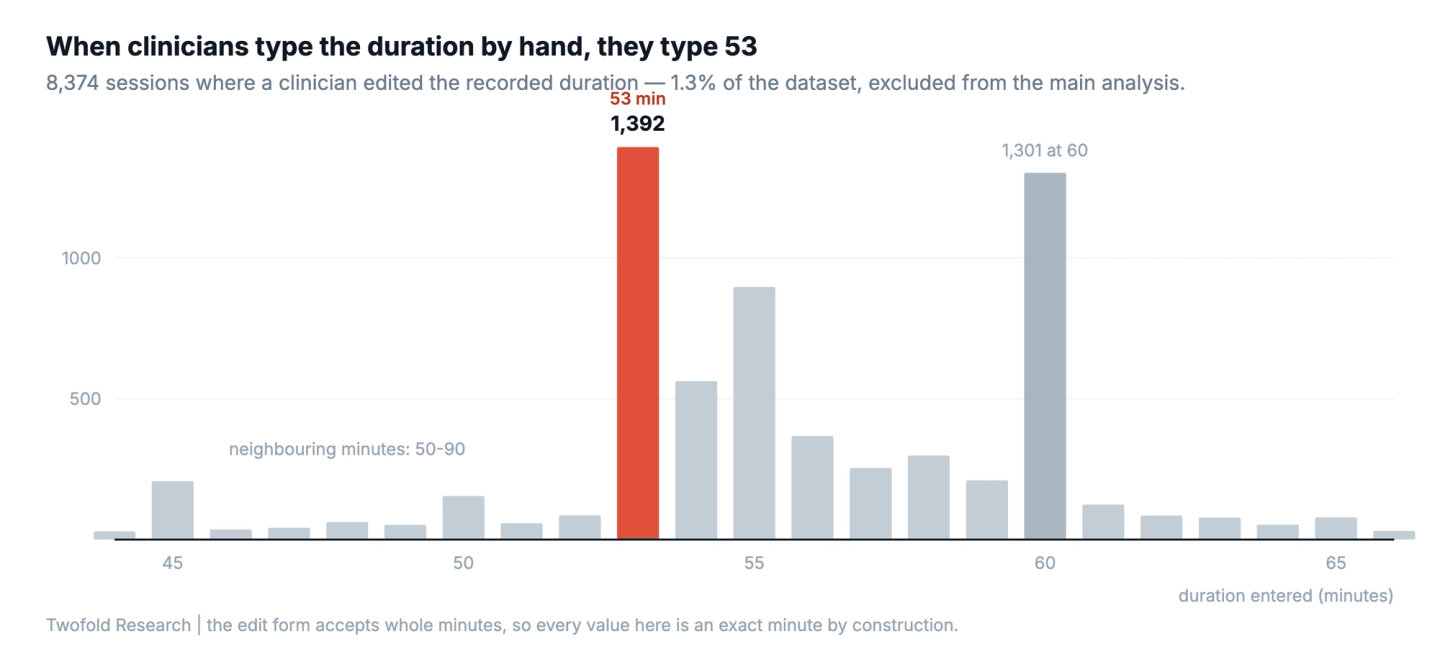
Figure 3. Manually entered session durations, minutes 44 to 66. Excluded from all other figures.
Among those 8,374 sessions, 53 minutes is entered 1,392 times, against 58 entries at 51 minutes and 86 at 52. The only comparable value is 60 minutes, at 1,301 entries. A typed duration doesn't measure how long a session ran, but it does record what the clinician wrote down.
What this doesn't establish
The distribution changes at a reimbursement boundary. Several mechanisms would produce that, and this dataset can't separate them.
Booking a 55‑minute appointment so it comfortably clears the threshold is ordinary practice management.
The 38-minute boundary
We also predicted a smaller step at 38 minutes, the floor of 90834. Sessions increase 14.6% from 37 to 38 minutes, against roughly 8% in the surrounding minutes. It is present but much smaller than the change at 53, and it separates a smaller financial gap — the lowest code from the middle one. We would not rest a claim on it alone.
Limitations
Method
Parameter | Value |
|---|---|
Window | 1 February 2026 to 1 August 2026, fixed |
Psychotherapy sessions | 661,330 total: 652,956 system-measured, 8,374 manually entered |
Clinicians | 4,105 |
Primary analysis | System-measured durations only |
Included | Live conversation recordings with successfully generated, non-deleted notes |
Excluded | Dictation and typed notes; 7,231 sessions under 1 minute; 1,005 over 4 hours |
Professions | The twelve psychotherapy specialties from the earlier study; all twelve resolved to specialties in the database |
Control cohorts | Physical, occupational and speech therapy (31,955 sessions); psychiatry (229,038) |
Privacy | Aggregate counts per minute. No visit, clinician or patient identifiers and no session content. Buckets with fewer than 5 contributing clinicians are suppressed. |
The earlier study used a rolling six‑month window from its run date, which isn't reproducible. This one uses fixed dates.
The data
Minute‑by‑minute counts for every figure above — psychotherapy split by system‑measured and manually entered, both control cohorts, and the four largest professions — are published as session-length-by-minute-2026.csv under CC BY 4.0. The specialty‑level dataset from the earlier study is also available. Questions: info@trytwofold.com
About Twofold
Twofold is an ambient AI scribe for clinicians. It records the visit and drafts the clinical note, and session duration is stored as part of that workflow, which is what made this analysis possible. Audio is discarded once the note is drafted and patient data is not used to train models. More about the product.