
Free for a week, then $19 for your first month
Template

Medication Log Template

Discover practical Medication Log templates to enhance your documentation efficiency.

Medication Log Template Hero Image

Picture this: You're managing a full roster of patients, each with their own complex medication schedules. It's easy to feel overwhelmed trying to keep track of all the scripts, dosages, and refill dates. This is where the Medication Log Template steps in, offering a way to organize and maintain medication records without the headache.

What Is a Medication Log Template?

A Medication Log Template is a structured tool used to document and track patient medication details. It serves as a crucial component in maintaining accurate medical records and ensuring the continuity of care.

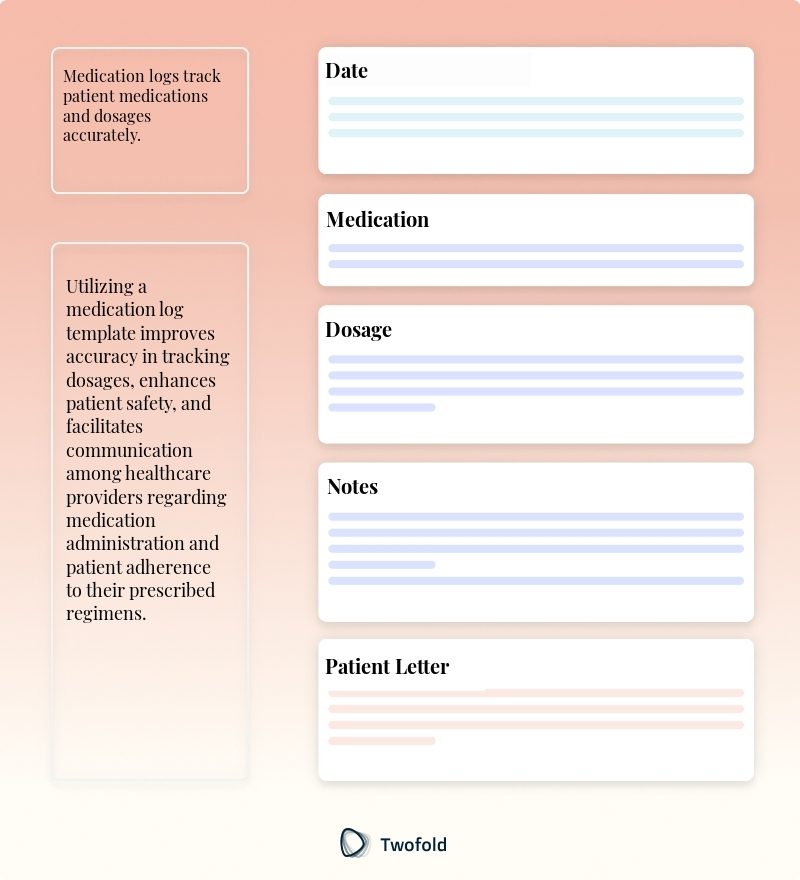
This template typically includes fields for medication names, dosages, administration schedules, and any necessary notes on patient reactions or adjustments. With these details, healthcare providers can ensure that patients are adhering to their prescribed regimens.

Key Components of a Medication Log Template

The central elements of a Medication Log Template ensure comprehensive documentation.

  • Patient Name and ID
  • Medication Name
  • Dosage
  • Frequency and Timing
  • Route of Administration
  • Prescribing Doctor
  • Notes on Side Effects
Key Components of Medication Log Template

How to Use a Medication Log Template: Step-by-Step Process

  1. Initiate a log entry by filling out the patient identification fields.
  2. List each medication along with the prescribed dosage.
  3. Enter the administration schedule, ensuring clear timing instructions.
  4. Record any changes or updates to medications during follow-up visits.
  5. Review the log regularly to ensure ongoing accuracy and compliance.

Benefits of a Medication Log Template

Benefit

Description

Improved Patient Safety

Reduces the risk of medication errors with clear documentation.

Enhanced Communication

Provides a concise reference for healthcare teams.

Efficient Record Keeping

Streamlines the process of tracking medication histories.

Stakeholders in Medication Log Templates

Several key stakeholders benefit from well‑maintained medication logs.

  • Doctors: Dr. Smith can use the log to review current medications before prescribing new treatments.
  • Nurses: Nurse Jane relies on the log to administer accurate dosages during her shift.
  • Pharmacists: John, a pharmacist, checks the log for potential drug interactions before filling prescriptions.

Example of a Medication Log Template

An example could include fields like patient name, list of current medications, dosages, administration times, and special instructions.

See Template Example

Real-World Use Cases: Practical Impact of the Medication Log Template

In practical scenarios, the Medication Log Template can significantly influence patient care.

  • Elderly care: A nursing home streamlines communication between staff during shift changes, substantially reducing medication errors.
  • Outpatient practices: An outpatient clinic uses medication logs to minimize the risk of adverse drug reactions in multi-medication patients.
  • Inpatient facility: A busy hospital ward enhances the efficiency of its rounding process by having up-to-date medication logs readily accessible.

Conclusion

The Medication Log Template proves to be an indispensable tool in healthcare settings, improving documentation standards and reducing errors. By maintaining thorough and accurate medication records, healthcare professionals can provide better patient care and communicate more effectively with their teams. With the right strategies in place, managing complex medication regimens becomes a much more straightforward task.

Disclaimer: This article is for informational purposes only and does not constitute legal or medical advice. Always consult professional guidelines and regulatory bodies for specific compliance requirements.

FAQ

Frequently asked questions

  • How should a Medication Log Template be adapted for patients with fluctuating or as-needed dosages?

    In situations where patients have medications that require fluctuating or 'as‑needed' dosages, the Medication Log Template should include a dynamic field specifically for dosage variations.

    This field should allow for daily entry updates to capture when a patient has deviated from standard dosages due to specific symptoms or needs, which is crucial for medications like insulin, pain management drugs, or psychiatric medications.

    A dedicated 'Note' section can also be utilized to document the reasoning behind each dosage change, ensuring clarity in clinical decisions and in communicating with other healthcare providers. Regular reviews and an approval process for dosage changes should be implemented for safety.

  • What are the best practices for incorporating electronic Medication Log Templates into existing Electronic Health Record (EHR) systems?

    Integrating a Medication Log Template into existing EHR systems requires ensuring compatibility with the EHR software’s architecture. Selecting a template that can be easily customized and upgraded is beneficial.

    The template should be compliant with data standards such as HL7 or FHIR to facilitate seamless data exchange.

    EHR workflows should be evaluated to determine where the template best fits and ensure that data entry does not become cumbersome for healthcare providers. User training is crucial, and feedback loops should be established to continuously refine the integration process, focusing on user‑friendliness and efficiency.

  • How do you manage medication logs for patients with complex drug interaction profiles or contraindications?

    When dealing with patients who have complex drug interaction profiles or contraindications, it is critical to incorporate automated alerts in the Medication Log Template. These alerts should trigger when potential interactions are detected as new medications are logged.

    The template should include a dedicated section for documenting known allergies and contraindications, which should be prominently displayed to avoid oversight.

    Integration with drug databases for real‑time interaction checking is recommended, enabling providers to make informed decisions quickly. Ensuring that pharmacists are actively engaged in reviewing these logs can further decrease the risk of adverse events.