

Free for a week, then $19 for your first month
Template

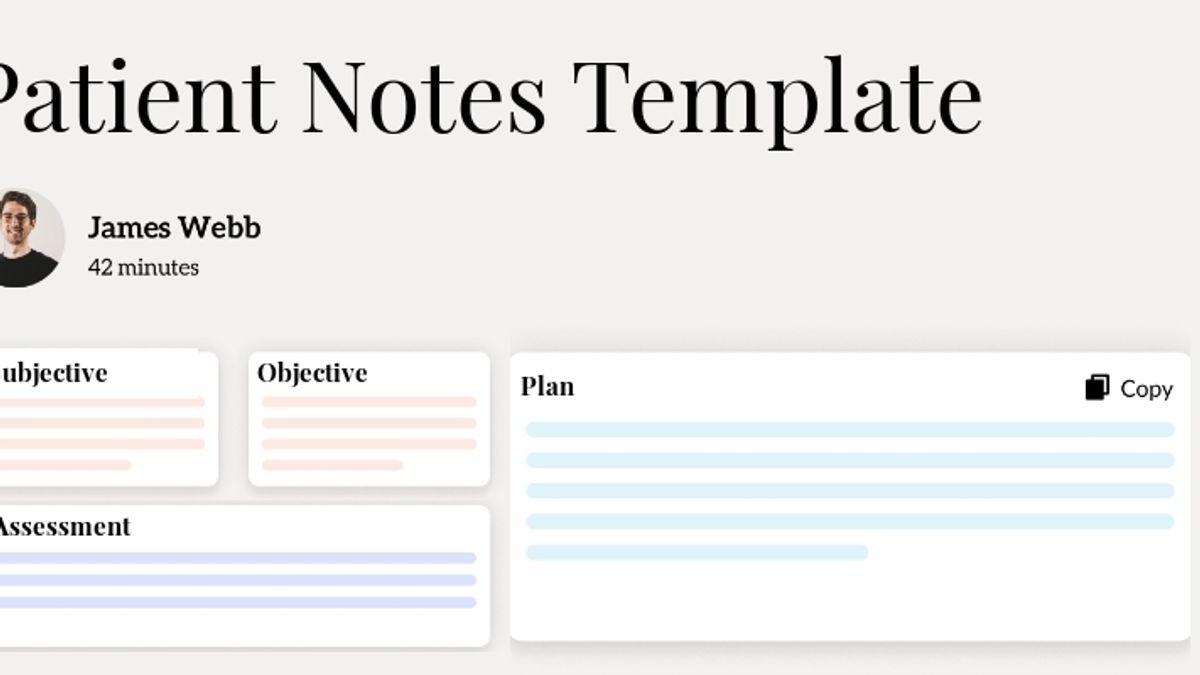
Patient Notes Template

Discover practical Patient Notes templates to enhance your documentation efficiency.

Patient Notes Template Hero Image

Are you often overwhelmed by jotting down medical notes that are accurate, clear, and concise? You're certainly not alone. Finding a seamless way to document patient interactions without losing critical information has been a persistent challenge for healthcare professionals. Dive into the nuances of a Patient Notes Template to transform your note‑taking process.

What Is a Patient Notes Template?

Patient Notes Templates are structured frameworks aiding healthcare providers in methodically documenting patient encounters. They ensure records are comprehensive, improving communication and continuity of care.

They help maintain standardized documentation across various providers, enhancing the accuracy and utility of patient information. By promoting efficiency, they free up more time for actual patient care.

Key Components of a Patient Notes Template

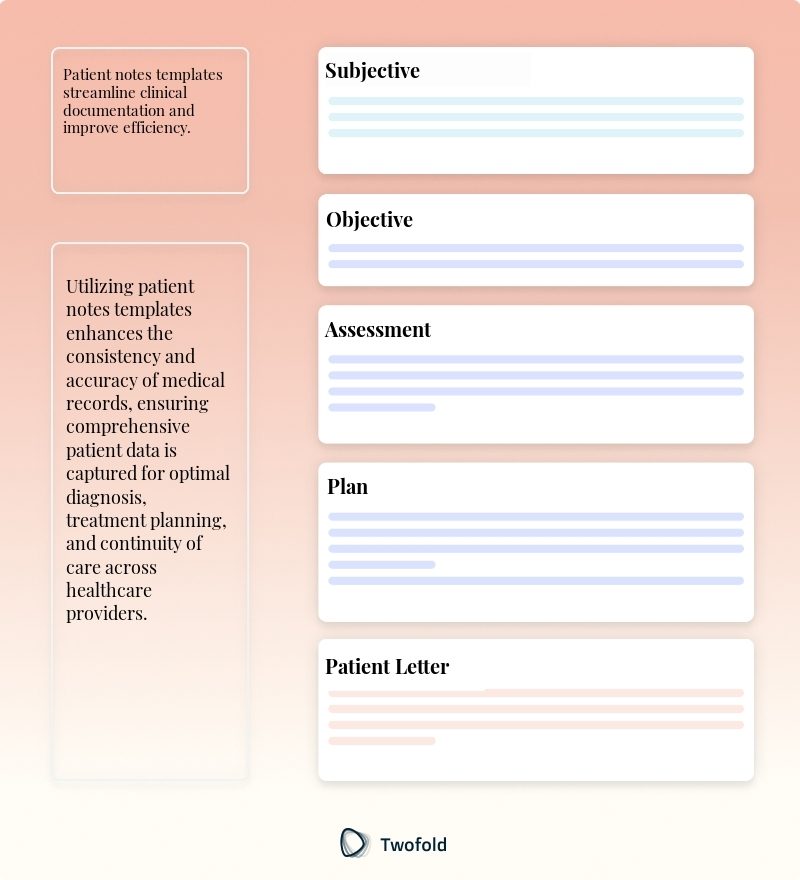
A typical Patient Notes Template comprises several critical elements, each serving a specific purpose:

  • Patient Identification: Essential patient details such as name, age, gender, and medical ID.
  • Reason for Visit: The primary complaint or reason for the current encounter.
  • Medical History: A quick overview of past and present medical conditions and treatments.
  • Diagnosis: Professional evaluation of the patient's condition based on presented symptoms and test results.
  • Treatment Plan: Prescribed medications, procedures, and follow-up appointments.
  • Provider Signature: A confirming signature ensuring the authenticity and accountability of the documentation.
Key Components of Patient Notes Template

How to Use a Patient Notes Template: Step-by-Step Process

  1. Gather and enter all relevant patient identification details.
  2. Document the reason for the patient's visit and elaborate on symptoms, if necessary.
  3. Record the patient's medical history with a focus on relevant past conditions.
  4. Conduct and document any examinations, capturing all findings accurately.
  5. Provide a diagnosis, supporting it with observations and test results.
  6. Outline a treatment plan and schedule follow-ups as necessary.
  7. Complete your notes by signing them, confirming their accuracy.

Benefits of a Patient Notes Template

Benefit

Description

Standardization

Ensures uniformity in patient records across different practitioners.

Time-Efficiency

Reduces the time spent in note-taking, allowing for more patient interaction.

Accuracy

Minimizes errors in documentation by following a consistent structure.

Improved Communication

Enhances understanding and collaboration among different healthcare providers.

Stakeholders in Patient Notes

Various stakeholders benefit from well‑maintained patient notes. Here are some key players:

  • Healthcare Providers: Physicians and nurses who rely on these notes for accurate diagnosis and treatment decisions. For example, Dr. Smith quickly assessed a patient's progress by reviewing comprehensive notes from previous visits.
  • Patients: They receive more precise treatment and continuity of care. Consider a patient who seamlessly transitioned between doctors, thanks to coherent historical records.
  • Healthcare Administrators: They ensure compliance with legal standards and improve operational efficiency. Jane, a clinic manager, noticed fewer disputes over patient records due to precision in note-taking.

Example of a Patient Notes Template

An example of a Patient Notes Template may include fields for the patient's demographics, history, vitals, diagnosis, and follow‑up recommendations, all designed to capture critical health information efficiently.

See Template Example

Real-World Use Cases: Practical Impact of the Patient Notes Template

Patient Notes Templates profoundly affect many practical scenarios, enhancing efficiency and patient safety through real‑world applications.

  • Emergency Situations: Imagine a doctor accessing an ER patient's summary swiftly, aiding in critical decision making during high-pressure situations.
  • Chronic Disease Management: A diabetes clinic uses these notes to track patient progress over months, adapting treatment plans effectively.
  • Multi-Practitioner Settings: In a multidisciplinary facility, professionals from different specialties coordinate care seamlessly through standardized notes.

Conclusion

Incorporating a robust Patient Notes Template into daily practice enhances clarity, ensures accuracy, promotes continuity of care, and boosts overall efficiency in healthcare settings. As healthcare professionals strive to improve patient outcomes, these templates emerge as crucial facilitators of effective communication and documentation.

Disclaimer: This article is for informational purposes only and does not constitute legal or medical advice. Always consult professional guidelines and regulatory bodies for specific compliance requirements.

FAQ

Frequently asked questions

  • How do Patient Notes Templates handle the documentation of complex diagnostic procedures, such as differential diagnoses?

    In scenarios where multiple potential conditions must be considered, the template should include sections for documenting differential diagnoses. This involves listing all possible conditions, observations, and test results, enabling the healthcare provider to methodically narrow down possibilities.

    Templates should offer flexibility to add detailed commentary and rationale for excluding certain diagnoses based on evolving information or additional tests.

    Advanced templates may feature checklist formats or dropdowns to streamline recording differential diagnoses, particularly useful in a multidisciplinary context where specialists contribute differing perspectives.

  • What are some strategies for integrating Patient Notes Templates with electronic health record (EHR) systems in specialized practice settings?

    Integration requires ensuring compatibility between the template and existing EHR systems, potentially involving custom fields or data mapping to preserve data integrity across platforms.

    Specialized practice settings, like oncology or cardiology, may require unique template fields that capture discipline‑specific metrics or patient information, necessitating custom development or modification of standard templates.

    Robust data validation processes should be implemented to prevent data entry errors when templates feed directly into EHR systems, ensuring that specialized data like genetic markers or pharmacogenetic profiles are accurately recorded.

  • How should Patient Notes Templates be adapted for telehealth visits to ensure comprehensive and accurate documentation?

    Telehealth visits require modifications to templates to incorporate virtual consultation elements, such as video quality or connectivity issues, which can impact assessments.

    Templates should include fields to capture patient‑reported outcomes and self‑measured vitals, since physical assessments might be limited during remote consultations.

    Handling security and HIPAA compliance involves ensuring that the digital format of the notes maintains confidentiality, incorporating encrypted fields for sensitive data, especially if patient notes are shared via telehealth platforms with third‑party integrations.