What a treatment plan is
The intake tells you what's going on. The treatment plan says what you and the client are going to do about it. Each problem the client wants to work on gets a goal, each goal gets one or more objectives that can be counted or observed, and each objective gets an intervention you will deliver. A date to look at it again closes the loop.
Outpatient therapists aren't held to one national format, but Medicare spells out what a plan must contain in a psychiatric hospital. Under 42 CFR 482.61(c), the plan is based on an inventory of the patient's strengths and disabilities and includes a substantiated diagnosis, short‑term and long‑range goals, the specific treatment modalities, the responsibilities of each team member, and documentation that justifies the diagnosis and treatment. Most payer and agency forms are some version of that list, so it works as a checklist in private practice too.
| | |
|---|
| What we're treating, the targets and the methods | After the intake, for any client in ongoing therapy |
| Why the problem started and why it keeps going | Before the plan, to pick the right interventions |
| What the whole team is doing for one patient | Several providers share the patient, often with chronic illness |
| Clinical goals plus housing, benefits and other practical needs | Agency or case management settings |
| What happened over a course of treatment | At discharge, transfer or a payer request |
| What the client does in a suicidal crisis | Any client with suicide risk, alongside the treatment plan |
What each section holds
| |
|---|
| Name, date of birth, plan date, treating clinician |
| Each diagnosis with its ICD-10-CM code, and what the assessment found that supports it |
| What the client brings: skills, supports, motivation, past successes |
| Two to four problems in plain words, ideally the client's own |
| Where the client wants to be when treatment ends |
| Steps toward each goal, each with a number and a target date |
| What you will do, how often, and who does it if there's more than one clinician |
| Session schedule and the expected length of treatment |
| When the plan is formally reviewed, plus what triggers an earlier review |
| Client and clinician, with the date |
Treatment plan example
Daniel (fictional), 26, works as a software tester. For two years he has spent close to three hours a day washing his hands and re‑checking that the stove and front door are off. He is now late to work twice a week and has stopped visiting his parents because their kitchen "isn't clean enough". His intake assessment found contamination obsessions with washing rituals and checking compulsions, with no depressive episode.
| Daniel's treatment plan, October 21, 2026 |
|---|
| F42.2, mixed obsessional thoughts and acts. Obsessions and compulsions are both documented at intake. |
| Wants to change, keeps a detailed log already, close to his younger sister, steady job |
| "Washing and checking take over my mornings and evenings." |
| Daniel gets ready and leaves for work in under 45 minutes without going back to check. |
| 1a. Builds an exposure hierarchy of at least 12 situations with his therapist by November 4. 1b. Cuts total washing time from about 3 hours to under 1 hour a day by January 15, measured by his own daily log. 1c. Leaves home with one check of the stove and door, five mornings in a row, by February 1. |
| "I've stopped seeing my family." |
| Daniel has dinner at his parents' house twice a month. |
| 2a. Eats one meal at his parents' kitchen table using the response-prevention plan by December 20. 2b. Two family dinners a month for two months running by March 1. |
| Exposure and response prevention, 50-minute sessions weekly, with between-session exposures assigned and reviewed each week. Psychoeducation for Daniel and, with his consent, one joint session with his sister. Referral to his primary care physician to discuss medication if washing time hasn't dropped by half at the January review. |
| Formal review January 15, 2027. Earlier review if a depressive episode or suicidal thoughts emerge. |
| Daniel and his therapist, October 21, 2026 |
Each objective names a number Daniel already tracks, so the January review is a matter of reading his log. That's the test for any objective: could someone else tell from the record whether it was met?
Coding the diagnosis on the plan
The diagnosis line is where plans and claims most often disagree. For OCD, the FY2027 ICD‑10‑CM Alphabetic Index sends "disorder, obsessive‑compulsive" to F42.9, obsessive‑compulsive disorder, unspecified. The more specific codes come from the tabular list: F42.2 is mixed obsessional thoughts and acts, F42.3 is hoarding disorder and F42.4 is excoriation (skin‑picking) disorder. If your intake documents both obsessions and rituals, as Daniel's does, F42.2 says more than F42.9.
Category F42 also carries an Excludes2 note for obsessive‑compulsive symptoms that occur in depression (F32.‑, F33.‑). If the client's checking only appears during depressive episodes, code the depression and describe the symptoms in the plan.
Blank treatment plan template
Copy this into your record system and repeat the problem block as needed.
- Client name, date of birth, plan date:
- Treating clinician and credentials:
- Diagnoses with ICD-10-CM codes:
- Assessment findings that support the diagnosis (two or three lines):
- Strengths and supports:
- Problem 1, in the client's words:
- Long-term goal 1:
- Objective 1a (behavior, number, target date):
- Objective 1b:
- Interventions for problem 1 (method, frequency, who delivers it):
- Problem 2, goal, objectives and interventions:
- Session frequency and expected length of treatment:
- Referrals and coordination with other providers:
- Formal review date, and what would trigger an earlier review:
- Client signature and date:
- Clinician signature and date:
Common mistakes
- Objectives with no number. "Reduce compulsions" can't be reviewed. "Washing under 1 hour a day by January 15" can.
- Interventions listed as a menu of every method you know. Name what you'll actually do with this client and how often.
- A plan that never changes. If the progress notes show the client met an objective in week six, the plan should show a new one by week eight.
- Goals the client didn't agree to. Write problems in the client's words and have them sign.
- A diagnosis on the plan that doesn't match the one on the claim, or a code the assessment doesn't support.
How often to review a treatment plan
Outpatient review intervals come from your payer contracts, your state rules and your agency's policy, so check those first. Many practices review every 90 days and whenever something important changes. In a Medicare psychiatric hospital, 42 CFR 482.61(d) requires progress notes at least weekly for the first two months and at least monthly after that, and those notes must contain recommendations for revising the treatment plan as indicated. Even outside a hospital, writing a line in each progress note on which objective moved keeps the plan honest.
Who can see the treatment plan
Under HIPAA, the treatment plan is part of the regular record. The definition of psychotherapy notes in 45 CFR 164.501 leaves out any summary of the treatment plan, so the extra protection psychotherapy notes get doesn't extend to it. Expect clients, payers and other treating providers to be able to see it under the usual rules, and write it accordingly: concrete, respectful and free of process notes.
Writing treatment plans with Twofold
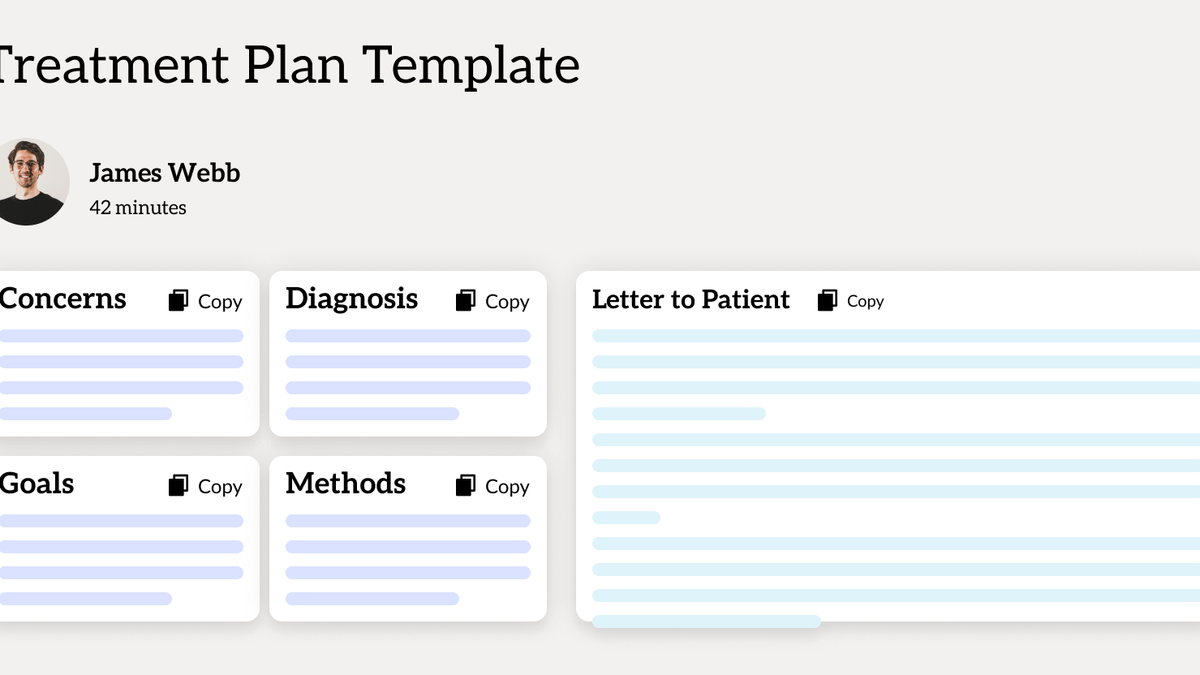
You can set this layout up as a custom template in Twofold. After the planning session, Twofold drafts problems, goals and objectives from what you and the client discussed, and you set the numbers and dates before signing. For the progress notes that track the plan, see our guide to writing therapy progress notes in DAP, BIRP or GIRP.
Before the plan: the biopsychosocial assessment and the case conceptualization template. Alongside it: treatment goals for anxiety, progress notes and the safety plan. At the end: the treatment summary and discharge summary.
Reviewed and updated October 2026.