


Artificial intelligence is finding its way into exam rooms. These tools can quickly transcribe conversations and generate draft notes. Clinicians must still uphold their obligations regarding patient data, so that means thinking carefully about how the AI uses the information it hears. It means being upfront with patients about the technology. It also requires knowing who controls the data once the visit ends. Many practices overlook these details in the rush to adopt new software. This guide addresses those responsibilities directly, focusing on how to use HIPAA-compliant AI note tools without losing the trust that takes years to build.
Principle 1: Privacy
Privacy, in this context, refers to a patient's right to control who sees their health information. The clinician's job is to ensure that unauthorized parties cannot access Protected Health Information (PHI).
The main concern is data flow. Where does the audio go after the visit ends? Does it stay on your local device, or does it go to a vendor's cloud server? Some companies retain recordings to improve their models. Others delete audio files immediately after transcription. These distinctions matter. A policy that sounds reasonable in a vendor's marketing materials may not align with your legal obligations.
To address this, you need to assess the vendor's infrastructure. Start by requesting a Business Associate Agreement, or BAA. This contract is required under HIPAA. It binds the vendor to the same safeguards you must follow. Without a BAA, the vendor is not legally obligated to protect your patient data.
You should also examine how the AI handles identifiers. Names, dates of birth, and medical record numbers should be stripped from any data used for system diagnostics. If the vendor cannot confirm this level of de‑identification, the tool poses a risk.
Below are questions worth asking before you commit to any AI documentation tool. These are not exhaustive, but they provide a starting point.
- What security protocols protect data during transmission and storage?
- Are audio files deleted automatically, and if so, when?
- Does the vendor use patient data to train or improve its algorithms?
- Where are the servers physically located?
- Who inside the vendor's organization can access the transcribed notes?
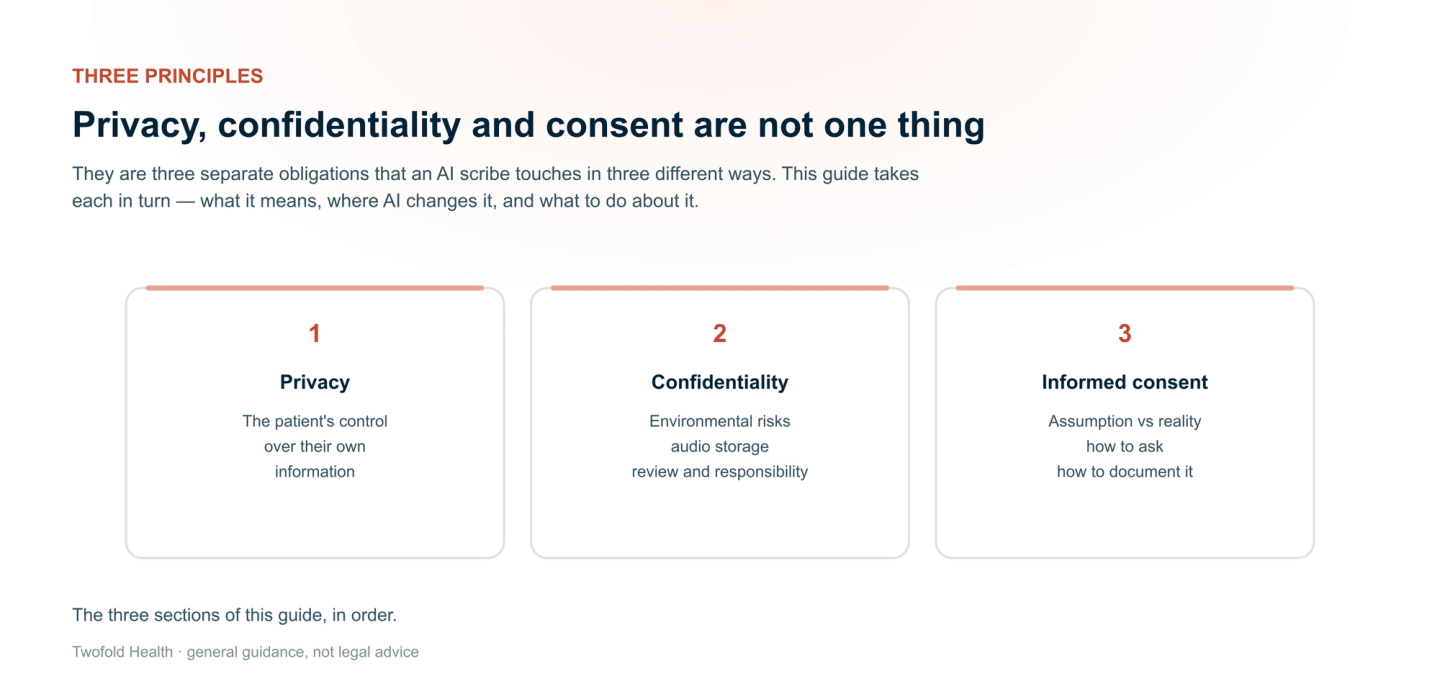
Principle 2: Confidentiality
Confidentiality is distinct from privacy, though the two are often confused. Privacy concerns access. Confidentiality concerns what you do with the information once you have it. You cannot repeat what a patient tells you. You cannot use their story for casual conversation. This duty exists regardless of whether the information is stored on paper or processed by software.
An AI scribe introduces complications here. The tool listens to everything. It captures not just clinical facts but also hesitations, offhand remarks, and emotional cues. Some of this material is relevant, some of it is not. The AI does not distinguish between the two. It simply transcribes. That means you are responsible for filtering the output before it becomes part of the permanent record.
The AI Challenge
- The device cannot identify who is speaking or whether the conversation is clinically relevant.
- Transcriptions may include sensitive details that were never intended for documentation, such as family disputes or financial stress.
- The software lacks contextual judgment. It will record whatever it hears, regardless of setting or appropriateness.
Environmental Risks
- Activating the scribe in a waiting room or hallway may capture conversations involving other patients.
- The microphone should only be active inside the exam room.
- Activation must occur after you have obtained the patient's agreement, not before.
Audio File Storage
- Some vendors retain recordings for quality improvement, others store them temporarily and then delete them.
- A voice recording is identifiable information, even before transcription occurs.
- If the file is leaked or accessed without authorization, you are accountable.
- You must know which storage policy applies to your practice.
Review and Responsibility
- AI-generated summaries sometimes include errors or hallucinations.
- The software may insert a detail that was never mentioned or misinterpret a symptom.
- Mistakes become part of the legal record if you do not catch them.
- You must review every note before signing it.
A Note on Pressure
Some clinicians feel pressure to trust the output because the tool saves time. That pressure is understandable, but the time saved is not worth the cost of a breach of confidence. The patient who learns their private remark was captured and stored without their knowledge will question everything else you say.
Principle 3: Informed Consent
Informed consent is a process. The goal is to ensure that patients understand what will happen during their visit and what tools you will use to document it. They need enough information to make a voluntary decision. This principle rests on respect for patient autonomy. Patients have the right to know who is listening to their words and how that information will be used.
The introduction of an AI scribe complicates this process. Many patients assume that only you and your staff are present. They may not realize that a software application is recording and transcribing the conversation. This assumption does not absolve you of the duty to disclose. If you fail to inform the patient, you have not obtained valid consent.
The Gap Between Assumption and Reality
- Patients generally understand that you will take notes, as this is expected.
- Patients do not generally understand that an AI may be processing their speech in real time.
- The distinction matters: A machine does not have the same obligations as a human.
- Without disclosure, the patient cannot meaningfully consent to the use of this technology.
Best Practices for Obtaining Consent
- Discuss the AI scribe before you activate it, do not wait until after the visit begins.
- Explain what the tool does in plain language.
- Describe what happens to the audio and the transcribed notes. (Mention storage, deletion, and vendor access if relevant.)
- Offer the patient a choice. They should be able to decline without feeling that their care will suffer.
See how to handle situations when a patient refuses recording.
Suggested Language for the Conversation
A few sentences can cover the essential points.
"I would like to use a tool that listens to our conversation and helps me take notes. It allows me to focus on you rather than typing. The audio is deleted after the visit. Are you comfortable with that?"
"This is an AI application that generates a draft of our visit. I will review and edit everything before it becomes part of your record. Is it okay if I use it?"
"We are trying a new documentation method today. It records our conversation and creates a summary. You are welcome to say no. Would you prefer that I take notes the usual way?"
Handling Refusal
Some patients will decline. This should not create tension. You can switch to manual documentation without suggesting that the patient is being difficult. The refusal may stem from privacy concerns, cultural values, or a general discomfort with technology. None of these reasons are invalid; respect their decision and document the refusal in the chart.
Documenting Consent
- Record that you obtained consent in the patient's chart.
- Note the date and time of the discussion.
- Include the patient's response, whether they agreed or declined.
- If they agreed, note that they were given the option to refuse.
When Verbal Consent Is Sufficient
Verbal consent is generally acceptable for AI documentation, provided you have disclosed the relevant information. Some practices prefer written consent, especially if they use AI in multiple settings. The standard depends on your state laws and institutional policies. If you are uncertain, consult your compliance officer.
A Final Consideration
Consent is not a one‑time event. If you introduce a new AI tool or change the vendor's data policy, you should inform your patients again. They cannot consent to something they do not know about. The obligation to disclose is ongoing, and patients who feel informed are more likely to trust you.
Conclusion
The three principles discussed here apply every time you see a patient. Technology will continue to evolve, and new tools will emerge. That does not change the obligations you carry. Using a HIPAA-compliant AI scribe responsibly means staying informed about how it works and being transparent with those you treat. The goal is not to avoid technology but to use it in a way that preserves what matters most, the patient‑provider relationship.