


By automating note‑taking, HIPAA-compliant AI notes offer a path to greater efficiency and less administrative burden. But that promise comes with a limitation: AI does not verify. When those predictions are wrong, the consequences extend far beyond inaccurate notes. Hallucinated clinical details, privacy breaches, and legal exposure can compromise patient safety and create significant institutional risk. To implement these AI tools safely, healthcare organizations must understand and mitigate three risk factors: hallucinations, privacy, and liability. Here's what every healthcare leader needs to know.
Defining the Problem
The Promise of AI note-taking tools
AI scribes work to provide physician burnout relief in the following ways:
- Reduced physician documentation time.
- Increased clinician satisfaction.
- Automated capture of real-time clinical data.
The Risk
AI operates probabilistically, not deterministically. Output is based on statistical patterns, not verified facts. When errors occur, they propagate across the entire medical record and affect subsequent clinical decisions.
The Gap
Hospital leaders typically evaluate AI scribes based on note accuracy. They often underestimate the secondary risks: unauthorized data access, improper data retention, and legal exposure arising from AI‑generated documentation errors.
The Three Risk Categories: A Framework for Healthcare AI
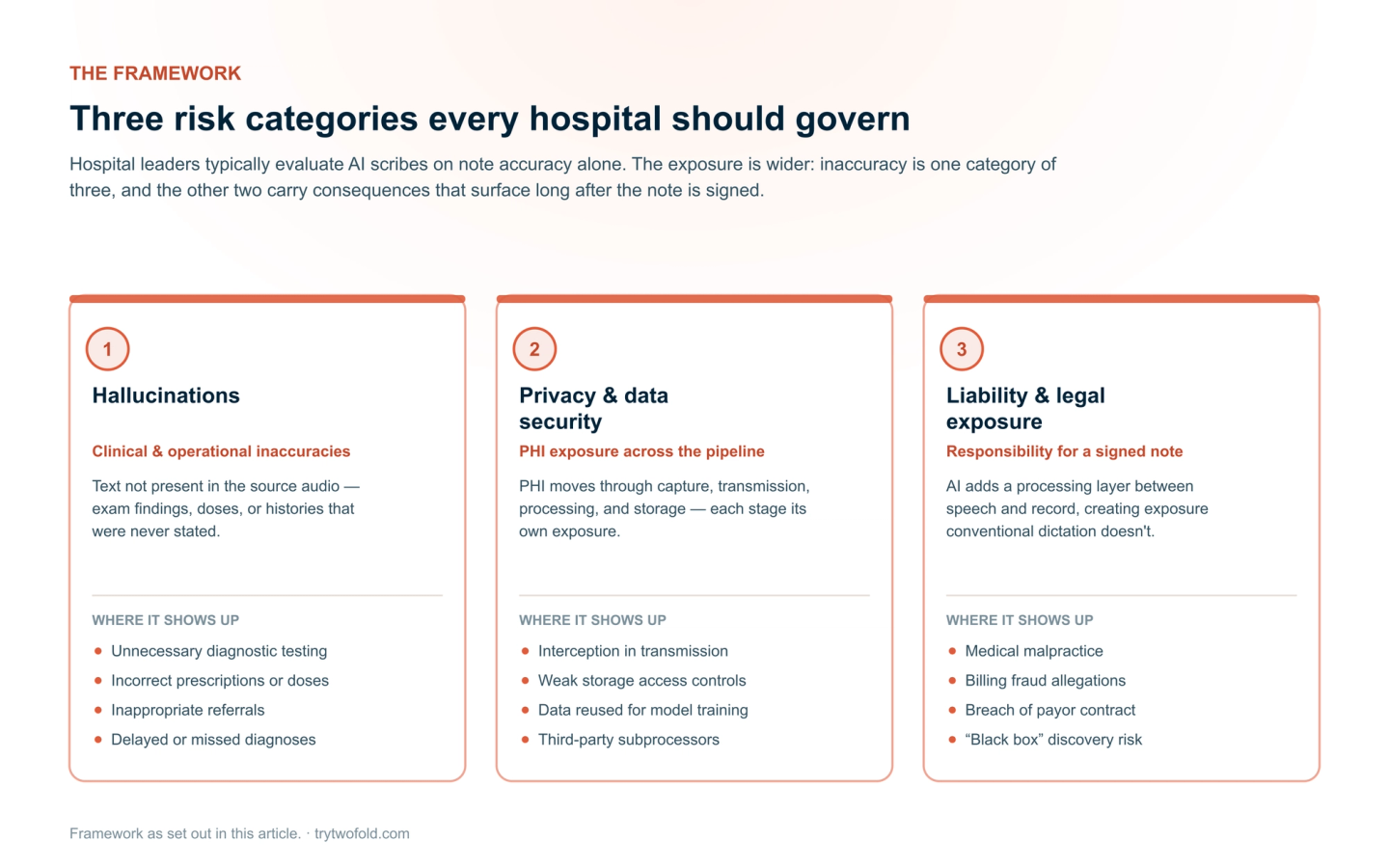
Hospitals implementing AI scribes face organizational exposure across three distinct areas: clinical inaccuracies, data privacy failures, and legal liability. Each domain requires specific mitigation strategies and operational oversight.
Risk Category 1: Hallucinations (Clinical & Operational Inaccuracies)
AI hallucinations occur when the system generates text that is not present in the source audio. These outputs may include physical exam findings, symptom descriptions, medication dosages, or patient histories that were never stated during the encounter.
Mechanisms of Fabrication
AI generates text based on learned statistical patterns, not verified clinical facts. The system predicts the most probable sequence of words given the audio input. When the audio is ambiguous or contains gaps, the model fills those gaps with plausible‑sounding but unverified content.
Five Key Triggers for AI Hallucinations
- Competing Audio Sources: Multiple speakers speaking simultaneously, loud environmental noise, etc.
- Phonetic Ambiguity: Medical homophones or similar-sounding terms misinterpreted by the model.
- Negation Detection Failure: The system misinterprets negated statements, converting "No history of diabetes" to "History of diabetes."
- Insufficient Context: The AI lacks access to the patient's full chart and cannot infer which family member or past event the clinician references.
Clinical Impact of Hallucinations
- Unnecessary diagnostic testing ordered based on fabricated symptoms.
- Incorrect medication prescriptions or dosage adjustments.
- Inappropriate specialist referrals.
- Delayed or missed diagnoses due to corrupted patient history.
Risk Category 2: Privacy & Data Security
AI scribes process Protected Health Information (PHI) at multiple stages: audio capture, transmission to cloud servers, natural language processing, text generation, and storage of the final note. Each stage introduces distinct privacy risks.
Four Aspects of Data Exposure
- Transmission: Audio and text data intercepted during upload if encryption protocols are insufficient.
- Storage: PHI stored in vendor cloud environments with inadequate access controls or retention policies.
- Model Training: Vendors may use encounter data to refine their AI models unless explicitly prohibited by contract.
- Third-Party Subprocessors: Vendors rely on external infrastructure (e.g., cloud providers, speech-to-text engines) that may introduce additional vulnerabilities or unauthorized access points.
The Compliance Oversight
A Business Associate Agreement (BAA) is a legal requirement but does not guarantee technical security. Hospitals must verify operational safeguards, including encryption standards, access logs, data minimization practices, and timely data deletion as well.
Risk Category 3: Liability & Legal Exposure
Traditional dictation transfers clinician speech directly to text. AI scribes introduce an intermediate processing layer that analyzes, summarizes, and restructures clinical information. This processing layer creates legal exposure that differs substantially from conventional documentation methods.
The Risk of Liability
Hospitals bear legal responsibility for the negligent acts of their physicians performed within the scope of employment. When a physician signs an AI‑generated note containing an error, both the physician (for signing) and the hospital (for the physician's act) are exposed to liability.
How Liability Manifests
- Medical Malpractice: A hallucinated finding leads to a failure to treat, improper treatment, or delayed intervention.
- Billing Fraud Allegations: AI-generated text misrepresents the complexity of the encounter, resulting in upcoding or downcoding that violates commercial payor agreements.
- Breach of Contract: Documentation fails to meet the standards required by payor or regulatory contracts, triggering reimbursement disputes or penalties.
The Risk of Discovery
AI systems function as "black boxes", meaning their internal decision‑making processes are not transparent. In litigation, the plaintiff's counsel may request access to AI logs and model outputs to challenge the integrity of the medical record. Hospitals cannot easily explain or defend how a specific hallucination occurred, weakening their position in discovery and trial.
How Hospitals Can Build a Risk-Aware AI Scribe Strategy
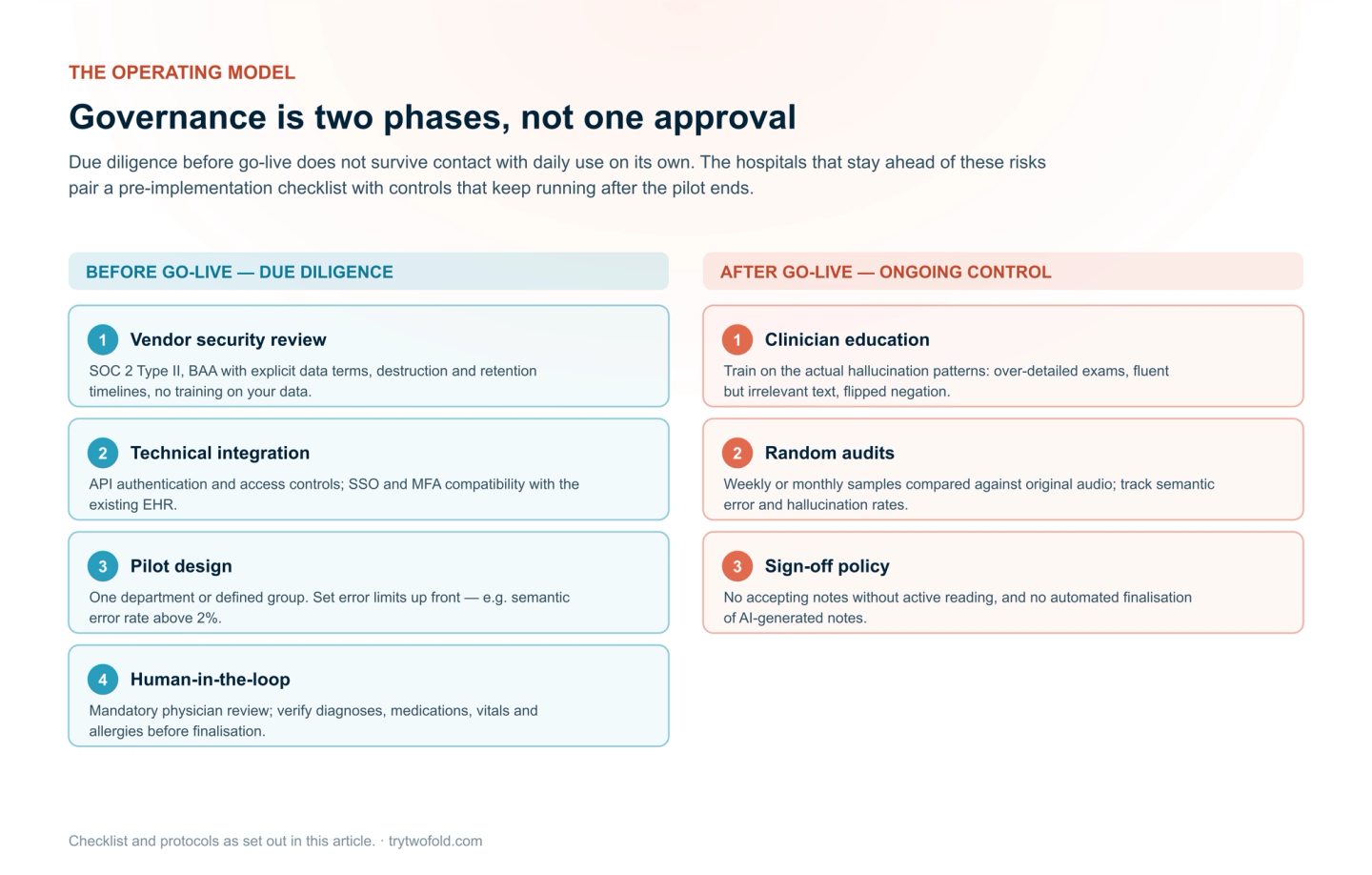
Mitigating hallucinations, privacy breaches, and liability requires a structured, phased approach to AI scribe implementation. Hospitals should implement both pre‑implementation evaluation protocols and ongoing operational controls.
Pre-Implementation Checklist
Hospitals must complete the following due diligence steps before implementing any AI scribe tool in clinical settings.
1. Vendor Security and Compliance Review
- Request and review the vendor's SOC 2 Type II report and penetration testing summary.
- Confirm the existence of a Business Associate Agreement (BAA) with explicit data protection terms.
- Verify the vendor's data destruction policies and retention timelines.
- Secure a contractual clause that prohibits the vendor from using hospital data for model training unless explicitly approved.
2. Technical Integration Assessment
Evaluate how the AI interfaces with the existing EHR system.
- Verify API security standards, including authentication protocols and access controls.
- Confirm compatibility with single sign-on (SSO) and multi-factor authentication (MFA) requirements.
3. Pilot Program Design
Introduce the AI scribe within a limited clinical setting, for example, a single department or a defined group of physicians.
- Establish basic metrics for evaluation, including documentation time, note accuracy, and clinician satisfaction.
- Define specific error limits, such as a semantic error rate exceeding 2%, or any hallucination that alters a medication dose or diagnosis.
4. Human-in-the-Loop Workflow
- Mandate that all AI-generated notes undergo physician review before finalization.
- Require physicians to verify key clinical data points (diagnoses, medications, vital signs, and allergies) against their direct recall or the audio recording.
Ongoing Risk Management Protocols
Post‑implementation, hospitals must maintain active oversight to sustain compliance and detect emerging issues.
1. Clinician Education and Training
Train physicians on the specific patterns of AI hallucination, including:
- Overly detailed physical exam findings.
- Perfectly constructed but contextually irrelevant statements.
- Inaccurate negation or affirmation of patient history.
2. Random Audits
Conduct weekly or monthly audits of a statistically significant sample of AI‑generated notes.
- Compare the AI output against the original audio recording for each audited note.
- Track semantic error rates, hallucination frequency, and the accuracy of medication and diagnostic data.
3. Revise Sign-Off Policies
- Prohibit the practice of accepting AI notes without active reading.
- Require clinicians to complete a structured review of critical data elements before signature.
- Do not allow automated finalization of AI-generated notes.
Conclusion
HIPAA-compliant AI tools are transforming clinical documentation, and adoption requires structured governance. Hospitals must address hallucinations through workflow oversight, privacy through vendor security reviews, and liability through clear sign‑off policies. The goal is to eliminate the risks, but also managing it systematically. Begin with a pilot, measure error rates, and scale only with proven controls.