


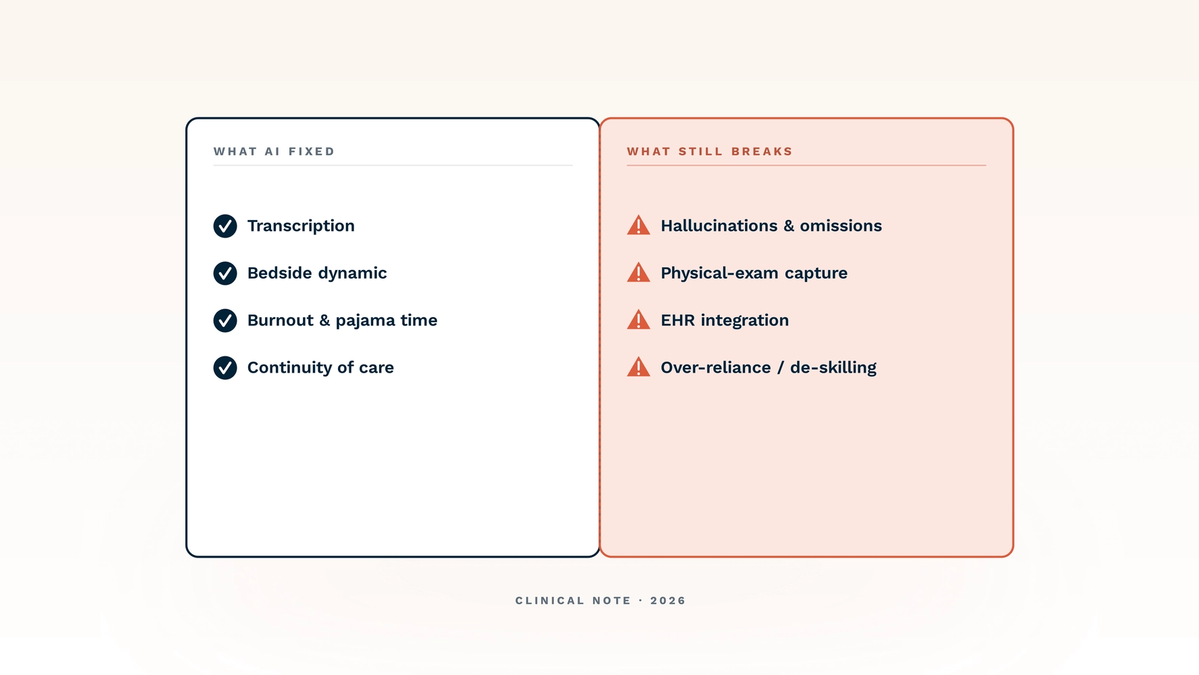
The average clinician spends about a third of their time on clinical documentation. AI clinical notes promise to change that. Ambient scribes and real‑time transcription now generate complete SOAP notes in seconds, restoring eye contact and reducing after‑hours work. But these tools are not flawless; hallucinations, omitted physical exam findings, and medico‑legal risks remain significant. The key is learning where AI excels, where it fails, and how to fix what needs fixing. This article separates the real gains from the remaining gaps.
What AI Is Actually Doing to Clinical Notes Today
Ambient AI medical scribes now listen to patient encounters and generate complete SOAP notes, HPI, and assessment plans within seconds. Major EHR vendors have embedded this technology into thousands of clinics. Real‑time transcription, medication extraction, and billing code suggestions are live.

How AI Is Changing Clinical Notes: Key Benefits for Clinicians
AI clinical notes are delivering measurable relief where it matters most: time, patient connection, burnout, and care coordination. Below are the four most significant benefits clinicians report today.
1. Real-Time Transcription and Structured Note Generation
AI converts conversation into HPI, ROS, physical exam, and A&P sections automatically; no typing and no extra templates. Notes are ready within 30 seconds after the patient leaves. The structure is consistent, billable, and requires only a quick review rather than a full write‑up.
Learn what makes quality clinical notes more than just basic transcription.
2. Improved Patient-Clinician Dynamic at the Bedside
With no screen or keyboard distraction, clinicians make eye contact again. Research shows patients perceive better listening and empathy when the physician is not typing.
3. Reducing Burnout and Eliminating "Pajama Time."
Evening documentation, often called "pajama time", is a top driver of physician burnout. AI clinical notes cut after‑hours charting, and clinicians report leaving the clinic on time and reclaiming evenings for family and rest.
4. Enhanced Continuity of Care Through AI-Generated Visit Summaries
AI doesn't just help the clinician; it helps the next clinician as well. Auto‑generated visit summaries extract key action items (pending labs, follow‑up plans, medication changes) and translate them into plain language for patients.
Specialists receive cleaner handoffs, and patients leave with a personalized after‑visit summary they can actually understand, improving adherence and reducing callbacks.
What Still Needs Fixing in AI Clinical Notes
Despite the above‑mentioned gains, AI clinical notes are not ready for unsupervised use. Below are four critical gaps that still require human oversight.
1. Hallucinations, Omissions, and Clinical Accuracy
These types of "hallucinations" are the single greatest safety risk:
- Added Findings: AI documents exam findings and data even when the exam was never performed.
- Wrong Laterality: "right knee swelling" when the patient complained of left knee pain.
- Omitted Negatives: Fails to document "denies chest pain", which is a medico-legal risk.
2. Physical Exam Capture and the Verbalization Problem
AI only hears what is spoken.
- Silent Auscultation: The clinician listens to the heart and lungs but says nothing, so the AI documents nothing.
- Silent Palpation: Checking for tenderness, warmth, or crepitus without narration = missing data.
- Solution Required: Clinicians must learn to "think aloud," a non-intuitive skill that disrupts natural workflow.
- Consequence: Incomplete physical exam sections lead to denied claims and poor clinical handoffs.
3. EHR Integration and Workflow Fragmentation
- Field Mapping Failures: AI puts the HPI in the ROS section or the assessment in the plan field.
- Structured Data Gaps: SNOMED, LOINC, and billing codes are often missing, leading to extra manual entry.
- Result: Clinicians save time on drafting but lose it on reformatting and troubleshooting.
Compare free vs. paid AI note tools to see which handles integration better.
4. Clinician Over-Reliance and the De-Skilling Risk
Trainees who only review AI notes may never learn to write good ones.
- Loss of Narrative Synthesis: Junior clinicians stop practicing how to write and organize a medical story from scratch.
- Analogous Risk: Residents may lose the ability to identify what is missing from a note.
Best Practices for Reviewing and Fixing AI-Generated Clinical Notes
AI clinical notes save time only if you review them efficiently. Below is a practical review protocol.

5-Step Review Protocol
- Scan for Hallucinations First: Focus on medications, allergies, laterality, and negative statements. These carry the highest legal and safety risk.
- Review the Physical Exam Section: If you didn't say it aloud, it didn't happen. Delete any finding you cannot confirm.
- Verify Medical Decision Making (MDM): Does the AI's assessment match your actual thought process? Delete any generic filler language.
- Check Billing Elements: Ensure required ROS and time-based documentation are present and accurate.
- Add Your "Human Signature: One sentence of nuanced clinical judgment or patient context that only you could write.
How Twofold Gives Clinicians Accurate, Compliant AI Clinical Notes Without the Trade-Offs
Most AI scribes force a trade‑off, for example, speed OR accuracy. Twofold eliminates that choice by:
- Fixing the Physical Exam Problem: Twofold's smart prompts and structured templates help you document without changing how you work. Your physical exam section will finally match what you actually did.
- Preserving your Clinical Judgment: Many AI tools overwrite your corrections or "learn" bad habits from negligent dictation habits. Twofold treats you as the expert, and your edits train the system to match your style.
- Delivering Audit-Ready Notes: Speed is useless if notes fail billing audits. Twofold embeds compliance frameworks directly into the workflow, so you get a note that's both fast to generate and safe to sign.
Conclusion
AI clinical notes are transforming documentation by saving time, reducing burnout, and restoring eye contact with patients. But they are not without error; hallucinations, missing physical exam findings, and medico‑legal risks remain real. The solution requires adopting these practices: reviewing for laterality and negatives, verifying physical exam sections, and never skipping your human signature. Twofold was built for this balance, and when used wisely, AI amplifies clinical judgment. The future of clinical notes is intelligently assisted, with you always in control.