


A Twofold note from a 15‑minute visit uses about 2 watt‑hours of electricity and about 7 millilitres of water — roughly an LED bulb running for 12 minutes, or seven plain Google searches. A 90‑minute session comes to about 8 Wh and 27 mL, about two tablespoons. Those are the real numbers, and for most clinicians they are dramatically smaller than expected.
They are also, as far as we can tell, the only per‑note energy and water figures any AI scribe publishes at all. That distinction matters more than it might sound, because the cost of an AI note is not a fixed property of "AI" — it's the result of specific engineering choices, and it varies between tools by more than an order of magnitude. A vendor who hasn't measured it can't tell you what theirs is.
If you've hesitated to use an AI scribe because you didn't want to add to the environmental cost of data centers, that instinct is a reasonable one — AI does use real electricity and real water, and the headlines about it aren't invented. But the headline numbers describe something different from what you do when you finish a note. This article gives you the per‑note figures, explains where they come from and why ours look the way they do, puts them next to things you already do in a clinic day, and covers the comparison almost everyone forgets: writing that note yourself isn't free either.
Disclosure: this article is published by Twofold Health, and the per‑note figures are for Twofold's own pipeline — they are not an industry average, and we don't present them as one. They come from our published help‑centre page, which is based on peer‑reviewed LLM inference research and our actual hardware profile. Every external comparison below states its assumptions so you can check the arithmetic yourself. Last verified July 2026.
The Numbers, Per Note
These are the figures we publish in our help centre, covering the full job: transcribing the recording and generating the finished clinical note.
Recording length | Energy | Water | Same as an LED bulb for | Same as this many plain Google searches |
|---|---|---|---|---|
15 minutes | ~2 Wh | ~7 mL (about 1.5 teaspoons) | 12 minutes | ~7 |
45 minutes | ~4.5 Wh | ~15 mL (about 1 tablespoon) | 25 minutes | ~15 |
90 minutes | ~8 Wh | ~27 mL (about 2 tablespoons) | 50 minutes | ~27 |
Why This Is a Twofold Number, Not an "AI" Number
Before going further, the most important caveat — and the most important point — in this whole article: nothing above is a fact about AI in general. It's a measurement of one specific system.
The benchmarking study behind our estimates, Jegham et al. (2025), compared 30 state‑of‑the‑art models running in commercial data centers and found that the most energy‑intensive of them exceed 29 Wh for a single long prompt — more than 65 times what the most efficient systems use for comparable work. Same task, same era, same industry, 65x apart.
So the honest version of "is AI bad for the environment?" isn't a yes or a no. It's: which AI, built how, run where? That's a question you can put to any vendor — and the rest of this article is our answer to it, along with what we think you should ask everyone else.
Why AI Feels Like It Should Cost More Than This
The gap between what clinicians expect and what a note actually costs comes from three honest sources of confusion.
First, training is not inference. The alarming figures you've read — the ones involving thousands of homes' worth of electricity — usually describe training a large model, a one‑time industrial process, or the aggregate demand of an entire product serving hundreds of millions of daily queries. Generating your note is inference: one short job on an already‑trained model. Those are different orders of magnitude for the same word, "AI."
Second, aggregate numbers get read as individual ones. The benchmarking study our estimates draw on — Jegham et al. (2025) — makes this vivid: a single short query can cost as little as 0.42 Wh, but multiplied by 700 million queries a day it becomes electricity comparable to tens of thousands of homes. Both facts are true. The enormous one describes a planetary‑scale product, not your Tuesday afternoon.
Third, "AI" is not one number. The same study found the most energy‑intensive models exceed 29 Wh for a long prompt — more than 65 times the most efficient systems doing comparable work. That spread is the single most useful thing a clinician can know here: the environmental cost of an AI tool depends enormously on how it was built and how it's run, so it's a fair question to ask a vendor, and a fair thing to compare between them.
What a Note Costs Next to Your Clinic Day
Watt‑hours and millilitres are hard to feel. Set them beside things you already do without a second thought — using the same kind of operational water, not agricultural or embedded water, so the comparison is fair:
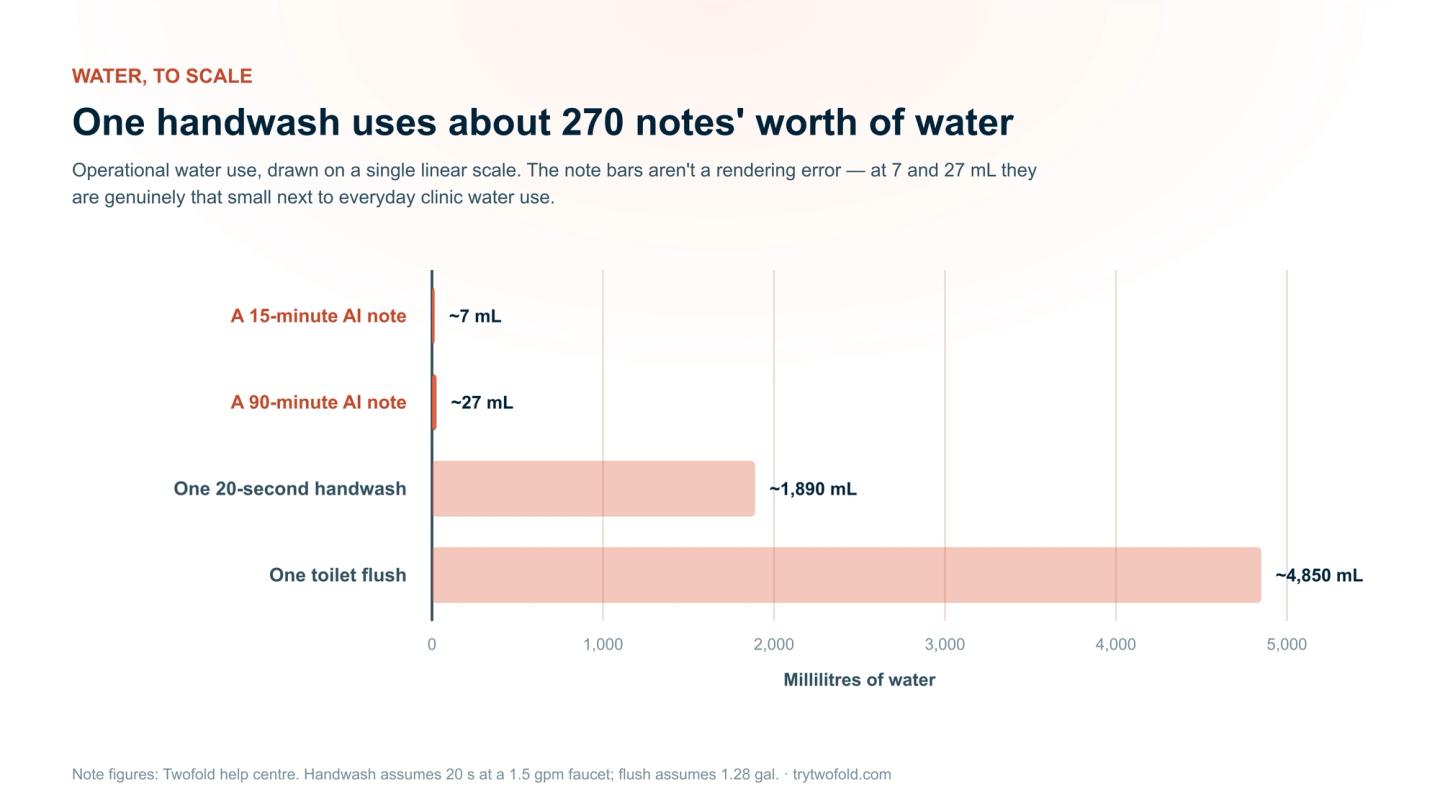
- Washing your hands once. A 20-second wash at a standard 1.5 gallons-per-minute faucet uses roughly 1,890 mL. That single handwash is about 270 fifteen-minute notes, or about 70 of the longest 90-minute sessions.
- Flushing a toilet once. A modern 1.28-gallon flush is roughly 4,850 mL — around 180 ninety-minute session notes in a single flush.
- A full day of documentation. Twenty 15-minute visits comes to roughly 40 Wh and 140 mL of water — less than one-tenth of a single handwash, and about the same electricity as leaving one 60 W incandescent bulb on for 40 minutes.
None of this means the cost is zero. It means the cost of one clinician documenting one day of care sits far below the threshold where individual behaviour change moves the needle — and far below where most people intuitively place it.
The Comparison Everyone Forgets: What Manual Charting Costs
Here is the part that rarely makes it into the debate. The alternative to an AI note is not nothing. It's you, at a laptop, often after hours, typing.
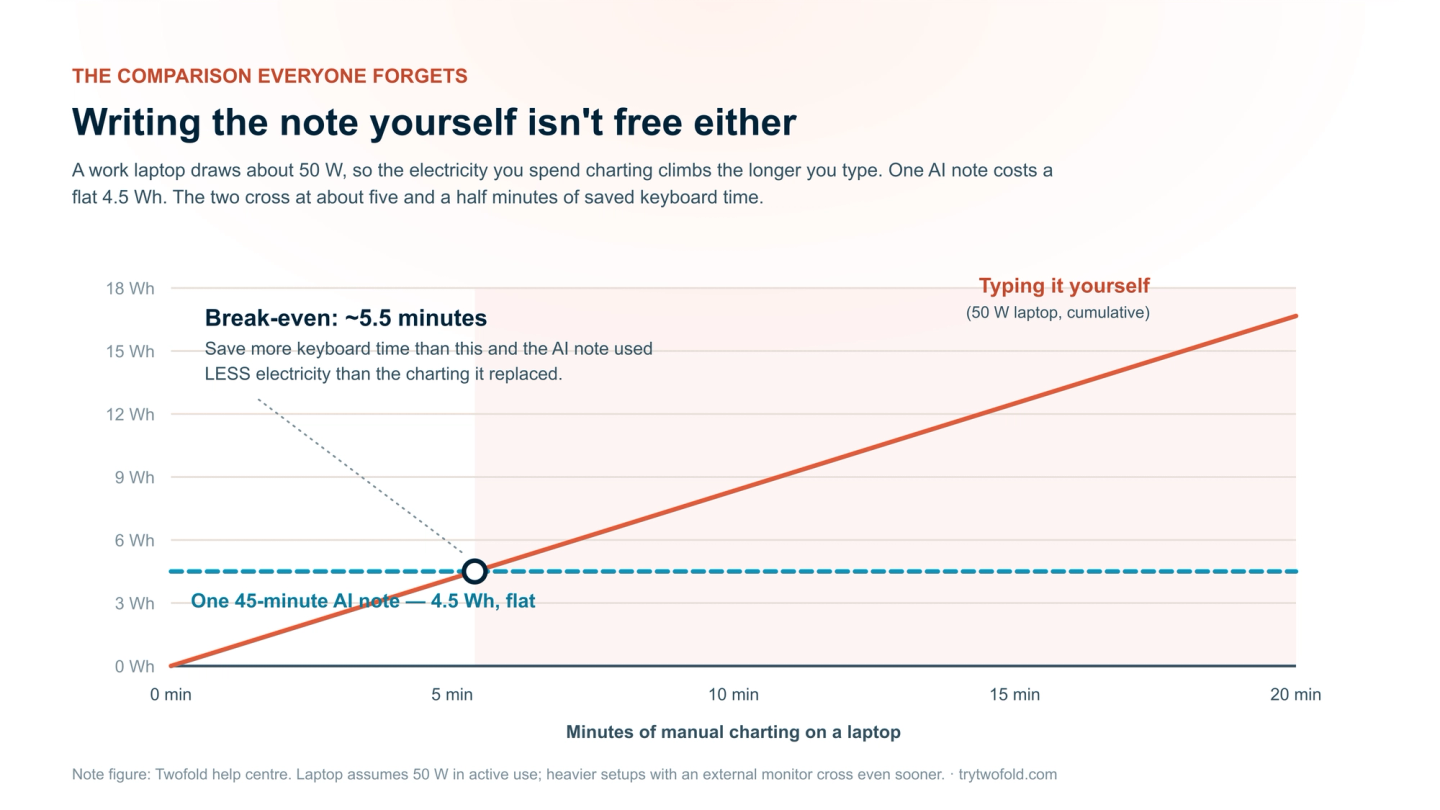
A typical work laptop draws somewhere around 50 watts in active use — more with an external monitor, less on a very efficient ultrabook. At 50 W, the arithmetic is unforgiving:
- A 15-minute visit note costs ~2 Wh — about 2.5 minutes of laptop time.
- A 45-minute session note costs ~4.5 Wh — about 5.5 minutes of laptop time.
- A 90-minute session note costs ~8 Wh — about 10 minutes of laptop time.
This isn't a rhetorical trick; it's the same accounting we'd want applied to any tool. A technology's footprint is only meaningful against the footprint of what it displaces. Judged that way, ambient documentation looks less like an indulgence and more like an efficiency.
Where the Water Actually Goes
The water question deserves a straight answer, because it's the one most people find genuinely surprising: why would software use water at all?
Data centers generate a great deal of heat, and many are cooled using evaporative systems — water is evaporated to carry heat away, and that water is consumed rather than returned. So when your note is generated, a small amount of freshwater is evaporated at the facility doing the computing. That is a real cost and worth naming plainly. The relevant question is scale: at roughly 7 to 27 mL per note, a clinician generating notes all day is consuming a small fraction of a single handwash‑equivalent of cooling water.
It's also a cost that varies enormously by facility, by cooling design, and by regional climate — which is why the choice of data‑center partner matters as much as the choice of model.
How We Made This Number Small
A per‑note figure is the output of four engineering levers. Here they are, and here is what we chose on each — so you can judge the reasoning rather than take the number on faith.
- Model efficiency. A right-sized model doing a well-defined job costs a fraction of an oversized general-purpose one, and most of that 65x spread in the literature comes down to this single decision. We run models sized for clinical documentation, not a general assistant that happens to write notes.
- Utilization. Idle hardware still draws power, so a server running at a third of capacity wastes most of what it consumes. We deliberately keep ours near full utilization, so the energy per note falls instead of being spread across idle time.
- Purpose-built hardware. Chips designed for efficient inference do identical work for meaningfully less energy than general-purpose alternatives. Our inference runs on hardware chosen for exactly that.
- Data-center quality. Facility efficiency and cooling design drive the electricity overhead and essentially all of the water figure. We partner with cloud providers running industry-leading data centers, which is a large part of why the water number lands in millilitres rather than litres.
None of those four is exotic. They're available to any vendor willing to treat efficiency as a requirement rather than an afterthought. The reason per‑note costs vary so widely across the industry is that not everyone does.
The Number Most Vendors Don't Publish
Here is the part we'd rather you verify than believe: when we went looking for comparable per‑note energy and water figures from other AI scribe vendors, we couldn't find any.
That is not a claim that other tools are worse. We genuinely don't know, and we won't pretend to — you can't compare against a number that doesn't exist. It's a narrower and more useful observation: the information isn't public, and that absence is itself a finding. Researchers examining AI environmental reporting describe the same problem at industry scale — very little public visibility into what these systems actually consume, and no standardised reporting that would let a buyer compare vendors. Health technology assessment has the same hole: environmental measures show up in only a small minority of reports.
You can read the figures, the methodology, and the update commitment on our public help-centre page. It isn't gated, and it isn't a sustainability brochure — it's a table with numbers in it.
An Honest Accounting: What These Numbers Don't Include
Any environmental figure that arrives without caveats should be treated with suspicion, so here are ours plainly stated:
- These are inference estimates — the cost of generating your note. They do not amortize the one-time cost of training the underlying models across notes.
- This is not a full lifecycle assessment. It excludes manufacturing the servers, building the facilities, and eventual hardware disposal.
- The water figure is operational cooling water at the data center. It isn't embedded water in the supply chain, and it isn't directly comparable to agricultural water footprints you may have seen for food.
- These are modelled estimates from published research and our hardware profile, not a meter attached to your individual note. They're honest approximations, not laboratory measurements.
We'd rather show our work with its limits attached than offer a vague reassurance. If the numbers ever change meaningfully, we'll update them.
If Sustainability Is Part of Your Decision
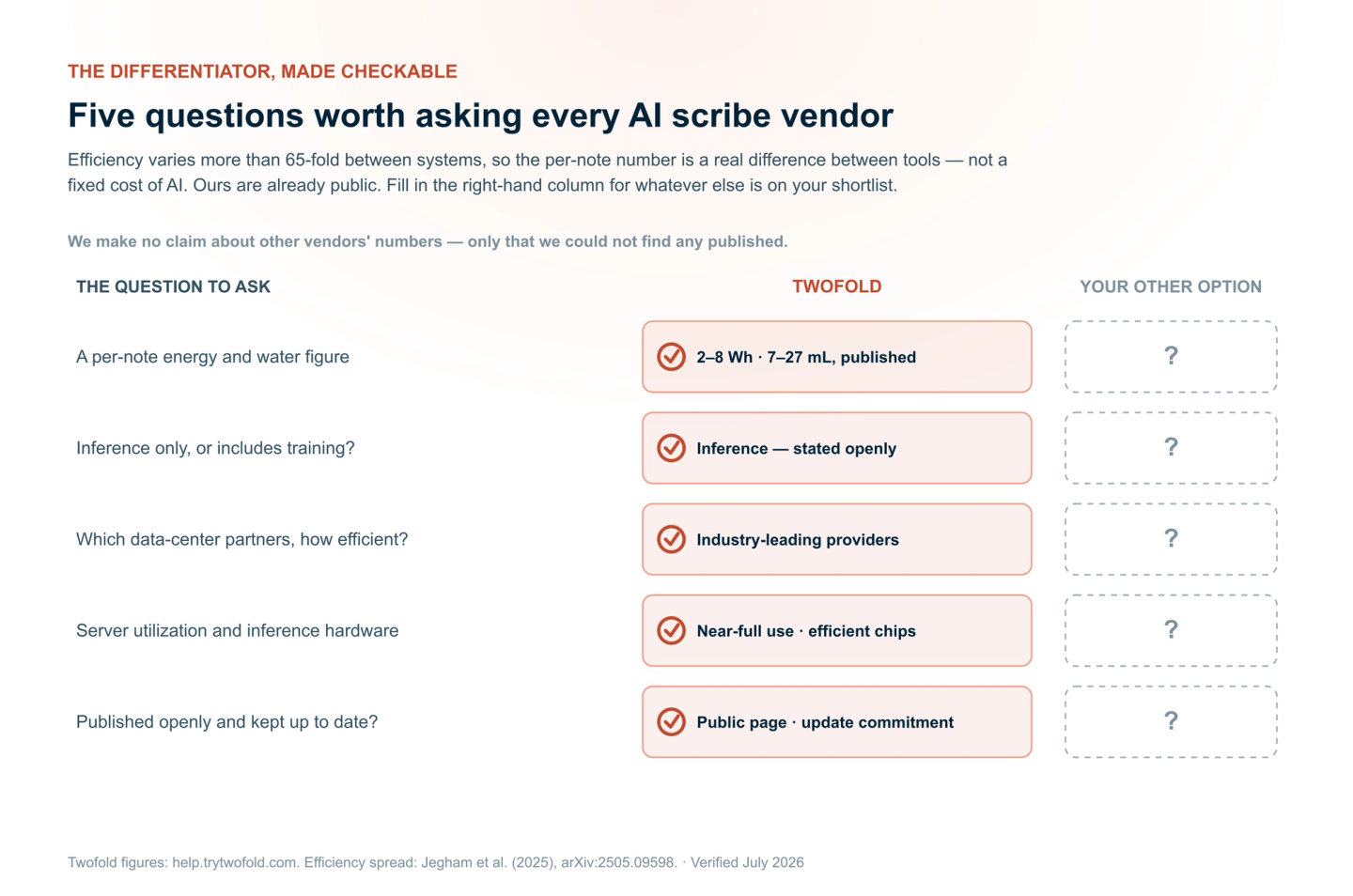
You don't have to take any single vendor's word for this — including ours. If environmental impact genuinely factors into your choice of tools, these are the questions worth asking whoever you're evaluating:
- Can you give me a per-note or per-request energy and water figure, not a company-wide sustainability statement?
- Does that figure cover inference only, or does it include amortized training?
- What data-center partners do you use, and what are their efficiency and cooling profiles?
- How do you keep utilization high, and what hardware are you running inference on?
- Will you publish the numbers openly and update them when they change?
A vendor that can answer those specifically is doing the work. A vendor that answers only in adjectives may not be. For what it's worth, all five of those answers for Twofold are already public, which is the standard we think the category should be held to — including us.
Bottom Line
The environmental hesitation many clinicians feel about AI documentation is well‑intentioned, but the arithmetic doesn't support it at the level of one clinician writing one note. A note costs single‑digit watt‑hours and a spoonful or two of water — comparable to a handful of web searches, and a rounding error against a single handwash. Weighed against the after‑hours laptop time it replaces, it very likely comes out ahead.
But the more useful takeaway is the one underneath the numbers: this is a Twofold figure, not an AI figure. Efficiency varies more than 65‑fold between systems doing comparable work, which makes it a real point of difference between tools rather than a fixed cost of the technology. We chose right‑sized models, high utilization, efficient inference hardware, and strong data‑center partners — and then we published what that produced, with the methodology and the caveats attached. We're not aware of another AI scribe that has. So if this question matters to you, ask every vendor on your shortlist for their per‑note number. Ours is here, it's free to read, and you can try Twofold and judge the trade for yourself.