


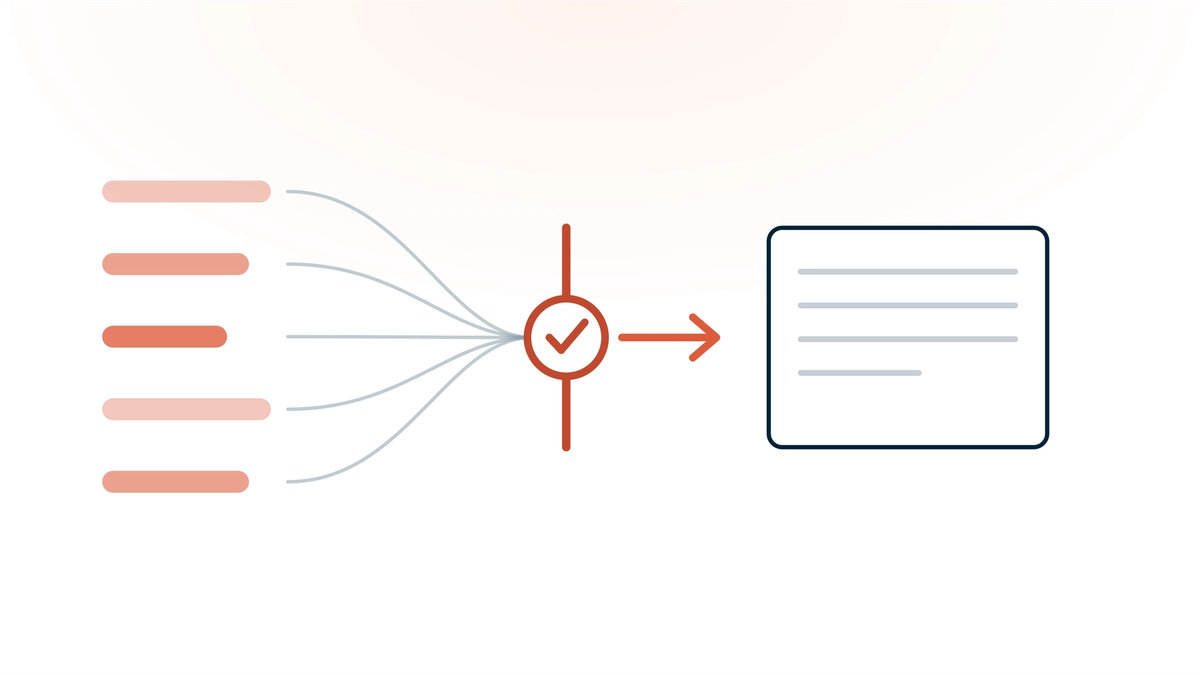
Healthcare is rapidly transitioning into an AI‑integrated workflow. While Generative AI offers remarkable potential, it introduces significant clinical liabilities. Realizing the benefits of AI in healthcare also requires realizing the risks. Explore specific use cases, AI risks, and how to implement safety protocols to ensure equitable care.
Defining Generative AI in a Clinical Context
To understand its impact on healthcare, we must first distinguish it:
Generative AI: Algorithms designed to produce new, original content, including clinical text, synthetic medical images, and patient‑friendly summaries, based on patterns learned from vast training datasets.
Large Language Models (LLMs)
At the root of most healthcare generative applications are LLMs, which function
as advanced probability engines. Here is how they work:
- Processing Natural Language: LLMs ingest unstructured clinical text (notes, journals, transcripts) and convert them into numerical representations (embeddings) that capture semantic meaning.
- Predictive Generation: They generate responses by predicting the next most statistically probable word in a sequence, allowing them to draft coherent discharge summaries, clinical notes, or even synthetic patient records.
- Synthetic Data Creation: Critically, they can produce de-identified synthetic patient variants, enabling researchers to train models and test hypotheses without exposing real Protected Health Information (PHI).
Key Use Cases: A Departmental Approach
To appreciate GenAI's true value, we must examine how it serves distinct stakeholders across the healthcare ecosystem. The table below segments applications by departmental function:
Department Stakeholder | Primary Goal | GenAI Application |
|---|---|---|
Revenue Cycle & Admin | Reduce documentation burden & accelerate billing | Drafting clinical notes, discharge summaries |
Clinical (Physicians) | Augment diagnostic accuracy & patient comprehension | Synthetic data generation, treatment simplification |
Operations & Patient Services | Improve access and engagement | Triage drafting, translation, literature synthesis |
The Risks to Consider with Generative AI in Healthcare
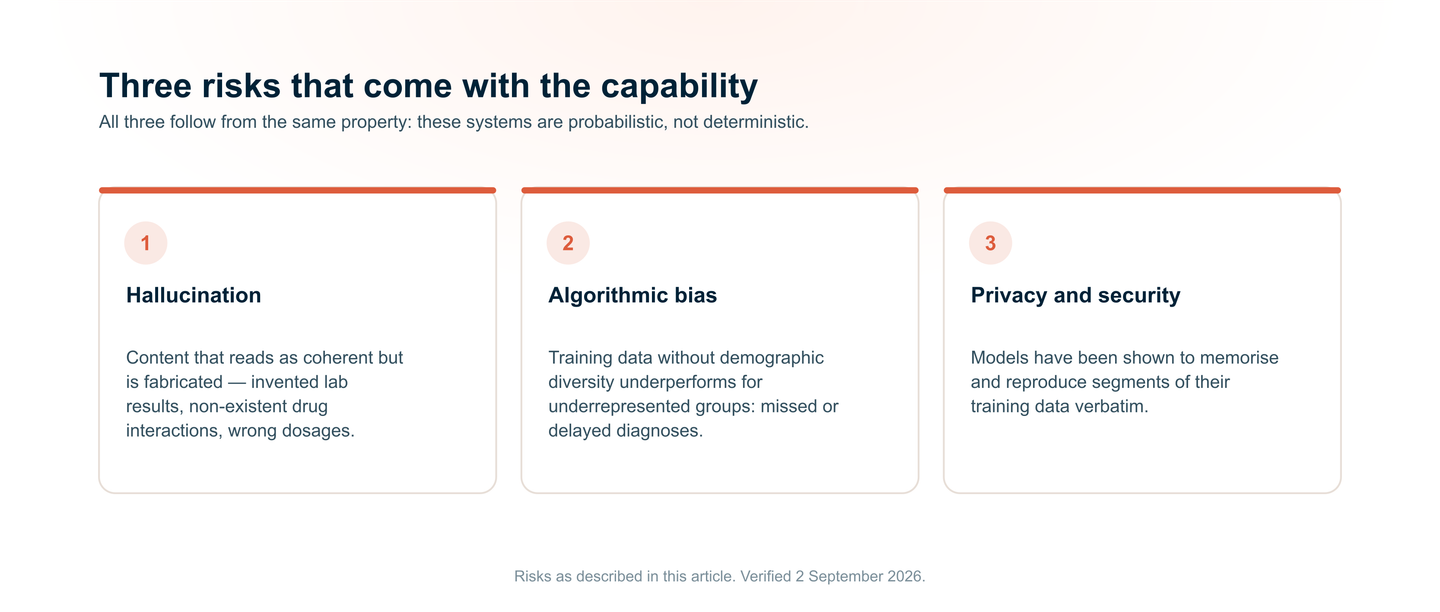
While Generative AI promises unprecedented efficiency, its probabilistic nature introduces clinical liabilities that cannot be overlooked. This section examines the three most critical risk categories:
The Hallucination Problem
A Hallucination refers to instances where the AI generates content that appears coherent but is entirely fabricated. This is the most dangerous risk in clinical settings.
- Clinical Consequences: Hallucinations manifest as invented lab results, non-existent drug interactions, incorrect medication dosages, or fabricated physical exam findings. These errors, if blindly integrated into the electronic health record (EHR), become permanent parts of the patient's legal medical history, potentially influencing future care decisions.
Learn more about the AI hallucination problem.
Algorithmic Bias
Generative AI models learn patterns from their training data. If that data lacks demographic diversity, the resulting outputs systematically underperform for underrepresented populations, amplifying existing healthcare disparities.
- Clinical Consequences: Bias manifests as missed or delayed diagnoses in minority groups, culturally insensitive patient communications, and skewed treatment recommendations that do not account for genetic or physiological variations.
- The Liability Exposure: Hospitals implementing biased AI tools face not only face poor clinical outcomes but also significant reputational damage and potential legal action under healthcare civil rights protections.
See more in-depth information on AI bias in healthcare.
Privacy and Data Security
The very mechanism that makes LLMs powerful (their ability to retain and recall patterns) introduces unique privacy vulnerabilities beyond traditional data breaches.
- The "Memorization" Risk: Generative models have been shown to inadvertently memorize and reproduce segments of their training data verbatim. When that data includes clinical narratives, there is a risk of the AI revealing Protected Health Information (PHI) in response to unrelated prompts.
- Data Provenance Challenges: The nature of large-scale training makes it difficult to examine exactly what PHI was used, where it originated, and whether proper consent was obtained. This creates significant compliance gaps under HIPAA frameworks.
- Operational Risks: If third-party AI vendors process clinical text through public or unsecured cloud environments, patient data may be stored or trained upon outside the hospital's control, violating data-sharing agreements and exposing institutions to substantial regulatory fines.
The Future: Mitigation Strategies
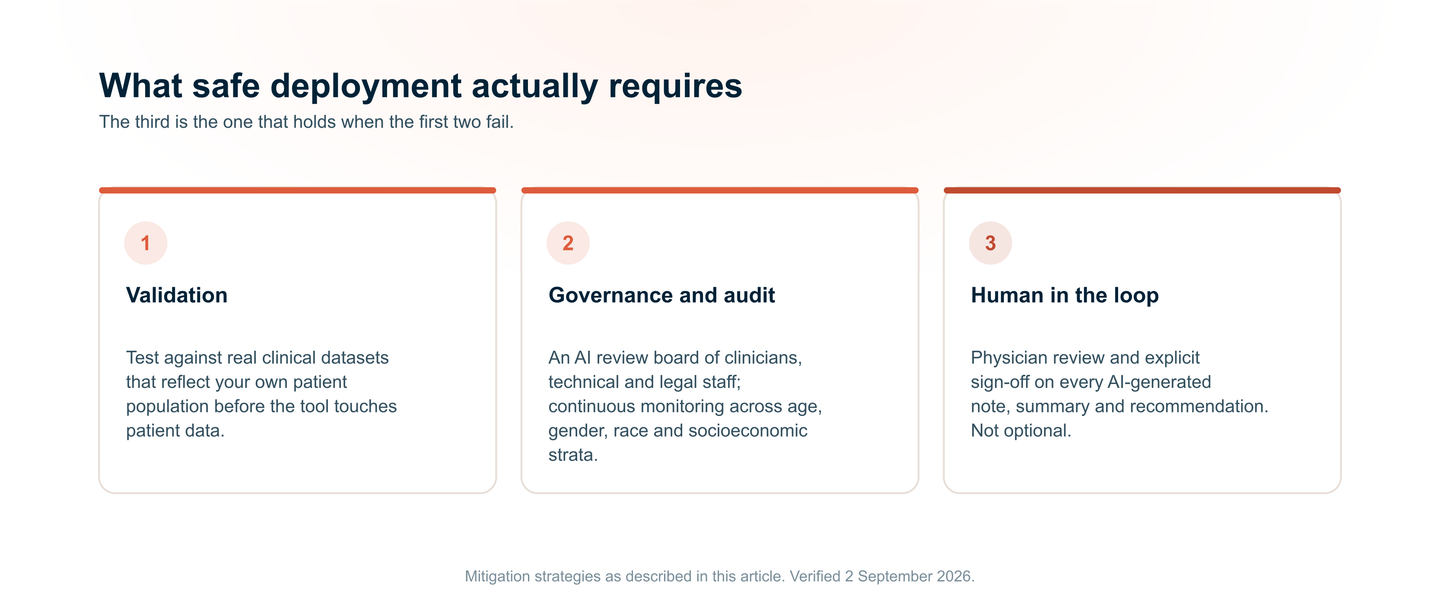
Deploying Generative AI safely demands systemic safety protocols.
1. Validation
Before any generative tool interacts with patient data, it must undergo clinical validation.
- Domain-Specific Testing: Evaluate models against real-world clinical datasets that reflect your specific patient population, including diverse demographics and complex comorbidities.
2. Institutional Governance & Continuous Auditing
Safety requires an active, multi‑disciplinary oversight structure embedded within the healthcare organization.
- AI Review Boards: Establish committees comprising clinicians and tech/ legal experts to vet all AI clinical note tools before procurement and monitor their real-world performance post-implementation.
- Algorithmic Bias Supervision: Implement automated reviews that track model performance across age, gender, race, and socioeconomic strata, flagging any statistically significant disparities.
3. The Mandatory "Human-in-the-Loop" Protocol
Generative AI must remain a decision‑support tool, never a replacement for clinical judgment.
- Compulsory Review: Establish policies requiring physician review and explicit sign-off on all AI-generated clinical notes, summaries, and recommendations before they enter the permanent medical record.
Conclusion
Generative AI represents a transformative force in healthcare, offering relief from documentation burdens and accelerating clinical discovery. However, realizing the full potential of this technology requires a disciplined safety protocol, where AI clinical notes assist with, rather than replace, clinical judgment.