


Clinicians have reported that AI‑generated notes feel increasingly generic, stripped of individual voice and clinical nuance. The same technology that promises efficiency may be doing the opposite for writing notes with your voice. This article explores whether AI medical scribes are improving clarity or homogenizing one of medicine's most critical communication tools.
What AI Scribes Actually Do, and Why Doctors Are Adopting Them
Before weighing the risks of homogenized notes, it's important to understand exactly how these tools function and why they've become the fastest‑growing AI application in modern healthcare. The adoption is a direct response to the documentation crisis, which is the main cause of physician burnout.
How Ambient AI Scribing Works
Ambient AI scribes are passive listeners that require no active typing or dictation from the clinician. Here is the typical workflow:
- Initiation: The clinician launches a secure app on their smartphone or desktop at the start of a patient encounter.
- Passive Recording: The tool records the natural conversation between the provider and the patient. Unlike traditional dictation, the physician does not need to interrupt their flow.
- AI Processing: The audio is transmitted to a large language model (LLM) that transcribes the speech and extracts medically relevant data, filtering out casual chatter while identifying symptoms, history, exam findings, and treatment plans.
- Draft Generation: Approximately 30 seconds after the appointment ends, the AI outputs a structured clinical note, typically formatted in the standard SOAP (Subjective, Objective, Assessment, Plan) format or a similar EHR-compatible format.
- Human-in-the-Loop: The physician must review, edit, and sign off on the final note before it is added to the electronic health record (EHR). The goal is to reduce the creation time, not eliminate clinical oversight.
The Quality Question: Are AI Notes Better or Worse?
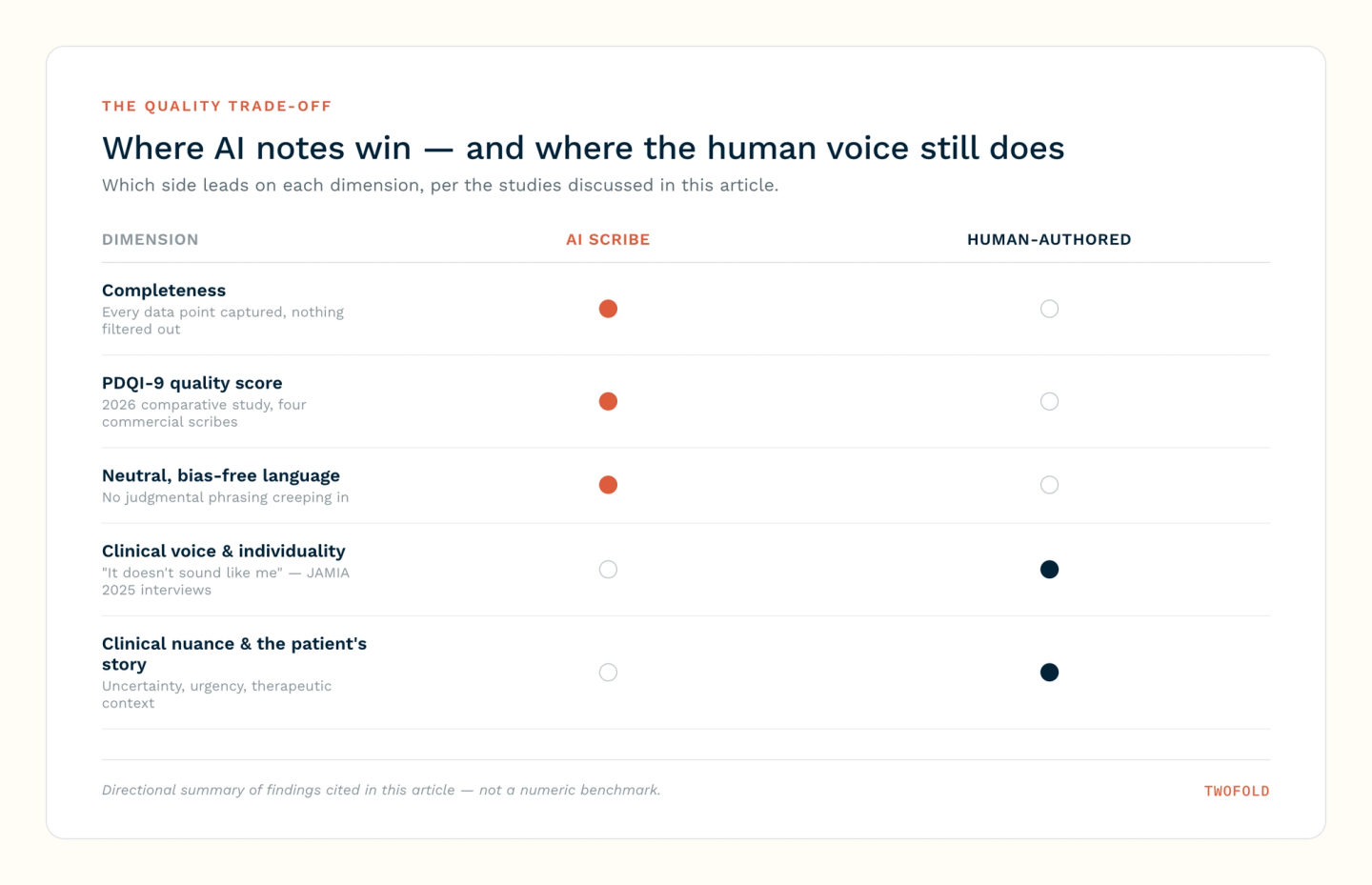
Does an AI‑generated note match or surpass the quality of a human‑authored one? It depends on how you define "quality." When it comes to structure and completeness, AI wins. But when it comes to clinical reasoning and contextual accuracy, the answer becomes far more complicated.
AI Notes Excel in Some Areas
AI medical scribes often outperform humans in technical documentation metrics. In a 2026 comparative study, researchers evaluated four commercial AI scribes against human scribe documentation in simulated general practice consultations. The results were remarkable:
- Exceptional Completeness: The study highlighted AI's superiority in thoroughness and freedom from bias, ensuring that every relevant data point from the conversation was captured without the clinician's subconscious filtering.
- PDQI-9: When assessed using the Physician Documentation Quality Instrument-9 (PDQI-9), AI-generated notes scored higher than the human notes.
Beyond these scores, AI scribes bring additional qualitative benefits:
- Reduced Cognitive Load: By removing the need to mentally juggle typing and active listening, physicians report feeling more present and engaged with their patients.
- Neutral Language: AI tends to avoid the sometimes judgmental or biased language that can inadvertently creep its way into human notes, promoting more objective documentation.
Where AI Notes Fall Short
Despite these impressive metrics, AI scribes harbor weaknesses that current technology struggles to overcome.
- The Hallucination Problem: AI models are prone to "hallucinations," which involve generating plausible but entirely fabricated content. In clinical settings, this manifests as tests that were never ordered, physical exams that were never performed, or medications not discussed.
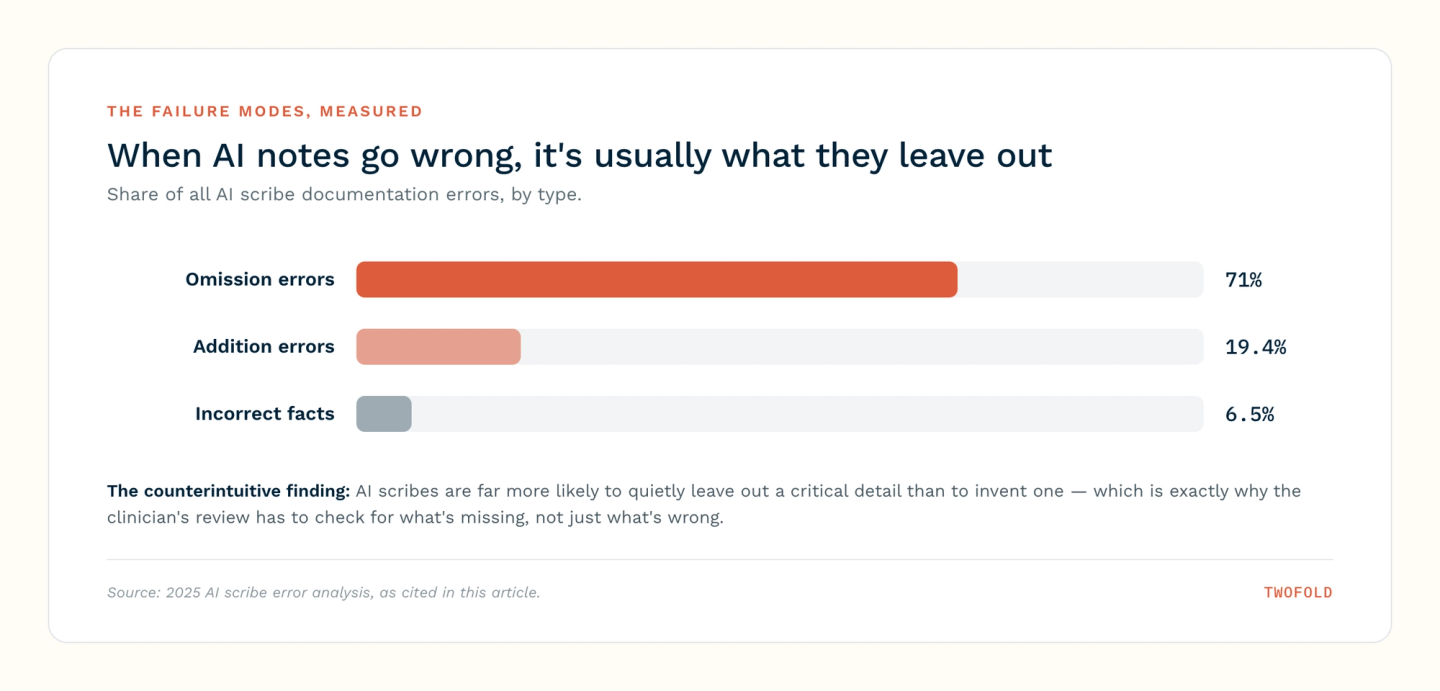
- Omission Errors: A 2025 AI scribe analysis revealed that omission errors constitute 71% of all mistakes, followed by addition errors (19.4%) and incorrect facts (6.5%). This means AI is most likely to leave out critical details rather than invent them.
- Generalization of Clinical Nuance: AI algorithms often simplify specific medical terminology to fit generic templates. This loss of diagnostic specificity can mislead other providers reviewing the chart.
- Specialty-Specific Blind Spots: Generic models frequently miss the nuanced vocabulary and clinical patterns specific to cardiology, neurology, or orthopedics. If the AI isn't trained on specialty-specific data, it will default to generalized prose.
The Homogenization Problem: Do All AI Notes Sound the Same?
As AI scribes grow more popular across clinical settings, a concern has emerged from the very physicians using them: 'these notes don't sound like me'.
What Clinicians Are Saying
A 2025 qualitative study published in the Journal of the American Medical Informatics Association (JAMIA) conducted in‑depth interviews with clinicians across a range of specialties who had participated in an ambient AI scribe pilot and enterprise rollout. The findings are detailed below:
The "Loss of Voice"
Participants reported a perceived loss of "voice" in their AI‑assisted documentation.
One clinician noted: [The ambient scribe] is not my voice, right? [The ambient scribe] is a very different voice from my voice. My notes have a certain voice ... And so when I read the note, it doesn't sound like me – Participant 18.
Additionally, clinicians described a fundamental shift in their relationship to their own notes. One participant characterized the change as moving from being less of a "content creator" and more of a "content editor" – Participant 16.
The implication is clear: physicians are no longer actively constructing the clinical narrative; they are merely approving or tweaking what an algorithm has generated. This passive role, repeated day after day, risks losing the very cognitive skills that note‑writing once reinforced.
Why AI Scribes Make All Doctors Sound the Same: The Technical Reasons
The homogenization is sometimes the result of the inner workings of the AI scribe.
The "Black Box" Problem
AI scribes rely on LLMs that often function in ways their programmers don't fully understand, also known as a 'Black Box'. This unpredictability makes it difficult to control or customize outputs with precision.
Standardized Output Formats
Nearly all AI scribes generate notes in SOAP (Subjective, Objective, Assessment, Plan) or similar EHR‑compatible formats within approximately 30 seconds of a consultation ending. While this standardization improves readability and ensures completeness, it also produces notes that are structurally identical across different clinicians, specialties, and even institutions. The format becomes the voice.
The Risks of Homogenized Documentation
Homogenized documentation carries tangible risks for patient care, physician development, and the medical profession itself.
Loss of Clinical Reasoning Skills
There is growing concern that over‑reliance on AI could diminish clinical reasoning skills. Note‑writing has traditionally been a formative exercise, a discipline through which medical students and residents learn to organize their thoughts, weigh evidence, and articulate differential diagnoses. If the next generation of physicians grows up editing rather than writing, what happens to their clinical expertise?
Communication Breakdown
Clinical notes are communication tools. They convey clinical reasoning to colleagues and provide context for future providers. When all notes sound the same, they lose the ability to convey:
- A physician's clinical confidence (or appropriate uncertainty).
- The urgency of a diagnosis.
- The therapeutic relationship and contextual factors.
- The "story" of the patient's illness.
How to Fix the Homogenization Problem
Solutions are emerging across three fronts: technical customization, workflow redesign, and governance frameworks.
Technical Solutions: Customization
Personalization Engines
Advanced AI scribe platforms can now track a clinician's edits over time, safely excluding patient data, and automatically incorporate their preferred terminology, documentation style, and formatting.
Specialty-Specific Templates
Generic AI models miss specialty‑specific nuances. Department heads can implement custom templates for team consistency while ensuring individual voice is reflected in notes.
Strategic Prompting
Clinicians can move from passive users to active directors, employing strategic prompting techniques that force the AI to capture nuance, individual language, and specific clinical observations.
Workflow Solutions: Human Oversight and Hybrid Models
Human-in-the-Loop
The most practical path is AI with humans in the loop, technology that includes human intervention through supervision, correction, or feedback. Every AI‑drafted note must have a clearly assigned human reviewer accountable for accuracy, completeness, and clinical intent.
Hybrid AI Scribing
A hybrid model sends AI‑generated draft notes to experienced documentation specialists for review before the clinician signs off. This shifts the validation burden away from the clinician while ensuring notes meet specialty‑specific guidelines.
Governance and Quality Frameworks
Treating AI Scribes as a Quality and Safety Responsibility
Ambient AI scribes directly shape the medical record that supports clinical decisions, handoffs, billing, and legal accountability. Governing them should be treated as a Quality and Safety responsibility.
Mandatory Human Review of High-Risk Elements
For high‑stakes documentation, such as psychotherapy notes, mandatory human review should cover findings, neurologic status, history, procedures performed, and future treatment plans.
Continuous Monitoring and Feedback
AI systems that adapt over time require continuous risk management and post‑implementation performance monitoring throughout the full lifecycle.
Conclusion
AI scribes are transforming clinical documentation, but this progress comes with a cost: the homogenization of clinical voice. The solution is thoughtfully implementing personalization, human oversight, and governance frameworks that preserve clinical reasoning. The goal is clear: leverage AI for efficiency while ensuring every note reflects the clinician's judgment, expertise, and individual voice.