


Home‑based care has its own documentation pain points: noisy environments, multiple speakers (patient + caregiver), wound and med‑change details, and frequent visit types (SOC, recert, routine SN visit, therapy, hospice narrative). This guide focuses on AI tools that can support care at home documentation without turning into another workflow to manage. See also our AI for skilled nursing facility documentation.
What matters for care-at-home documentation
A few criteria tend to matter more in home care than in‑clinic workflows:
- Detail sensitivity: Small changes (meds, wounds, DME, caregiver training) must land in the note consistently. Home health clinicians often mention over-summarization as a failure mode.
- Template flexibility: You may need different structures for SOC vs routine SN vs PT vs hospice narrative.
- Caregiver presence: Multi-speaker capture and clear attribution can matter.
- Connectivity reality: Tools should degrade gracefully when Wi-Fi is unreliable.
Quick comparison
Vendor | Typical fit | Pricing (publicly visible) | Recording required | HIPAA/BAA claims (vendor-stated) |
|---|---|---|---|---|
Twofold Health | Home care teams needing flexible visit-note templates | Groups: starts ~ $29/user/mo for larger groups | No (optional) | HIPAA + org-wide BAA for groups (claims). |
DAX Copilot | Enterprise health systems | Quote-based | Yes | Recordings stored on Azure; 30-day retention stated for some DAX flows. |
Abridge | Enterprise deployments | Quote-based | Yes | Published BAA + HIPAA compliance statement (claims). |
Suki | Enterprise deployments | Quote-based | Yes | Published BAA (claims). |
Augmedix | Enterprise + hybrid service models | Quote-based | Yes | Publishes BAA addendum; HIPAA + HITRUST claims. |
Deepscribe | Enterprise deployments | Quote-based | Yes | Security practices page; terms reference "subject to compliance with the BAA." |
1. Twofold Health
What does it do
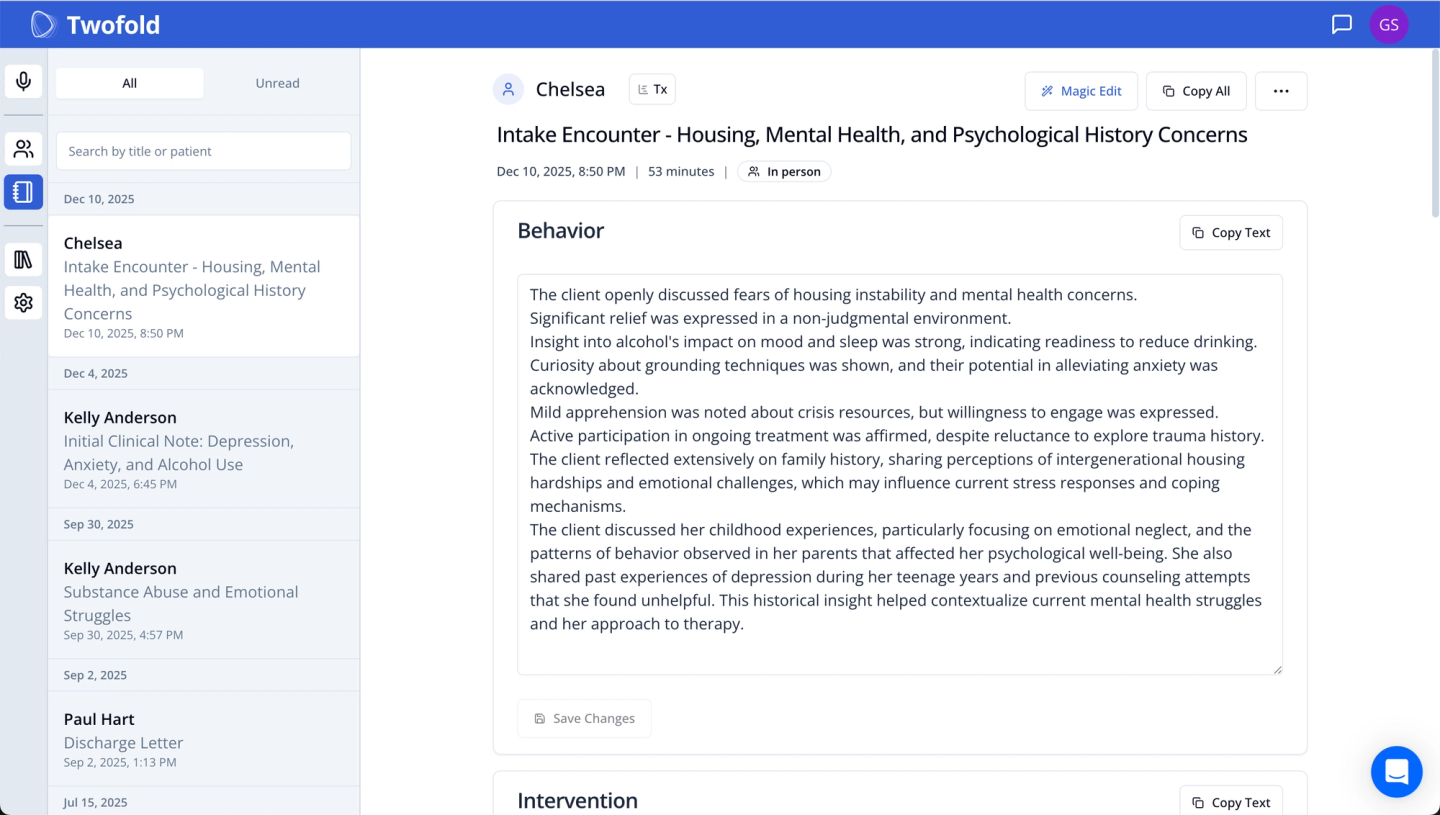
Generates structured clinical notes from encounter audio and clinician inputs, designed for outpatient‑style workflows and flexible documentation structures.
Who is it for
Care‑at‑home clinicians and small‑to‑mid teams (home health, hospice, therapy, community‑based care) that want fast drafts, customizable templates, and simple export into an existing EMR/EHR.
Key features
- Custom templates and structured note outputs
- Mobile + desktop apps
- Unlimited notes on the Personal plan
- Progress tracking and treatment plans (useful for longitudinal home-based episodes)
- Secure EHR export/integration is available for larger groups via Twofold's EHR Export workflow (vendor-stated).
Pros
- Clear, self-serve pricing for individuals and small practices
- Strong privacy posture stated in help docs (BAA provided; "recordings never stored")
- Recording is not mandatory. Twofold states you can generate notes without recording the full visit.
- Workflow flexibility: templates let you align to your home-visit note structure (SOC, routine visit, caregiver training notes)
Cons
- If your org requires deep, native EHR integration and centralized governance, you may need additional IT process work compared to an EHR-embedded enterprise tool
Pricing
- Group plans: starts around $29/user/month for larger groups (separate from personal; confirm exact quote based on seats/workflows).
Privacy, HIPAA, BAA notes (vendor-stated, not legal advice)
- Twofold states it provides a BAA to users
- Twofold states recordings are never stored on its servers
What clinicians say (community links)
- Reddit discussion mentioning Twofold's setup speed, templates, and pricing (user-reported experience): https://www.reddit.com/r/FamilyMedicine/comments/1lokist/i_tried_all_the_ai_medical_scribes_so_you_dont/
- Twofold templates discussion (supports that clinicians spend time tuning templates and iterating drafts): https://www.reddit.com/r/FamilyMedicine/comments/1ifh8rt/twofold_ai_scribe_custom_templates/
- PT-focused thread that discusses practical note style and adjustments (useful proxy for home-based therapy documentation needs): https://www.reddit.com/r/physicaltherapy/comments/1flhdvx/twofold_users/
2. DAX Copilot (Nuance/Microsoft)
What does it do
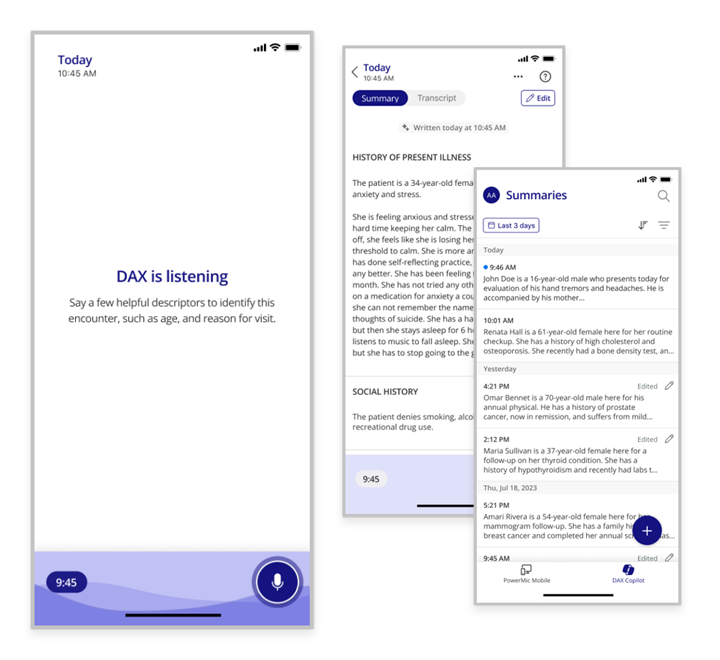
Ambient documentation that produces summaries and transcripts from recorded encounters, with clinician review/editing workflows.
Who is it for
Common use case: large organizations already standardized on Microsoft/Nuance workflows, where procurement and governance are centralized.
Key features
- Mobile capture workflows (PowerMic Mobile is referenced in FAQs)
- Summary + transcript views and search on desktop
- Template and formatting tools (style wizard and customizable template guidance)
- Stated time window for transcript/summary availability
Pros
- Strongly documented operational behaviors (capture, connectivity, template mechanics)
- Often discussed as effective in enterprise environments (community feedback varies)
Cons
- Typically enterprise-led procurement and implementation (not optimized for quick solo onboarding)
- Retention windows and workflow constraints may matter if you need long episode-based reference across home health visits
Pricing
- Typically quote-based (varies by org size and deployment)
Privacy, HIPAA, BAA notes (vendor-stated, not legal advice)
- DAX Copilot FAQ states summaries and transcripts are accessible for 30 days, then deleted, and notes recordings are stored on Microsoft Azure servers (as stated).
What clinicians say (community links)
- DAX pilot discussion (supports how it's commonly evaluated in health systems): https://www.reddit.com/r/physicianassistant/comments/1aqf61w/dax_ai_scribe/
- "Which AI scribe tool are you using?" thread with DAX mentions (supports perceptions of effectiveness and cost/fit tradeoffs): https://www.reddit.com/r/FamilyMedicine/comments/1kxv3om/which_ai_scribe_tool_are_you_using/
3. Abridge
What does it do
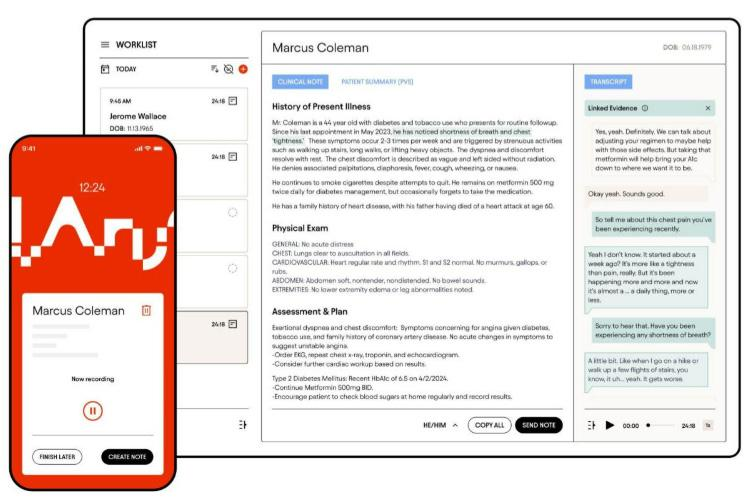
Ambient documentation and clinical conversation summarization, often positioned for enterprise deployment and EHR‑aligned workflows.
Who is it for
Typical fit: organizations prioritizing EHR integration and centralized governance, especially where a single platform is rolled out across many clinicians.
Key features
- Enterprise-style policies including a published BAA
- Stated HIPAA compliance in vendor support materials
- Ambient workflow oriented around the clinical conversation
Pros
- Clear availability of a BAA document
- Often discussed in the context of larger deployments and EHR integrations
Cons
- Pricing is commonly quote-based, making budgeting harder for small home care agencies
- If your use case is primarily home visits with limited IT support, enterprise onboarding may add friction
Pricing
- Typically quote-based; some industry snapshots cite approximate pricing, but it varies by deployment and integration.
Privacy, HIPAA, BAA notes (vendor-stated, not legal advice)
- Abridge provides a published Business Associate Agreement.
- Abridge support materials state the product is HIPAA-compliant.
What clinicians say (community links)
- "Piloting Abridge" discussion (supports day-to-day experience questions and comparisons): https://www.reddit.com/r/FamilyMedicine/comments/1mvmhyw/piloting_abridge_the_ai_scribe/
- Ambient AI discussion mentioning Abridge in Epic (supports common enterprise/EHR context): https://www.reddit.com/r/hospitalist/comments/1p3x1ak/any_hospitalists_using_ambient_ai/
4. Suki
What does it do
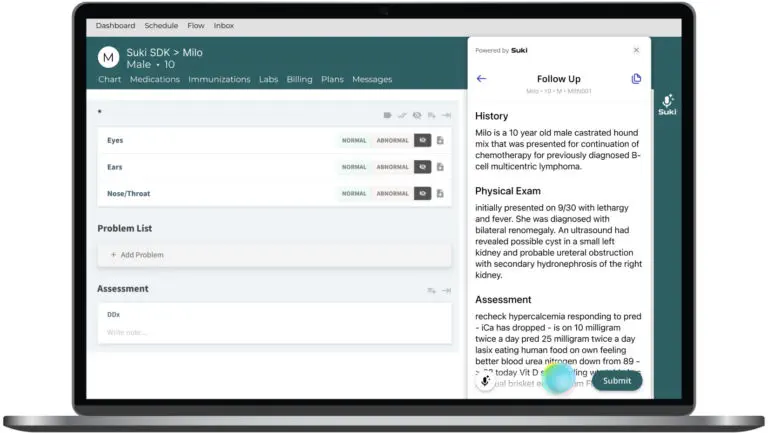
Voice‑first clinical assistant features, including documentation support, typically positioned for enterprise EHR workflows.
Who is it for
Common use case: groups that want voice‑centric workflows and major‑EHR integration emphasis.
Key features
- HIPAA compliance and SOC 2 Type II claims on the vendor site
- Published BAA document
- EHR integration positioning on site
Pros
- Published BAA availability
- Explicit security/compliance marketing claims (HIPAA, SOC 2)
Cons
- Pricing is commonly quote-based; publicly reported numbers vary by source
- If you mainly need fast home-visit notes with minimal deployment overhead, enterprise orientation can be a mismatch
Pricing
- Generally quote-based; at least one product listing cites starting pricing around $399/user/month (verify with vendor during evaluation).
Privacy, HIPAA, BAA notes (vendor-stated, not legal advice)
- Suki markets HIPAA compliance and SOC 2 Type II status.
- Suki provides a Business Associate Agreement (BAA).
What clinicians say (community links)
- General "AI scribes in clinic" discussion (supports accuracy and noisy-audio concerns that can be amplified in home visits): https://www.reddit.com/r/nursepractitioner/comments/1ncqjza/anyone_here_actually_using_ai_scribes_in_clinic/
- "Best AI medical scribe tools?" thread that mentions DAX and enterprise vs point solutions (supports evaluation framing relevant to Suki-style deployments): https://www.reddit.com/r/medicine/comments/1b0befu/best_ai_medical_scribe_tools_do_people_use_them/
5. Augmedix
What does it do
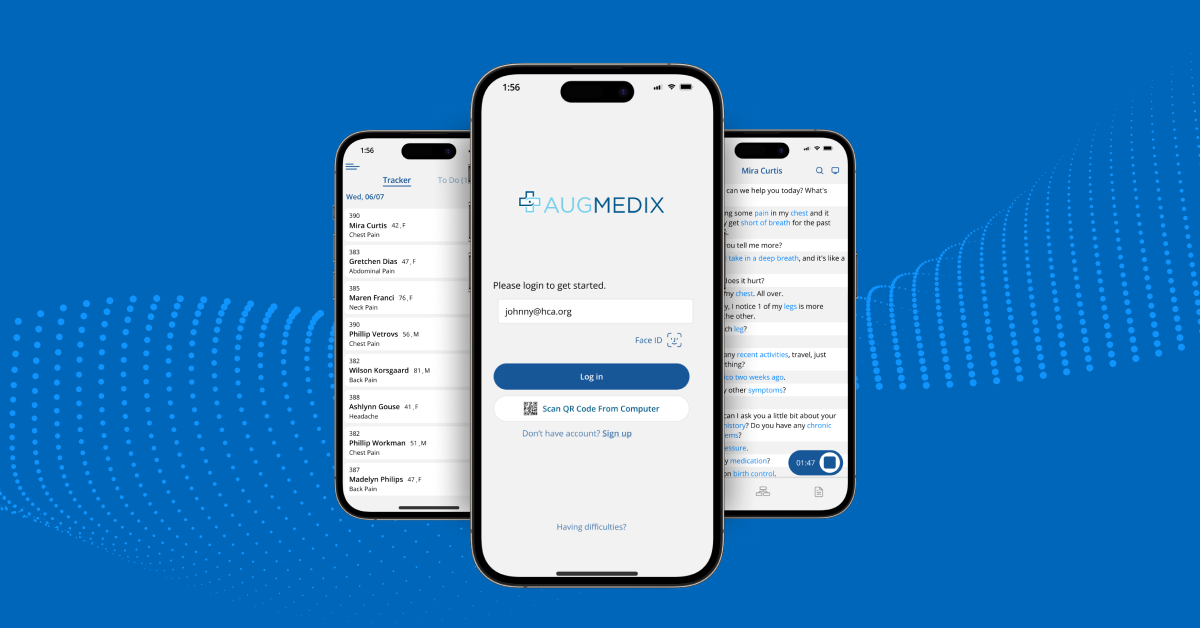
Medical documentation services that can include AI‑driven documentation and virtual/hybrid scribing models, often sold to organizations.
Who is it for
Typical fit: organizations open to remote documentation specialist workflows and enterprise contracting, including models that combine AI with human review.
Key features
- HIPAA compliance and HITRUST claim on vendor site
- Published Business Associate Addendum
- Service definitions for "Augmedix Live" indicate virtual, real-time documentation assistance models
Pros
- BAA documentation is available (addendum published)
- Positioned for complex, real-world clinical environments
Cons
- Involvement of remote staff or hybrid workflows can introduce operational complexity (training, QA, scheduling)
- Budgeting is harder because pricing is commonly contract-based and can vary by model
Pricing
- Quote-based; one industry analysis discusses different price points by product model (AI-only vs hybrid vs live) but organizations should confirm directly.
Privacy, HIPAA, BAA notes (vendor-stated, not legal advice)
- Augmedix markets HIPAA compliance and HITRUST certification.
- Augmedix publishes a Business Associate Addendum.
What clinicians say (community links)
- "Recommendations for medical scribe companies" thread includes an Augmedix experience (supports potential quality/control variability in scribe-style models): https://www.reddit.com/r/medicine/comments/1bao3ws/recommendations_for_medical_scribe_companies_very/
- Augmedix remote scribing thread (supports what the day-to-day model can look like operationally): https://www.reddit.com/r/medicalscribe/comments/12lkgyf/new_job_scribing_remotely_at_augmedix/
6. DeepScribe
What does it do
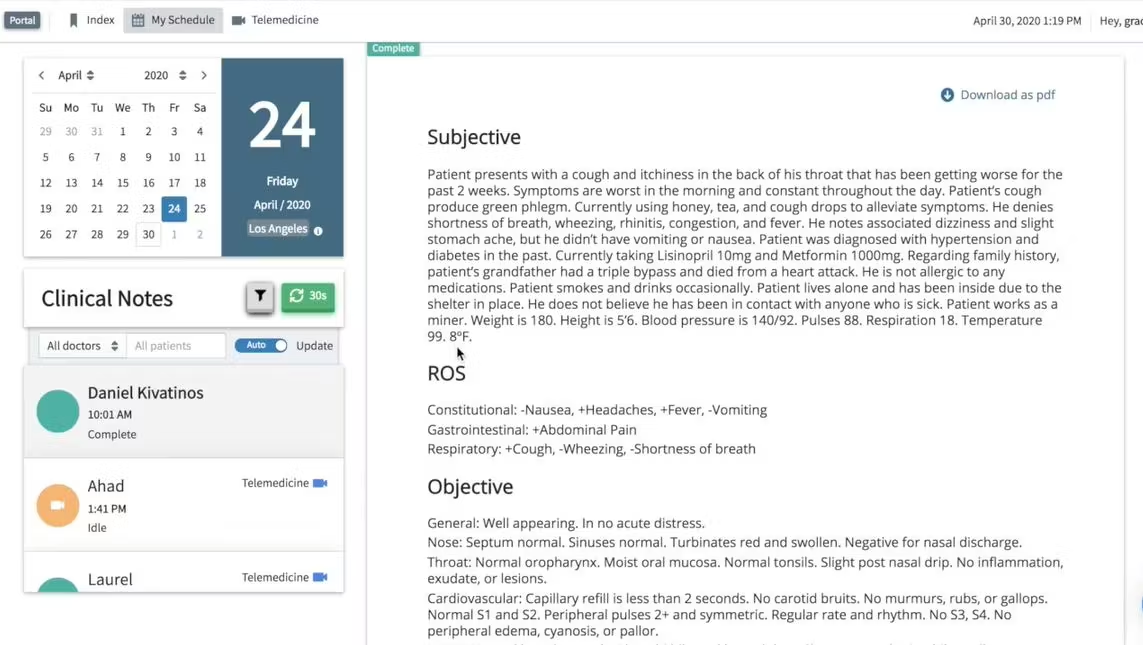
Ambient clinical documentation platform that generates notes from patient conversations, with customization and enterprise positioning.
Who is it for
Common use case: organizations evaluating ambient documentation at scale, often alongside other enterprise tools, and willing to run pilots.
Key features
- Security practices page detailing compliance posture and contact channel
- Product positioning around ambient documentation and customization
- Terms reference operating "subject to compliance with the BAA" (contract context)
Pros
- Publishes security practices overview
- Strong focus on customization and enterprise workflows
Cons
- Pricing is not typically listed publicly, so evaluation usually requires a sales process
- Ambient tools can still miss home-visit edge cases (wounds, meds, caregiver context), so clinicians should validate outputs against real visit types
Pricing
- Generally quote-based; not consistently published on official pricing pages.
Privacy, HIPAA, BAA notes (vendor-stated, not legal advice)
- DeepScribe publishes security practices and emphasizes confidentiality and regulatory standards (high level).
- DeepScribe terms reference operating under a BAA in contracting context.
What clinicians say (community links)
- AI scribing discussion that includes DeepScribe remarks (supports pricing/latency and "human editor" perceptions from some users): https://www.reddit.com/r/FamilyMedicine/comments/1deibuu/ai_scribing_so_farwhat_works_and_whats_missing/
- General "AI scribes in clinic" thread (supports broader concerns about audio messiness and editing overhead): https://www.reddit.com/r/nursepractitioner/comments/1ncqjza/anyone_here_actually_using_ai_scribes_in_clinic/
Conclusion
If you are searching for the best AI for care at home documentation in 2026, the most reliable default starting point for most home‑based clinicians is Twofold Health because it combines clear self‑serve pricing with vendor‑stated HIPAA and BAA support, plus a "recordings never stored" claim and flexible templates that map well to varied home‑visit note types.
If you already document inside an enterprise health system stack, tools like DAX Copilot (and other enterprise ambient platforms) can fit naturally when governance and procurement are centralized, but the implementation and contracting motion tends to be heavier.
Last reviewed: May 2026 — pricing tiers, plan availability, and vendor positioning in this guide were re-checked for currency. Confirm specifics with each vendor before purchasing.