


If you are searching for the best AI note takers for psychologists (or the best AI scribe for psychologists) in 2026, the practical differences come down to a few things: how notes are captured (recording vs dictation vs text), how easily you can get the final note into your workflow, and what the vendor states about HIPAA, BAAs, and data handling.
This guide compares 6 options with a psychologist‑first lens, including EHR‑native tools and standalone AI scribes. See also our best AI scribe for mental health.
How We Ranked the Best AI Scribe for Psychologists
Psychology documentation is not generic "SOAP note writing." We prioritized tools that fit real psychotherapy workflows and reduce risk:
- Psychologist fit: supports common therapy note styles (SOAP, DAP, GIRP/BIRP), and lets you reflect your modality instead of forcing generic medical phrasing.
- Workflow flexibility: options beyond "record every minute," since not every client population or practice culture wants full-session capture.
- Transparency: clear statements about HIPAA/BAA posture, deletion windows, and what happens to transcripts or audio.
- Cost clarity: predictable pricing that makes sense for weekly sessions.
- Real clinician feedback: community threads where clinicians discuss what works, what breaks, and what feels ethically uncomfortable.
1. Twofold: Best Overall AI Note Taker for Psychologists in 2026
Why it's #1 for psychologists: Twofold combines (1) a psychology‑friendly note workflow, (2) unusually clear compliance positioning for a small, modern product, and (3) predictable pricing that clinicians repeatedly point to as a deciding factor.
What Does It Do?
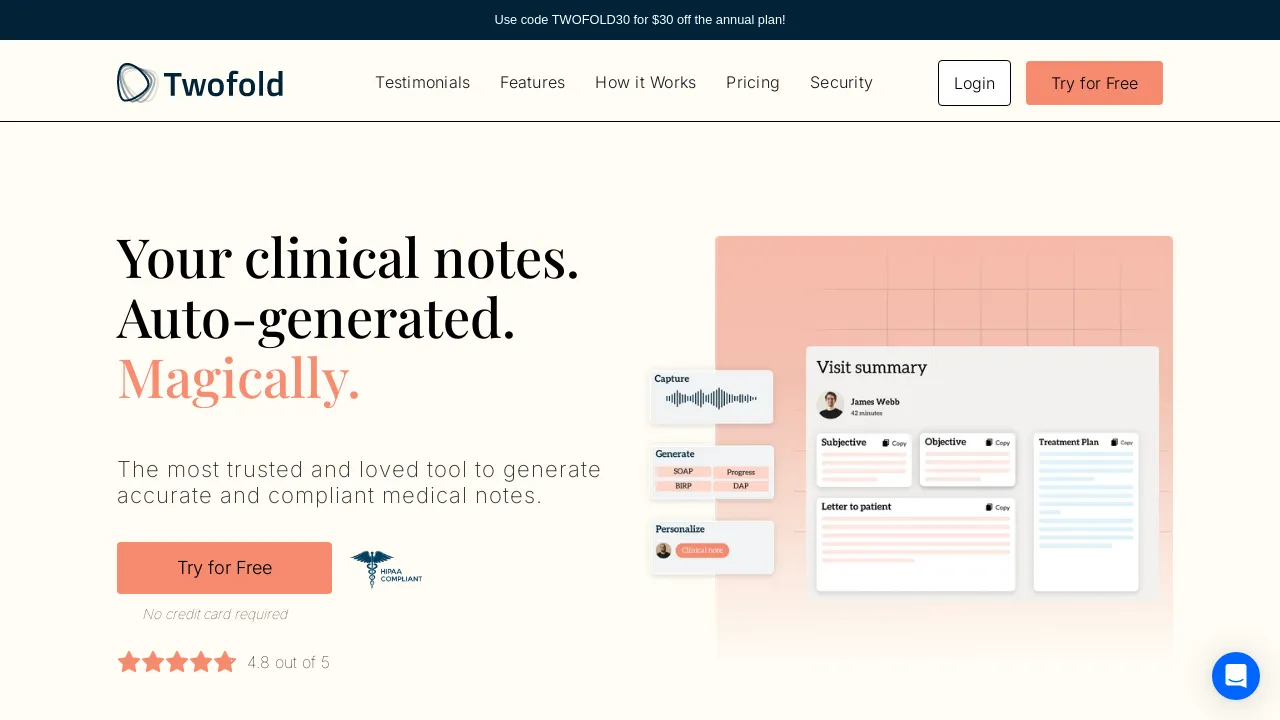
Twofold is an AI scribe that turns session content (recorded, dictated, typed, or uploaded) into structured clinical notes, with customization options for templates and related documentation.
Who Is It For?
- Psychologists who want a best-in-class AI scribe without being locked into one EHR
- Clinicians who prefer flexible capture (record sometimes, dictate sometimes)
- Anyone optimizing for predictable monthly cost rather than per-minute or per-note fees
Key Features
- Multiple capture modes: record full session, dictate a summary, type key points, or upload audio
- Unlimited notes on the Personal plan (per pricing docs)
- Template-driven documentation (useful for payer language consistency and supervisor preferences)
- HIPAA positioning with automatic BAA at signup (vendor-stated)
- User-controlled deletion and explicit statement that PHI is not used for AI training (vendor-stated)
Pros
- Flexible workflow: not "recording-only," which matters in sensitive psychotherapy contexts
- Clear compliance claims: automatic BAA at signup and "no PHI used for training" (vendor-stated)
- Strong value: clinicians repeatedly cite lower cost versus other tools and better customization
- EHR-agnostic: easier to keep your current practice stack.
- Mobile friendly: easy-to-use iOS and Android apps
- 24x7 human support: available for all tiers and all users
Cons
- If you want a fully integrated EHR experience (scheduling, billing, notes, AI all-in-one), you may prefer an EHR-native option instead
Pricing
- Personal plan: $49/month billed annually including unlimited notes, access to all features and 24x7 human customer support.
- Discount available on the website.
Privacy, HIPAA, BAA Notes (Vendor-Stated, Not Legal Advice)
- Twofold states it is HIPAA compliant and provides an automatic BAA at signup.
- Twofold states it uses Microsoft Azure encryption, has no audio storage, and does not use PHI for AI training.
- Twofold states users have control over permanent data deletion.
What Clinicians Say (Forum Links)
Clinicians on Reddit commonly mention:
- Choosing Twofold after comparing other scribes due to price and template customization.
- Reporting meaningful time savings, but still doing a "final touches" pass (as with most AI note tools).
- Recommending it as a fit when you want to keep SimplePractice or other systems and use a standalone scribe.
Links:
What Clinicians Say (Community Threads)
- "Best AI Platform for Notes?" (r/therapists) - Compares options and includes discussion of pricing and workflow tradeoffs.
- "Tired of typing notes after sessions..." (r/ClinicalPsychology) - Mentions real-world usage patterns and editing expectations across AI note tools.
- "Suggestions for AI Scribes" (r/therapists) - Highlights common decision criteria like consent, workflow friction, and trust.
2. SimplePractice Note Taker
What Does It Do
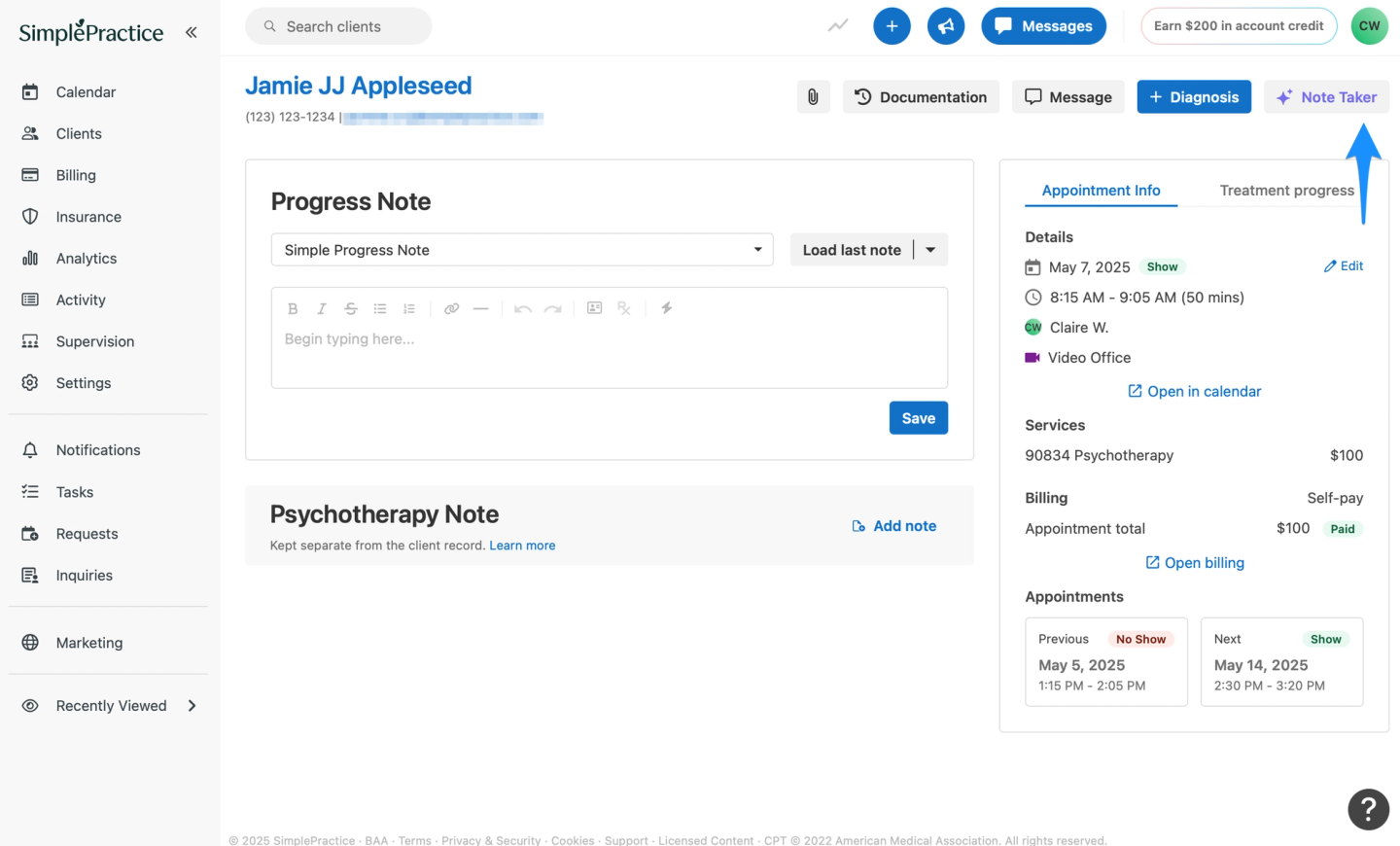
SimplePractice Note Taker records appointment audio to produce a transcript and then generates a draft progress note inside SimplePractice, referencing the client's previous progress note.
Who Is It For
Psychologists already using SimplePractice who want AI drafting that stays inside the SimplePractice appointment and note workflow.
Key Features
- Transcript generated within minutes after the session; recording deleted once the full transcript is available
- Draft note generated from transcript and prior progress note
- Draft note and transcript viewable for up to 7 days or until the note is signed and locked (whichever comes first)
- Dictation mode can generate a draft note from recorded dictation (not plain text)
Pros
- EHR-native drafting inside SimplePractice reduces copy/paste steps.
- Clear vendor-described retention window for transcript visibility (7 days or until sign/lock).
Cons
- Works only with SimplePractice Telehealth for in-session telehealth recording (per FAQ), which can be limiting if you use another video platform.
- Vendor notes that AI may generate mistakes and requires review and edits before saving.
Pricing
- Note Taker add-on: $35/month per enabled clinician after a 30-day free trial.
Privacy, HIPAA, BAA Notes (Vendor-Stated, Not Legal Advice)
- SimplePractice states Note Taker is HIPAA compliant and aligned with its security and privacy policies.
- SimplePractice states recordings are deleted immediately after transcription, and transcripts are retained for the shorter of 7 days or until the note is signed and locked.
- SimplePractice publishes a Business Associate Agreement.
What Clinicians Say (Community Threads)
- "Simple Practice and it's new AI note taker" (r/therapists) - Discusses rollout experience, expectations, and workflow questions.
- SimplePractice Community: "Issues with NoteTaker" - Describes troubleshooting and reliability friction points from users.
- "Simplepractice AI Note Taker" (r/therapists) - Mentions practical concerns like pricing and adoption decisions.
3. TherapyNotes TherapyFuel
What Does It Do
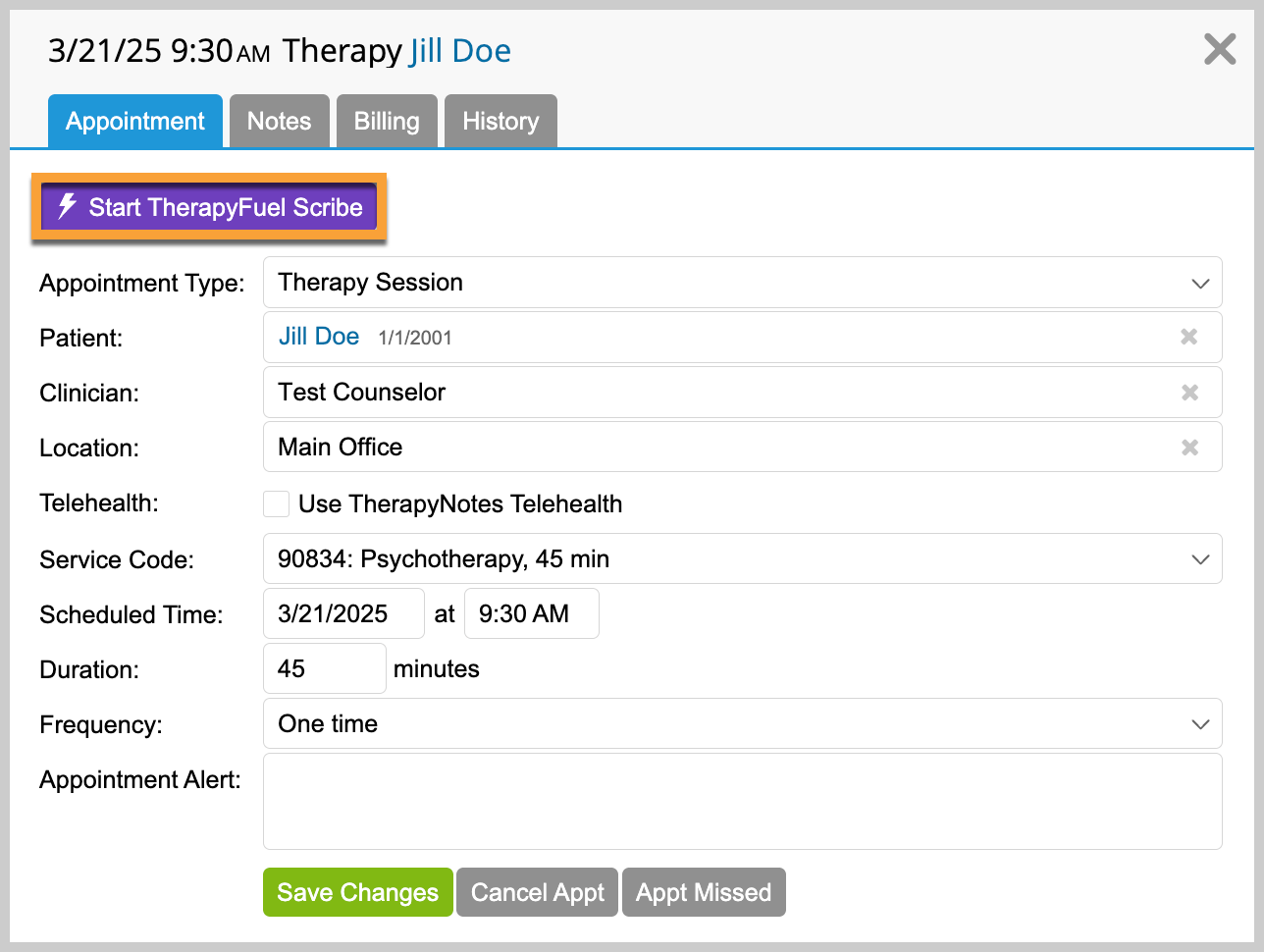
TherapyFuel is a suite of AI tools inside TherapyNotes. TherapyNotes describes two primary documentation paths: generating a note from a typed session summary, or using TherapyFuel Scribe to listen during a session and draft a note from a transcript.
Who Is It For
Psychologists already on TherapyNotes who want AI drafting embedded in the TherapyNotes documentation flow.
Key Features
- Generate a progress note from a typed session summary
- TherapyFuel Scribe can listen during in-person or TherapyNotes Telehealth sessions
- Describes encryption for audio in transit and deletion of audio after successful transcript
- Describes transcript storage until the note is generated and signed, or 30 days (whichever is sooner)1
Pros
- EHR-integrated workflow inside TherapyNotes (less exporting or copying).
Cons
- TherapyFuel Scribe only works within TherapyNotes (not a third-party telehealth platform), per FAQ.
- Support and troubleshooting may be slower for Scribe issues due to limited transcript access, per FAQ.
Pricing
- TherapyFuel: $40/month for each enabled user.
Privacy, HIPAA, BAA Notes (Vendor-Stated, Not Legal Advice)
- TherapyNotes publishes a Business Associate Agreement for practices and requires it be signed/uploaded (per help center).
- TherapyNotes states audio is deleted after a successful transcript; transcripts are stored until the note is signed or 30 days pass.
- TherapyNotes states TherapyFuel access to PHI is covered under their BAA and that minimal information is used for generation.
What Clinicians Say (Community Threads)
- "TherapyFuel? Anyone using..." (r/therapists) - Asks about day-to-day experience and whether it feels worth the added cost.
- "AI Note Assistance Without Recording/Transcribing" (r/therapists) - Mentions TherapyFuel in the context of typed-summary workflows and EHR lock-in.
- "Do you use AI for notes?" (r/therapists) - Discusses mixed comfort levels, including consent and ethical concerns around AI documentation.
4. TheraPro AI
What Does It Do
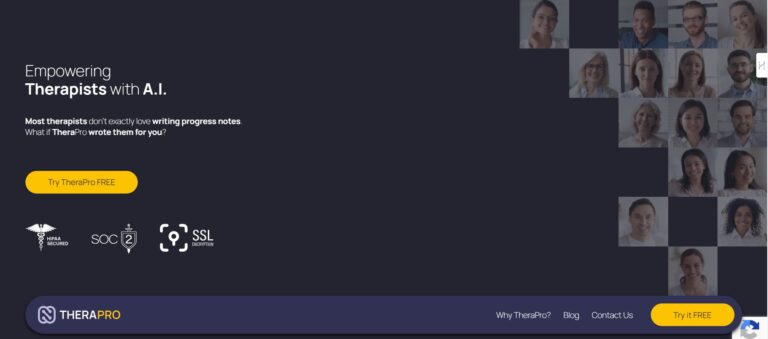
TheraPro AI is a standalone AI documentation tool that offers "full sessions," "recap sessions," and "typed sessions" depending on plan limits.
Who Is It For
Psychologists who want a standalone AI note workflow and are comfortable moving notes into their EHR manually (or outside the EHR‑native tools).
Key Features
- Multiple session input modes: full session, recap session, typed session
- States it does not keep session recordings and deletes temporary audio recordings after a summary is created (with limited exceptions for debugging)
- Publishes a HIPAA Business Associate Agreement
Pros
- Clear plan tiers with a "no limits" option for higher volume use.
- Vendor provides a public HIPAA BAA document.
Cons
- Some clinicians prefer to closely review contractual language around derived data and rights before adopting AI tools in therapy settings.
- As with other tools, expect some editing time to align drafts with your documentation style and risk language.
Pricing
- Pro: $59/month.
Privacy, HIPAA, BAA Notes (Vendor-Stated, Not Legal Advice)
- TheraPro publishes a HIPAA BAA.
- TheraPro states it does not keep session recordings and that recordings are deleted after the session summary is created (with limited exceptions).
- TheraPro also publishes Terms of Service and a Privacy Policy that may be relevant to evaluate before using with PHI.
What Clinicians Say (Community Threads)
- "Reconsider using AI to turn your sessions into progress notes" (r/therapists) - Raises concerns about consent and what happens to data under different vendors' terms.
- "AI note-taking software is licensing your client data" (r/PsychotherapyLeftists) - Discusses how clinicians interpret vendor contracts and de-identified data clauses.
5. Mentalyc
What Does It Do
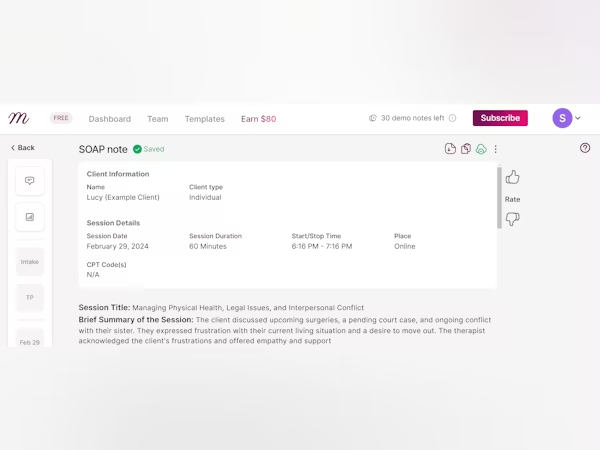
Mentalyc is a standalone AI note taker that supports multiple input methods (record, upload audio, voice‑to‑text, or typed notes) and offers a range of templates and note types.
Who Is It For
Psychologists who want a broad set of templates and plan tiers (including higher‑volume options) and are comfortable using a separate tool alongside their EHR.
Key Features
- Multiple capture modes: record, upload audio, voice-to-text, or type notes
- Higher tiers add more templates, additional client types (for example couple/family), and other features
- Security page states you can delete your data anytime and download a BAA and informed consent materials
- Publishes a Business Associate Agreement
Pros
- Tiered plans can match different caseload sizes (from limited monthly notes up to higher volume).
- Vendor provides BAA-related materials and a security page that discusses deletion controls.
Cons
- Like all AI note tools, clinicians report needing to check drafts for errors or missing nuance before finalizing.
- Pricing can increase meaningfully at the highest tier compared with lighter plans.
Pricing
- Super: $119.99/month (solo practice monthly).
Privacy, HIPAA, BAA Notes (Vendor-Stated, Not Legal Advice)
- Mentalyc pricing page references consent forms and a BAA/HIPAA agreement.
- Mentalyc publishes a Business Associate Agreement.
- Mentalyc security page states you can delete your data anytime and provides access to BAA and informed consent materials.
What Clinicians Say (Community Threads)
- "Anyone using Mentalyc or Upheal for their notes?" (r/therapists) - Asks about fit and general experience across AI note tools.
- "Found major errors in my Mentalyc AI notes..." (r/therapists) - Describes accuracy issues and the need for careful review.
6. Blueprint AI
What Does It Do
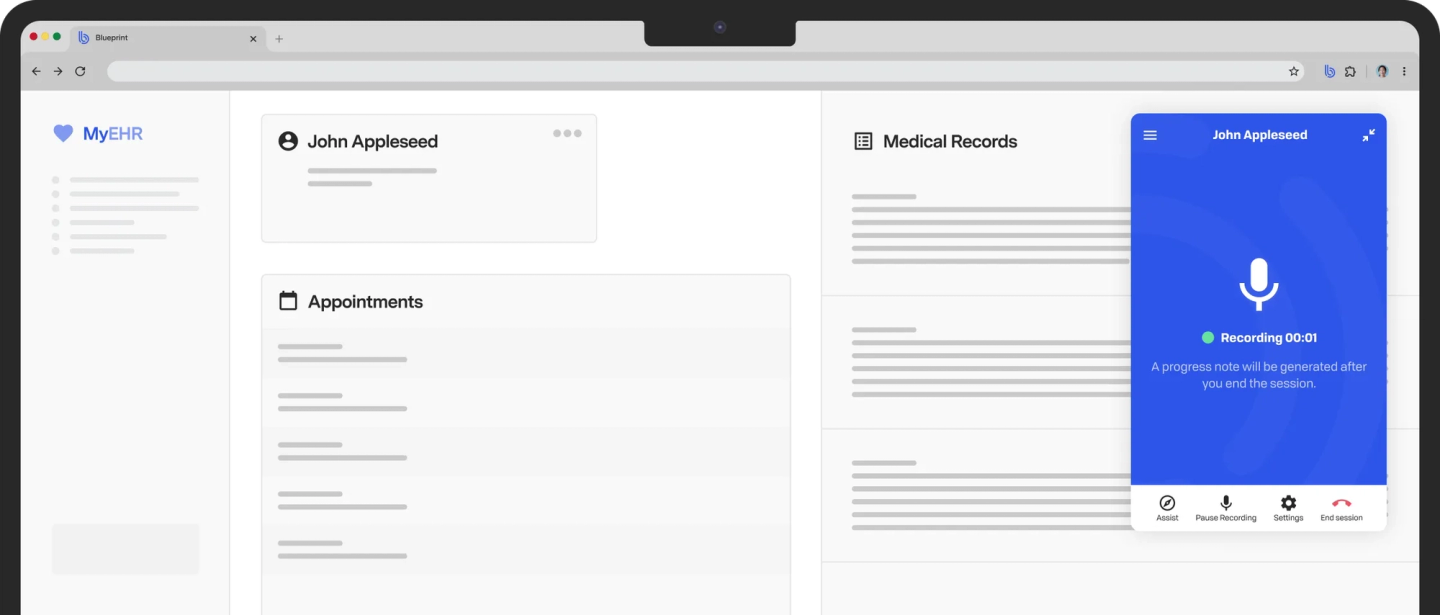
Blueprint describes an AI Notetaker that listens, transcribes, and drafts progress notes and treatment plans, positioned as part of a broader practice platform.
Who Is It For
Psychologists who are comfortable with per‑session pricing and want a tool that may extend beyond note drafting into a larger platform approach.
Key Features
- AI-assisted documentation priced per session (plans vary by feature set)
- Pricing page describes automated progress notes via recordings, dictations, or uploads.
- Website states automatic audio deletion after transcription and that users can set retention policies for clinical artifacts
Pros
- Vendor describes retention controls and audio deletion behavior on its site.
Cons
- Per-session pricing can become expensive with a full-time caseload compared with flat-rate subscription tools.
- Some clinicians report mixed comfort levels with any "listening in session" tool, even when a vendor describes deletion and compliance steps.
Pricing (Highest Publicly Listed Tier)
- Pro: $1.49 per session ($149 for 100 notes/month).
Privacy, HIPAA, BAA Notes (Vendor-Stated, Not Legal Advice)
- Blueprint publishes a Business Associate Agreement page.
- Blueprint's site states audio recordings are deleted after transcription and that you can set retention policies and delete data.
What Clinicians Say (Community Threads)
- "Blueprint for Documentation" (r/therapists) - Asks for opinions and day-to-day experience with Blueprint for documentation.
- "What are your thoughts about AI assistants for therapy..." (r/therapists) - Describes adoption friction and clinician feelings about being pushed toward AI note tools.
Conclusion
If you are searching for the best AI note takers for psychologists or the best AI scribe for psychologists in 2026, the decision usually comes down to workflow flexibility, clarity of vendor‑stated privacy posture, and how easily you can finalize notes in your existing documentation system.
For most psychologists, Twofold is the most sensible starting point because it combines (1) flexible capture options (record or summary), (2) an EHR‑agnostic workflow that fits nearly any practice setup, and (3) clearly published HIPAA and BAA materials you can review as part of your compliance process.