


In 2026, AI is no longer a novelty in medicine; it is a practical necessity. Physicians face administrative burdens, and the right tools can reclaim hours for patient care. This guide breaks down the six best AI tools for doctors by category, from AI medical scribe platforms to clinical search and secure communications. You'll learn what works, what doesn't, and how to choose wisely.
Why Doctors Need Different AI Tools for Different Jobs
- Documentation Eats Hours That Should Go to Patients: The administrative burden remains the leading cause of burnout. AI must offload the mental load of note-taking.
- Clinical Search Still Defaults to Outdated Workflows: Traditional search engines are too slow and unfiltered for point-of-care decision-making.
- Physician Communications Have No Purpose-Built AI Layer: General AI (like ChatGPT) lacks the privacy and contextual nuance required for peer-to-peer medical consultation.
- The Wrong Tool for the Job Creates More Work, Not Less: Using a generic LLM for clinical notes can lead to "hallucinations" and compliance risks. Specialized HIPAA-compliant AI note tools are required.
Best AI Tools for Doctors in 2026: TL;DR
Tool | Category | Verdict |
|---|---|---|
Twofold | Documentation | The standard for specialty-specific, HIPAA-compliant clinical notes. |
OpenEvidence | Clinical search | The fastest way to get evidence-based answers at the point of care. |
Doximity GPT | Physician comms | Secure, medical-specific drafting for peer-to-peer and patient messages. |
Dragon Medical One | Dictation | The standard for hands-free voice-to-text. |
Freed | Documentation | A good choice for clinicians seeking an AI medical scribe. |
Heidi Health | Documentation | Great for global clinicians needing flexible note templates. |
6 Best AI Tools for Doctors in 2026
1. Twofold (Documentation)
Category: Clinical Documentation & AI medical scribe.
Key Features:
- Specialty-specific note generation (Therapy, Psychiatry, Primary Care).
- Ambient listening technology (AI medical scribe) that drafts notes in real time.
- Copies finished notes into any EHR in one click.
- Support for therapy-specific workflows.
Benefits:
- Reduces "pajama time" (charting after hours).
- Ensures compliance with built-in HIPAA safeguards.
- Increases face-to-face time with patients.
Limitations:
Requires a stable internet connection; initial setup takes a few minutes.
2. OpenEvidence (Clinical Search)
Category: Clinical Search & Decision Support
Key Features:
- Trained on the New England Journal of Medicine and other credible sources.
- Cites sources for every answer to prevent AI hallucination.
- Free for verified healthcare professionals.
Benefits:
- Provides instant answers to complex clinical questions.
- Eliminates the need to scroll through irrelevant search results.
Limitations:
Designed for search, not for generating patient‑specific documentation.
3. Doximity GPT (Physician Communications)
Category: Physician Communications
Key Features:
- Integrated into the Doximity network (the "LinkedIn for Doctors").
- Secure drafting tool for letters of medical necessity, insurance appeals, and peer messages.
- HIPAA-compliant environment.
Benefits:
- Saves time on administrative correspondence.
- Maintains a professional tone in difficult communications.
Limitations:
Not a diagnostic tool; limited to text generation within the Doximity ecosystem.
4. Dragon Medical One (Dictation)
Category: Dictation & Voice‑to‑Text
Key Features:
- Cloud-based speech recognition.
- Deep integration with major EHRs (Epic, Cerner).
- Specialized medical vocabulary recognition.
Benefits:
- High accuracy for medical terminology.
- Allows for hands-free navigation of the EHR.
Limitations:
- Traditionally more expensive than newer AI scribes; requires the doctor to speak linearly (command-style).
5. Freed (Documentation, Alternative)
Category: Documentation
Key Features:
- Ambient AI scribe that learns your style.
- Simple interface with minimal training required.
- Focuses on "clinician-first" design.
Benefits:
- Quick setup.
- Good for solo practitioners.
Limitations:
Less customizable for highly specific subspecialties than Twofold.
6. Heidi Health (Documentation, Alternative)
Category: Documentation
Key Features:
- Global reach with support for multiple languages.
- "Ask Heidi" feature to query the visit transcript.
- Customizable note templates.
Benefits:
- Flexible for diverse patient populations.
- Strong focus on the "patient summary" feature.
Limitations:
Some users report a learning curve for template customization.
AI Tools for Doctors Comparison Overview.
Tool | Category | HIPAA-Compliant | Pricing Model |
|---|---|---|---|
Twofold | Documentation | Yes | $49/mo billed annually or $69 monthly; 7-day free trial |
OpenEvidence | Clinical search | Yes | Free (verified clinicians) |
Doximity GPT | Communications | Yes | Free (network members) |
Dragon Medical One | Dictation | Yes | Enterprise |
Freed | Documentation | Yes | Subscription |
Heidi Health | Documentation | Yes | Freemium/Subscription |
The Four Categories of AI Every Doctor Actually Uses
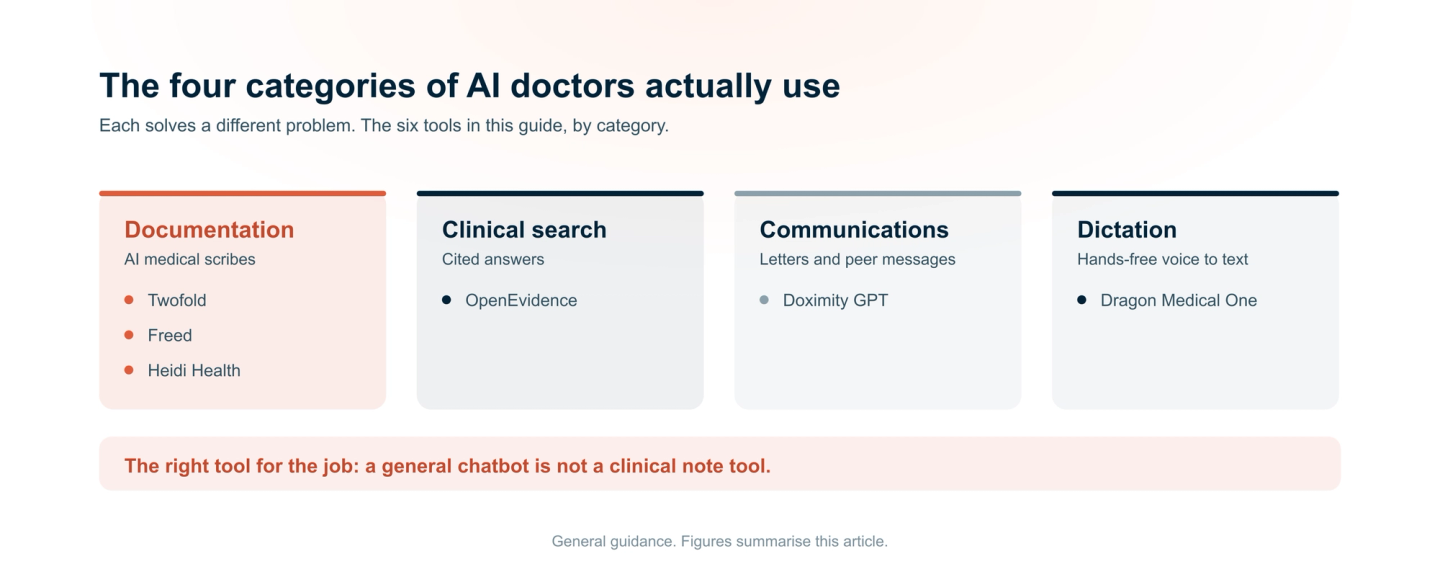
- Documentation and Clinical Notes: AI medical scribes listen to patient encounters and generate structured notes in real time, and tools in this category must be HIPAA-compliant and get the note into your EHR without double entry.
- Clinical Search and Decision Support: AI-powered clinical search tools filter peer-reviewed literature and provide cited, evidence-based answers at the point of care.
- Physician Communications: AI built for physician communications helps generate professional, secure, and context-aware messages.
- Dictation and Voice-to-Text: Dictation remains essential for clinicians, and AI dictation tools offer high accuracy for medical terminology and hands-free EHR navigation.
What Makes an AI Tool Worth Using in a Clinical Setting
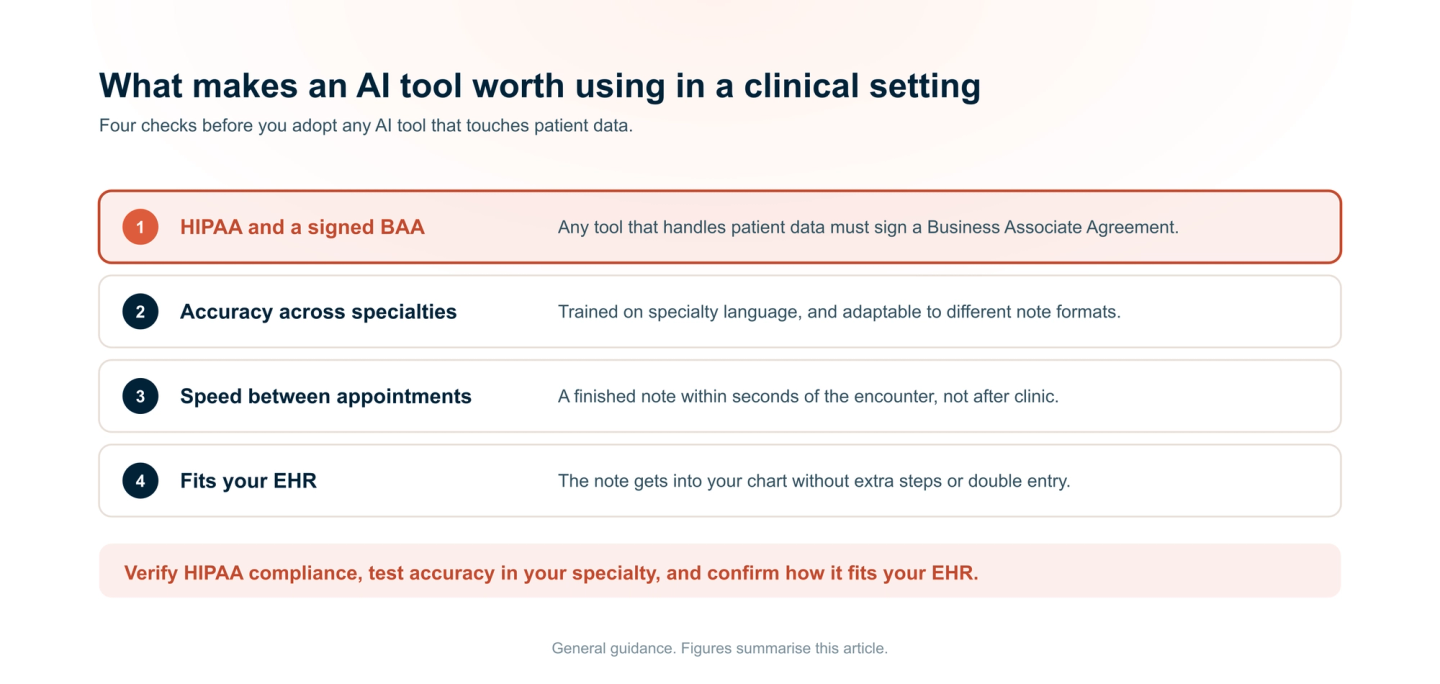
- HIPAA Compliance and Data Handling: If a tool interacts with patient data, it must be HIPAA-compliant and willing to sign a Business Associate Agreement (BAA). Be wary of free AI note tools and their claims of 'compliance'.
- Accuracy That Holds Up Across Specialties and Note Types: The best AI scribe tools are trained on specialty-specific language and can adapt to different note formats.
- Speed That Fits Between Appointments, Not After Them: Look for ambient scribes that draft in real time and deliver a note within seconds of the encounter ending.
- EHR Compatibility That Doesn't Require Extra Steps: The note should reach your chart without double entry, whether through a native integration or a one-click copy into any EHR.
How to Choose the Right AI Tool for Your Practice
Feature | What to Look For | Red Flag |
|---|---|---|
Compliance | Signed BAA, data encryption | Data that may be used for training |
Workflow | Ambient listening | Requires manual data entry |
Integration | Works with your EHR (native sync or one-click copy) | Retyping notes into the chart |
Pricing | Per provider or group rates | Hidden setup fees |
How Twofold Handles Clinical Documentation Across Every Specialty
- Specialized Templates: Unlike generic scribes, Twofold is built with specific logic for mental health, primary care, and specialty clinics.
- The Advantage: We combine the speed of an AI medical scribe with the nuance required for therapy and clinical notes.
- Security First: We prioritize HIPAA compliance above all else, ensuring your patient data remains secure.
Conclusion
The best AI tool for doctors in 2026 is not the most hyped; it is the one that fits your workflow. Success lies in specialization: AI medical scribes for documentation, clinical search tools for decision support, and secure platforms for physician communications. Each category solves a distinct problem. Before adopting any tool, verify HIPAA compliance, test accuracy against your specialty, and confirm how it fits your EHR.