



A chiropractic note that only says “subluxation palpated, tolerated well” is not substantial for a Medicare review. The record has to show the PART elements, tissue changes, and prove the care is active treatment rather than maintenance. This article provides a complete initial visit and follow‑up, each documenting PART, followed by guidance on the active‑vs‑maintenance distinction and the AT modifier.
Example 1: Initial Visit
Documenting the visit using SOAP elements.
Subjective
- Chief Complaint: Low back pain, 3 weeks, insidious onset, 6/10, worse with prolonged sitting and bending forward.
- History: No prior episodes; no red flags; no imaging indicated.
Objective
- Pain (P): 6/10 lumbar paraspinal, non-radiating.
- Asymmetry (A): Right iliac crest low; right PSIS tender.
- Range of Motion (R): Flexion 45° (normal 60°), extension 15° (normal 25°), right lateral flexion 20° with pain.
- Tissue Changes (T): Hypertonicity L4-S1 paraspinal; palpable segmental restriction L4/L5; skin temperature change noted,
Assessment
- Diagnosis: Segmented dysfunction L4/L5 with associated myofascial hypertonicity; subluxation complex documented by the PART findings above.
- Care Type: Active treatment; condition has a defined course.
Plan
- Frequency: 3x weekly for 2 weeks, then reassess.
- Goals: Reduce pain to ≤3/10 and restore flexion to ≥55° within 4 weeks.
- Modalities: Manual adjustment L4/L5; home exercise instruction.
Example 2: Follow-Up Visit, Week 2
Subjective
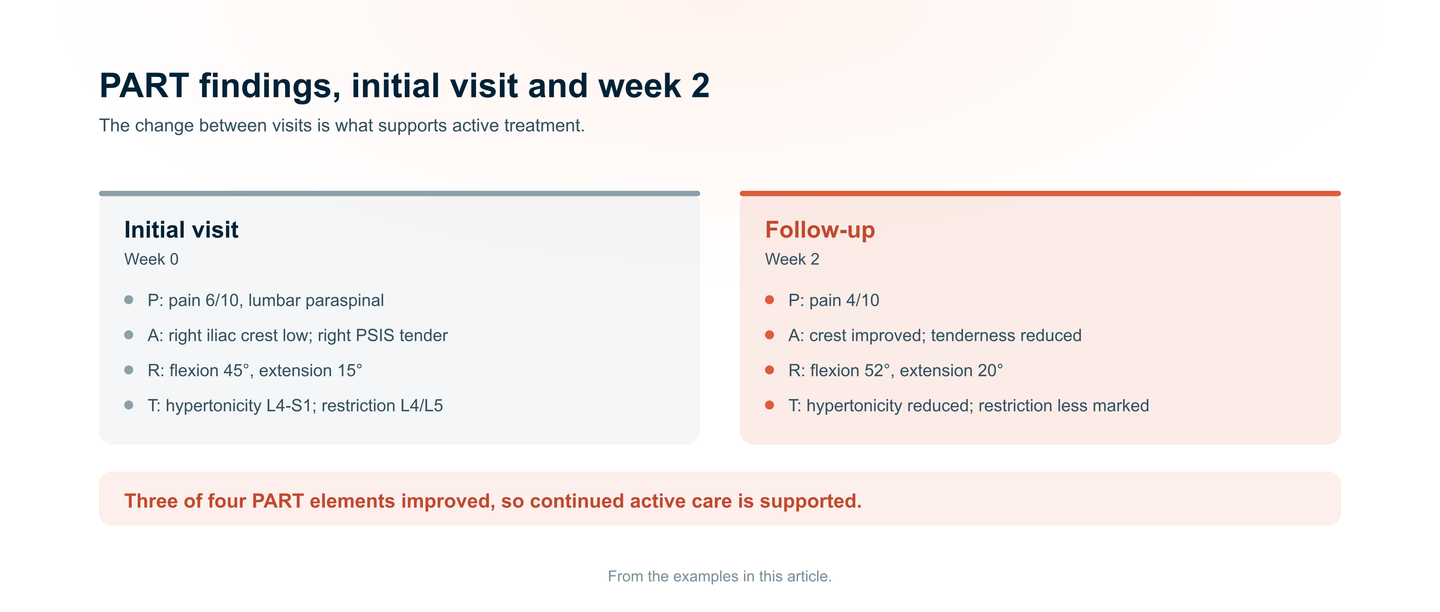
- Interval: Pain decreased from 6/10 to 4/10; sitting tolerance improved, still sore after long drives.
Objective
- P: 4/10 lumbar paraspinal.
- A: Right iliac crest improved but still low; tenderness reduced.
- R: Flexion 52° (from 45°), extension 20° (from 15°), right lateral flexion 25° with mild discomfort.
- T: Reduced hypertonicity L4-S1; segmental restriction L4/L5 persists but is less pronounced.
Assessment
- Response: Objective improvement in three of four PART elements; supports continued active care.
- Not maintenance: Measurable functional gains continue; treatment remains aimed at restoring function.
Plan
- Continue: 2x weekly for 2 weeks; reassess ROM and pain at week 4.
- Document: AT modifier supported by the functional progress above.
Active Treatment Vs. Maintenance Care
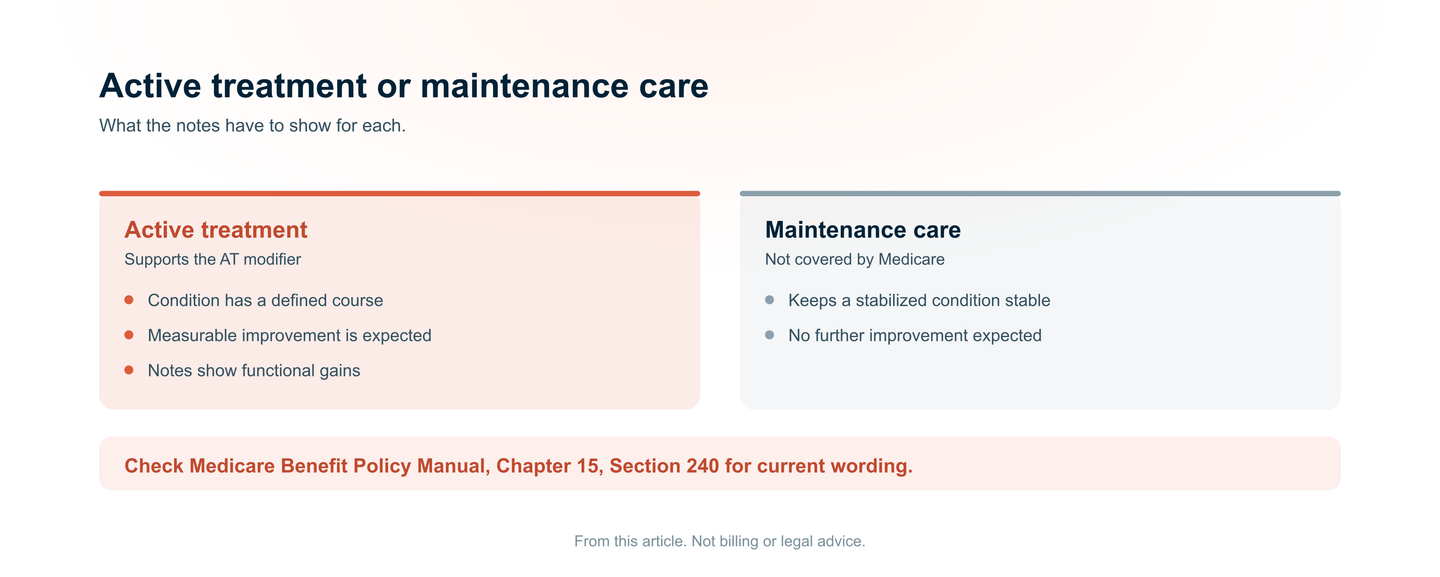
- Active Treatment: Condition has a defined course; care is expected to produce measurable improvement; documentation shows functional gains.
- Maintenance Care: Care is provided to maintain a stabilized condition; no expectation of further improvement (not covered by Medicare).
The AT Modifier
- What it Signals: The AT modifier attests that the service is active treatment. It is a claim, and your note must support it.
- What Supports It: Objective improvement in PART elements, documented goals, and a plan that ties frequency to progress.
- What Undermines It: Repeated identical findings across visits with no change, or notes that never state a treatment goal.
Verify Against the Manual
- Check the Source: Medicare Benefit Policy, Chapter 15, Section 240 covers coverage of chiropractic services and the maintenance-care exclusion.
- Why Check It: Payer guidance and local coverage determinations vary; confirm current wording before relying on it.
- Document Accordingly: The notes language should mirror the manual's active-versus-maintenance distinction.
Conclusion
Document all four PART elements in every objective section, show functional progress in every assessment, and state the care type explicitly so the AT modifier is supported rather than assumed. A note that repeats identical findings visit after visit cannot demonstrate active treatment. Draft with the AI scribe for chiropractors, and use our SOAP notes guide for the base format.