



Documenting a session with an angry patient requires clinical and professional discipline. Elevated clinician emotions often lead to subjective charting, which undermines objectivity and defensibility. Effective dictation prioritizes observable actions, explicit verbal content, and specific therapeutic responses. This article provides a framework for AI‑assisted dictation that ensures AI therapy notes capture clinical significance while maintaining professional compliance and consistency across treatment records and documentation.
Understanding the "Outburst"
Effective dictation requires cognitive control. When a patient presents with signs of aggression, the clinician's autonomic nervous system is activated. This physiological response can impair the cognitive functions required for precise clinical language.
The Risk of "Subjective Charting"
Stress-induced thinking produces documentation errors. These errors fall into three categories:
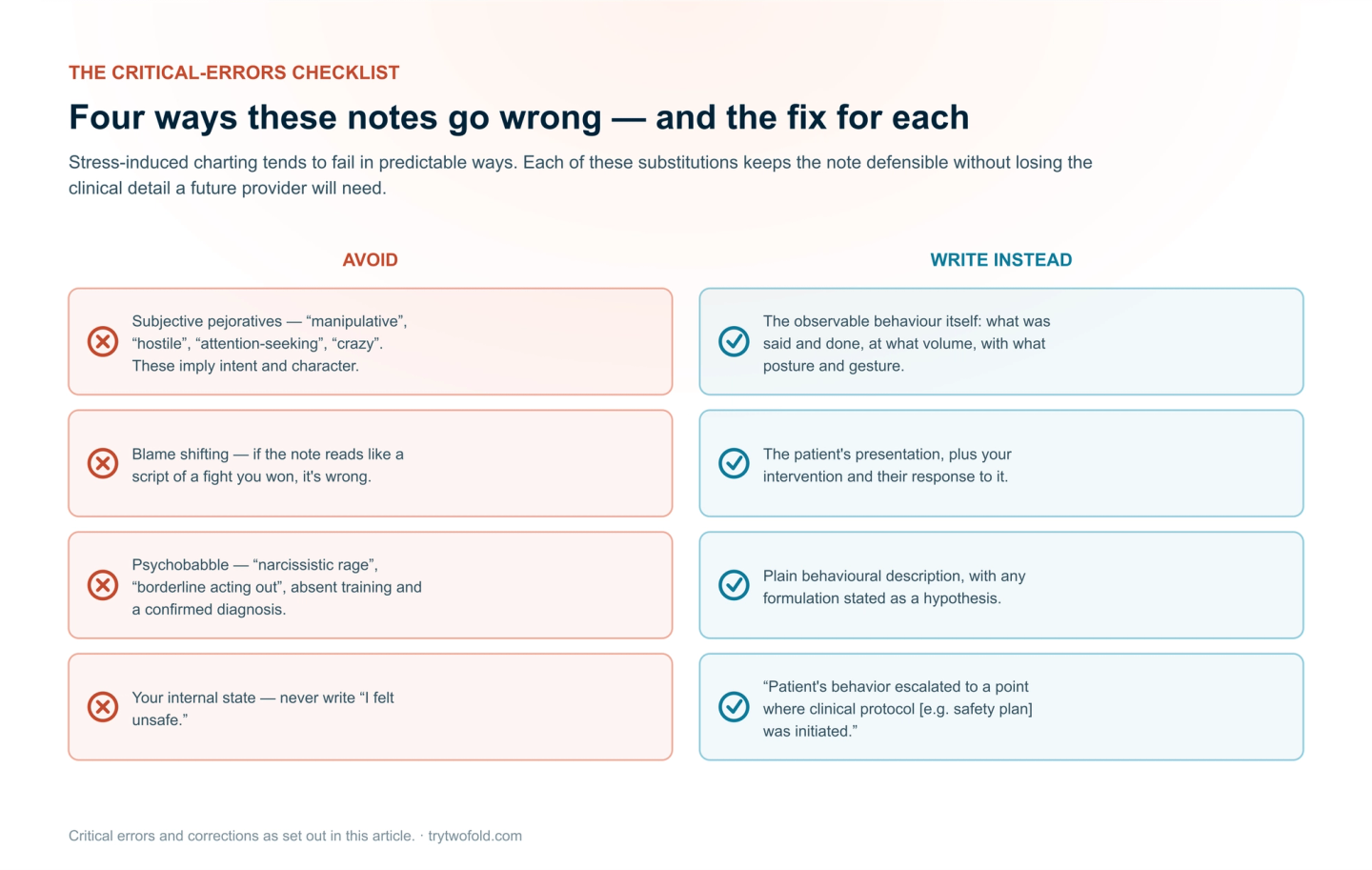
- Subjective Pejoratives: Use of diagnostic-sounding but judgmental terms such as "manipulative," "hostile," "attention-seeking," or "crazy." These terms imply intent and character rather than describe observed behavior.
- Defensive Documentation: Charting that prioritizes justifying the clinician's actions over describing the patient's presentation. This often appears as excessive detail about safety protocols or exaggerated language about threat level, written to preempt liability rather than to document treatment.
- Loss of Clinical Nuance: Over-focusing on the intensity of the emotional expression while failing to document the content, triggers, cognitive distortions, or contextual factors that carry therapeutic significance.
The "Objective Translation" Framework
The central principle of clinical documentation during aggressive encounters is behavioral description rather than characterological definition. Observing and documenting discrete behaviors maintains objectivity. Assigning traits or motives introduces clinician bias and reduces the defensibility of the note.
The Rule: Describe the behavior. Do not define the person.
Behavioral descriptors are verifiable. Trait labels (e.g., "hostile," "manipulative") are inferential and lack evidentiary support within the note itself. Adherence to this rule therefore ensures the note remains fact‑based and clinically useful for future providers.
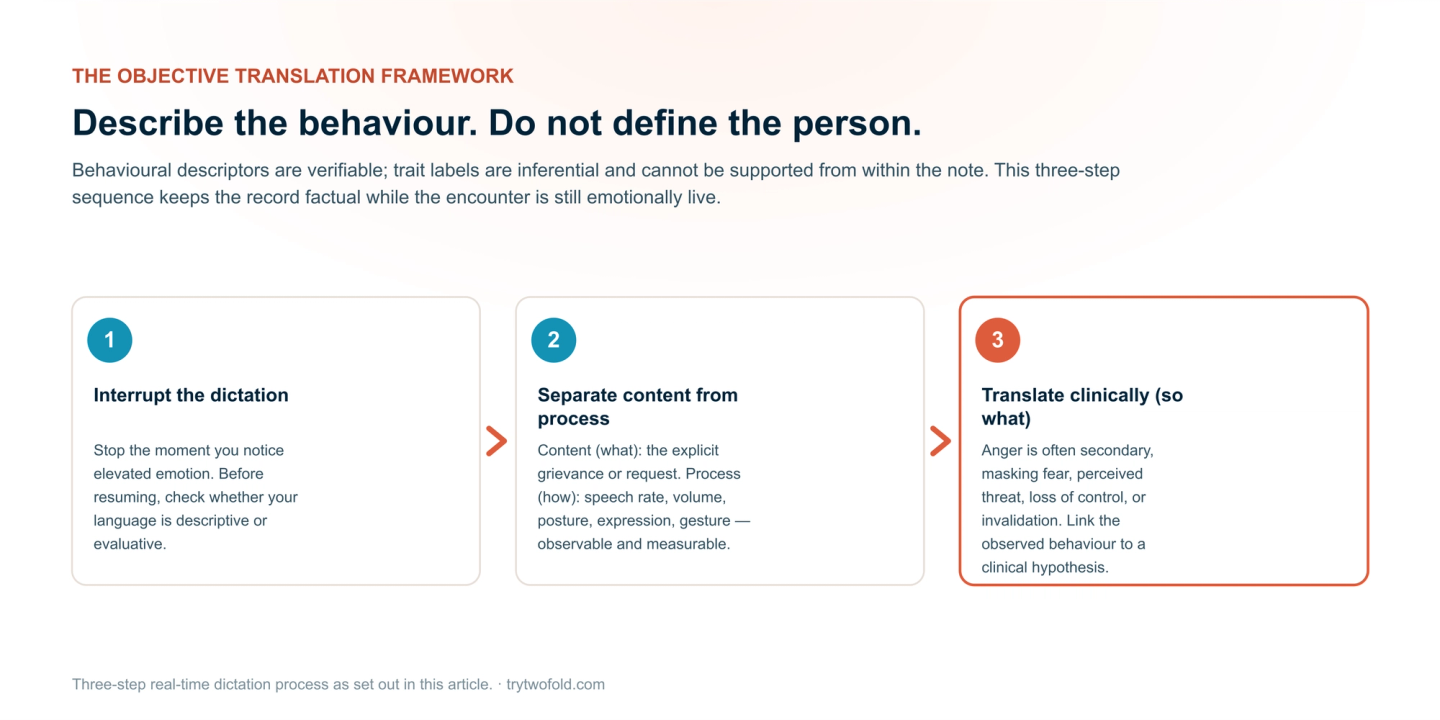
The 3-Step Process for Real-Time AI Therapy Note Dictation
Step 1: Dictation Interruption
Stop dictation immediately upon recognition of elevated emotions. Resuming dictation requires the clinician to first assess whether their language selection is descriptive or evaluative.
Step 2: Separation of Content from Process
Divide the patient's presentation into two categories:
- Content (What): The explicit verbal grievance, request, or stated concern. This is the factual subject matter of the patient's communication.
- Process (How): The paralinguistic and behavioral features accompanying the content. This includes speech rate, vocal volume, posture, facial expression, and gesture. Process data are observable and measurable.
Documenting both categories separately prevents the emotional intensity of the process from obscuring the clinical relevance of the content.
Step 3: Clinical Translation ("So What")
Identify the underlying driver of the expressed anger. Anger in clinical settings frequently serves as a secondary emotion, masking fear, perceived threat, loss of control, or invalidation. Translating the presentation requires linking the observable behavior to a clinical hypothesis. This translation justifies the selection of subsequent interventions and situates the encounter within the broader treatment framework.
Structuring the AI Dictation
A consistent format ensures all required clinical elements are captured while maintaining objectivity. Two primary dictation structures are recommended for 'angry patient' encounters: the Problem‑Solution Format and the Emotion‑as‑Data Approach. Both are compatible with AI therapy note tools and produce clinically complete, defensible notes.
The Problem-Solution Format
- Utility: By requiring inclusion of the clinician's intervention and the patient's response, this technique ensures the note reflects therapeutic activity, not just a crisis description.
- Structure: Each documented segment follows a three-component sequence:
- Trigger: The specific observable event, topic, or external factor that preceded the patient's elevated emotional state.
- Intervention: The specific clinical technique, verbal response, or environmental adjustment employed by the clinician.
- Outcome: The patient's subsequent behavior, verbal response, or affective state following the intervention.
Dictation Template:
"Trigger: (Patient behavior). Intervention: (Clinician action). Outcome: (Patient response)."
The Emotion-as-Data Approach
- Utility: This approach redefines anger from an obstacle to clinical information. By documenting anger as a signal, the clinician links the immediate presentation to the patient's diagnostic formulation and treatment objectives.
- Implementation: Dictate anger as a measurable clinical variable that provides information about the patient's internal state, cognitive processes, or relational patterns. This requires articulating the connection between the behavioral presentation and the clinical hypothesis.
Dictation Template:
"Patient's (affective presentation) appears correlated with (underlying cognitive/emotional factor) related to (treatment context or prior session content)."
Critical Errors to Avoid Checklist
- Avoid "Blame Shifting": If the note reads like a script of a fight you won, it's wrong.
- Avoid Psychobabble: Do not use terms like "narcissistic rage" or "borderline acting out" unless you are specifically trained and the diagnosis is confirmed.
- Avoid Vulgarity: You do not need to document every curse word said. "Patient used explicit language to express frustration" is sufficient.
- Never Document your Internal Thoughts: Never write "I felt unsafe." Write: "Patient's behavior escalated to a point where clinical protocol [e.g., safety plan] was initiated."
Conclusion
Clinical documentation during angry patient encounters requires deliberate adherence to objective behavioral description. Translating reactive observations into measurable behavioral data ensures notes remain defensible, clinically useful, and free from evaluative bias. Consistent application of the Problem‑Solution Format and Emotion‑as‑Data Approach produces records that capture therapeutic activity while maintaining professionalism. Accurate AI therapy notes serve both the patient's treatment continuity and the therapist's legal protection.