

Many clinics implement ambient scribes without a clear framework, relying on anecdotes rather than real‑world data to gauge ROI. Conversely, high‑performing clinics systematically track a balanced scorecard of key metrics. From documentation efficiency and revenue cycle gains to patient satisfaction and clinician well‑being, this article breaks down exactly what top clinics monitor after implementing AI clinical notes.
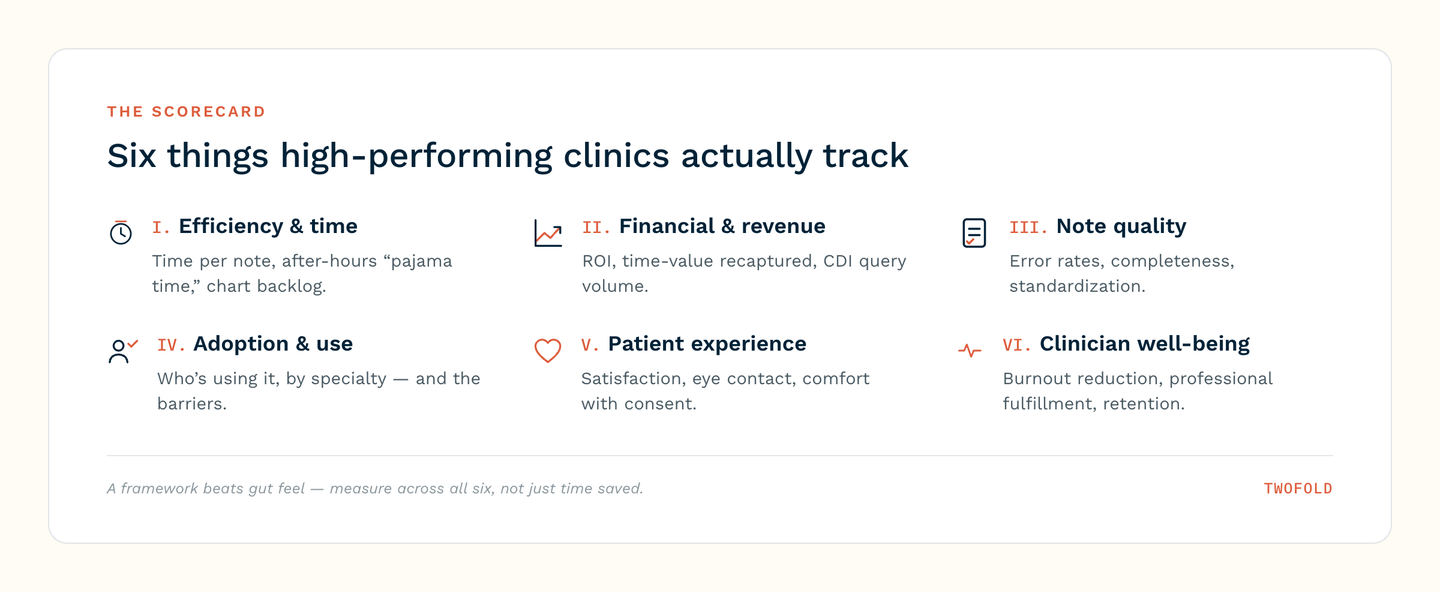
I. Efficiency & Documentation Time Metrics
High‑performing clinics track documentation efficiency across the following four points:
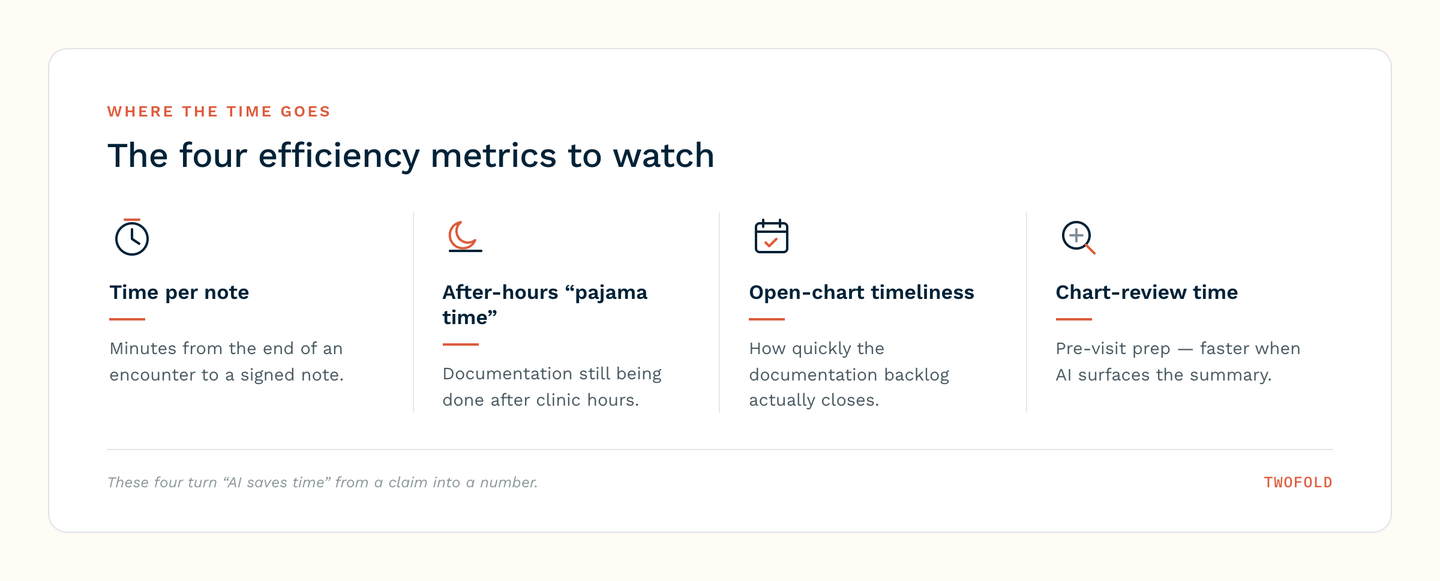
1. Time Per Note
- What to Track: Average minutes spent documenting per patient encounter, pre- and post-implementation.
- Why it matters: Directly quantifies AI's core value proposition: faster documentation.
2. After-Hours Documentation ("Pajama Time")
- What to Track: Time spent in EHR outside scheduled hours.
- Why it Matters: Strongest correlation with burnout and retention; measures whether AI returns time to clinicians' personal lives.
3. Open Chart Timeliness (Backlog Indicator)
- What to Track: Number of open, unsigned charts; percentage of notes closed same day.
- Why it Matters: Delayed notes fall into coding delays, care continuity gaps, and additional stress.
4. Chart Review Time (Pre-Visit Preparation)
- What to Track: Time spent reviewing patient charts before encounters.
- Why it Matters: AI summaries can streamline pre-visit preparation.
II. Financial & Revenue Cycle Metrics
Financial metrics provide the evidence that justifies AI investment and demonstrates sustainable ROI.
1. Return on Investment (ROI) & Time Value Recapture
- What to Track: Total time saved translated into financial value; direct ROI calculation.
- Why it Matters: Connects clinical efficiency gains to organizational financial health.
2. Clinical Documentation Improvement (CDI) Queries
- What to Track: Number of CDI queries requiring clinician clarification.
- Why it Matters: Each query represents workflow disruption for clinicians and delayed revenue for the organization.
Why High-Performing Clinics Track This:
- Fewer queries indicate more complete, accurate initial documentation.
- Directly correlates with AI's ability to capture all relevant diagnostic and procedural details.
- Reduces clinician interruption and frustration.
III. Clinical Note Quality & Accuracy
High‑performing clinics treat quality as a non‑negotiable prerequisite and systematically track accuracy, completeness, and consistency to ensure AI enhances clinical documentation standards.
1. Note Accuracy & Error Rates
- What to Track: Frequency of misattributed symptoms, wrong medication doses, missed negations, hallucinations, and other errors in AI-generated notes.
- Why it Matters: AI-generated errors carry the same legal and clinical weight as manually written errors, and can propagate across the EHR.
2. Note Completeness & Length
- What to Track: Character or word count of notes; percentage of note content attributable to AI versus clinician edits.
- Why it Matters: Indicates whether AI captures comprehensive clinical detail without missing critical elements.
Quality Markers to Assess:
- Presence of all required History of Presenting Illness (HPI) elements.
- Complete Review of Systems (ROS) documentation.
- Comprehensive Physical Exam findings.
- Appropriate Assessment and Plan.
3. Standardization & Consistency
- What to Track: Variability in note structure, completeness, and quality across providers and specialties.
- Why it Matters: Standardized notes improve care coordination and meet insurance requirements.
- Strategic Use: Identify outlier providers who may need additional training or AI customization.
Benefits of Standardization:
- Easier for covering clinicians to quickly locate critical information.
- Reduces query volume from coding and billing teams.
- Supports quality reporting and MIPS compliance.
IV. Adoption & Utilization Metrics
High‑performing clinics treat adoption as an actively managed metric that requires ongoing attention.
1. Specialty-Level Adoption Variation
- What to Track: Adoption rates broken down by specialty, practice setting, and clinician demographics.
- Why it Matters: Identifies which workflows benefit most and where additional support is needed.
Common Patterns:
- High Adoption Specialties: Primary care, psychiatry, cardiology, diabetes care (narrative-heavy encounters).
- Lower Adoption Specialties: Surgical specialties, procedural care (less documentation burden).
Strategic Use:
- Tailor training to specialty-specific workflows.
- Adjust AI templates for specialty-specific documentation requirements.
- Set realistic specialty-specific utilization targets.
2. Barriers to Adoption (Qualitative Tracking)
- What to Track: Clinician-reported barriers through surveys, focus groups, and help desk tickets.
- Why it Matters: Quantitative utilization data tells you what is happening; qualitative data tells you why.
Common Barriers to Monitor:
- Note quality concerns (accuracy, completeness).
- Workflow integration issues (launching AI, copying notes).
- Technical issues (latency, errors, crashes).
- Specialty-specific mismatches (templates don't fit).
- Privacy concerns (patients are uncomfortable with ambient listening and refuse recording).
V. Patient Experience Metrics
High‑performing clinics track patient experience metrics to ensure the technology enhances the human connection at the heart of medicine.
1. Patient Satisfaction Scores
- What to Track: Net Promoter Score (NPS), or other standardized patient satisfaction measures.
- Why it Matters: Patients notice when clinicians are more present, make more eye contact, and spend less time looking at screens.
2. Patient-Provider Interaction Quality
- What to Track: Patient perception of clinician attentiveness, eye contact, time spent in direct conversation, and overall bedside manner.
- Why it Matters: The primary mechanism by which AI improves satisfaction is that clinicians spend less time typing and more time connecting.
3. Patient Comfort & Consent
What to Track: Patient acceptance of ambient listening technology; opt‑out rates
Why it Matters: Patients must feel comfortable with AI documentation for adoption to succeed at scale.
- Key Considerations:
- Most patients are receptive when clinicians explain the technology clearly.
- Transparency reduces anxiety: "This AI will help me focus on you instead of typing"
- Track opt-out rates by clinician and patient demographics.
- Best Practice: Standardize a brief, patient-friendly consent script that all clinicians use consistently
VI. Clinician Well-Being & Retention Metrics
Lastly, the most compelling ROI of AI clinical notes is measured in the humanity it restores to clinicians. High‑performing clinics recognize that efficiency gains are useless if they don't translate to better professional lives.
1. Burnout Reduction
- What to Track: Standardized burnout measures; Stanford Professional Fulfillment Index, Maslach Burnout Inventory (MBI), or single-item burnout questions (e.g., "On a scale of 1–10, how burned out do you feel?")
- Why it Matters: Burnout drives turnover, compromises patient safety, reduces productivity, and ruins the joy in practicing medicine.
2. Professional Fulfillment & Job Satisfaction
- What to Track: Measures of job satisfaction, meaning in work, professional fulfillment, and intent to stay.
- Why it Matters: Beyond burnout reduction, does AI help clinicians find more joy and purpose in their work?
Conclusion
High‑performing clinics don't treat AI clinical notes tools as a one‑and‑done solution. They actively track a balanced scorecard spanning efficiency, revenue, quality, adoption, patient experience, and clinician well‑being. The organizations that measure comprehensively and act on their data will capture the full return on their AI scribe investment, both financially and humanly.