


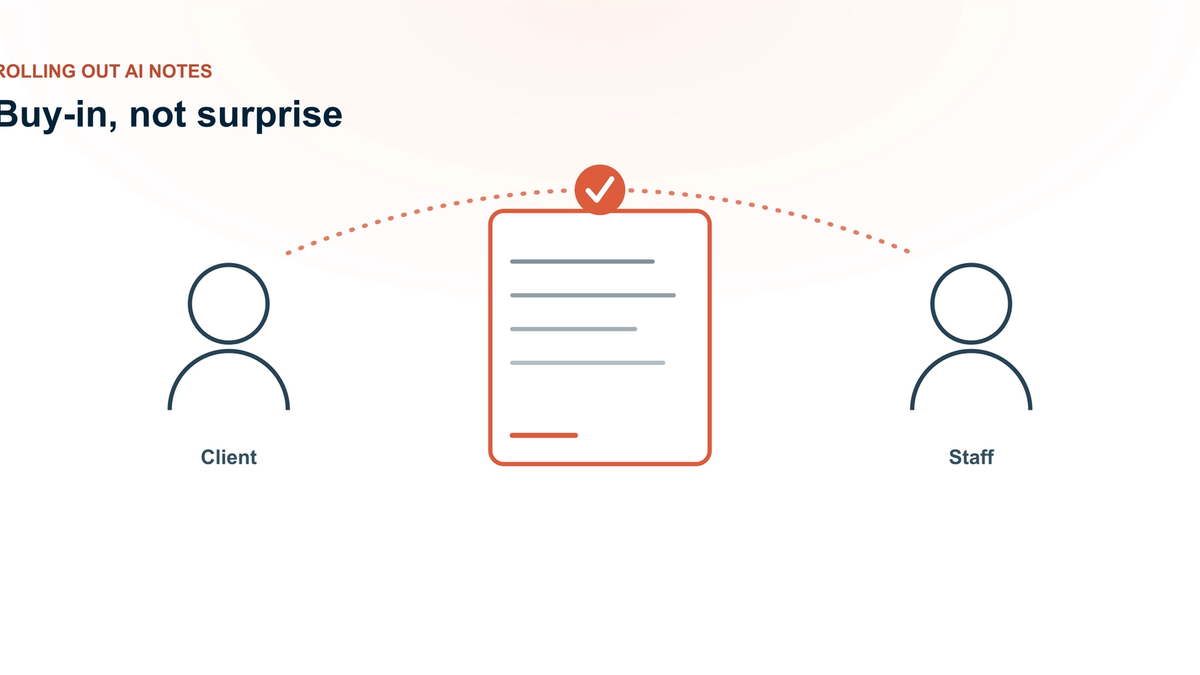
Implementing AI for therapy notes is a logistical and emotional balancing act. When done poorly, it can destroy client and staff trust. When done properly, it cuts admin time in half without compromising the therapeutic alliance. The solution is phased rollouts that prioritize staff comfort and transparent workflows. Here's how to introduce an AI therapy note tool without spooking your staff or clients.
Why Clients and Staff Get Spooked
Before you even open the software, you have to address the discomfort that AI naturally triggers.
The Client's Perspective: Fear of the "Third Ear"
To a client, the therapy room is a sanctuary. Introducing an AI scribe feels like inviting a stranger to sit in the corner and take notes.
Privacy vs. Convenience
Clients like the idea of a therapist being alert and well‑rested, but they may feel uncomfortable if that means their conversations are recorded. They ask: "Will my therapist be paying more attention to the screen than to me?" Even when you explain that the AI is for administrative relief, clients may subconsciously perceive it as a violation of the one-on-one dynamic. The convenience of faster notes means nothing if the client feels surveilled.
The Staff's Perspective: Fear of Redundancy and Tech-Failure
While clients worry about privacy, your staff and clinicians worry about their professional identity and daily workflow. These fears are unspoken but deeply felt.
The "Robot Replacement" Myth
For many clinicians, note‑taking isn't just paperwork; it's a clinical discipline. They fear that automating it diminishes their expertise or, worse, signals that a machine could eventually replace their clinical judgment. They need to hear that the AI handles transcription, not interpretation; the empathy, diagnosis, and therapeutic attunement remain exclusively human.
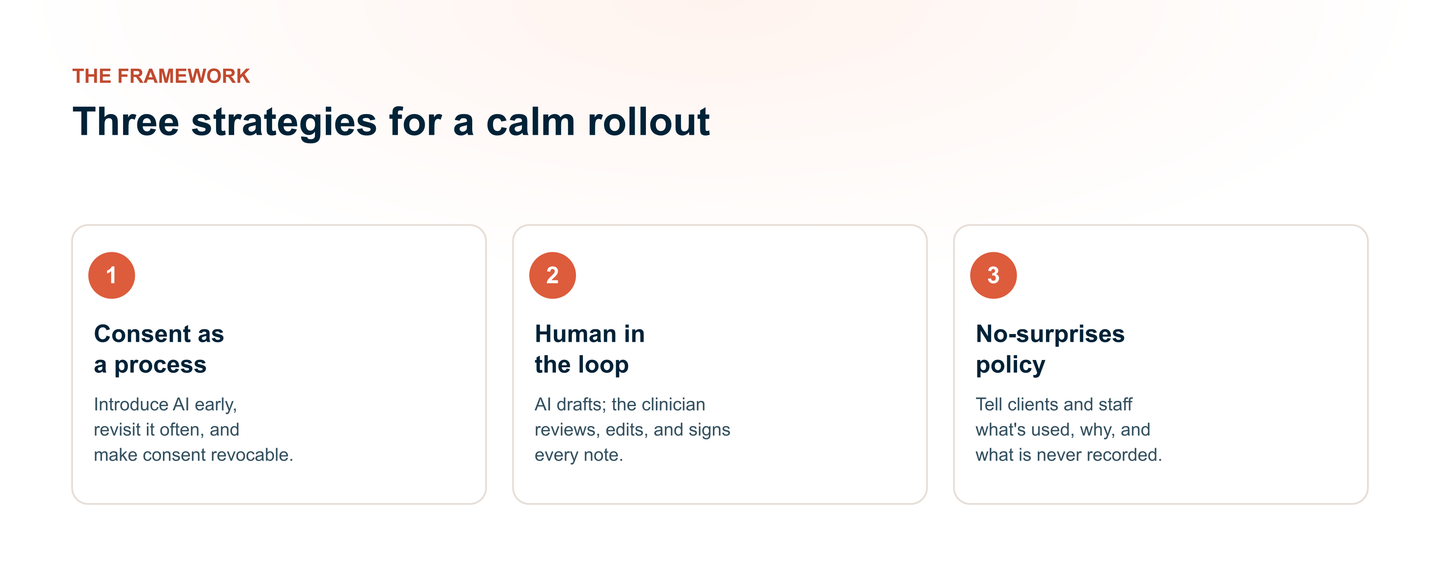
Strategy 1: Informed Consent as a Process
Informed consent for AI cannot be a single checkbox listed on an intake form. It must be an ongoing, conversational process that respects the client's autonomy at every stage.
Normalize the Conversation Early
Don't spring the AI on a client in the middle of a session. Introduce the concept during the initial intake phone call or the first session's orientation phase. Frame it as part of your commitment to being fully present, i.e., explain that using a scribe allows you to focus entirely on them rather than typing.
- The "Opt-Out" Alternative: If you frame it as the new standard practice and offer a clear, judgment-free opt-out, you signal confidence in the tool while handing back control.
See more info on how to deal with patient opt-opts.
Strategy 2: The "Human-in-the-Loop" Workflow (Staff Focus)
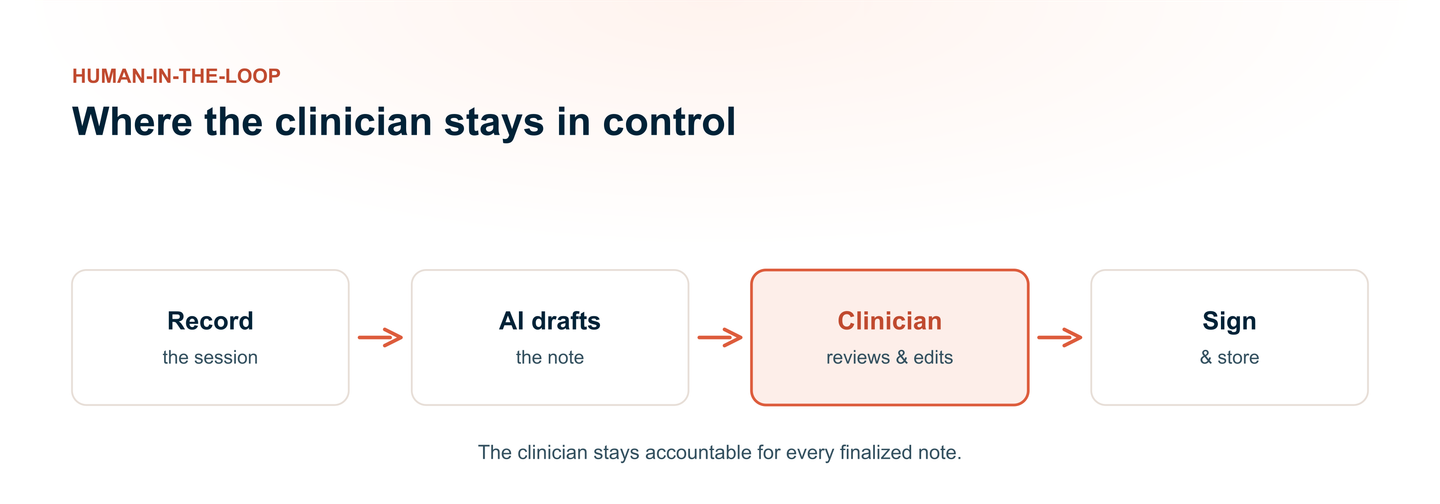
Successful AI implementation depends on staff buy‑in. If your clinicians perceive AI as a threat to their jobs, they are more likely to resist its adoption. The solution is a workflow that places human judgment firmly at the center.
Positioning AI as a "Scribe," Not a "Replacement"
Language matters here. Never refer to the AI as an "automated note‑taker" or "smart documentation system." These terms imply autonomy. Instead, consistently use the word 'scribe', a tool that listens and transcribes but lacks any clinical reasoning.
Practical Tips for Staff Training
Training should be an ongoing, hands‑on coaching process. Here are three actionable strategies to embed into your training:
- Start with Simple Sessions: Encourage your therapists to use it during check-in sessions or follow-up appointments where the clinical complexity is low and the emotional intensity is manageable.
- Edit in the Session: Train therapists to reserve the final two minutes of the session for a collaborative review. It also gives clients power over how their words are summarized, deepening trust and ensuring accuracy.
- Reward Efficiency, Not Just Adoption: Publicly recognize those who have mastered the workflow. When staff see their colleagues enjoying shorter evenings and lighter workloads, adoption becomes aspirational rather than obligatory.
Strategy 3: The "No Surprises" Policy
Even with consent forms and staff training, the moment of truth occurs when the client walks into the room and sees the setup. The physical and digital environment must communicate safety before a word is spoken. A "no surprises" policy means the AI's presence is obvious, optional, and entirely non‑threatening.
The "Revocable Consent" Framework
The most powerful safety mechanism you can offer is the explicit permission to stop the AI instantly.
Emphasize the following to every client during the first session:
"You are in complete control of this tool. If at any point during our session you feel uncomfortable, distracted, or simply don't want the AI to capture something, you can say the word 'Pause,' and I will stop it immediately. No questions asked, no judgment, no impact on our work. We can resume it later, or leave it off for the rest of the session. It is entirely your choice."
Conclusion
Rolling out AI without spooking anyone comes down to one principle: respect the human first, use the technology second. Informed consent, pilot programs, and a "no surprises" policy are foundational for a seamless rollout. When staff feel supported, and clients feel in control, AI for therapists becomes a helpful tool that enhances the clinical workflow.