


A CBT treatment plan names the mechanism maintaining the problem, then maps each intervention to the objective it is meant to move, and says how progress will be measured. This article provides a complete plan for panic disorder, from problem list to measurable objectives, with thought records, behavioral experiments, and an exposure hierarchy mapped to each one. Additionally, it includes a shorter depression example, since anxiety and depression are the two most common plan variants.
The Structure of a CBT Plan
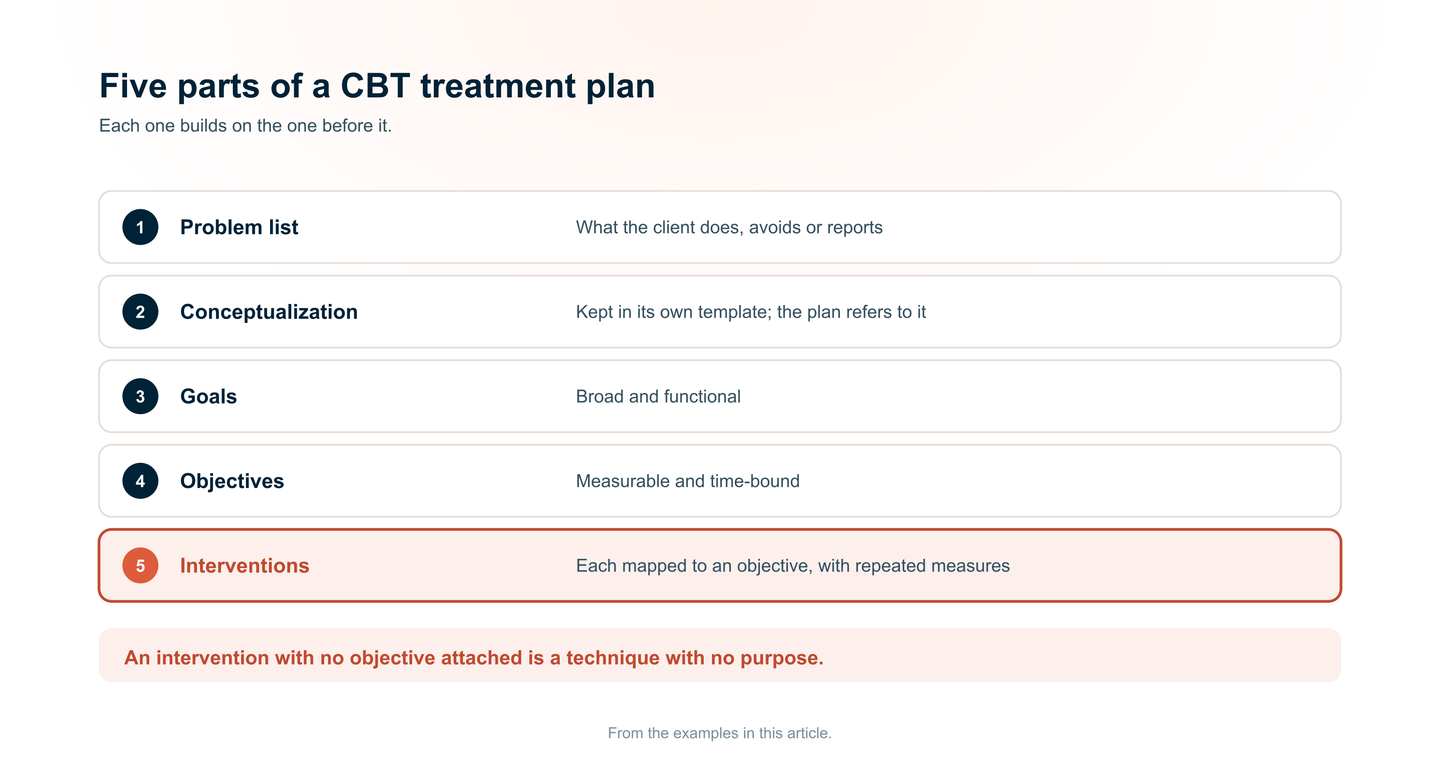
- Problem List in Observable Terms: What the client does, avoids, or reports
- Case Conceptualization: Use a separate template for this, as the plan should reference it.
- Goals: Broad and functional.
- Objectives: Measurable and time-bound.
- Interventions and Measurement: Each intervention mapped to an objective, with a schedule for repeated measures.
Goals vs. Objectives
- Goal: What life looks like when treatment succeeds. Broad, functional, rarely numeric.
- Objective: How you will know it is happening. Measurable, dated, and tied to a specific intervention.
Why the Mapping Matters
An intervention without a clear objective attached is essentially a technique with no purpose. Mapping makes the plan auditable and tells the next clinician what to try if the first approach stalls.
Full Example: Panic Disorder
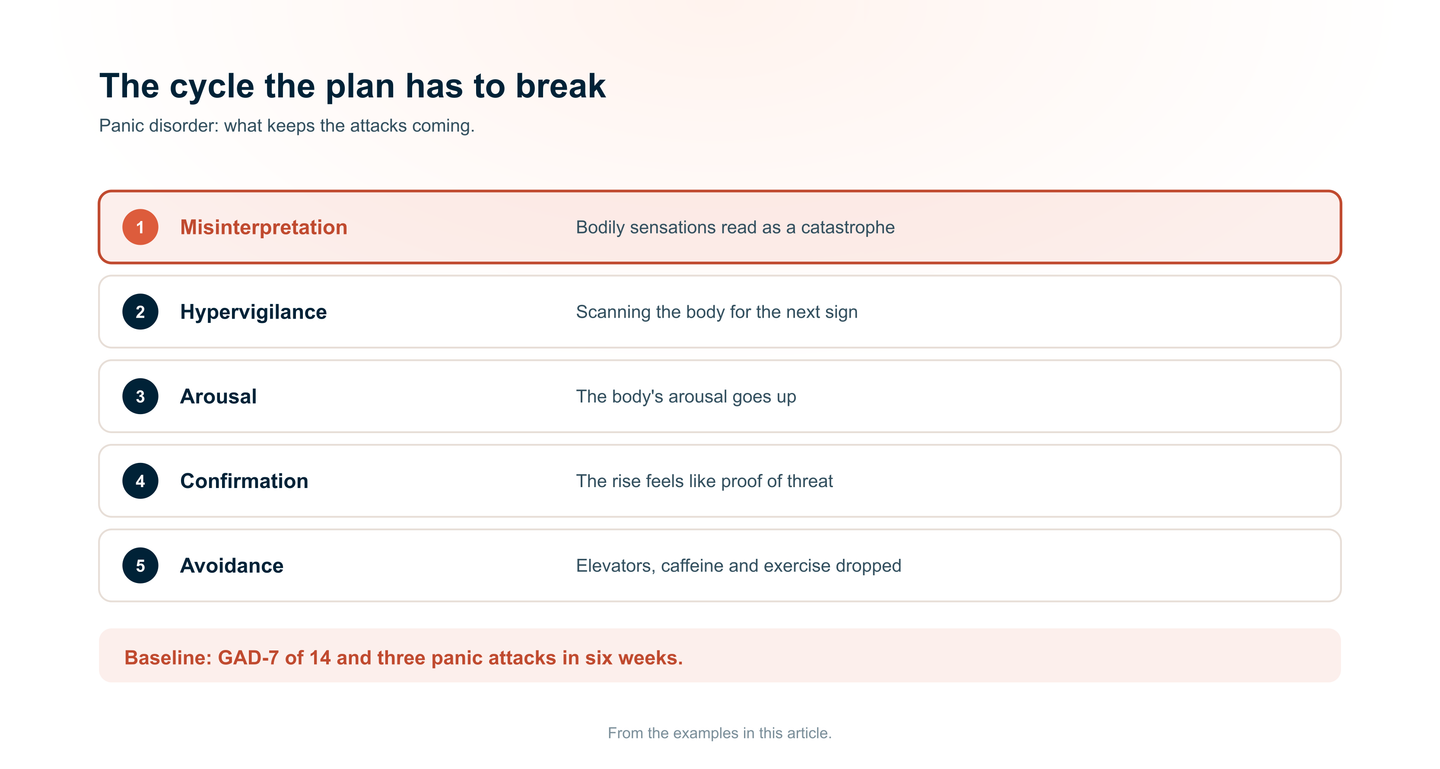
- Presenting: Three panic attacks in 6 weeks; interoceptive avoidance (elevators, caffeine, exercise); safety behaviors (phone in hand, sitting near exits).
- Maintenance Cycle: Catastrophic misinterpretation of bodily sensations:
- Hypervigilance
- Arousal.
- Confirmation of threat.
- Avoidance.
- Baseline: GAD-7 = 14; panic attacks 3 in 6 weeks.
Goals and Objectives
1. Goal: Reduce panic frequency and fear of bodily sensations.
- Objective 1A: Zero panic attacks in a 4-week window by week 10.
- Objective 1B: Rate fear of bodily sensations ≤3/10 on a 0-10 scale by week 10.
2. Goal: Eliminate interoceptive and situational avoidance.
- Objective 2A: Complete all 8 hierarchy steps with SUDS ≤3 by week 12.
- Objective 2B: Ride an elevator alone twice weekly for 4 consecutive weeks.
Interventions Mapped to Objectives
Objective | Intervention |
|---|---|
1A, 1B | Psychoeducation on fight-or-flight; interoceptive exposure. |
1B | Though records targeting catastrophic predictions. |
2A | Behavioral experiments testing predictions during exposure. |
2B | Graded in vivo exposure hierarchy with safety-behavior fading. |
Short Example: Depression
- Presenting: MDD, moderate; PHQ-9+ 17; withdrawal from two friendships; stopped cycling.
- Goal: Restore daily activity and social contact.
- Objectives:
- 1: PHQ-9 ≤9 by week 12.
- 2: Two scheduled activities daily.
- 3: One social contact per week for 4 consecutive weeks.
- Interventions: Behavioral activation scheduling; activity monitoring; thought records targeting “nothing will help.”
- Measurement: PHQ-9 at baseline, week 6, discharge. For note language, see PHQ-9 and GAD-7 progress notes.
Conclusion
A CBT plan works best when it names the mechanism, maps every interaction to a measurable objective, and schedules the measurement up front. Goals describe the life the client wants back; objectives are how you will know it's arriving. For note language that carries the measurement forward, see our guides to PHQ-9 and GAD-7 progress notes and the EMDR treatment plan for a contrasting structure.