


Progress notes need named clinical actions, meaning they need verbs that show what the therapist actually did and how the client responded. This article provides 120 intervention words grouped by modality, namely CBT, DBT, ACT, psychodynamic, solution‑focused, motivational interviewing, play therapy, and family systems. Each list comes with sample note sentences, and a side‑by‑side example shows vague documentation next to specific documentation.
Why Named Interventions Matter
- Medical Necessity: A named intervention shows that a trained clinician did something that warranted the service billed.
- Treatment Plan Linkage: The intervention should map to the goal. "Used cognitive restructuring" connects to a goal about maladaptive thoughts; "explored feelings" connects to nothing.
- Continuity: A covering clinician can see what has already been tried.
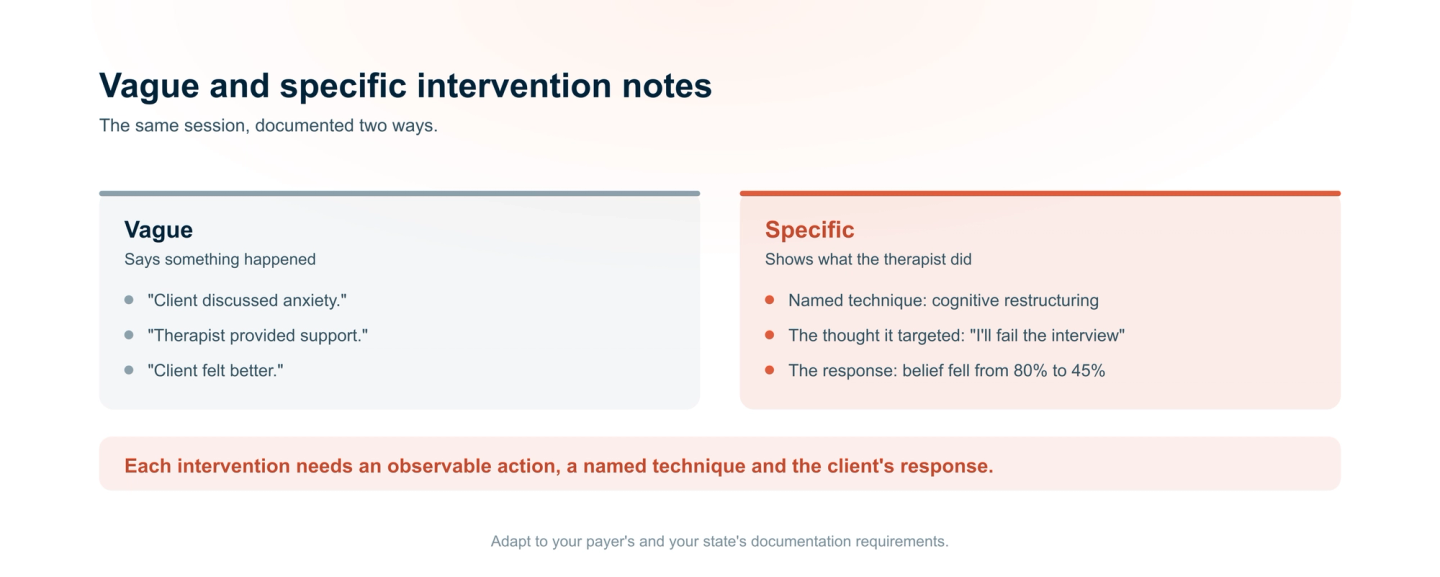
Vague vs. Specific, Side by Side
- Vague: "Client discussed anxiety. Therapist provided support. Client felt better."
- Specific: "Therapist used cognitive restructuring to challenge the prediction 'I'll fail the interview'; client generated two alternative outcomes and rated belief in the original thought down from 80% to 45%."
- The Difference: Observable action, named technique, measurable response.
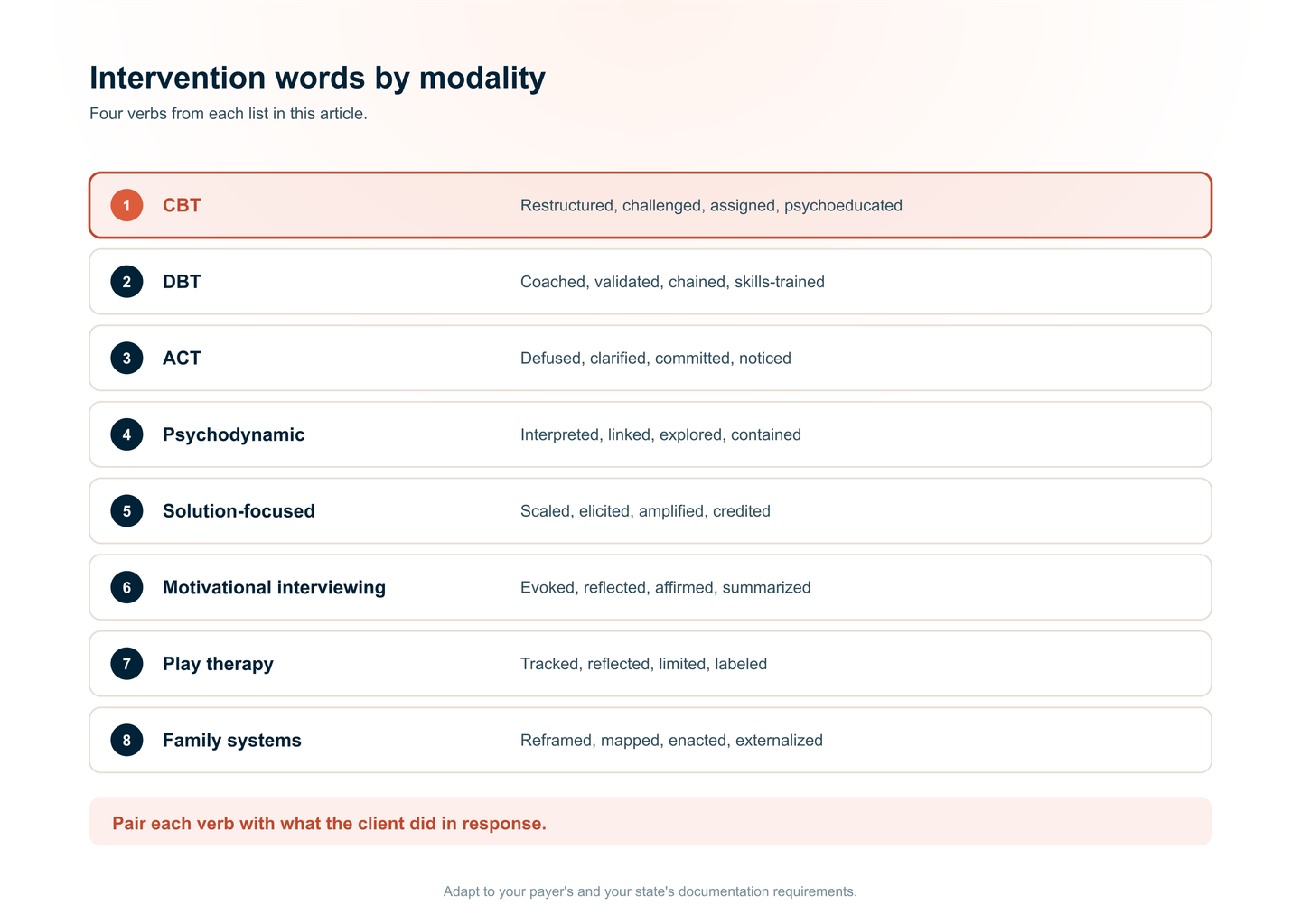
120 Intervention Words by Modality
Format for each: A verb list plus two sample note sentences.
CBT (15 words)
Verbs: Psychoeducated, identified, challenged, reframed, restructured, tested, assigned, reviewed, modeled, reinforced, labeled, examined, evaluated, planned, shaped.
Samples:
- "Therapist guided cognitive restructuring of the thought 'I always fail at everything I do', and client identified three exceptions".
- "Therapist assigned a behavioral activation plan; client committed to two scheduled walks."
DBT (15 words)
Verbs: Coached, chained, validated, reinforced, contracted, hierarchy‑checked, skills‑trained, rehearsed, modeled, analyzed, problem‑solved, oriented, redirected, tracked, generalized.
Samples:
- "Therapist coached TIPP during a distress spike; client's urge rating dropped from 8 to 4."
- "Therapist modeled a chain analysis of the therapy-interfering behavior and identified two intervention points."
ACT (15 words)
Verbs: Defused, accepted, clarified, committed, noticed, expanded, anchored, normalized, distinguished, invited, externalized, contacted, values‑checked, modeled, practiced.
Samples:
- "Therapist used defusion ('I'm having the thought that...'); client reported reduced struggle with the thought."
- "Therapist clarified values in relationships and linked them to one committed action this week."
Psychodynamic (15 words)
Verbs: Interpreted, reflected, confronted, named, linked, explored, contained, held, examined, traced, mirrored, connected, surfaced, observed, worked through.
Samples:
- "Therapist interpreted the client's withdrawal as a response to anticipated rejection."
- "Therapist linked current relational pattern to early caregiving experience; client made a connection."
Solution-Focused (15 words)
Verbs: Scaled, elicited, amplified, highlighted, exception‑mapped, envisioned, constructed, credited, reframed, asked, projected, noticed, reinforced, complimented, planned.
Samples:
- "Therapist asked the miracle question; client described a concrete first sign of change."
- "Therapist amplified a previous exception and asked how the client might repeat it."
Motivational Interviewing (15 words)
Verbs: Evoked, reflected, affirmed, summarized, elicited, explored, rolled, supported, emphasized, highlighted, weighed, engaged, focused, guided, planned.
Samples:
- "Therapist evoked change talk and reflected the client's stated reasons for reducing use."
- "Therapist rolled with resistance rather than confronting it; client elaborated on ambivalence."
Play Therapy (15 words)
Verbs: Tracked, reflected, labeled, limited, joined, normalized, modeled, interpreted, contained, prompted, rehearsed, named, followed, bridged, scaffolded.
Samples:
- "Therapist tracked and labeled affect as the child buried the figure; the therapist reflected the reunion sequence."
- "Therapist set a limit on aggression and prompted an acceptable alternative; child used it."
Family Systems (15 words)
Verbs: Reframed, mapped, joined, restructured, externalized, enacted, balanced, interrupted, coached, hypothesized, normalized, boundary‑set, detriangulated, sequenced, assigned.
Samples:
- "Therapist reframed the symptom as protecting family stability, shifting blame away from the identified patient."
- "Therapist interrupted the escalating exchange and coached each partner to speak directly."
Conclusion
Specific verbs make clinical work visible. A named intervention, paired with the client's observable response, shows reviewers exactly what the service was and why it was necessary. Use these lists as a starting point; one or two precise interventions per note will always outperform a sentence stuffed with techniques. For the structures that hold them, see our guides to progress notes, DAP notes, and BIRP notes.