


Artificial intelligence is changing documentation by helping providers reclaim valuable time. However, for mental health professionals, integrating AI scribes carries unique risks. While HIPAA sets a baseline for all medical data, the application of HIPAA-compliant AI note-taking diverges between general medicine and behavioral health. The heightened sensitivity of psychotherapy notes, stricter state‑level privacy laws, and the therapeutic alliance demand a different approach to compliance. This article explores exactly where these requirements diverge and how to stay safe.
What HIPAA Requires for AI Notes (Regardless of Specialty)
Before examining the divergences, it's essential to establish the common baseline. HIPAA's Privacy, Security, and Breach Notification Rules apply uniformly to any AI tool handling Protected Health Information (PHI). Whether you're in cardiology or psychiatry, your AI scribe must meet these three non‑negotiable safeguards:
- Encryption: All PHI must be encrypted at rest (stored) and in transit (transmitted) to prevent unauthorized interception.
- Business Associate Agreements (BAAs): Your AI vendor must sign a legally binding BAA that explicitly assumes liability for safeguarding your patient data.
- Access Controls & Audit Logs: Role-based permissions must restrict access to viewing, editing, or exporting AI-generated notes. Comprehensive audit trails are also required to track every access and modification.
The Divergence: Mental Health vs. General Medicine
At its core, the divergence between the two specialties is about the nature of the data. In general medicine, notes are predominantly objective and factual: lab results, vital signs, and observable symptoms, etc.
In mental health, notes are subjective, interpretive, and deeply personal, containing psychological assessments, emotional vulnerabilities, and trauma histories.
Below is a comparative table of the two:
Aspect | General Medicine | Mental Health Practice |
|---|---|---|
Primary Focus | Objective data (labs, vitals, imaging) | Subjective analysis (emotions, cognition, behavior) |
Consent | Standard HIPAA consent (signed form) | Often requires specific, separate AI/behavioral consent |
AI Data Classification | Treated as routine medical records | May qualify as "Psychotherapy Notes" with stricter rules |
Disclosure Risk | Moderate; disclosure is often for TPO (Treatment, Payment, Operations) | High: requires specific authorization beyond TPO in many cases |
State Law Preemption | Low | High, some states add stricter mental health protections |
Below are the three key regulatory areas driving these differences:
A. The Psychotherapy Notes
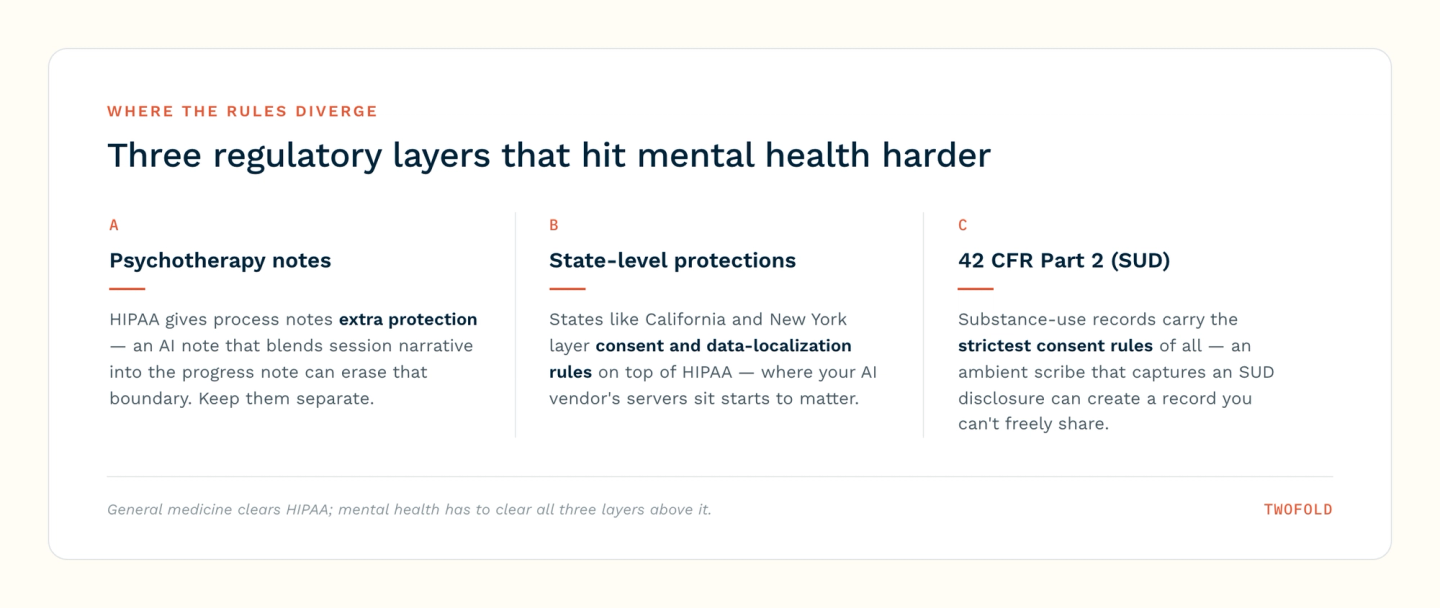
Under HIPAA, psychotherapy notes are defined as notes recorded by a mental health professional that document or analyze the contents of a counseling session. Critically, they are not the same as routine progress notes (which include medication, treatment modality, and summaries).
- The Difference: Psychotherapy notes are granted extraordinary protection. Unlike general medical records, they cannot be disclosed without the patient's explicit, signed authorization.
- The AI Implication: If your AI scribe transcribes a full therapy session or generates a detailed emotional analysis, does that output qualify as a "Psychotherapy Note"? The risk is that providers inadvertently store these AI outputs as standard medical records, stripping them of their heightened legal protection.
- Best practice: Configure your AI to flag session-based narratives and store them in a separate, restricted section of the EHR, distinct from general medical progress notes.
B. State-Level Protections
Many states (including California, New York, etc.) have enacted laws that impose stricter privacy requirements for mental health records than HIPAA itself.
Where AI Gets Complicated:
- Specific Consent: Some states require explicit, separate consent for the use of AI or third-party data processing specifically for mental health records, rather than relying on a consent form at intake.
- Data Localization: A growing number of state regulations restrict how mental health data must be stored. If your AI vendor hosts data on servers outside your state (or outside the US), you may be violating state law even if you are fully HIPAA-compliant.
- Takeaway: Review the mental health-specific statutes in every state where your patients reside.
C. SUD (Substance Use Disorder) Regulations (42 CFR Part 2)
Perhaps the strictest divergence lies in substance use disorder (SUD) records. Governed by 42 CFR Part 2.
- The Main Conflict: Under HIPAA, you can share general medical records for TPO (Treatment, Payment, Operations) without explicit patient consent. Under Part 2, you cannot disclose SUD records for these purposes without a specific, signed patient authorization, except in emergencies.
- The AI Risk: If your AI note aggregates data from a patient's intake and mentions "alcohol use disorder" or "opioid dependency," that document is now subject to Part 2. If your AI system automatically shares that note with a billing department or external payer without a Part 2-specific consent, you face severe penalties.
- Practical Solution: Implement AI workflows that automatically redact or flag SUD-related terminology, ensuring those notes are never automatically routed outside the treatment team. Your AI vendor must explicitly address Part 2 compliance in your BAA.
Clinical Validity: AI Accuracy and "Hallucinations"
AI scribes are remarkable technological tools, but they are not infallible. They can "hallucinate", which means generating plausible‑sounding but entirely fabricated information (from incorrect medication dosages to symptoms the patient never mentioned). While this is a concern across all specialties, the consequences and detectability of these errors diverge dramatically between medical and mental health settings.
The Medical Context
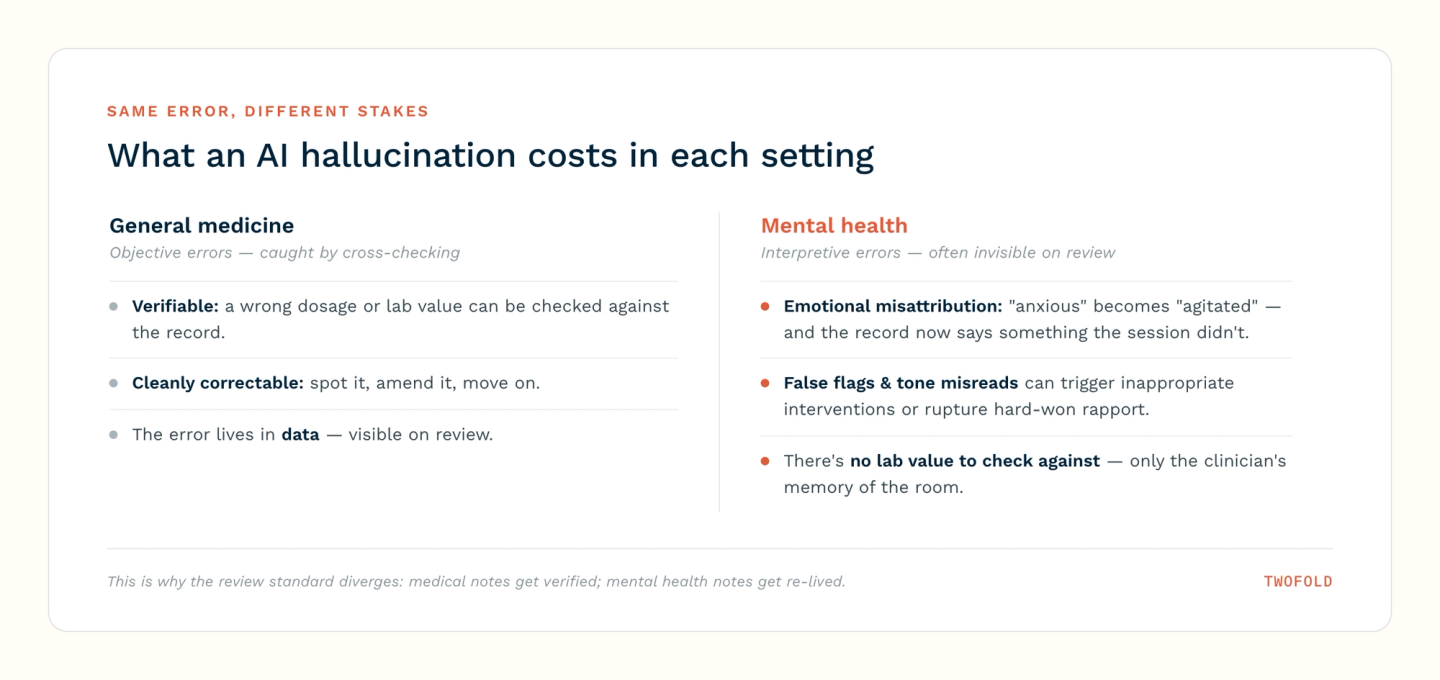
In general medicine, an AI hallucination typically involves objective, verifiable data. For example, it might incorrectly list a patient's allergy to penicillin.
Why it's Manageable:
- Verifiability: These errors are usually caught during the clinician's review because they contradict the hard data captured during the visit (vitals, lab results, medication lists).
- Clear Corrections: The fix is straightforward: correct the number or delete the wrong medication name.
The Mental Health Context: Nuance, Rapport, and Rupture
In mental health, the stakes are qualitatively different. AI hallucinations in this space tend to involve subjective interpretation, which is the very essence of therapeutic work.
Consider These Scenarios:
- Emotional Misattribution: The AI documents that the patient expressed "suicidal ideation" when they never spoke about it.
- False Flags: The AI "invents" a history of trauma or inserts a perceived emotional state (e.g., "patient appears highly defensive") that is completely inaccurate.
- Tone Misreading: The AI misinterprets therapeutic silence or a moment of vulnerability as "resistance to treatment."
Why it's Harmful:
- Therapeutic Rupture: If a patient sees an AI-generated note that mischaracterizes their emotional state, trust is broken instantly. The safe space is compromised.
- Inappropriate Interventions: A false suicidal ideation flag could trigger an unnecessary psychiatric hold, a welfare check, or a family notification.
- Invisibility: Unlike a wrong blood pressure reading, there is no external device to check against. The error is interpretive, making it far harder to spot unless the clinician reads every word with extreme scrutiny.
The Human-in-the-Loop: A Divergent Standard
This workflow dictates a different standard for AI usage:
Aspect | General Medicine | Mental Health |
|---|---|---|
Clinician Review Burden | Moderate, mainly fact-checking numbers and medications. | Heavy, requires reading for emotional nuance and interpretive accuracy. |
AI Role | Drafting tool; output is largely accepted after quick verification. | Co-pilot at best; every subjective phrase must be individually evaluated. |
Editing Required | Minimal; corrections are often mechanical. | Extensive; the clinician must often rephrase or delete entirely to preserve clinical meaning. |
Risk Tolerance | Higher, errors are visible and correctable. | Much lower, errors can rupture the therapeutic alliance. |
Practical Implementation: How to Stay Compliant
- Map Your Data Flows: Identify what data the AI captures, where it's stored, who can access it, and how it's transmitted. Classify session narratives as "Psychotherapy Notes" stored in a restricted EHR section separate from standard progress notes.
- Vet Vendors with Mental Health Questions: Ask:
- Do you store mental health data separately?
- How do you handle 42 CFR Part 2 (SUD) data?
- Do you use our data to train your models? Where are your servers located?
- Can you provide SOC 2 Type II or HITRUST certification?
- Separate AI Workflows:
- Route general medical data (vitals, medications) to standard progress notes.
- Route session narratives and emotional assessments to a restricted "Psychotherapy Notes" section.
- Enforce Access Controls: Restrict psychotherapy notes to the treating clinician and clinical supervisor only. Billing staff should only see encounter summaries, never session narratives. Maintain comprehensive audit logs tracking every view and edit.
- Establish a Review Protocol: Clinicians must review and heavily edit subjective interpretations, verify all factual data, and retain the AI draft separately for audit purposes.
- Train Your Team: Ensure all staff understand that mental health AI documentation differs from general medical documentation.
Conclusion
The divergence between HIPAA‑compliant AI note‑taking requirements for mental health and general medicine is a distinction driven by data sensitivity, patient vulnerability, and regulatory strictness. While both settings share a HIPAA baseline, mental health practices must build significantly higher protections around psychotherapy notes, SUD records, and informed consent. Implementing AI in behavioral health demands transparency, rigorous vendor vetting, and a human‑in‑the‑loop review process.