
Free for a week, then $19 for your first month
Expert Advice

Operating an Embedded AI Scribe: Support, Outages and Quality After Launch

What changes after you embed an AI scribe: who takes the support call, what an outage does to your brand, and the SLA you inherit.

A clinician's request arriving at the platform's own product, with a faded vendor panel sitting behind it connected only by a dotted line the clinician never sees.

Embedding an AI scribe moves four responsibilities onto your team that no integration guide covers. Your support desk takes the first call about a bad note. Your vendor's outage becomes your outage. You have to monitor note quality across clinicians you do not employ. And you cannot promise your customers more uptime than your vendor promises you.

Everything written about embedding a scribe stops at launch — build versus partner, integration architecture, who signs the Business Associate Agreement. This covers the part after that, which is where the cost actually shows up.

Your Support Desk Takes the First Call

The clinician using your product does not know your vendor exists. Under a white‑label arrangement they are not supposed to. So when a note comes back wrong, the ticket opens with you — and your tier‑one agent, who has never seen a transcription pipeline, has to decide whether this is a product bug, a capture problem, or a model limitation.

Three things worth settling before launch rather than during the first incident:

01
What tier one can resolve alone
Microphone permissions, browser support, template selection, a session that never uploaded. These are the majority of tickets and none of them needs the vendor.
02
What gets escalated, and how
Agree the escalation path, the response window, and the format. A vendor who needs a session identifier you never captured cannot help you.
03
What diagnostics you can capture without touching PHI
Session IDs, timestamps, duration, capture mode, error codes. Enough to debug, none of it clinical. Decide this before your support tooling is built, not after.
The volume is not where you expect
Most support load from an embedded scribe is capture and environment problems, not note quality. Staffing for note complaints and getting microphone tickets is the common miss.

A Vendor Outage Is Your Outage

When the scribe is embedded, its failures are attributed to your brand. The clinician does not experience a vendor incident; they experience your product not working, in front of a patient.

The questions that matter are less about uptime percentages than about behaviour under failure:

  • Is there a public status page, and does it reflect degradation or only total outages?
  • How are incidents communicated to partners, through what channel, and how quickly?
  • What are the degradation modes? If generation is down, does capture keep buffering locally and retry — or is the session lost?
  • What is the historical incident record, not the advertised target?

That third question separates vendors more than any other. A tool that queues audio and retries when the service returns fails invisibly. A tool that drops the session fails in front of a patient, and your support desk hears about it. Ask for the specific behaviour, and test it during the pilot by pointing the integration at a dead endpoint.
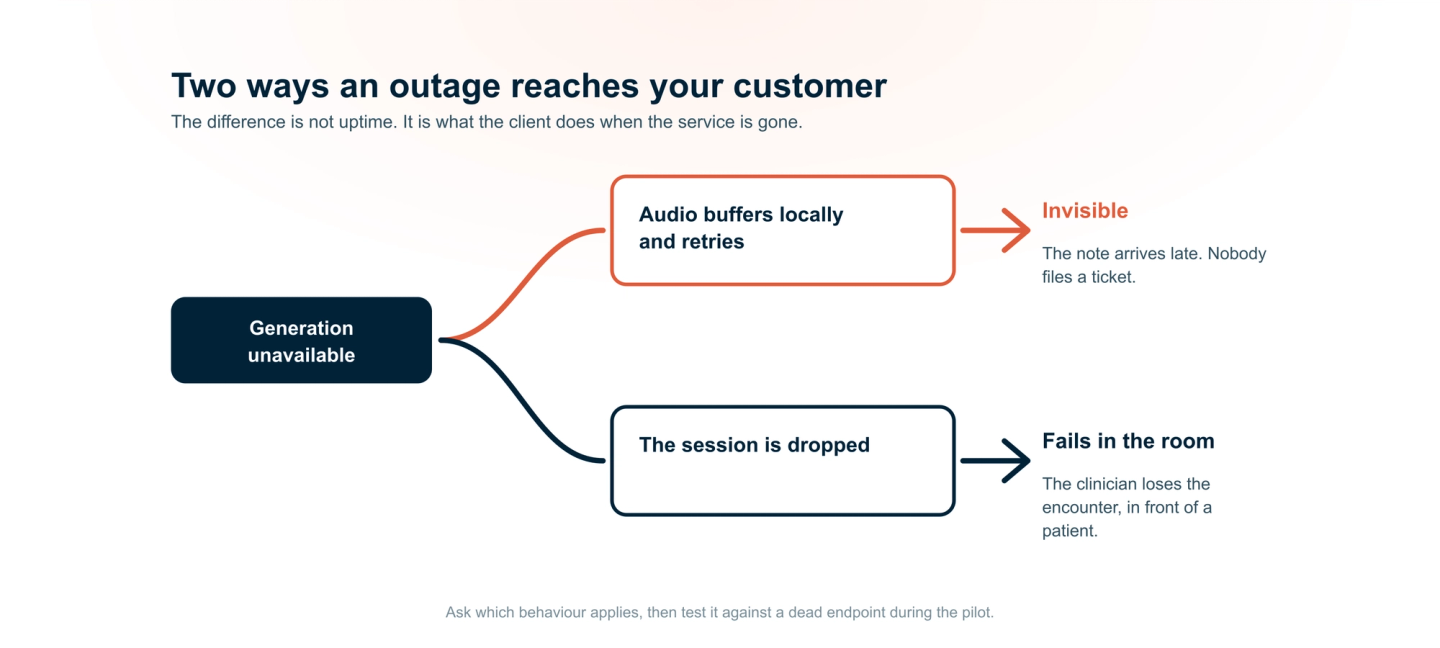
Two paths from an unavailable generation service. If audio buffers locally and retries, the outage is invisible and the note simply arrives late. If the session is dropped, the clinician loses the encounter in front of a patient.

Monitoring Quality Across Clinicians You Do Not Employ

You cannot read their notes. You may not have lawful access to them, and you should not want it. So quality monitoring has to run on signals that are not clinical content:

Signal

What it tells you

Watch for

Regeneration rate

How often a clinician rejects the first draft outright

A rise after any vendor model change

Edit rate or time-to-sign

How much work the draft still needs

Gradual drift, which is easy to miss month to month

Abandonment

Sessions captured but never signed

Concentrations in one specialty or one capture mode

Support ticket themes

What clinicians say when they bother to tell you

Repeated wording — the same complaint phrased three ways

Per-specialty variance

Whether the aggregate is hiding a failure

One specialty performing far below the mean

Baseline during the pilot
Whatever you choose to measure, capture the numbers while the integration is still small. Without a baseline you cannot tell whether a later model update made anything worse — you will only have the aggregate, and the aggregate moves slowly.

That last row is the one that catches teams out. A platform serving primary care, behavioural health and physical therapy can show a perfectly healthy overall edit rate while one specialty quietly performs badly enough that those customers are churning.
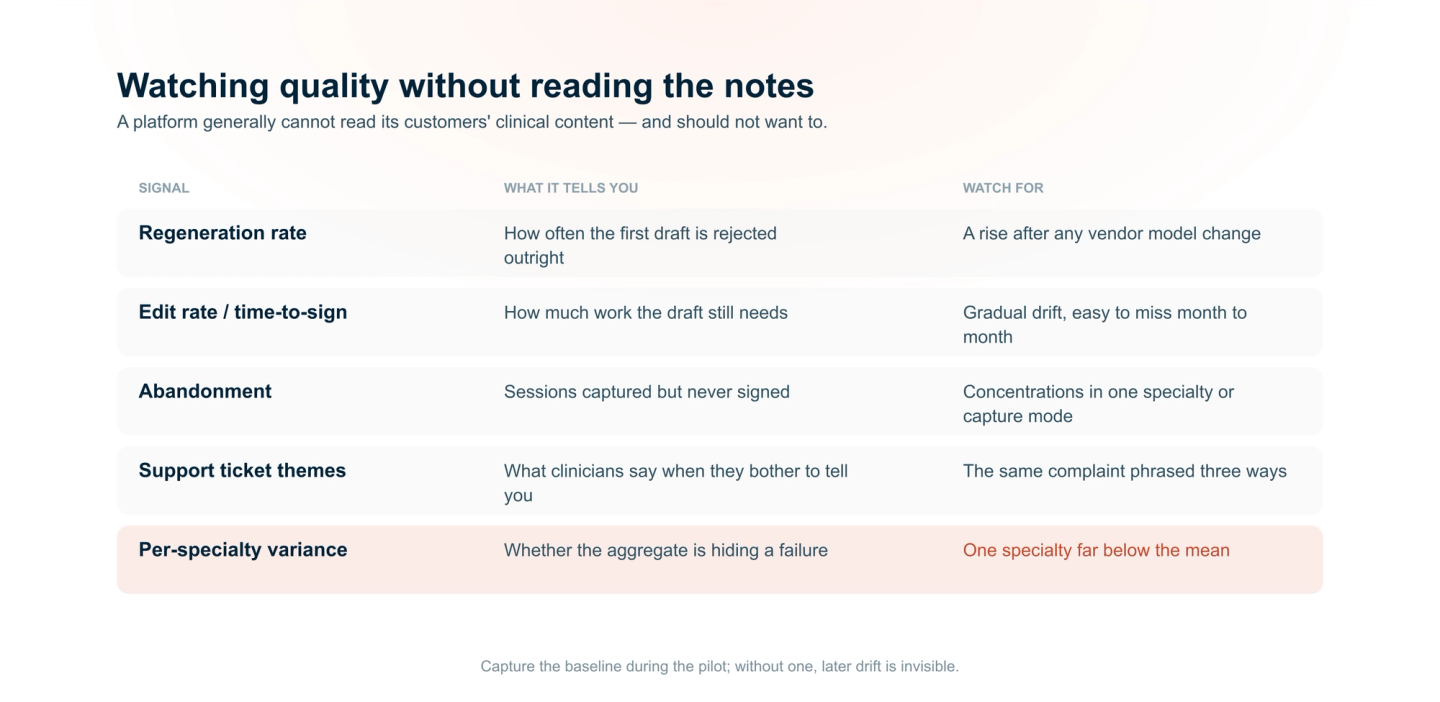
Quality signals a platform can monitor without reading clinical notes: regeneration rate, edit rate or time-to-sign, abandonment, support ticket themes, and per-specialty variance — the last of which can hide a failing specialty behind a healthy average.

The SLA You Inherit, and the One You Can Offer

You cannot promise your customers more availability than your vendor promises you. That sounds obvious and is routinely violated, usually because the customer contract was drafted by a commercial team and the vendor contract by an engineering one.

Either match the vendor's terms in your own agreements, or carry the gap deliberately and price it. What to pin down:

  • Availability commitment, and what remedy applies when it is missed — service credits are common and rarely meaningful.
  • Notice period for breaking API changes, and how long deprecated versions keep working.
  • Model changes. This is the one teams miss: a model update can change note style, length and structure overnight without a single API contract changing. Ask what notice you get and whether you can pin a version.
  • Support response windows for your escalations, separately from end-user support.

The Incident Chain Runs Through You

Under the HIPAA Breach Notification Rule, a business associate must notify the covered entity of a breach without unreasonable delay and in no case later than 60 calendar days after discovery. Sixty days is a ceiling, not an allowance — "without unreasonable delay" is the operative standard.

The structural point for a platform: your vendor's duty runs to you, and your duty runs to your customers, who carry the public‑facing obligations to patients and to HHS. If your vendor's contractual window is the statutory maximum and your commitment to your customers is shorter, you have signed a gap you cannot close.

Negotiate the window, not the statute
Many Business Associate Agreements set a far shorter contractual notice period than the regulatory ceiling — commonly 24 to 72 hours for initial notice, with details to follow. That is the term to negotiate, and it costs nothing to ask for at signature.

What to Settle Before You Sign

A short list, ordered by how expensive each is to fix after launch rather than before:

Question

Why it bites later

Who answers the clinician's first call, and what can they see?

Support tooling is built early and rebuilt expensively

What happens to an in-progress session when the service is down?

Determines whether outages are invisible or career-limiting

What quality signals are exposed to us, through what interface?

You cannot baseline what you cannot read

What notice do we get before a model change?

Note style can change with no API change at all

What is the breach notification window in our BAA?

Sets whether your own customer commitments are keepable

What availability are we contractually promised?

Caps what you can promise onward

Bottom Line

The integration is the easy part, and it is the part everyone plans for. What determines whether an embedded scribe is a good decision eighteen months later is operational: who absorbs the support load, how the thing fails, whether you can see quality drift before your customers do, and whether the commitments you made onward are ones your vendor actually backs.

These are questions to put to any vendor, Twofold included. If a partner team cannot answer them specifically, that is itself the answer.

General guidance, not legal advice
Breach notification obligations depend on your role under HIPAA and on the terms of your own agreements. Confirm both with your counsel rather than relying on the summary here.

Sources

  • U.S. Department of Health and Human Services. 45 CFR 164.410 — Notification by a business associate. eCFR. Source for the requirement to notify the covered entity without unreasonable delay and no later than 60 calendar days after discovery of a breach.
  • U.S. Department of Health and Human Services. Breach Notification Rule. Source for the allocation of notification duties between business associate and covered entity.
  • The 24-to-72-hour contractual notice window described here is a common Business Associate Agreement term, not a regulatory requirement. Check what your own agreement says rather than assuming either figure.
  • The operational guidance in this article — support tiering, degradation modes, quality signals and SLA terms — is drawn from the structure of platform-vendor relationships rather than from a published study. It is offered as a checklist to test vendors against, not as measured results.
  • General guidance, not legal advice. Confirm breach notification obligations and contractual terms with your own counsel.
FAQ

Frequently asked questions

  • Who provides support when an AI scribe is embedded in another product?

    The platform does, in the first instance. A clinician using an embedded or white‑labeled AI scribe usually does not know the underlying vendor exists, so tickets open with the platform's support desk. Most of that volume is capture and environment issues — microphone permissions, browser support, sessions that failed to upload — rather than note quality. Platforms should agree an escalation path, response window and diagnostic format with the vendor before launch, and decide which non‑clinical diagnostics (session IDs, timestamps, capture mode, error codes) support can capture without touching PHI.

  • What happens to my product if the AI scribe vendor has an outage?

    The failure is attributed to your brand, because the clinician experiences your product not working rather than a vendor incident. What matters more than an advertised uptime figure is the degradation mode: if generation is unavailable, does capture keep buffering locally and retry, or is the session lost? A tool that queues and retries fails invisibly; one that drops the session fails in front of a patient. Ask for the specific behaviour and test it during the pilot by pointing the integration at a dead endpoint.

  • How do you monitor AI note quality across clinicians you do not employ?

    Through signals that are not clinical content, since a platform generally cannot and should not read its customers' notes. Useful measures include regeneration rate, edit rate or time‑to‑sign, abandonment of captured sessions, recurring support ticket themes, and variance between specialties. Per‑specialty variance matters most: a healthy aggregate edit rate can conceal one specialty performing badly enough to drive churn. Capture a baseline during the pilot, because without one there is no way to tell whether a later model update degraded output.

  • What SLA should a platform ask an AI scribe vendor for?

    At minimum: an availability commitment with a stated remedy, a notice period for breaking API changes, defined support response windows for partner escalations, and — the term most often omitted — notice before model changes, since a model update can change note style, length and structure without any API contract changing. A platform cannot promise its own customers more availability than its vendor promises it, so either match the vendor's terms in downstream contracts or carry the gap deliberately and price it.

  • How fast must an AI scribe vendor report a breach?

    Under the HIPAA Breach Notification Rule (45 CFR 164.410) a business associate must notify the covered entity without unreasonable delay and in no case later than 60 calendar days after discovering a breach. Sixty days is a ceiling rather than an allowance, and the duty runs to the covered entity, which carries the public‑facing obligations to individuals and to HHS. Many Business Associate Agreements set a much shorter contractual window — commonly 24 to 72 hours for initial notice — and that contractual term is what a platform should negotiate, since its own commitments to customers depend on it.