


Many clinicians are turning to ChatGPT to reduce documentation time. However, the standard version of ChatGPT is not HIPAA‑compliant. HIPAA requires that any patient data entered into a system is encrypted, access‑controlled, and properly audited. The public ChatGPT does not offer these safety precautions. This means you cannot paste patient names, dates of birth, or clinical notes into the regular version. This article offers a practical guide on safe data entry and recommends more secure, healthcare‑specific alternatives.
Is ChatGPT HIPAA-Compliant?
No, the standard ChatGPT, whether the free version or the paid Plus subscription, operates through a public web interface.
This public platform does not include the technical safeguards required under the HIPAA Security Rule, such as data encryption during storage or strict access monitoring. So, you cannot enter any Protected Health Information (PHI) into standard ChatGPT under any circumstances.
The OpenAI BAA
OpenAI does offer a Business Associate Agreement (BAA), a legal contract that holds them accountable for protecting PHI.
However, this BAA is only available to organizations that purchase the "ChatGPT Enterprise" plan. This enterprise plan is distinct from the everyday chat website that most users access.
Without a BAA, OpenAI is not legally bound to follow HIPAA rules. Moreover, data submitted through the public interface can be reviewed and used by OpenAI to improve the model, meaning your patient data could be read by third‑party reviewers.
Action Required
Clinicians and healthcare institutions must actively verify that they are using a dedicated AI vendor with a valid BAA in place. Do not assume that simply using a paid account grants compliance.
The Main Risks: Why Standard ChatGPT Fails HIPAA
Standard ChatGPT uses user inputs to improve its algorithms. This means the information you type could be incorporated into future training datasets. If a clinician pastes clinical notes, this sensitive text could be stored indefinitely within OpenAI's systems.
Specific Security Concerns:
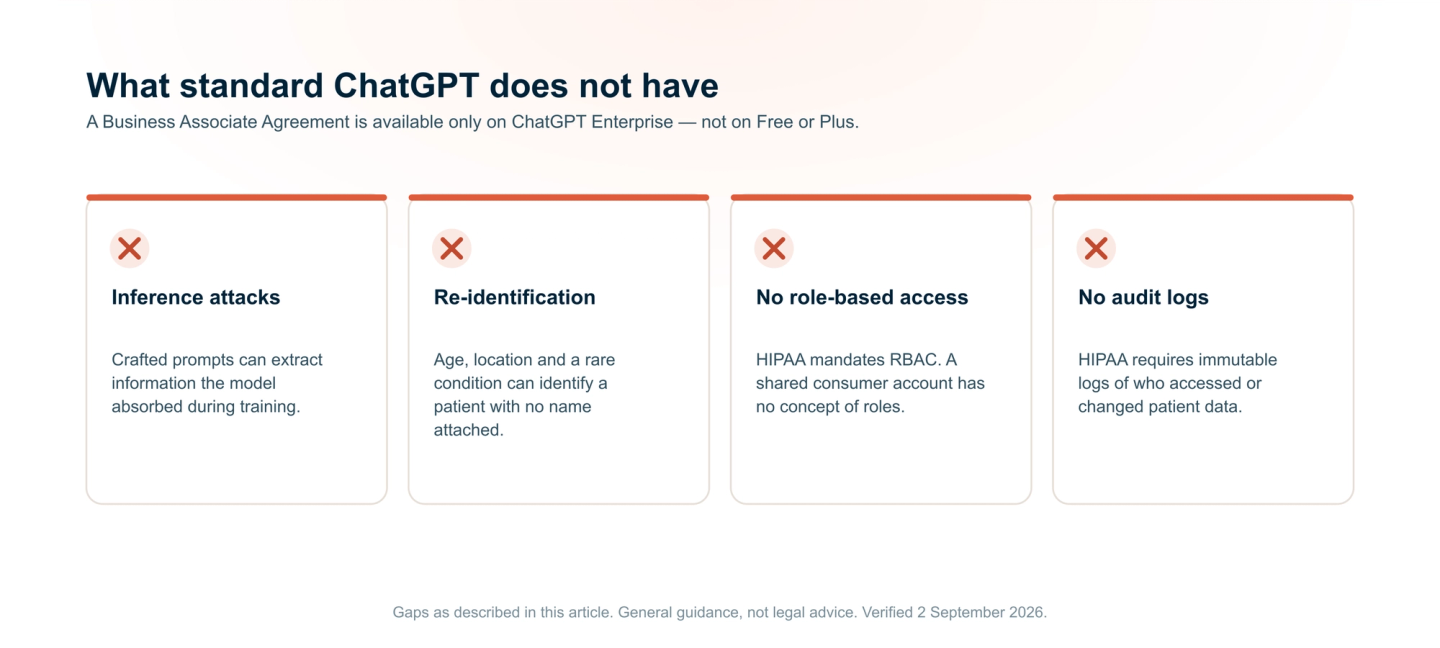
- Inference Attacks: A hacker could craft specific prompts to extract stored medical information from the model if the data was previously used in training.
- Data Re-identification: Even if you remove a patient's name, contextual details like age, gender, geographic location, or rare medical conditions often make it surprisingly easy to identify the individual.
- Lack of Access Controls (RBAC): HIPAA mandates Role-Based Access Control (RBAC). This means only specific, authorized staff members should have access to patient data based on their job function.
- No Audit Logs: HIPAA requires organizations to maintain detailed, immutable audit logs. These logs must track exactly who accessed or modified patient data, when they did it, and from which device. Without audit logs, healthcare providers cannot investigate data breaches effectively, nor can they demonstrate to regulators that they have implemented proper safeguards.
Essential Safeguards for Using AI
Even if you use a HIPAA-compliant AI note tool, you must follow strict security protocols. These safeguards ensure patient data remains protected throughout the process.
Strict De-identification Protocols
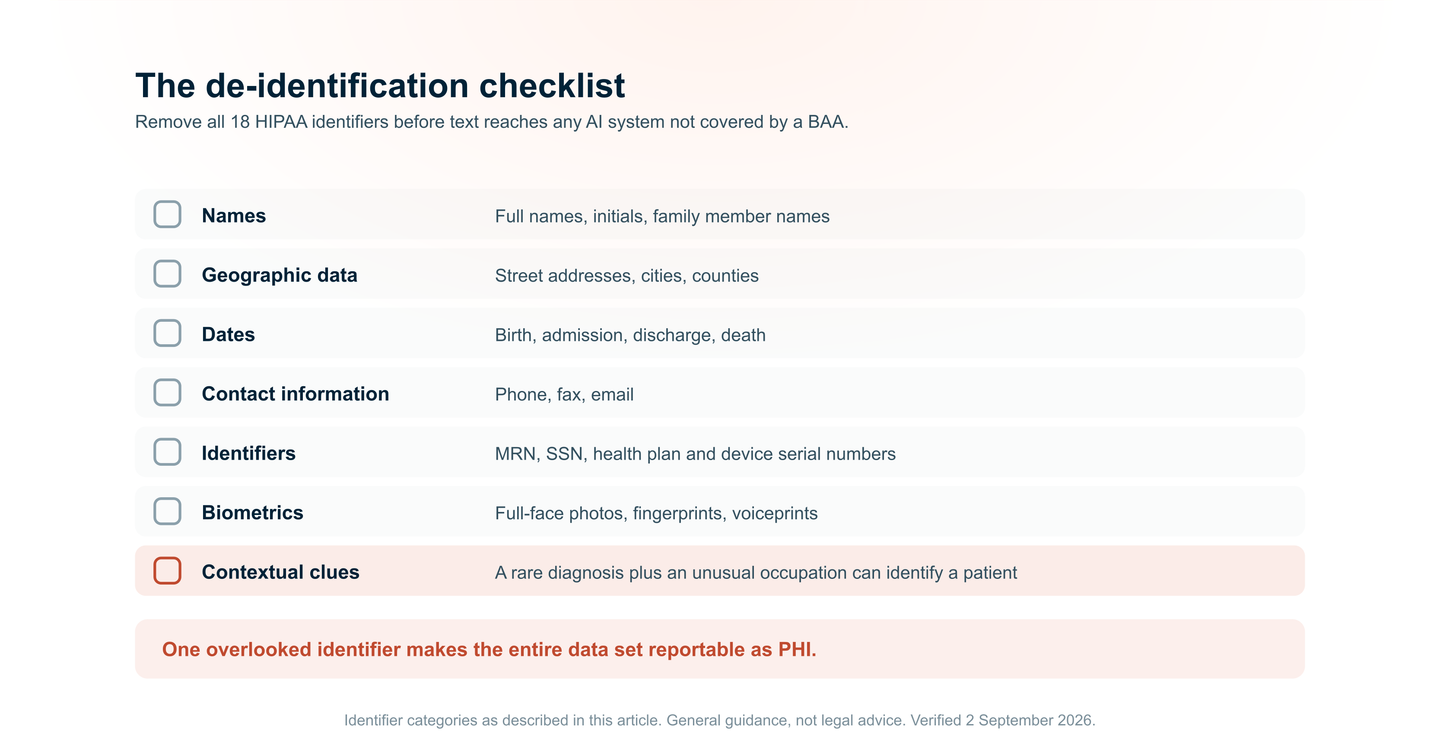
Before feeding any text into an AI system, you must remove all 18 HIPAA identifiers. This process is called de‑identification. Use this practical checklist:
- Names: Remove full names, initials, and any family member names.
- Geographic Data: Remove street addresses, cities, and counties.
- Dates: Remove exact dates of birth, admission, discharge, and death.
- Contact Information: Remove phone numbers, fax numbers, and email addresses.
- Identifiers: Remove Medical Record Numbers (MRNs), Social Security numbers, health plan beneficiary numbers, and device serial numbers.
- Biometrics: Remove full-face photos, fingerprints, and voiceprints.
- Contextual Clues: Be cautious with narrative text. A rare diagnosis combined with an unusual occupation can re-identify a patient, even without a name.
Key Reminder: De‑identification must be complete. A single overlooked identifier makes the entire data set reportable as PHI.
Encryption is Non-Negotiable
HIPAA requires encryption to protect data from unauthorized access. You must ensure your AI provider offers these two types:
- Encryption in Transit: Data must be encrypted as it travels from your device to the AI server. This uses TLS (Transport Layer Security) to prevent hackers from intercepting the information mid-transmission.
- Encryption at Rest: Data stored on the provider's servers must be encrypted using AES-256 (Advanced Encryption Standard). If a hacker breaches the database, they only see scrambled text, not readable patient information.
HIPAA Compliant Alternatives
Given the risks of public AI, clinicians have several safer options. These tools are purpose‑built for healthcare and offer full HIPAA compliance.
Dedicated Medical AI Scribes
Several companies develop HIPAA-compliant AI tools specifically for clinical documentation. Popular examples include Twofold Health, Nuance Dragon Ambient eXperience, and Abridge.
- Built for Healthcare: These platforms are trained on medical terminology, clinical note formats (SOAP, HPI), and common clinical workflows. This results in more accurate transcriptions and fewer hallucinations.
- BAA by Default: Unlike standard ChatGPT, these services sign a Business Associate Agreement (BAA) with every healthcare client. This contract legally holds them accountable for protecting your data and following HIPAA rules.
- EHR Integration: Many of these tools integrate directly with Electronic Health Record (EHR) systems.
See an AI scribe vs ChatGPT vs Claude for a comparison on which AI clinical note workflow is best for you.
Conclusion
The convenience of generative AI does not justify the risk of HIPAA violations. Standard ChatGPT lacks the encryption, access controls, and audit trails required to protect patient privacy. While enterprise APIs and private models offer compliance pathways, they demand substantial technical oversight and strict de‑identification protocols. For most clinicians, the safest and most practical choice is a dedicated HIPAA-compliant AI note scribe, built specifically for healthcare and backed by a signed BAA. Protecting patient data is not just a legal obligation but a fundamental ethical duty.