


A speech therapy SOAP note is a record of performance under specified conditions. This article provides two complete notes for the pediatric caseloads SLPs carry most often: articulation and language. Each is written the way SLPs actually record accuracy data: trials, cue level, and condition, followed by a short section on how school and clinic documentation differ and where they stay the same.
Example 1: Articulation Session, School-Based
Subjective
- Client: “M.M.”, age 7, grade 2.
- Report: Teacher reports M.M. avoids reading aloud in class; parent reports frustration during homework.
- Client Report: “I don't like saying my words”.
Objective
- Target: /r/ in the initial position of words, conversational level.
- Performance: 8 of 10 trials with minimal cues (verbal model); 3 of 10 in conversational speech with moderate cues (tactile prompt plus model).
- Stimulus Set: 20-word probe list, repeated twice.
- Baseline Comparison: Previous session was 6 of 10 with moderate cues.
Assessment
- Interpretation: Skill is emerging at the word level and not yet generalizing to conversation; consistent with the current objective.
- Error Pattern: Gliding to /w/ in 6 of 7 errors.
Plan
- Next Session: Continue word-level trials; introduce phrase-level with minimal cues.
- Home Program: 5-minute daily practice, word list sent home.
- Review: Re-probe conversational /r/ in four weeks.
Example 2: Language Session, Clinic-Based.
Subjective
- Client: “T.K.”, age 4,6, receiving clinic-based services.
- Caregiver Report: “He can't tell me what happened at daycare.”
Objective
- Target: Expressive language; use of past-tense verbs and sequenced narrative during structured play.
- Performance: Produced past-tense markers in 7 of 10 obligatory contexts with moderate cues; sequenced 3 events in 2 of 4 narrative probes with maximal cues.
- Baseline Comparison: Prior session was 5 of 10 and 1 of 4.
Assessment
- Interpretation: Past-tense use is emerging with support; narrative sequencing remains at the cued level.
- Observation: Increased spontaneous initiation during play, a very positive prognostic indicator.
Plan
- Next Session: Continue past-tense elicitation; add visual sequencing support.
- Caregiver Training: Model narrative talk during daily routines; handout provided.
- Review: Reassess narrative probes in six weeks.
Writing Accuracy Data the Way SLPs Record It
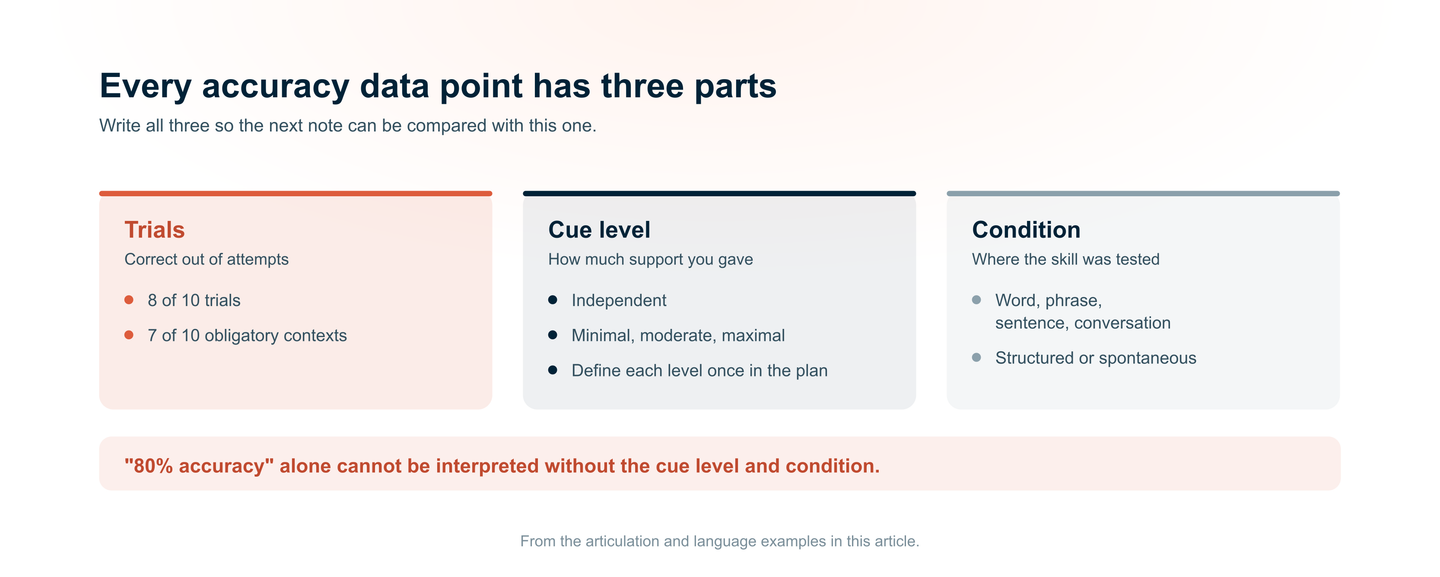
- Trials/Oppurtunities: 8 of 10, 7 of 10 obligatory contexts.
- Cue Level: Independent, minimal, moderate, maximal; define these once in the plan so they stay consistent.
- Condition: Word, phrase, sentence, conversational; structured or spontaneous.
What to Avoid
- Percentages Alone: “80% accuracy” without the cue level and condition is not interpretable/sufficient enough.
- “Improving” Without a Number: Pair every progress claim with the trial data that supports it.
- Inconsistent Cue Definitions: If “minimal cues” changes meaning between notes, the data cannot be compared.
School vs. Clinic Documentation
Which documentation requirements remain the same or differ based on setting:
What Changes
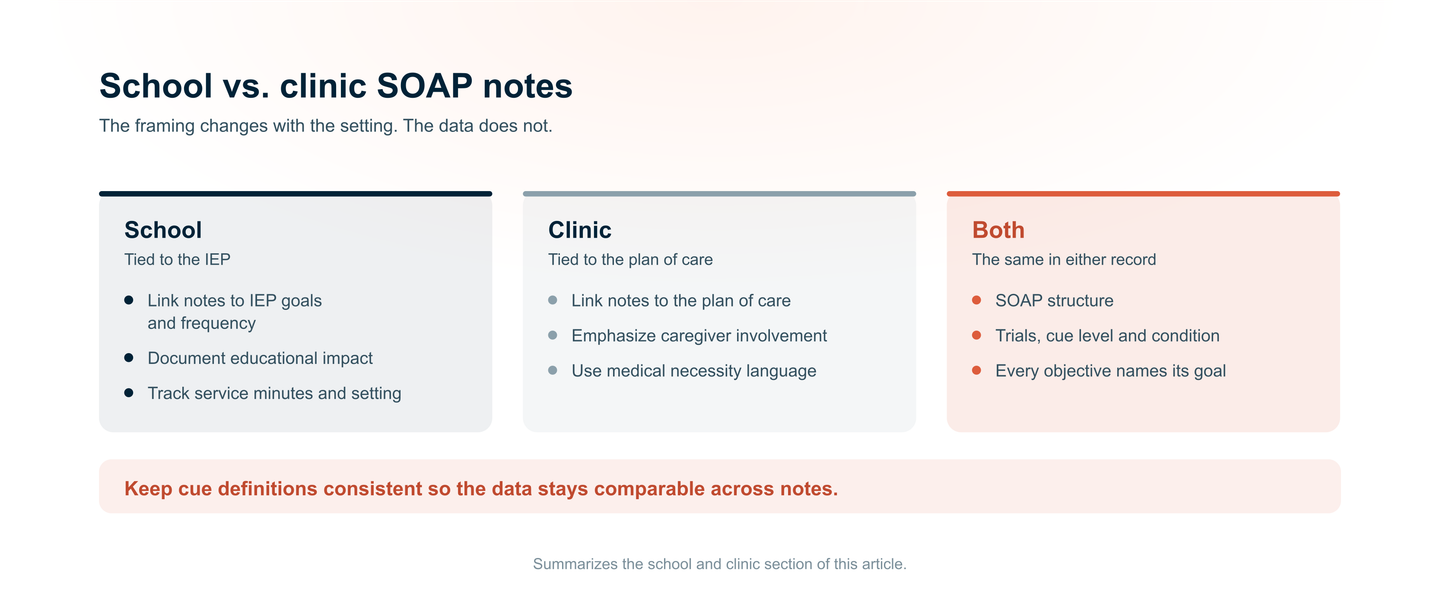
- School: Notes tie to IEP goals and frequency; document educational impact; service delivery minutes and setting are tracked.
- Clinic: Notes tie to the plan of care and often emphasize caregiver involvement; medical necessity language carries more weight.
- Both: SOAP structure, trial-and-cue data, and goal linkage remain the same.
What Stays The Same
- Goal Linkage: Every objective should name the goal it addresses, whatever the setting.
- Defensible Data: Trips, cues, and conditions (the same three elements in either record)
Conclusion
Speech therapy notes are data records; every objective should name the target, the trials, the cue level, and the condition, then link back to the goal. School and clinic settings change the framing, but not on the fundamentals. Keep cue definitions consistent across notes so the data stays comparable. Draft faster with our AI scribe for speech therapists, and see our guide to the best AI note taker for speech-language pathologists for workflow comparisons.