



Eleos Health is a serious platform. It calls itself "the System of Action for Community‑Based Care" and is built for behavioral health, SUD, home health and hospice organizations: ambient documentation, scanning of every note for compliance, revenue cycle tools, and — since April 2026 — a set of AI agents for clinical insights, coding and live quality checks.
So the useful question isn't "what's better than Eleos?" It's "which part of what Eleos does do we actually need?" An outpatient group practice that wants clinicians to finish notes faster needs something very different from a CCBHC that must audit every note before billing. The five alternatives below are sorted by that fit.
First, which situation are you in?
- You run an outpatient practice or group, and each clinician owns their caseload. You need a scribe clinicians will actually use, priced per clinician, that sits alongside your EHR. → Twofold.
- You're an agency already running a Qualifacts or Netsmart EHR. The AI built into your EHR is the shortest path. → Qualifacts iQ, Netsmart Bells.
- You need organization-wide review of documentation — every note scanned, audited or scored before it's billed. → Eleos, or ClinicalNotes.ai as a standalone alternative.
- Your problem is denials, prior authorizations and audit exposure rather than the time it takes to write notes. → Adentris.
At a glance
Tool | Best for | Public pricing | Works with |
|---|---|---|---|
Twofold | Outpatient practices and groups | Yes: $69/mo, or $49/mo billed annually; group pricing on request | Any EHR |
Qualifacts iQ | Agencies on Credible, CareLogic or InSync | No | Qualifacts EHRs only |
Netsmart Bells | Agencies on myAvatar, myEvolv or myUnity | No | Netsmart EHRs |
ClinicalNotes.ai | CCBHCs and CMHCs wanting a standalone option | No | EHR-agnostic |
Adentris | Denials, prior auth and audit exposure | Yes: free tier; Starter $100/mo | Epic, Kipu, athenahealth and others |
Pricing and positioning checked on each vendor's own website on 27 September 2026.
1. Twofold — best Eleos alternative for outpatient practices and groups
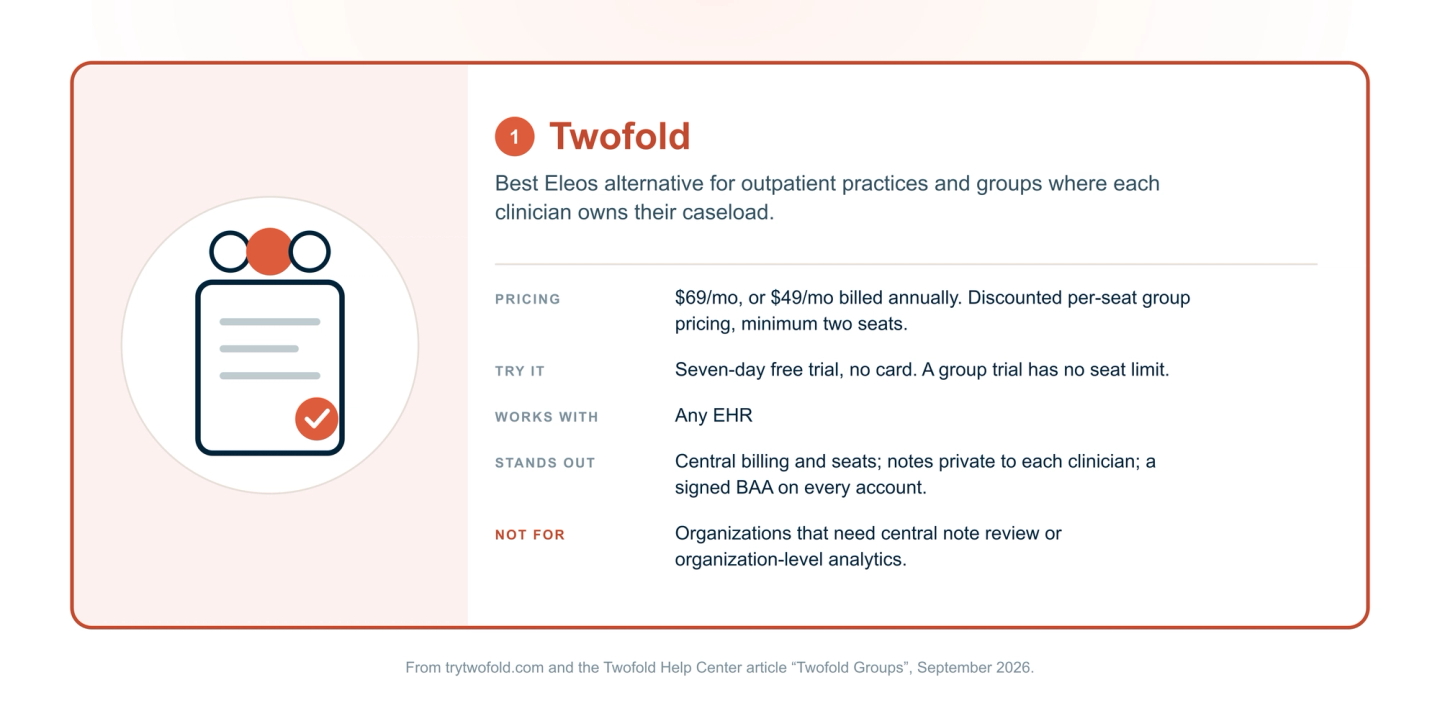
Best for: outpatient therapy, counseling and psychiatry practices — solo to multi‑clinician groups — where each clinician owns their caseload and the practice manages billing and seats.
Twofold is an AI scribe built around the clinician's daily note. It drafts SOAP, DAP, BIRP and GIRP notes, intakes and treatment plans from a session, with templates you can shape section by section, and the finished note goes into any EHR.
What makes it the practical alternative for this kind of organization is how groups work:
- You can try it before a sales call. Every account starts with a seven-day free trial, no card required, and a group trial has no seat limit, so the whole team can pilot it at once.
- Public pricing. The Personal plan is $69 a month, or $49 a month billed annually. Group plans use discounted per-seat pricing with a minimum of two seats.
- Central billing, private notes. An admin manages billing, seats and members centrally. Each clinician's clients and notes stay private to that clinician — admins included.
- Seats move with your team. When a clinician leaves, the admin reassigns the seat, and a group can keep the notes its members created while in the group.
- Shared templates. Clinicians share templates by link, and Twofold's support team can roll a template out to the whole group.
- A signed BAA on every account, at no extra cost.
Where Twofold is not the right Eleos replacement: it has no central queue for a director to review clinicians' notes, and no organization‑level documentation or outcomes analytics. If your organization needs either, you're in situation 3 below.
2. Qualifacts iQ — best for agencies already on a Qualifacts EHR
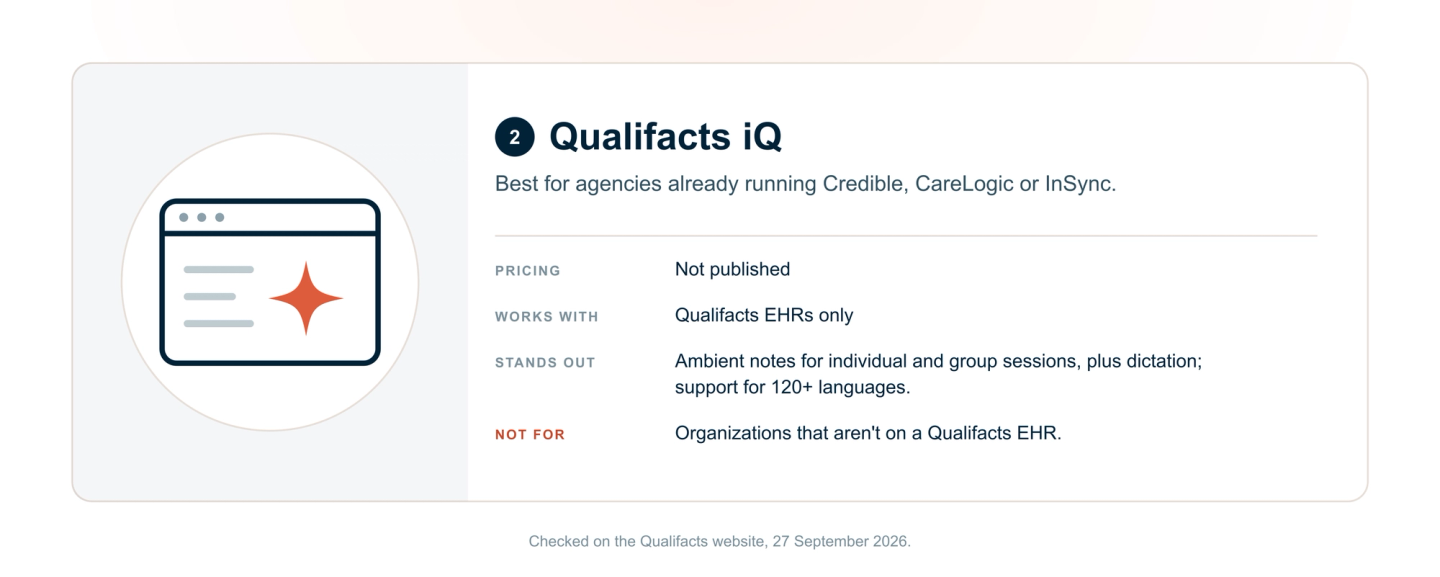
Best for: CCBHCs, mental health clinics and addiction treatment programs running Credible, CareLogic or InSync.
Qualifacts' iQ Clinical Documentation provides ambient notes for individual and group sessions plus dictation, and states support for more than 120 languages. It is built exclusively for Qualifacts' own EHRs, which is the main reason to choose it: the note is created where it's signed. Pricing isn't published.
Not for: anyone not on a Qualifacts EHR — it isn't available to them.
3. Netsmart Bells — best for agencies already on a Netsmart EHR
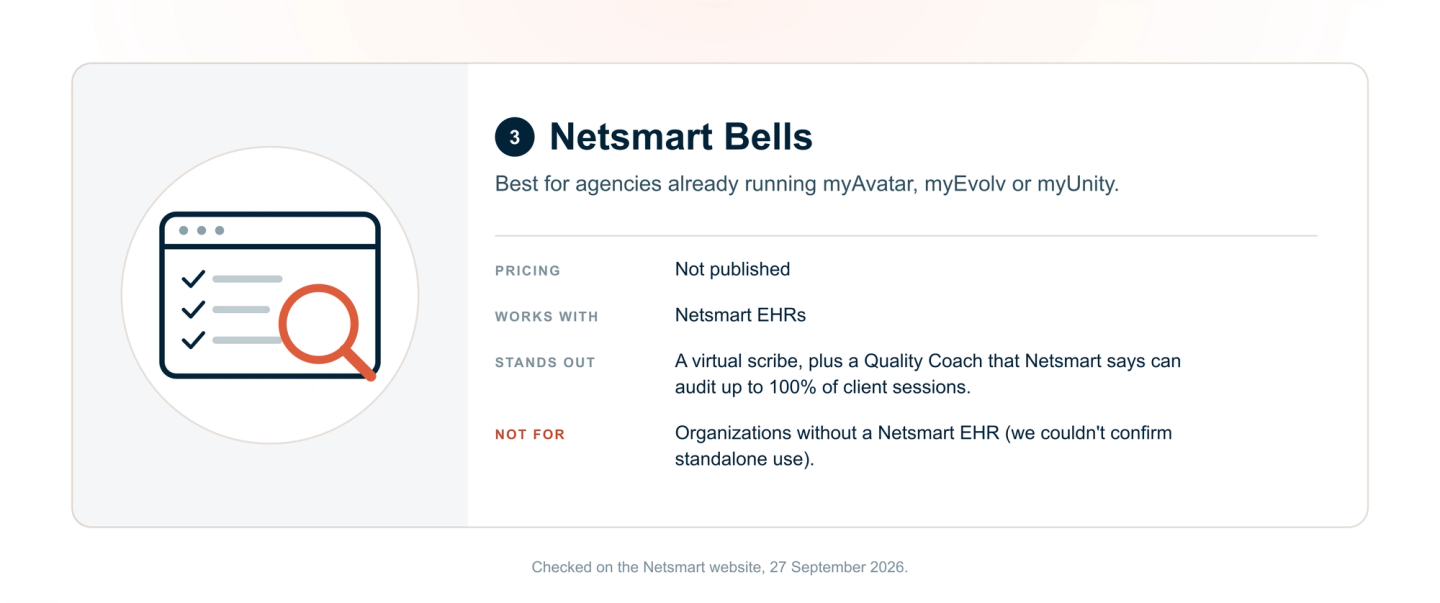
Best for: organizations running myAvatar, myEvolv or myUnity.
Bells includes a documentation assistant, a virtual scribe with ambient listening and dictation, and a Quality Coach that Netsmart says can audit up to 100% of client sessions — the closest match in this list to Eleos's compliance scanning. It is integrated with Netsmart's EHRs, and new organizations are routed to a demo. Pricing isn't published.
Not for: organizations that don't use a Netsmart EHR; we couldn't confirm standalone availability.
4. ClinicalNotes.ai — a standalone option for CCBHCs and CMHCs
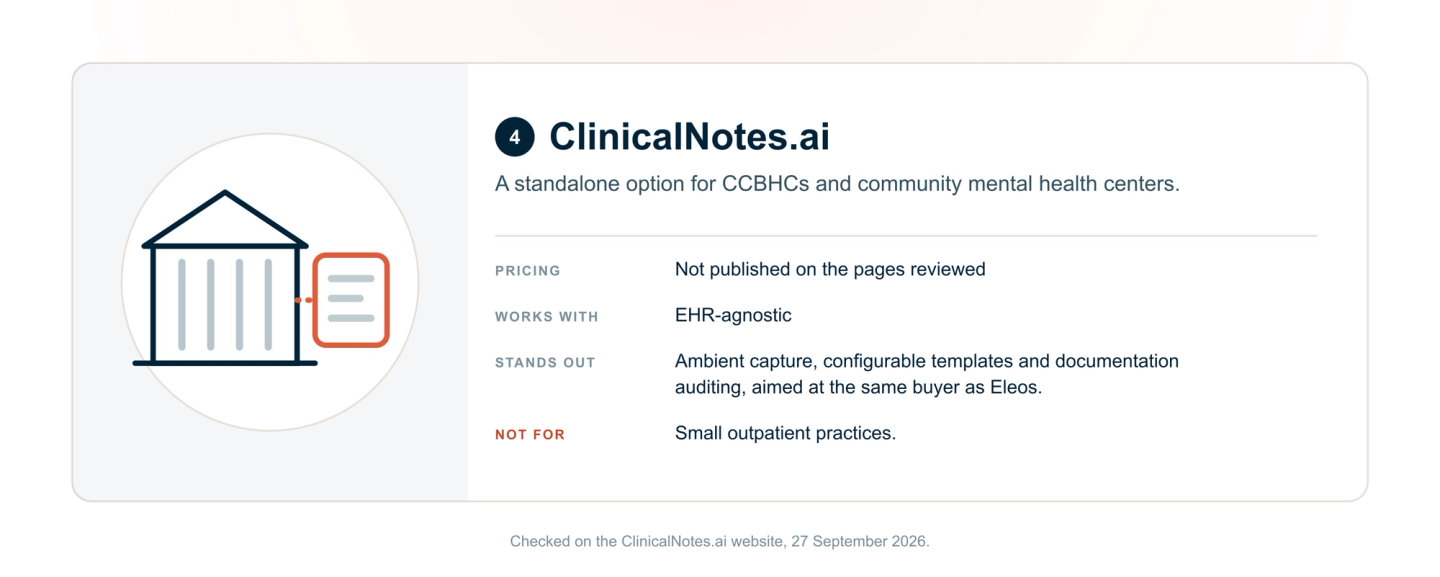
Best for: certified community behavioral health clinics and community mental health centers that want an EHR‑agnostic alternative aimed at the same buyer as Eleos.
ClinicalNotes.ai positions its enterprise product specifically for CCBHCs and CMHCs, with ambient capture, configurable templates and documentation auditing, and describes itself as EHR‑agnostic. Pricing isn't published on the pages we reviewed, so treat it as demo‑led.
Not for: small outpatient practices, which it doesn't target.
5. Adentris — best when the problem is denials, not notes
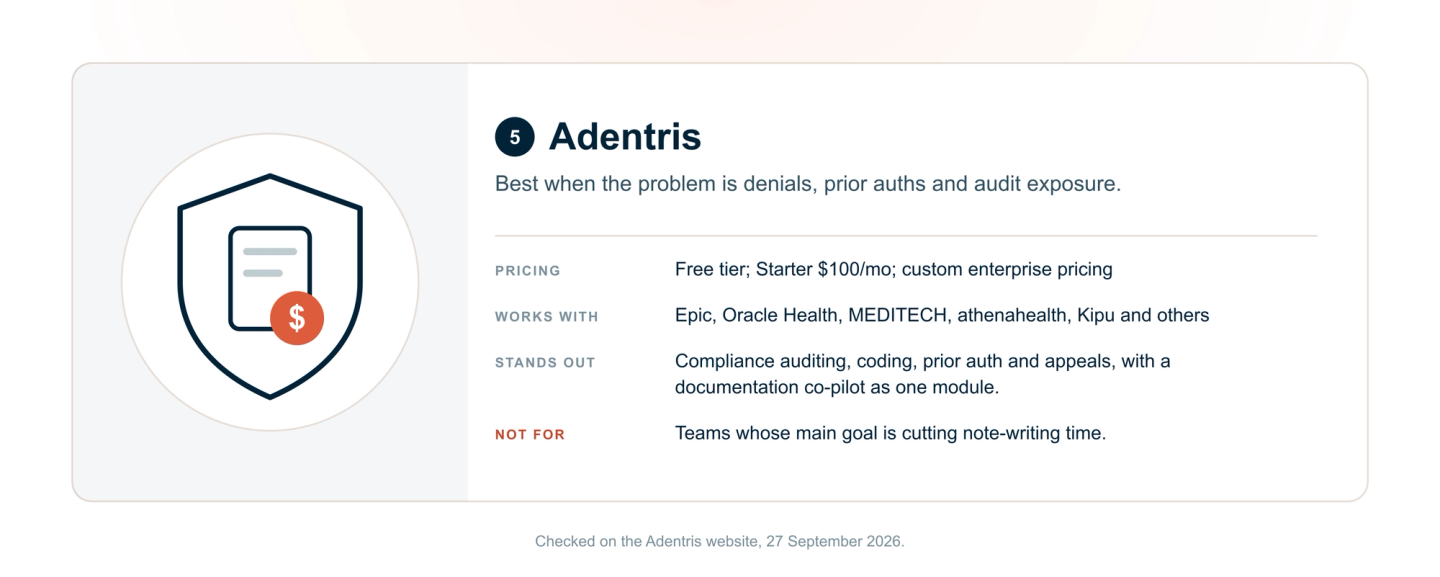
Best for: behavioral health networks and health systems whose documentation pain is audit exposure, coding, prior authorizations and denials.
Adentris is primarily a compliance and revenue‑integrity platform — auditing, coding, prior auth and appeals — with a documentation co‑pilot as one of its modules. It names Epic, Oracle Health, MEDITECH, athenahealth and Kipu among its integrations. Unusually for this category, pricing is public: a free tier, a Starter plan at $100 a month, and custom enterprise pricing.
Not for: teams whose main goal is cutting the time clinicians spend writing notes.
When to stay with Eleos
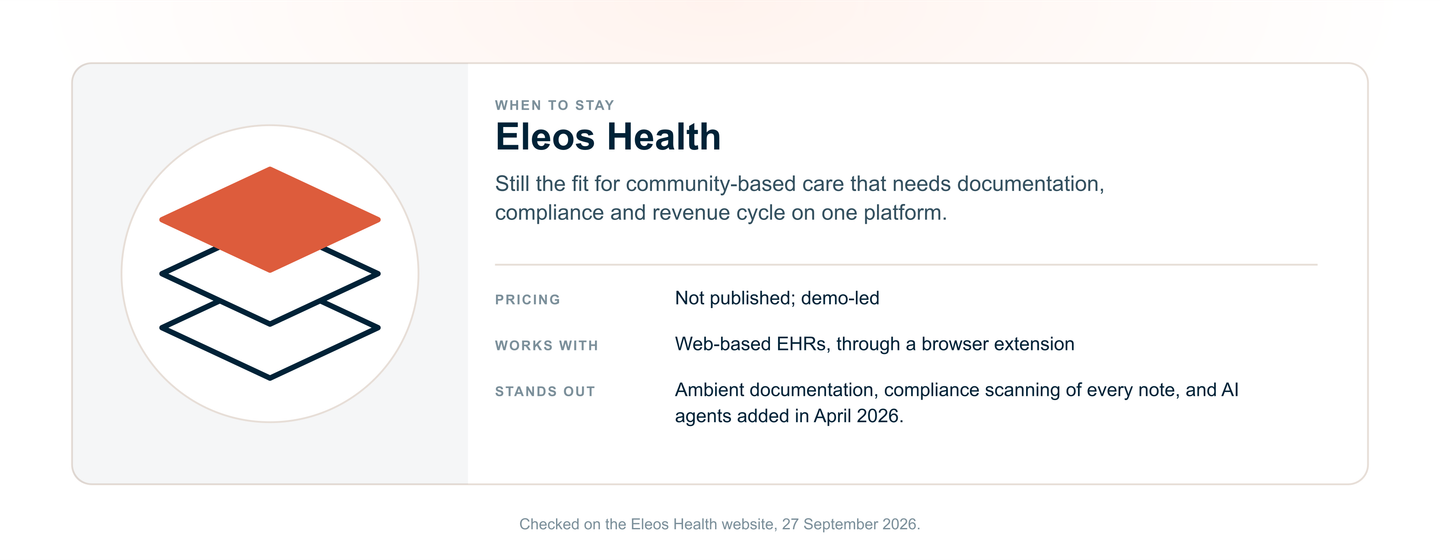
Eleos remains the strongest fit if you need documentation, organization‑wide compliance scanning and revenue cycle work on one platform, across community‑based care — especially with field staff and a web‑based EHR its browser extension can sit on. None of the alternatives above replace that whole combination, and it's better to know that before a pilot than after.
How to choose
- Start from the organization, not the demo. Who needs to see the notes — the clinician who wrote them, or a director or program? That one answer eliminates most of this list.
- Check the EHR first. If you're on Qualifacts or Netsmart, evaluate their built-in AI before anything else.
- Pilot with several clinicians on real sessions, for two weeks, against criteria you set in advance: time to signed note, how much of each draft survives editing, and whether clinicians want to keep using it.
- Price at full headcount. Per-seat, per-session and enterprise pricing behave very differently at ten clinicians than at one.