


Introduction to SimplePractice AI Note Taker
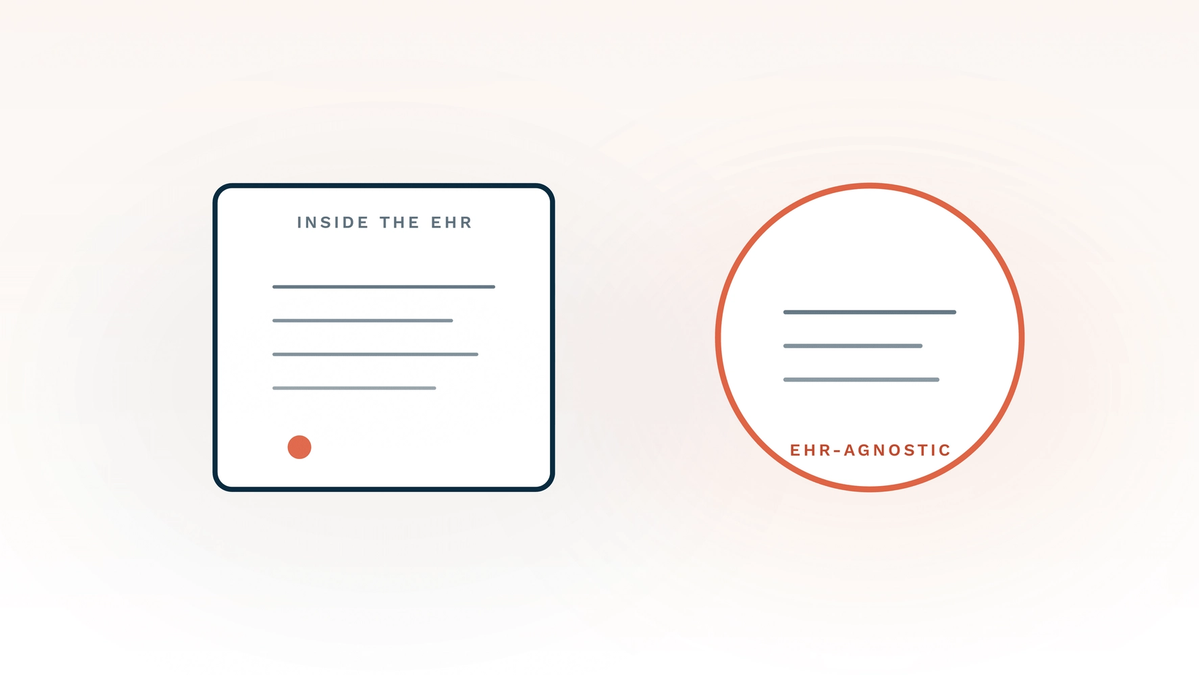
SimplePractice AI Note Taker is the native, in‑EHR AI scribe built into the SimplePractice platform. It launched as an add‑on to the SP subscription clinicians already pay for, with the promise of producing draft progress notes from session audio without leaving the chart you already work in. For practices fully inside SimplePractice Telehealth, that's an attractive proposition.
What follows is a clinician‑facing review grounded in the conversations I keep having with therapists who already use SimplePractice and are weighing the in‑EHR add‑on against external scribes. The focus: when it's the obvious choice, when it's not, and what to actually expect on $35/month per clinician.
Key Features and Claims
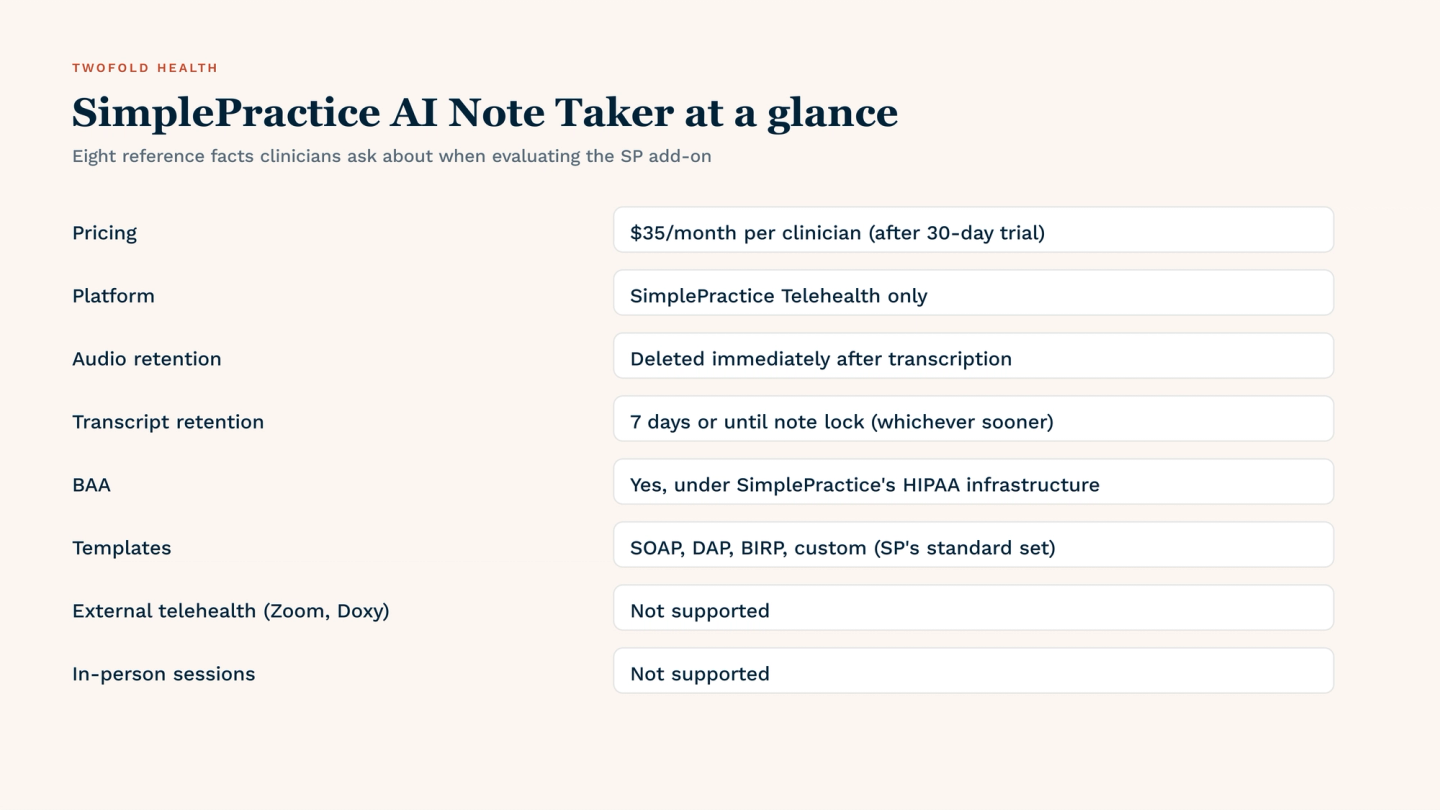
SimplePractice AI Note Taker is a focused product, not a broad assistant. It records audio during SimplePractice Telehealth sessions, transcribes the conversation, and produces a draft progress note in your chosen template (SOAP, DAP, BIRP, or custom) that lands inside the client chart you already work in. The clinician reviews the draft, edits as needed, and signs and locks the note when ready.
SimplePractice publishes specific handling guarantees: session recordings are deleted immediately after transcription, transcripts are retained for the shorter of 7 days or until the note is signed and locked, and the AI Note Taker is covered under SimplePractice's existing BAA pathway. There's a 30‑day free trial and the add‑on costs $35/month per enabled clinician after that.
Target Audience
The product is built for solo therapists and small mental‑health groups who already use SimplePractice as their primary practice management and EHR — and who do their telehealth on SimplePractice Telehealth specifically. If that describes your practice, the AI Note Taker is the lowest‑friction option available because everything happens inside the same workflow you already know.
It's not built for clinicians who do video sessions on Zoom, Doxy.me, or other platforms, who mix telehealth and in‑person sessions, who use a different EHR for any portion of their practice, or who want a tool that travels with them if they ever leave SP. For those clinicians, an external scribe is structurally a better fit, even though it costs slightly more per month.
Initial Setup Experience
Setup is genuinely simple if you're already on SimplePractice. The AI Note Taker is enabled per clinician from the SP admin area, the 30‑day free trial starts, and your next SimplePractice Telehealth session produces a draft. There's no separate account, no template‑building project, no IT involvement — SP's existing template library is what the AI maps to.
Most clinicians I've talked to who switched on the add‑on were producing usable drafts within their first or second session. The simplicity is a real strength: it's an in‑EHR add‑on, not a separate product to learn.
Safety Measures and Precautions
SimplePractice's published safety posture for the AI Note Taker covers the basics clinicians should expect: HIPAA‑compliant infrastructure under SP's existing BAA, audio deletion immediately after transcription, transcript retention capped at 7 days or note‑lock, and an opt‑in flow per session. AI‑generated drafts are explicitly labeled as drafts requiring clinician review.
Same caveats apply as with every AI scribe in 2026: the clinician remains the legal author of the note, drafts must be reviewed before signing, and high‑risk content (suicidality, abuse, complex risk assessment) needs to be verified rather than trusted to the model. SP's in‑EHR posture doesn't change those responsibilities — it just keeps the workflow in one place.
Inside SimplePractice: UI, voice, and templates
The AI Note Taker lives inside the existing SimplePractice client chart, so the visual style is whatever you're already used to inside SP. Voice recognition for two‑speaker therapy sessions is solid in typical telehealth audio conditions; multi‑speaker accuracy (e.g., couples or family sessions) tends to vary more, the same as with any AI scribe in 2026.
Templates are SP's standard set — SOAP, DAP, BIRP, customizable progress and psychotherapy notes — and the AI maps transcript content into whichever template the clinician selects for that session. The customization story is what SP already supports for its non‑AI templates, no more and no less. If you wanted a more exotic note format than SP ships, the AI Note Taker doesn't unlock new template surface; it operates within the existing one.
Real-World Performance
For solo therapists doing one‑on‑one telehealth on SimplePractice, the AI Note Taker delivers what it promises: a usable draft from the session audio that the clinician edits and signs. Reported time savings are real but moderate — typical reports I've heard are 5‑10 minutes saved per note for clinicians who keep their templates tight and review discipline strong.
Where performance softens: complex sessions with multiple participants, sessions with significant clinical risk content the clinician needs to verify carefully, and sessions where the clinician would have written a meaningfully different note than the AI draft produces. The clinician's editing time stays material — this is a drafting aid, not a replacement for the cognitive work of clinical documentation.
Integration and Workflow Efficiency
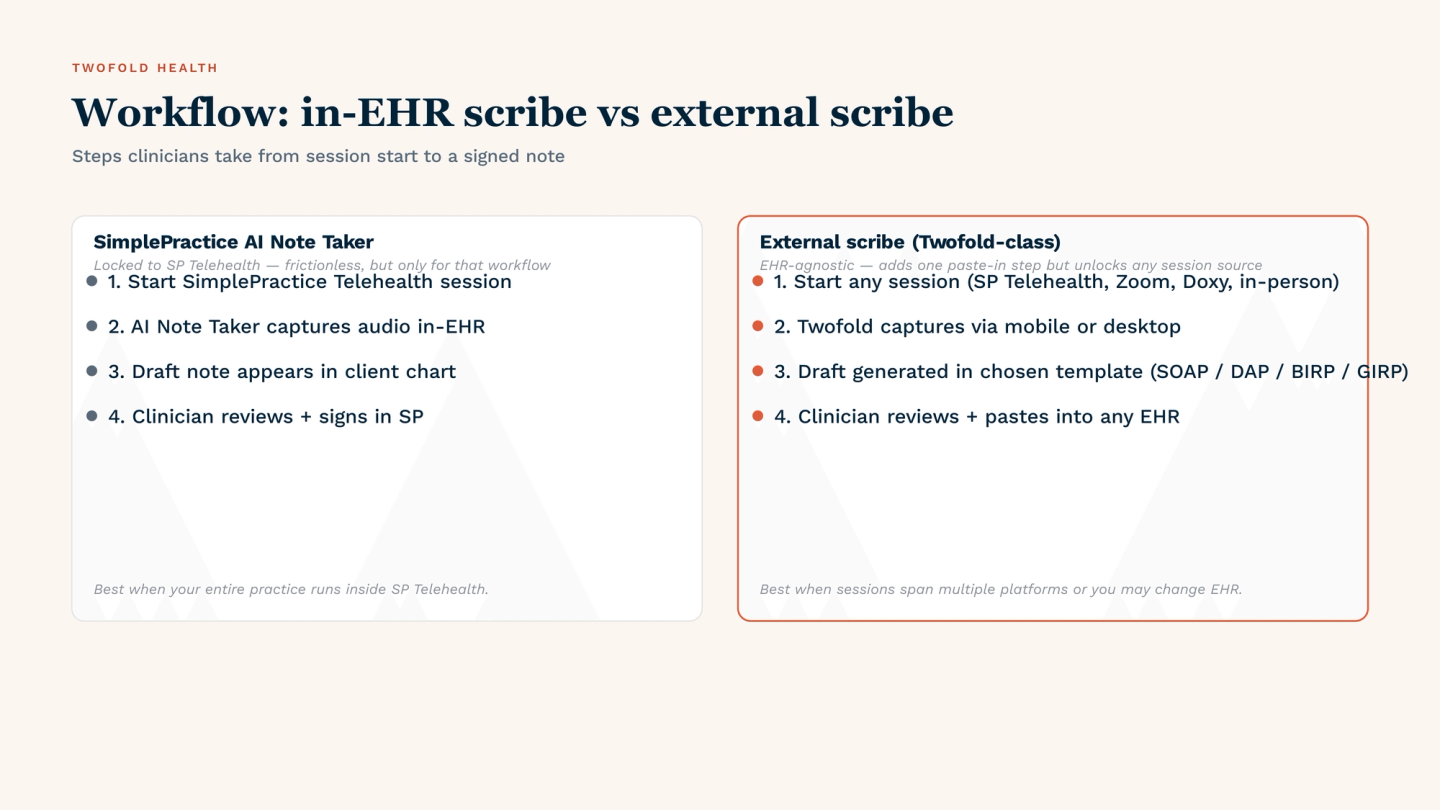
The integration story is the AI Note Taker's most defensible advantage and its biggest limitation, depending on your workflow. Inside SP Telehealth, the draft note lands in the chart automatically; no paste‑in step, no second app, no second login. For clinicians already running 100% of their work on SimplePractice, this is the cleanest possible workflow.
Outside SP Telehealth, the AI Note Taker simply doesn't work. There's no Zoom plugin, no Doxy integration, no in‑person flow, no API for external triggering. The integration depth is real but narrowly scoped — it's depth in exactly one direction.
Data Privacy and Security Compliance
SimplePractice's privacy posture for the AI Note Taker is built on top of its existing HIPAA‑aligned infrastructure, with a published BAA, audio deletion immediately after transcription, and transcript retention capped at 7 days. For SP customers whose compliance officer (or solo‑practice owner conscience) wants a clear data‑handling story, the published policy is concrete and short — which is a strength.
The practical implication: you can use the AI Note Taker with the same compliance confidence you'd use the rest of SimplePractice. For mental‑health clinicians whose data lives in SP anyway, this is a non‑issue.
SimplePractice AI Note Taker vs Twofold: Why Twofold Might Be the Better Choice for You
SimplePractice AI Note Taker and Twofold serve overlapping but importantly different audiences. The right pick depends on how locked‑in you are to SP Telehealth.
Twofold is the better default for clinicians who:
- Do telehealth on multiple platforms (SP Telehealth, Zoom, Doxy, Google Meet) and want one scribe across all of them.
- Mix telehealth and in-person sessions and want consistent AI documentation across both.
- Want notes that aren't structurally tied to one EHR — so if you ever change practice management, your scribe doesn't have to change too.
- Value a broader template surface (SOAP, DAP, BIRP, GIRP, intake, treatment-plan / re-authorization) than SP ships by default.
- Prefer transparent SMB pricing — Twofold at $49/mo on annual billing is broadly comparable to SP's $35/mo add-on once you account for plan tiers.
SimplePractice AI Note Taker remains the right pick when your entire practice runs inside SimplePractice Telehealth and you have no plans or reason to change that. In that scenario the native option's frictionless workflow is genuinely hard to beat.
Conclusion
SimplePractice AI Note Taker is a competent, focused, well‑integrated AI scribe for clinicians whose entire workflow is already inside SimplePractice Telehealth. The $35/month per clinician add‑on does what it promises within that boundary, and the in‑EHR experience is genuinely simpler than running an external tool alongside.
Almost every clinician I talk to who asks about the SP AI Note Taker is already an SP customer — and that's the right framing for the product. It's not competing for general‑market scribe attention; it's competing for the share of SP customers who would otherwise use an external scribe alongside SP. For clinicians whose practice doesn't sit entirely inside SP Telehealth — which is the broader audience — Twofold is the cleaner default: same price‑tier, broader template depth, and a workflow that isn't structurally tied to one EHR.
Summary
Use SimplePractice AI Note Taker if you already run your practice 100% inside SimplePractice Telehealth, you don't anticipate changing practice management software, and you want the lowest‑friction AI scribe option for that specific workflow. The native integration is real.
Use an external scribe like Twofold if you do telehealth across multiple platforms, mix telehealth and in‑person, want EHR‑agnostic notes, or value template depth beyond SP's defaults. The external workflow adds a paste‑in step but unlocks portability and breadth. See also our best AI for SimplePractice in 2026 and best AI for therapy notes.