


Therapists should choose Twofold if they want a flat, unlimited AI scribe for therapy notes: $49 a month billed annually, or $69 billed monthly ($19 for the first month on the monthly plan), with no monthly note cap. Choose Blueprint if measurement‑based care, per‑session pricing, or Blueprint's own EHR matters more: its Alongside plan is listed at $0.99 per session, its FAQ also lists $69 per seat per month for unlimited sessions, and its all‑in‑one EHR is $1.49 per session, checked November 13, 2026. At about 12 sessions a week, Blueprint's $0.99 per‑session price passes Twofold's $49 a month billed annually; above about 16 sessions a week, it also passes $69.
We make Twofold, so weigh our view accordingly. The fair read is that Blueprint has a real edge for therapists who want outcome measures and clinical tools tied to documentation, while Twofold has the cleaner price, broader therapy templates and unlimited use for a full caseload. Prices change, and Blueprint's pricing page shows two prices for its Alongside option, so check both pricing pages before you buy.
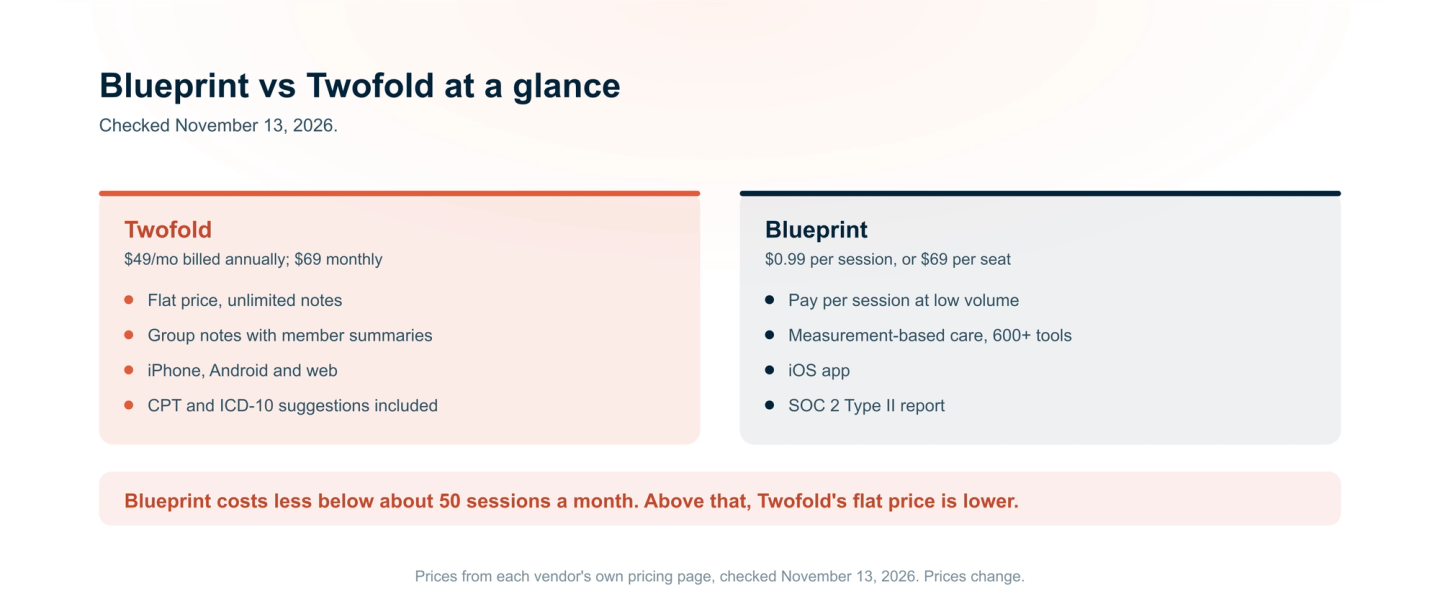
Blueprint vs Twofold at a glance
The short version is that Twofold is the simpler flat subscription and Blueprint is the more measurement‑focused option with per‑session and EHR pricing.
Feature | Twofold | Blueprint |
|---|---|---|
Price and billing | $49/mo billed annually; $69 monthly | Alongside $0.99/session; FAQ says $69/seat |
Note limit | Unlimited; no monthly or daily cap | Per-session, or $69/seat unlimited per FAQ |
All-in-one EHR | No; works beside EHRs | $1.49/session; 30-day trial listed |
Therapy formats | Group, couples, family, EMDR, supervision | SOAP, DAP, BIRP, GIRP, EMDR, intake |
Group notes | Group note plus individual summaries | Dedicated group-note workflow not published |
Couples and family | Built-in couples and family templates | Couples SOAP; family format not listed |
Treatment plans | Drafted from notes with progress tracking | Drafted from intake with measurable goals |
Measurement-based care | Not published as a charting suite | Outcome measures and 600+ clinical tools |
Coding suggestions | CPT and ICD-10 suggestions included | Coding help listed on Pro |
AI assistant | Ask Twofold included | AI Chat listed on Pro |
Capture and apps | Web, iPhone, Android, upload, dictation | Live, dictation, upload, summary; iOS app |
EHR workflow | Copy-paste; partner API for partner EHRs | Copy-paste, own EHR, Enterprise API |
Audio storage | Audio processed, never stored | Optional audio deleted after processing |
BAA | Signed BAA on every plan | BAA included in Terms |
Certifications | SOC 2 Type II in progress | SOC 2 Type II certified |
Free trial | 7 days, no card | 5 sessions; EHR 30-day trial |
Group plan | Custom per-seat pricing; volume discounts | Enterprise custom; annual contracts listed |
Where Blueprint is stronger
Blueprint is stronger when outcome tracking is part of the clinical workflow, or when a therapist sees few enough sessions that $0.99 per session is materially cheaper. Its pricing page lists built‑in outcome measures, suggested assessments, worksheets and interventions from a 600+ tool library. If you already use measures between sessions, Blueprint is more likely to feel like a clinical system around the note rather than a note generator alone.
- Measurement-based care is the clearest Blueprint advantage. Twofold drafts notes and treatment plans, but Blueprint publishes a broader outcomes and clinical-tool workflow on its pricing page.
- Blueprint is also stronger if you want the option to move into its all-in-one EHR. Twofold works beside EHRs, including SimplePractice and TherapyNotes, but it is not an EHR.
- Blueprint's per-session price can be attractive for a part-time caseload. If you average 8 sessions a week, $0.99 per session is about $34.32 a month before any flat seat switch.
- Blueprint has a completed SOC 2 Type II claim on its privacy page. Twofold's SOC 2 Type II certification is in progress, so buyers who require a completed report today may prefer Blueprint.
Where Twofold is stronger
Twofold is stronger for therapists who want unlimited notes, broad therapy templates and predictable billing without thinking about session volume. Twofold's pricing includes every note format, custom templates, Ask Twofold, CPT and ICD‑10 code suggestions, treatment plans, iPhone and Android apps, dictation, audio upload and a signed BAA without add‑ons.
- Unlimited use is the main practical difference for a full caseload. Twofold has no monthly cap, no daily cap and no per-note fee, so a therapist seeing 20 to 30 clients a week does not need to count sessions.
- Twofold is broader for therapy-specific documentation. It includes templates for group therapy, couples therapy, family therapy, EMDR, supervision, DBT, play therapy, substance use, intakes, psychiatric evaluation, medication management and custom templates.
- Twofold is clearer for group therapy documentation. One session can produce a group note plus an individualized summary for each participant, which is the workflow described on Twofold's group therapy note generator page.
- Twofold includes coding suggestions on each note. The clinician still reviews before billing, but CPT and ICD-10 suggestions are part of the plan rather than a higher-priced tier.
- Twofold's mobile support is broader. It has iPhone and Android apps plus the web app, while Blueprint's published native mobile app is iOS.
How much does each cost at common caseloads?
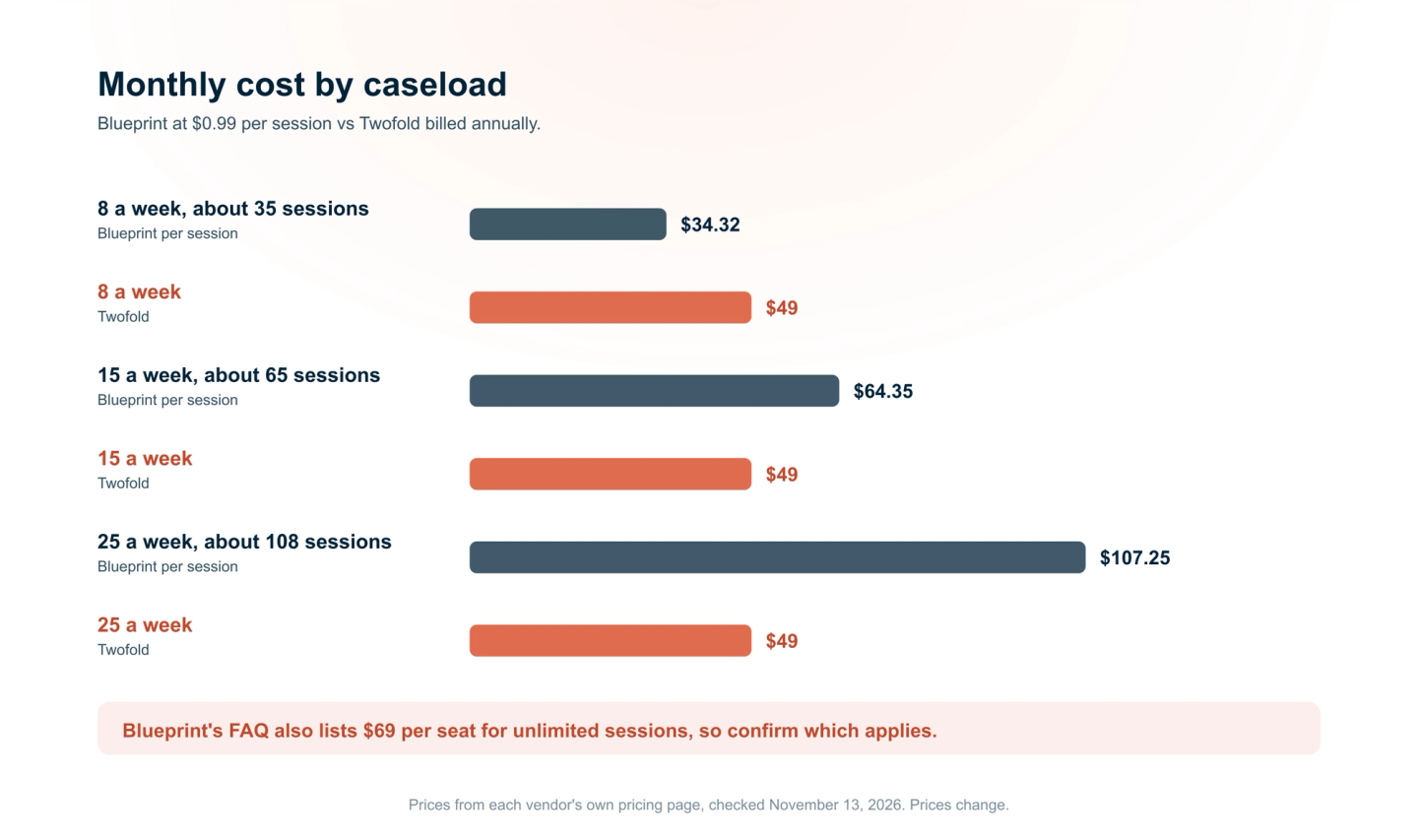
Blueprint's $0.99 per‑session option is cheaper at smaller caseloads, while Twofold's $49 a month billed annually is cheaper once you average about 12 sessions a week. The table uses the house math clinicians usually need for subscription decisions: weekly sessions x 52 / 12. It assumes one Blueprint session charge per therapy visit and compares against Twofold's annual‑billing monthly cost.
Weekly sessions | Monthly sessions | Twofold $49/mo billed annually | Blueprint $0.99/session | Lower listed cost |
|---|---|---|---|---|
8 | 34.7 | $49.00 | $34.32 | Blueprint by $14.68 |
15 | 65.0 | $49.00 | $64.35 | Twofold by $15.35 |
25 | 108.3 | $49.00 | $107.25 | Twofold by $58.25 |
Against Twofold's $69 monthly plan, Blueprint's $0.99 per‑session option stays lower until about 16 sessions a week. If Blueprint's FAQ‑listed $69 unlimited seat applies, that price matches Twofold's monthly plan and is $20 more than Twofold's $49 a month billed annually. If you price Blueprint's all‑in‑one EHR at $1.49 per session, the same caseloads are about $51.65, $96.85 and $161.42 a month.
How do therapy formats compare?
Twofold publishes more therapy‑specific formats, while Blueprint publishes a strong set of standard note formats plus custom templates. Blueprint's AI documentation page lists SOAP, DAP, BIRP, GIRP, EMDR, intake notes, psychiatric evaluations and custom templates. It also lists treatment plans, discharge summaries and letters.
For couples work, Blueprint documentation says a Couples SOAP note can produce three notes: one for each partner and a process note. Twofold has couples and family templates, plus a group therapy workflow that creates the group note and individual member summaries. For supervision notes, Twofold has a supervision note template; Blueprint does not publish a supervision‑note workflow.
How do EHR workflow and mobile capture compare?
Twofold is a sidecar scribe for any EHR, while Blueprint can be either a sidecar or its own EHR. With Twofold, the finished note is copied into SimplePractice, TherapyNotes, Epic, athenahealth or another EHR, and direct filing exists through the Twofold Partner API for partner EHRs. There is no direct SimplePractice integration, and there is no integration fee.
Blueprint's Alongside page says clinicians copy completed work into the chart and that direct connectors are coming soon. Blueprint's all‑in‑one EHR saves notes inside Blueprint, while Enterprise pricing lists custom EHR integrations and API access. For capture, Blueprint supports live recording, dictation, audio upload and summary input; its iOS app is published in the App Store. Twofold supports telehealth and in‑person sessions, dictation, audio upload, web, iPhone and Android.
How do privacy and data handling compare?
Both tools publish a HIPAA posture with BAA coverage, audio deletion and no AI training on client information, but Blueprint has the completed SOC 2 Type II claim today. Twofold's security page says audio is processed to create the transcript and note, then deleted; it is never written to disk. Notes and transcripts stay in the account until the clinician deletes them by default, with optional automatic deletion available on request for clinicians or groups.
Blueprint's privacy page says a BAA is automatically included as part of its Terms of Service, optional recordings are deleted immediately after processing, and client data is never used to train AI models. It also says finalized records are retained in line with professional and legal expectations, without publishing a specific retention period or auto‑delete setting.
How should a therapist switch between Blueprint and Twofold?
The safest switch is to decide your system of record first, then rebuild only the documentation workflow you actually use each week. A therapist moving from Blueprint's all‑in‑one EHR to Twofold has a different job than a therapist using Blueprint Alongside with an existing EHR, because Twofold is not replacing the EHR.
- Pick the record that remains authoritative. If your chart lives in SimplePractice, TherapyNotes or another EHR, keep that as the record and compare how each scribe gets the note there.
- List your five most common note types before testing. Include individual therapy, intake, couples, family, group, EMDR or supervision if they matter in your practice.
- Rebuild templates one at a time. Both products support custom templates, but the fastest test is to start with your most common progress note and one intake or treatment-plan workflow.
- Run one non-client test dictation to check tone, section order and required fields. Then test one real clinical workflow only after your BAA, consent language and internal policy are ready.
- Decide how notes enter the chart. Twofold is copy-paste unless your EHR is a partner API integration; Blueprint Alongside is copy-paste, while Blueprint's EHR keeps notes inside Blueprint.
- Check the security paperwork before the first client session. Compare BAA language, audio handling, transcript retention, AI training language and any certification requirement in your group or payer contract.
What should therapists compare during the free trials?
The best free‑trial test is a normal week of your actual documentation, not a polished demo session. Twofold offers a 7‑day free trial with no credit card. Blueprint lists 5 free sessions for Alongside and a 30‑day free trial for the all‑in‑one EHR; another FAQ line on the pricing page says every new signup starts with 30 days of free sessions, so confirm the trial terms before relying on them.
- Run the same session types in both tools: one standard individual session, one intake, one treatment-plan update and any specialty format you use often.
- Time the work after the session ends: generation, edits, signing prep and copying into the chart.
- Check medical-necessity language, progress toward goals, risk wording, diagnosis support and whether the note sounds like your clinical voice.
- For Blueprint, test the outcome-measure workflow and whether its clinical tools change your session prep or follow-up.
- For Twofold, test unlimited use during a busy day, group or couples templates, Ask Twofold edits and whether the EHR copy-paste step feels acceptable.
- Before choosing, calculate your expected monthly sessions with weekly sessions x 52 / 12 and decide whether you want per-session pricing or a flat unlimited plan.