


If your organization is evaluating Freed AI, the real question is not whether Freed is a strong product. It is. Freed publicly positions itself as a fast, self‑serve AI scribe with public pricing, a 7‑day no‑credit‑card trial, and a Chrome EHR Push extension that automatically transfers notes into browser‑based EHRs. Its public claims also emphasize a wide self‑serve clinician footprint and HIPAA‑aligned posture with SOC 2 Type II.
But if you are looking for the best overall Freed alternative — especially for outpatient mental‑health practices, group clinics, and teams that document across multiple platforms — Twofold is the stronger choice overall. Twofold offers a single Personal plan with full features (no tier gates), mental‑health template depth out of the box, EHR‑agnostic paste‑in that doesn't require a Chrome extension or browser‑rendered EHR, treatment plans and progress tracking as core features, and conservative audio handling.
What Freed does well
Any fair comparison should start with Freed's strengths. Freed is one of the most‑cited self‑serve AI scribes in 2026. Its homepage emphasizes fast onboarding, public pricing, and a Chrome EHR Push extension purpose‑built for browser‑based EHRs. Pricing is genuinely transparent across three tiers: Starter at $39/mo, Core at $79/mo, and Premier at $104/mo annual or $119/mo monthly.
Freed also has a credible public compliance and integration story. The vendor publishes HIPAA compliance and SOC 2 Type II certification on its site, the Chrome extension supports note transfer into many browser‑based EHR workflows, and the 7‑day no‑credit‑card trial makes evaluation low‑friction. For solo and small‑clinic primary‑care use, that combination of pricing transparency, fast trial, and browser‑EHR push is genuinely compelling.
That makes Freed a legitimate option, especially for buyers who want a self‑serve AI scribe with public pricing tiers and a Chrome‑based EHR workflow.
Why organizations still search for a Freed alternative
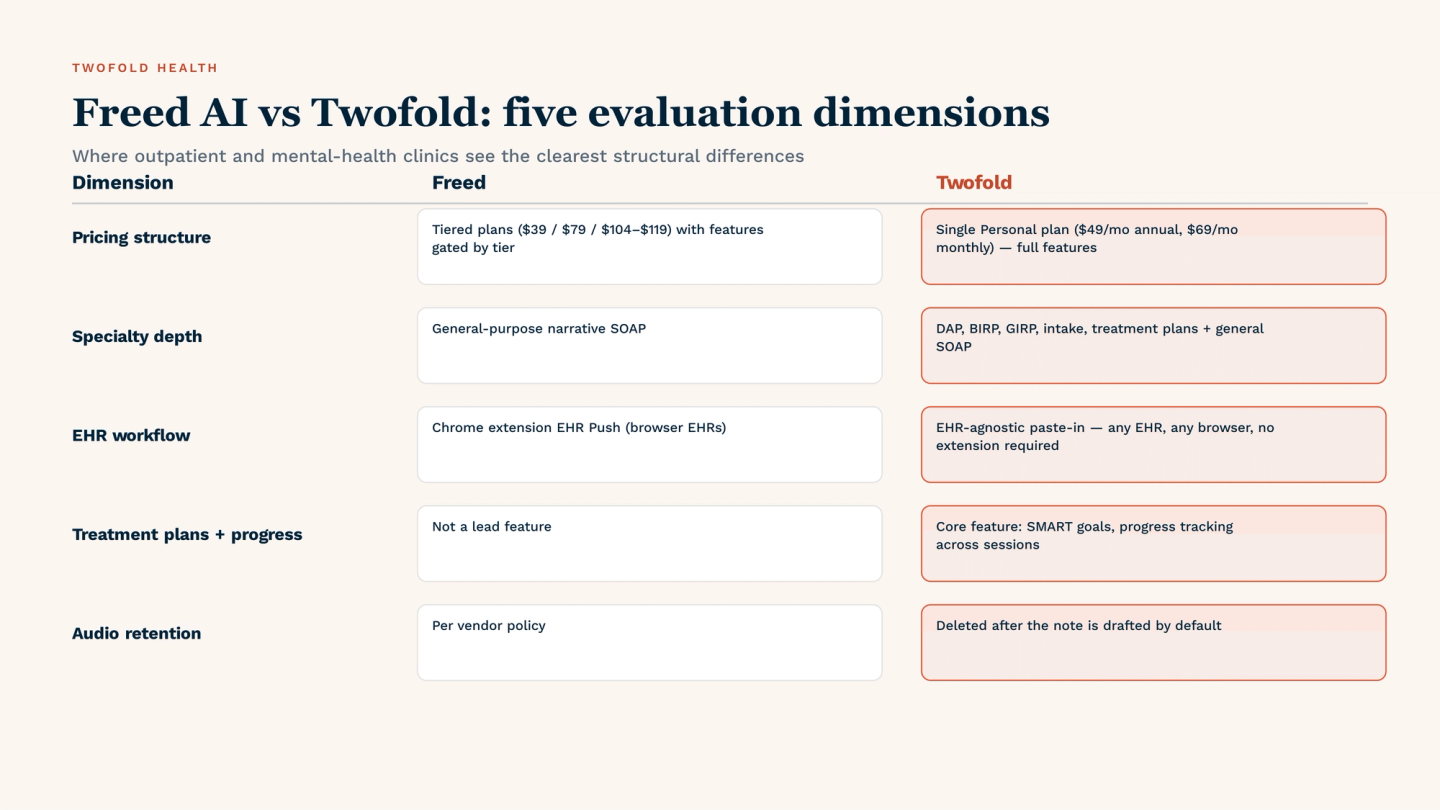
The reason organizations search for a Freed alternative is usually not that Freed lacks capability. It is that many buyers — especially in outpatient mental health and in teams that document across multiple platforms — want a tool that is easier to budget without tier‑gate surprises, more obviously built for specialty documentation depth (DAP, BIRP, GIRP, intake, treatment plans), and not dependent on a Chrome extension plus a browser‑rendered EHR for its core EHR workflow.
That difference matters. Outpatient mental‑health clinics, group practices, and teams that mix telehealth + in‑person + non‑browser EHRs often want a single predictable plan, specialty templates that don't need reshaping, and a paste‑in workflow that travels regardless of browser or EHR. Twofold's single Personal plan, mental‑health template depth, and EHR‑agnostic workflow make that easier.
Why Twofold is the best overall Freed alternative
1. Twofold is easier to budget and evaluate
Twofold publishes clear pricing publicly. Its help center lists a single Personal plan at $69/month billed monthly or $49/month billed annually, including unlimited notes, custom templates, treatment plans, client progress tracking, mobile and desktop apps, and premium support — with no feature gates between tiers on the individual plan. Its homepage also promotes a free trial path with no credit card required, plus group plans for clinics and teams.
By comparison, Freed publishes clear pricing across three tiers but features like custom templates, advanced workflow controls, and team‑management capabilities can sit behind upgrade boundaries. For organizations that want a single number to compare and a single feature set to evaluate, Twofold's single‑plan packaging is easier to shortlist and easier to budget. This is an inference from each vendor's public pricing and plan presentation.
2. Twofold is more clearly built for mental-health and outpatient documentation
Twofold's specialty and solution pages are unusually explicit about mental‑health and outpatient workflows. Its therapy notes page emphasizes structured templates for DAP, BIRP, GIRP, intake, and treatment plans — formats that mental‑health clinicians use every day. Its outpatient pages highlight customizable templates for visit types ranging from annual physicals to chronic‑disease management, with one‑click EHR‑ready output.
Freed's product is positioned as a general‑purpose narrative scribe — strong for SOAP‑style notes in primary care and general specialties. For mental‑health clinicians who need their drafts to land in DAP or BIRP structure with minimal reshaping, Twofold's specialty‑template depth is the more defensible default. That is what makes Twofold the strongest overall Freed alternative for mental‑health‑focused practices.
3. Twofold's EHR workflow doesn't depend on Chrome or a browser-based EHR
One of Freed's strongest selling points is its EHR Push Chrome extension, which automatically transfers notes into browser‑rendered EHRs. That works well when your EHR is browser‑based and you're on Chrome. It works less well — or doesn't work at all — when your EHR is a desktop application, when your clinic uses a different browser, or when you mix telehealth platforms whose EHR access isn't browser‑rendered.
Twofold's workflow doesn't depend on Chrome or a particular EHR architecture. Its clinical‑notes page emphasizes one‑click copy into any EHR in seconds with no complex setup required, and that pattern works equally well in desktop applications, mobile EHRs, and browser‑based systems. For teams that document across multiple platforms — or whose EHR isn't browser‑based — Twofold's EHR‑agnostic paste‑in is more durable.
4. Twofold ships treatment plans and progress tracking as core features
One of the clearest differences in public product positioning is that Twofold is not only about creating a single note. Twofold explicitly includes treatment plans and progress tracking in its product packaging and feature pages. Its pricing page lists both features in the standard plan, its progress‑tracking page says it tracks goals, outcomes, and interventions across sessions, and its treatment‑plan page emphasizes SMART goals and connecting treatment plans to notes over time.
That matters because many outpatient and behavioral‑health organizations care about continuity across visits — not just encounter‑by‑encounter dictation. Freed's lead positioning is the narrative note plus EHR Push, with treatment plans and longitudinal‑care workflows less prominently featured. In settings where continuity of care matters, Twofold's public feature set is more complete.
5. Twofold's audio handling is more conservative by default
Twofold's compliance positioning around audio is concrete: audio recordings are deleted after the note is drafted, by default. That's a tighter retention default than many self‑serve scribes, including Freed. For practices whose compliance officer (or solo‑practice owner conscience) wants a short data‑handling story, Twofold's default behavior is easier to defend in a security review.
Freed is HIPAA‑aligned and SOC 2 Type II certified, which are real strengths. But the specific audio‑retention default differs across vendors, and Twofold's posture (delete after drafting) is the more conservative starting point. For teams whose risk‑management posture leans toward minimization, that default matters.
Freed vs Twofold: which one should you choose?
Choose Freed if you want a fast self‑serve AI scribe with three transparent pricing tiers, a Chrome EHR Push extension that automates note transfer into browser‑based EHRs, and narrative SOAP‑style output that's well‑suited to general primary care. Freed's 7‑day no‑credit‑card trial makes that evaluation path low‑friction.
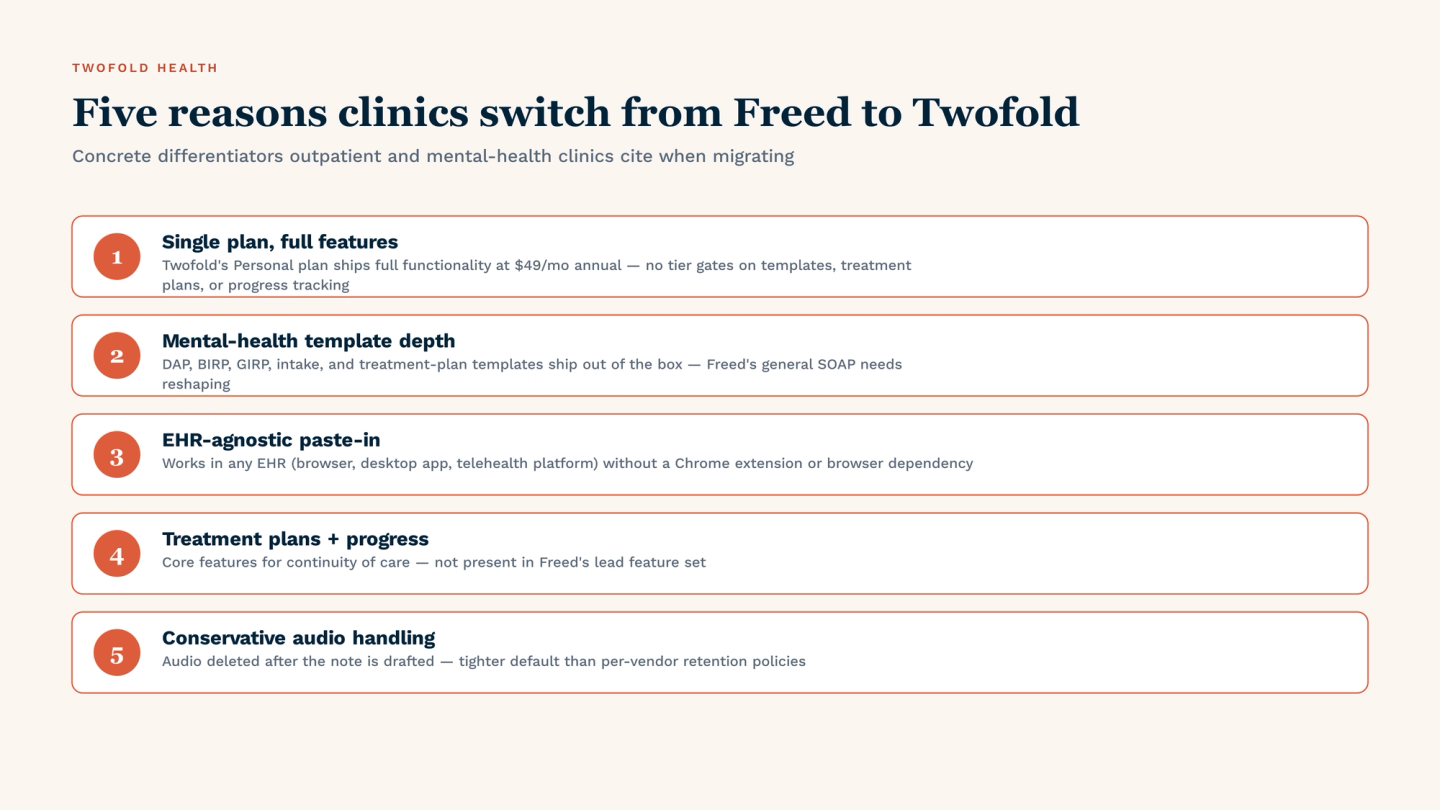
Choose Twofold if you want the best overall solution for outpatient mental‑health practices, group clinics, and teams that document across multiple platforms or non‑browser EHRs. Twofold is the stronger choice when your evaluation criteria include single‑plan predictable pricing, mental‑health template depth (DAP, BIRP, GIRP, intake, treatment plans), EHR‑agnostic paste‑in that doesn't require a Chrome extension, treatment plans and progress tracking as core features, and conservative audio retention defaults.
Final verdict
Twofold is the best overall Freed AI alternative for 2026. Freed is a strong and credible self‑serve AI scribe with public tiered pricing, a fast trial, and a Chrome EHR Push workflow that works well in browser‑based primary care environments. But Twofold is the better overall choice for most mental‑health, outpatient, and multi‑platform organizations because it combines single‑plan transparent pricing, mental‑health specialty depth, EHR‑agnostic workflow, treatment plans and progress tracking as core features, and conservative audio retention — all in a packaging that's easier to evaluate, easier to standardize across clinicians, and easier to defend in a security review.
Thinking of Switching?
If you're weighing a change, these step‑by‑step guides help you switch cleanly — without losing notes, templates, or paying for a renewal you won't use: