



Behavioral health documentation is different. Notes need to reflect medical necessity without sounding inflated, stay consistent with treatment plans across recurring sessions (the "golden thread"), and stand up to payer scrutiny. On top of that, supervisors and compliance teams often inherit a slow audit cycle where feedback lands months after the fact.
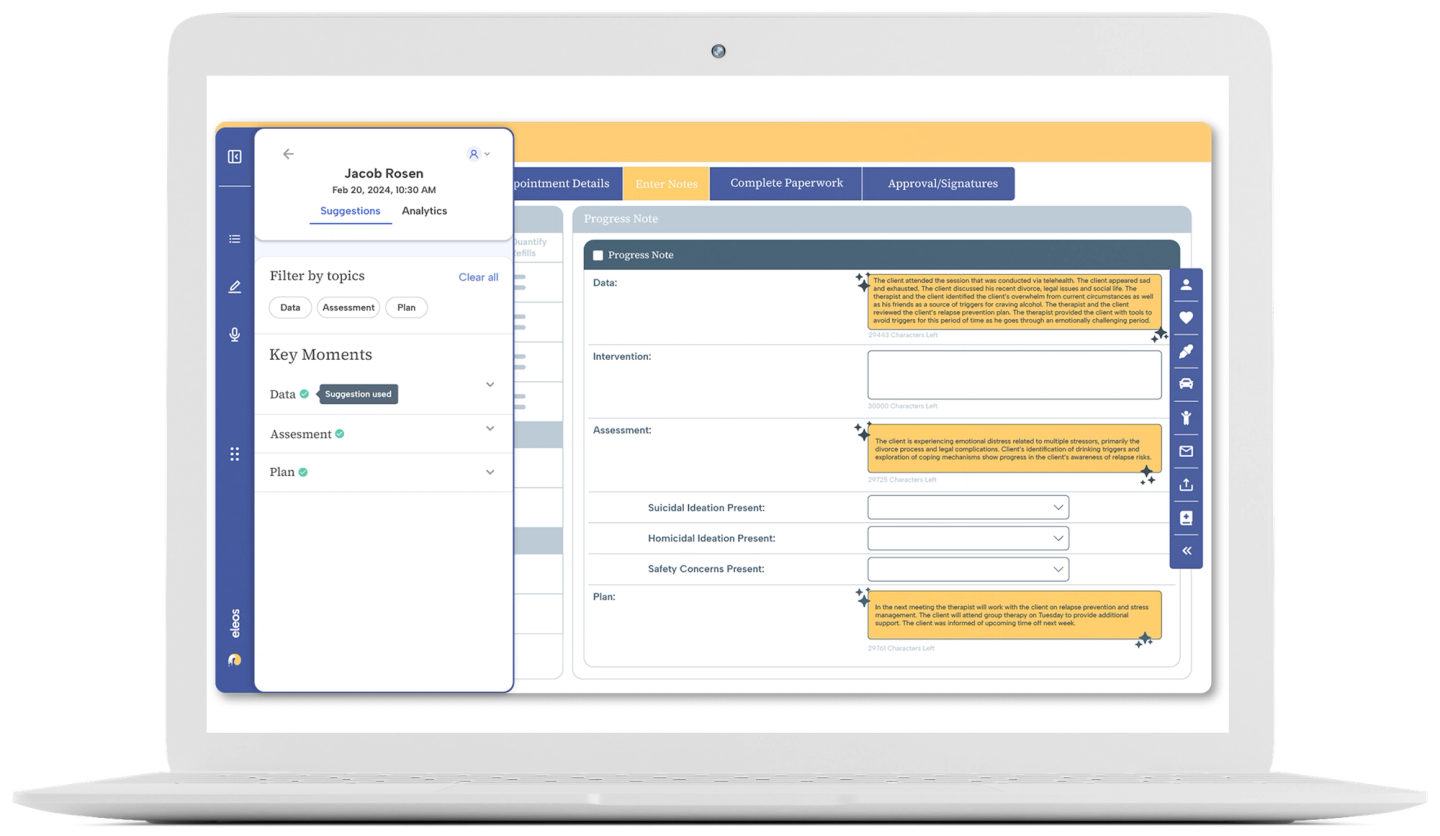
Eleos Health positions itself as a behavioral health AI platform that reduces documentation burden while giving organizations better visibility into note quality and training needs.
This review walks through Eleos' documentation workflow, compliance capabilities, security posture, and what to expect operationally. It also includes a practical side‑by‑side comparison with Twofold Health, using only verifiable, public data. See also our best Eleos Health alternatives.
What Eleos Health is and how it's positioned
Eleos markets itself as AI tools that reduce time spent on documentation by more than 70% and support care teams across behavioral health settings.
What that usually means in practice is:
- A workflow that captures session content (often via voice-based methods) and helps draft progress notes.
- A quality layer for supervisors and CQI teams to review documentation patterns at scale.
- An emphasis on behavioral health-specific language, templates, and compliance needs.
Eleos leans "organization‑first" rather than "solo clinician tool," and that influences everything from onboarding to pricing.
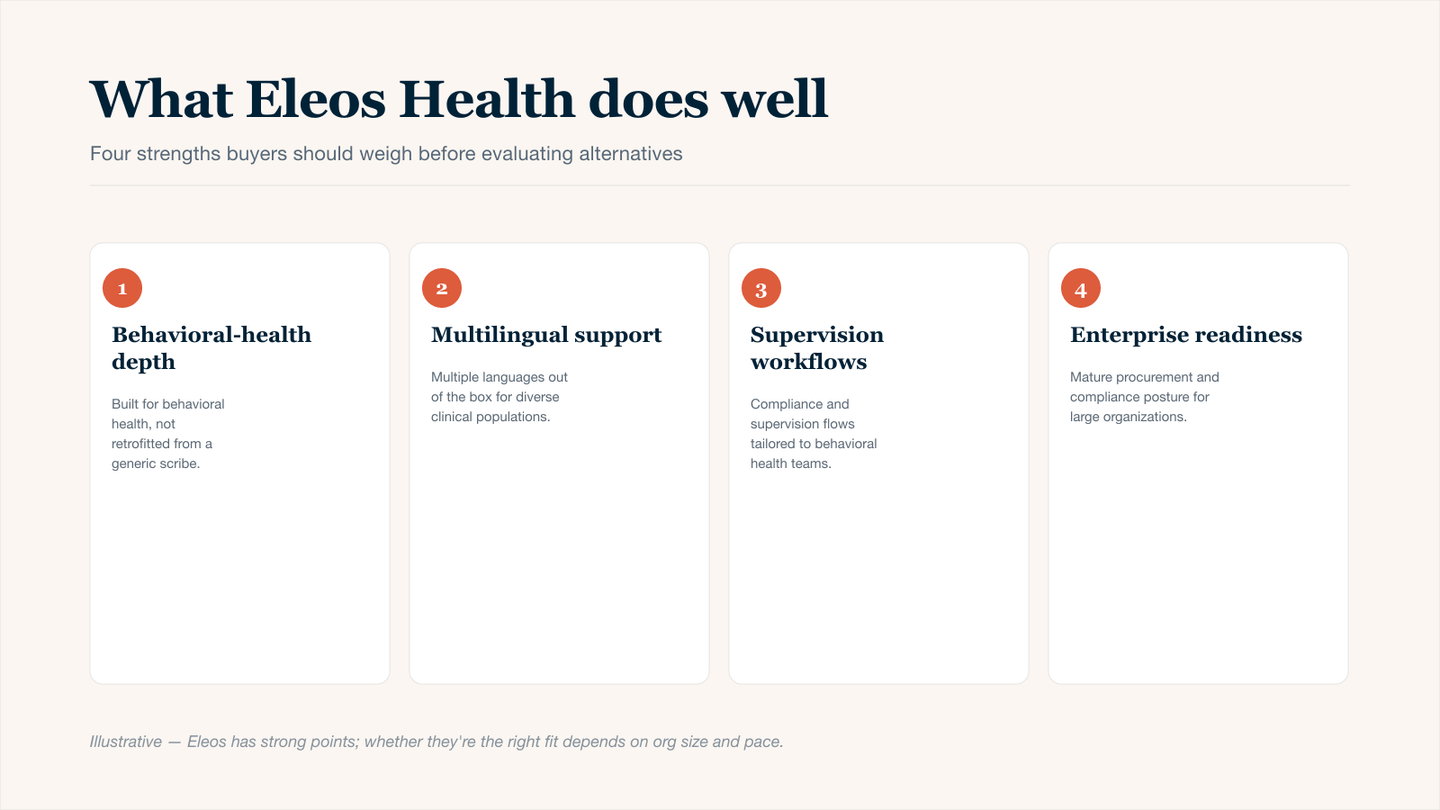
Four Eleos Health strengths that matter most when comparing AI scribes for behavioral health.
Documentation experience and note quality
Eleos' documentation offering emphasizes broad coverage across behavioral health session types, and a multilingual workflow where sessions can be captured in many languages and translated into English documentation.
Multilingual documentation
Eleos states its multilingual support recognizes over 150 languages, letting providers and clients speak naturally and then translating the output into English clinical documentation.
For organizations with interpreter‑heavy populations, this can reduce a common hidden cost: clinicians spending extra time translating notes after the session.
One-on-one session coverage and settings
Eleos describes documentation support across many 1:1 behavioral health session types, including intake and assessment narratives.
Offline and field-based workflows
Eleos has recently highlighted support for offline mobile workflows, especially for field‑based teams.
If your clinicians do home visits or community outreach, this can matter a lot, but it is worth validating in a demo exactly what "offline" means (capture, encryption, sync timing, and what happens if a device is lost).
Compliance and supervision workflows
This is the core reason many behavioral health leaders look at Eleos.
Eleos' compliance positioning includes:
- Reducing the average feedback cycle from "6+ months to 1 day."
- Helping teams shift time toward higher-risk notes.
- Scanning notes for common compliance red flags as part of a scalable CQI workflow.
If your organization struggles with retrospective audits that arrive too late to coach clinicians, this kind of workflow can materially change training velocity and reduce downstream denials.
Integration approach and workflow efficiency
Eleos repeatedly describes itself as EHR-agnostic and says it connects through a browser extension, with a "light lift" on the technical side.
Why this matters
A browser‑extension approach can speed implementation because you are not waiting on full EHR vendor API development. It can also be easier to deploy across varied programs where the EHR footprint is inconsistent.
What to validate in evaluation
- Whether the workflow supports structured fields your billing and compliance teams care about.
- How easy it is for clinicians to paste or insert content into the right templates.
- Whether you can enforce consistent note structure across teams and programs.
Security and compliance posture
Eleos publishes a dedicated security page and states it is SOC 2 Type II certified and has HITRUST compliance.
Its FAQ also describes regular security monitoring and annual third‑party penetration testing.
For behavioral health buyers, the right diligence questions usually include:
- Data retention options and audit logs
- Access controls and role-based permissions
- Whether customer data is used for model improvement and what opt-outs exist
- Consent workflow support for sensitive settings
Eleos provides a public security and privacy guide aimed at these topics.
Implementation expectations
Eleos describes a typical implementation timeline as two to three months, reflecting an org deployment rather than a purely self‑serve product.
That is not inherently negative, but it should shape your expectations around time‑to‑value.
If your organization needs results next week, you may prefer a product designed for quick trials and gradual rollout. Twofold's positioning is closer to that "start small, prove value fast" approach.
Pricing and procurement
Eleos does not present standard self‑serve pricing on its main site, and most buyers should expect a demo‑led, quote‑based procurement motion.
Practical tip: during procurement, insist on clarity around:
- seat minimums
- which modules are included (documentation vs compliance features)
- implementation fees
- contract length and renewal terms
Side-by-side comparison: Eleos Health vs Twofold Health
Eleos and Twofold can both support behavioral health documentation, but they often fit different organizational situations.
Capability | Eleos Health | Twofold Health |
|---|---|---|
Core positioning for BH | Behavioral health documentation plus compliance and supervision workflows | AI mental health scribe designed for fast adoption and daily note creation |
Compliance workflow | Emphasizes shortening feedback loops and focusing review on high-risk notes | Emphasizes producing accurate notes quickly with a HIPAA-first setup |
Multilingual support | 150+ languages highlighted | Multilingual support is available, with simpler rollout focus |
EHR workflow | EHR-agnostic, browser extension approach | Designed for low-friction clinical workflow, with clear onboarding and pricing |
Time-to-value | Typical implementation described as 2 to 3 months | Trial-oriented onboarding and fast pilot path |
Subtle but important takeaway: If your organization is primarily buying a compliance and supervision layer, Eleos may fit that mandate well. If your priority is getting clinicians using a scribe immediately, proving ROI in days, and keeping procurement simple, Twofold tends to be the smoother path for many teams.
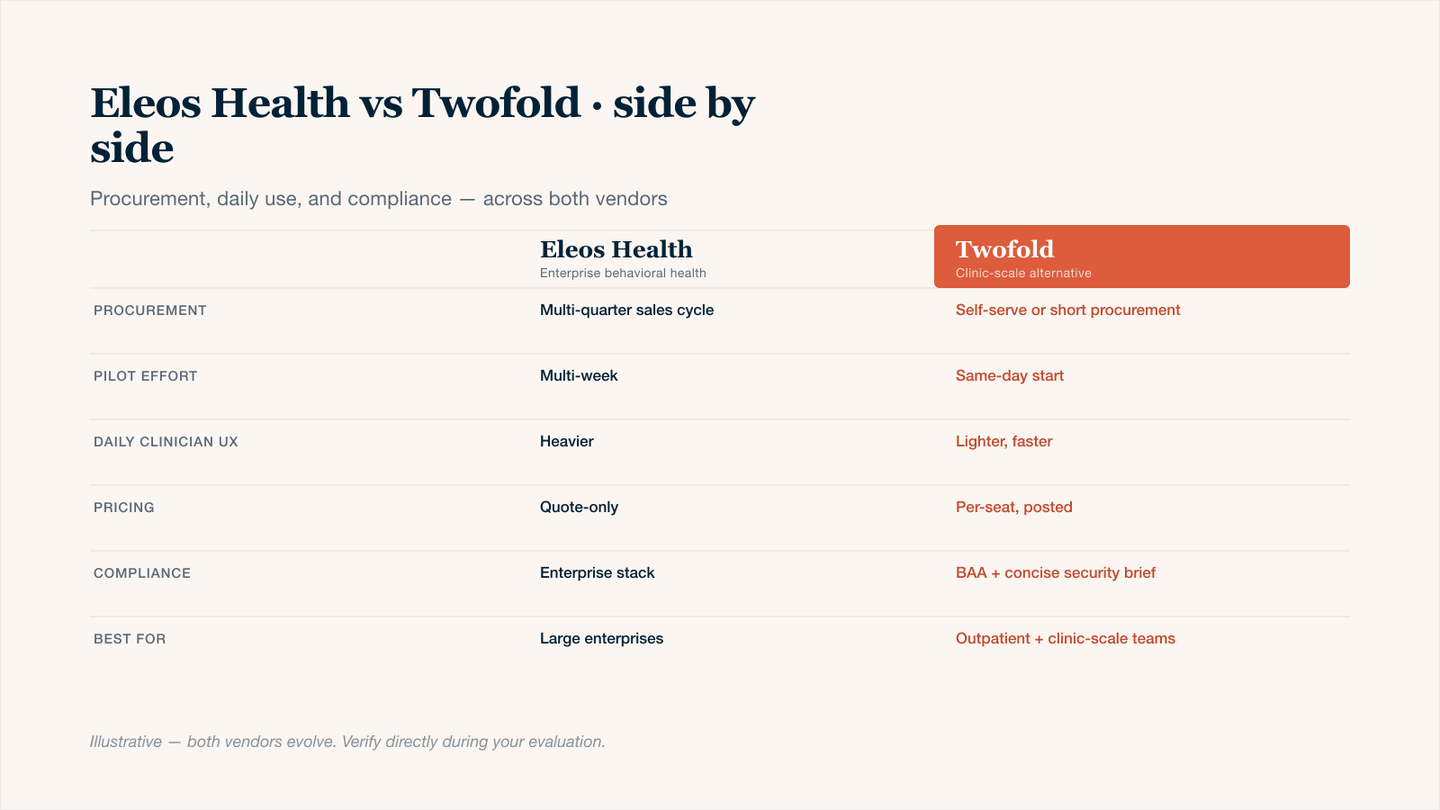
Eleos Health vs Twofold — procurement to compliance, side by side.
Bottom-line summary
Eleos Health is a serious behavioral health AI platform with clear emphasis on documentation efficiency, compliance review workflows, and operational visibility for supervision teams. Its public materials highlight multilingual documentation (150+ languages) and measurable compliance process improvements, including a stated reduction in feedback loops from "6+ months to 1 day."
Still, many organizations ultimately win by choosing the tool clinicians actually adopt quickly. If your goal is a fast pilot, predictable pricing, and a HIPAA‑first scribe experience that can start delivering value immediately, Twofold Health is often the better fit. It is built for low‑friction rollout and daily documentation usage, which is usually the fastest path to real ROI.
Note: The information provided in this article is based on data available as of February 1, 2026. Features and pricing are subject to change. Please consult the respective company websites for the most current information.
Disclaimer: This article is for informational purposes only and does not constitute legal or medical advice. Always consult professional guidelines and regulatory bodies for specific compliance requirements.